

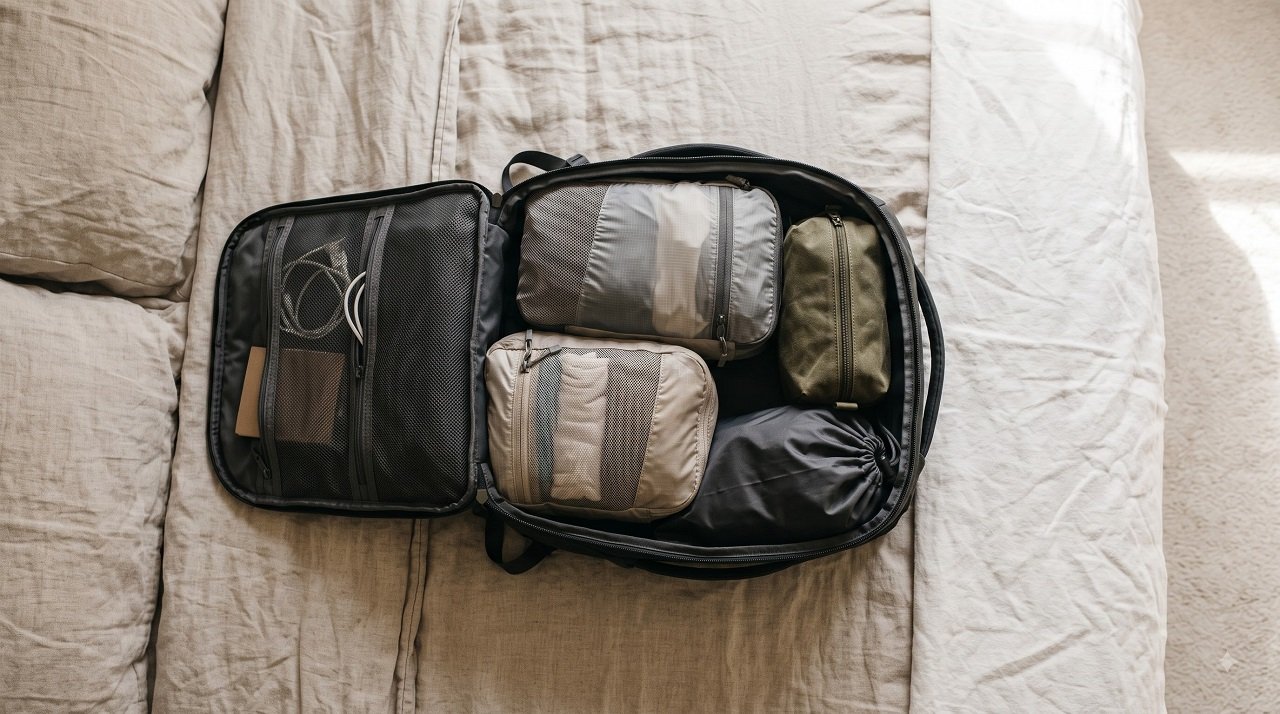
All statistics, airline size limits, and product performance figures in this guide reflect research published in 2026. Airline carry-on allowances and baggage fees change regularly.
If you are reading this in a later year, treat the packing system and formulas as still valid — the principles do not expire. But verify your specific airline’s current size and weight limits before you fly.
Check your airline’s official baggage page for current allowances. All sources used in this guide are listed at the end.
Introduction
Most carry-on packing guides give you a list. This one gives you a system.
The difference matters. A list tells you what someone else packed. A system tells you how to decide what goes in your bag — and why most of what you think you need does not.
The numbers show the problem clearly. A 2026 Global Rescue survey found that 38% of experienced international travelers now call overpacking their worst travel mistake. That is up from 32% in 2025 and 35% in both 2024 and 2023. Before the pandemic, in February 2020, 74% of travelers identified overpacking as their biggest issue.-11
Separate data from Radical Storage shows that 71.7% of travelers report having overpacked, and 40% return home with clothes they never wore.-6
That is not a discipline problem. It is a system problem. Most overpacking happens before the bag is open — in the decision stage, when each item is judged on its own rather than as part of a fixed total.
This guide fixes the system. It covers the volume-first method, the capsule wardrobe formula, the real math on packing cubes, a workable laundry plan, and a complete one-week packing list you can adapt to any destination.
If you are new to travel, read our essential travel tips for novice explorers first.
If you are traveling alone, pair this with our safe solo travel guide, which covers security and accommodation considerations that affect what you pack.
Why You Overpack (It’s Not Willpower)
Overpacking feels like a character flaw. It is actually a design flaw.
When you pack item by item, every object seems reasonable. Yes to the extra pair of shoes. Yes to the “just in case” jacket. Yes to the second charger. Each decision is made in isolation, so nothing ever gets cut.
The fix is to set a hard constraint first, then make every decision fit inside it. The constraint is volume, not willpower.-6
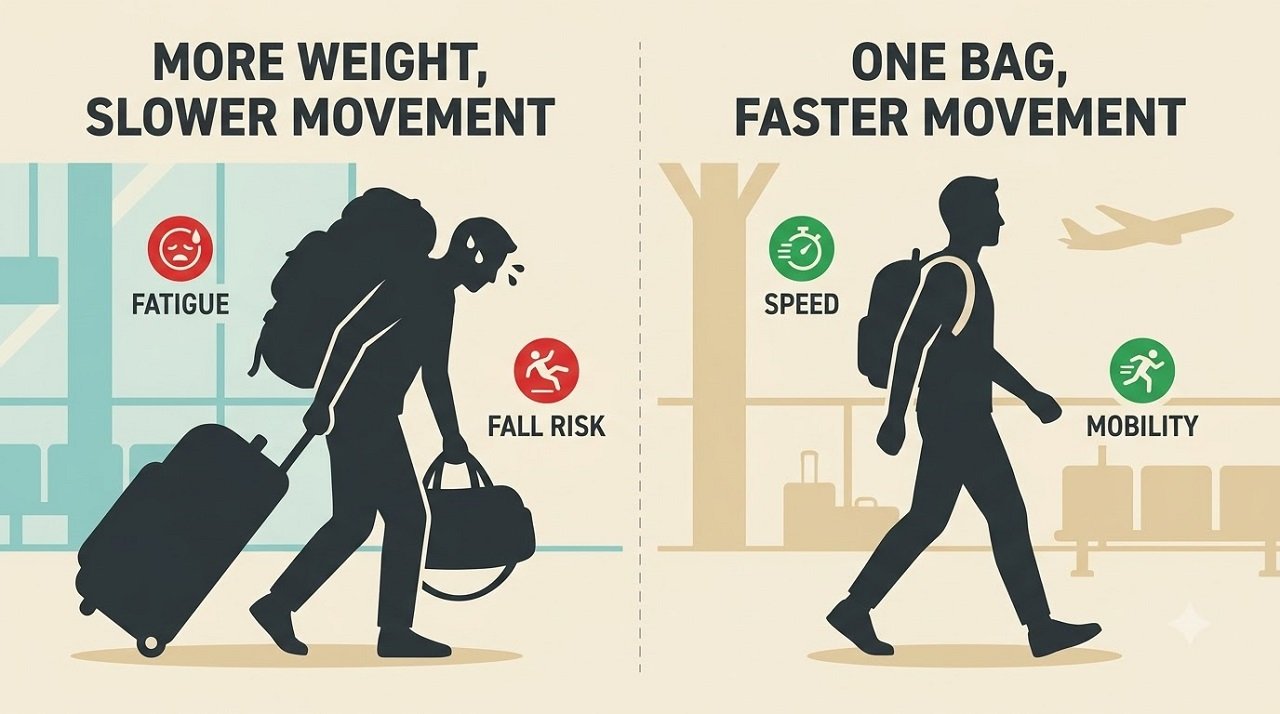
There is also a practical cost to ignoring this. Heavy luggage increases fatigue, reduces balance, and raises the risk of falls, back strains, and other injuries while moving through airports, stations, and uneven streets. In an emergency evacuation, oversized bags slow you down and may have to be abandoned.
Dan Richards, CEO of The Global Rescue Companies, describes it plainly: overpacking is “the single most consistent preventable mistake we see, year after year”.
The good news is that the financial incentive to pack light has never been stronger. Major US airlines now charge around $45 each way for a first checked bag on many routes, with airport payment costing more. Globally, airlines mishandle about 4.9 bags per 1,000 passengers, with Europe at 10.5 per 1,000 and Africa at 12.1 per 1,000.
One bag means no fee, no carousel wait, and no lost luggage risk.
The Volume-First Method — Choose the Bag Before the Clothes
The first decision is not what to pack. It is how much space you are allowed to fill.
Pick the bag for the trip length, then let that choice do the editing for you.
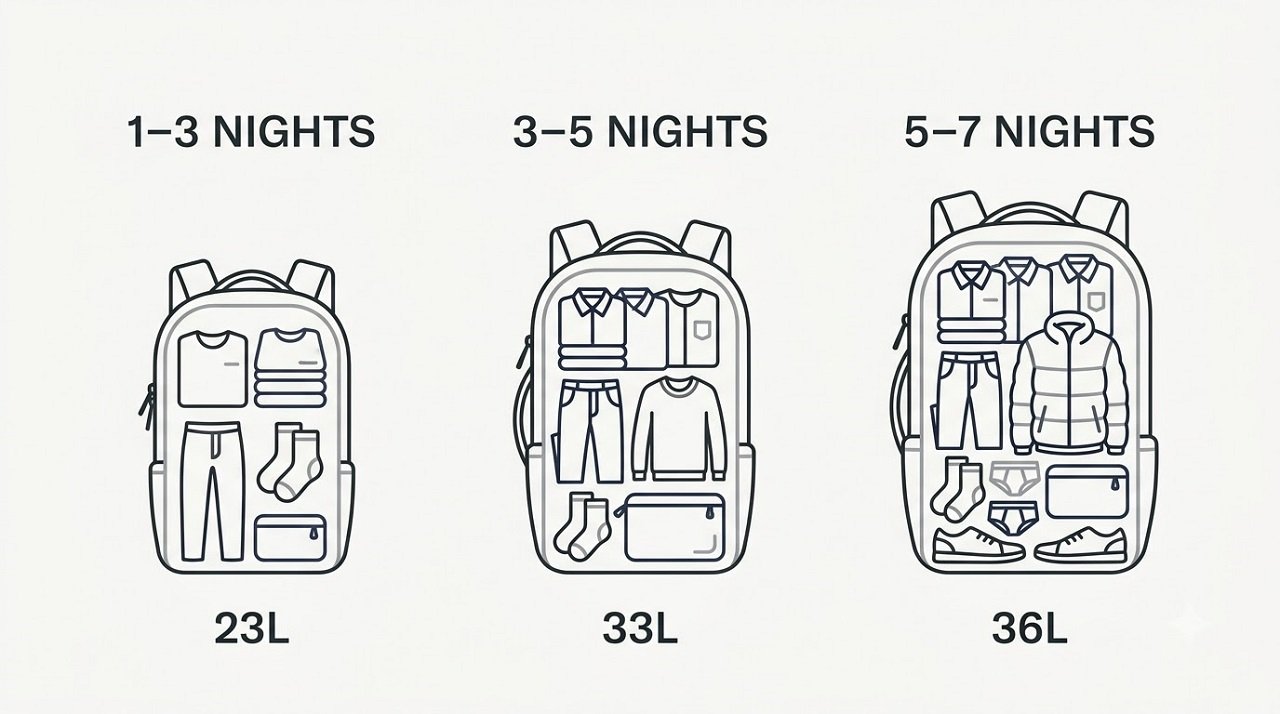
Bag Volume by Trip Length
| Trip Length | Bag Volume | Typical Format |
|---|---|---|
| 1–3 nights | 23–30L | Backpack or small cabin bag |
| 3–5 nights | 33–36L | Cabin-size hard shell or travel backpack |
| 5–7 nights | 30–36L | Panel-opening travel backpack |
A 23L backpack handles a two-night city trip without exceeding most European personal-item allowances. A 36L cabin bag is generous enough for a week of considered packing while staying inside standard carry-on size.
Know Your Airline’s Actual Limit
Most airlines allow carry-on bags up to roughly 22 × 14 × 9 inches (56 × 45 × 25 cm), including wheels and handles. But limits vary. Budget carriers are stricter and often enforce weight as well as size.
Check your specific airline before you pack. If you already own a bag, measure it. If you are buying one, start with our guide to travel backpacks for men, which covers capacity, access, and durability in more detail.
Why Volume Beats Weight for Most Travelers
Weight limits matter on some routes, but volume is the constraint that forces better decisions. A 36L bag that weighs 2 kg empty gives you more usable space than a heavier bag with the same external dimensions. If you fly budget carriers with combined weight limits, check the empty weight of the bag before buying.
The Capsule Formula — Relationships, Not Outfits
A capsule wardrobe is not a set number of outfits. It is a set of pieces where every item works with at least two others.
A piece that works with only one combination is a contingency item. Contingency items are how bags get heavy.
The 5-4-3-2-1 Formula
The 5-4-3-2-1 method assigns a specific count to each clothing category. It is designed for trips of roughly 7–10 days.-20
- 5 tops
- 4 bottoms
- 3 pairs of shoes (including the pair you wear)
- 2 layers
- 1 set of accessories
For shorter trips, a 2-5-1 formula works better: 2 bottoms, 5 tops, and 1 outer layer, designed for 3–5 days.
The 15-Piece Capsule
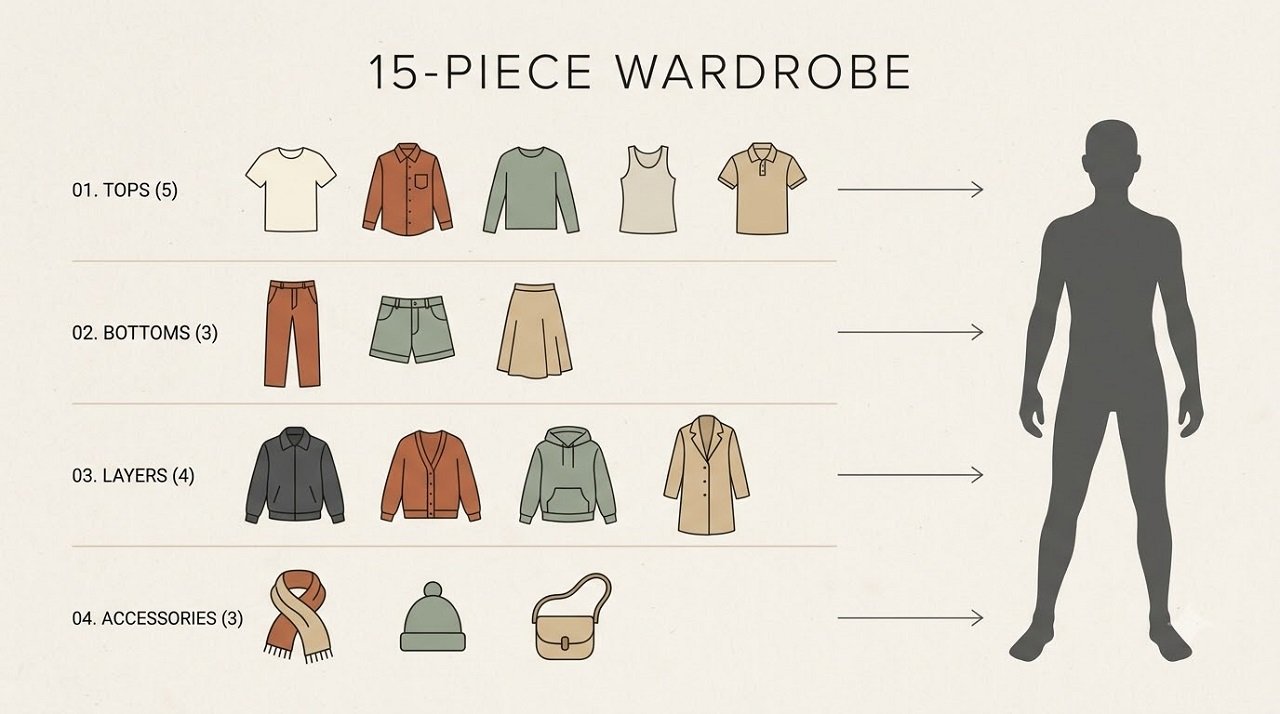
A more structured approach uses 15 pieces to cover 7–14 days across climates and contexts. It breaks down into 5 tops, 3 bottoms, 4 layers, and 3 accessories. The key is that the pieces create 20+ outfit combinations from a small set.-3
The One Rule That Makes It Work
Pick a single neutral color palette — black, navy, grey, or tan — so every item works with every other item. Then add a few accessories to create different looks without adding bulk.
Fabric Matters More Than Quantity
Quick-dry fabrics can be washed and worn again during the trip, which reduces how much you need to bring. Merino wool is particularly effective for travel because it resists odor. A New Zealand study using 13 trained smell assessors found that wool fabrics retained 66% less body odor intensity than polyester and 28% less than cotton.
That means a merino top can be worn several times between washes. Fewer washes means fewer clothes needed. Fewer clothes means a smaller bag.
If you are packing for a cold-weather trip, our winter travel destinations guide covers layering in more detail. If you are heading somewhere adventurous, the underrated adventure destinations guide explains what conditions to expect.
The Actual One-Week Carry-On Packing List
This list assumes a one-week trip, mixed weather, and access to a sink or laundry. Adjust quantities for climate, but keep the structure.
Clothing
- 5 tops — mix of t-shirts and one button-up or overshirt
- 3 bottoms — one pair of trousers or jeans, one lighter pair, one pair of shorts (if warm)
- 1 mid-layer — hoodie, sweater, or fleece
- 1 outer layer — packable rain jacket or lightweight puffer
- 5–7 underwear and socks — or 3–4 if you plan to wash
- 1 pair of walking shoes worn in transit
- 1 pair of sandals or casual shoes (optional, climate-dependent)
- 1 swimsuit (if relevant)
- 1 hat or cap
Toiletries
- Solid shampoo or soap bar — no liquid limit, no leaks
- Laundry sheets — TSA-compliant, lightweight, dissolves in a sink
- Toothbrush and toothpaste tablets
- Deodorant
- Sunscreen (solid or small liquid)
- Basic medications and a small first-aid kit
- Razor (if needed)
Liquids must follow the 3-1-1 rule for carry-on: containers of 3.4 oz (100 ml) or less, in one clear quart-sized bag. Solid toiletries avoid this problem entirely.
Technology
- Phone — 72% of travelers say their smartphone is the most important item they pack after their passport. It replaces cameras for 62%, maps for 55%, and boarding passes for 45%.-2
- Charging cable (bring two)
- Power bank (10,000 mAh or higher)
- Universal adapter if traveling internationally
- Earbuds or headphones
- eSIM or local SIM for data
Documents and Money
- Passport or ID
- Wallet and payment cards
- Travel insurance policy (printed and digital)
- Booking confirmations (saved offline)
- Hidden money pouch for backup cards and cash
If you have not arranged insurance yet, our guide to what travel insurance actually covers explains which benefits matter and which do not.
Comfort and In-Flight Items
- Reusable water bottle (empty through security)
- Snacks
- Eye mask and earplugs
- Light sweater or scarf for the plane
- Compression socks for long flights
What Not to Pack
- More than two pairs of shoes (including the pair you wear)
- “Just in case” formal wear unless you have a confirmed event
- Physical books — use an e-reader or phone
- Full-size toiletries
- Multiple chargers for the same device
- Anything you have not worn in the last six months
Packing Method and the Real Math on Packing Cubes
Packing cubes are sold as a space-saving miracle. The evidence is more mixed.
Regular Cubes vs. Compression Cubes
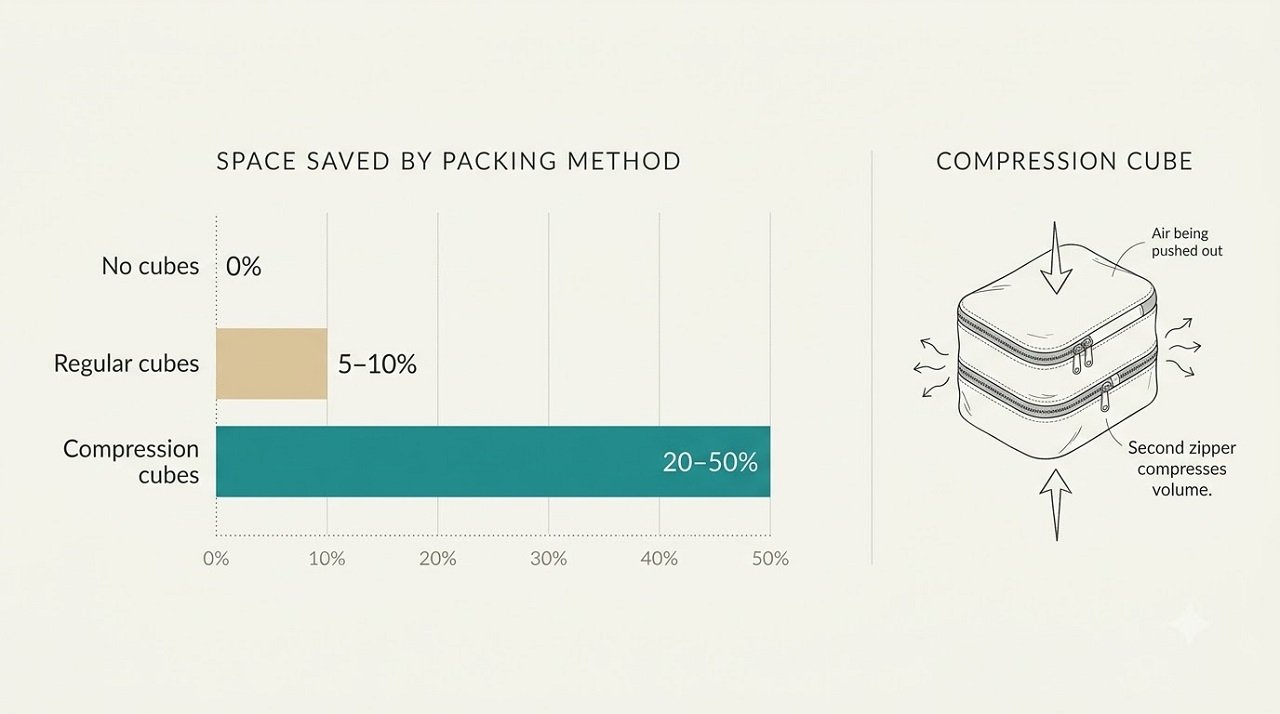
Independent packing tests show a clear difference:
| Method | Space Saved | Best For |
|---|---|---|
| No cubes (rolling/folding) | 0% (baseline) | Experienced packers, short trips |
| Regular packing cubes | ~5–10% | Organization, fast repacking |
| Compression cubes | 20–50% | Real volume reduction |
Regular cubes mostly organize the same volume into neater shapes. Compression cubes have a second zipper that pushes air out, which is what actually reduces volume.-31
Tests on compression cubes consistently show 20–30% volume savings per cube, with some results as high as 50% depending on what is packed.-31
The Practical Method
- Roll or fold tightly. Rolling is the most commonly used space-saving method among travelers — half of those surveyed roll clothes as tightly as possible.-2
- Use compression cubes for bulky items — sweaters, jackets, fleeces.
- Use regular cubes for organization — underwear, socks, cables, toiletries.
- Pack heavy items near the bag’s center of gravity, close to your back if it is a backpack.
- Keep essentials in one accessible pouch — documents, charger, medication, a change of underwear. If your bag gets gate-checked, you still have what matters.
The One-Bag Reality
Research shows 42% of travelers now prefer carry-on only, up from 28% in 2019, driven by baggage fees, lost luggage anxiety, and minimalist travel trends. One in five travelers has crammed at least a week’s luggage into a carry-on to avoid fees, and 58% say they will go to great lengths to avoid checked baggage charges.
If you can pack for a week in one bag, you are in the majority — and the majority is growing.
The Laundry Plan (The Real Secret to One-Bag Travel)
You cannot pack a week of clothes in a carry-on without a laundry plan. The math does not work. The solution is to wash clothes mid-trip.
Sink Washing
Washing clothes in a hotel sink is inexpensive, convenient, and effective. All you need is a small amount of detergent or a laundry sheet.
The method:
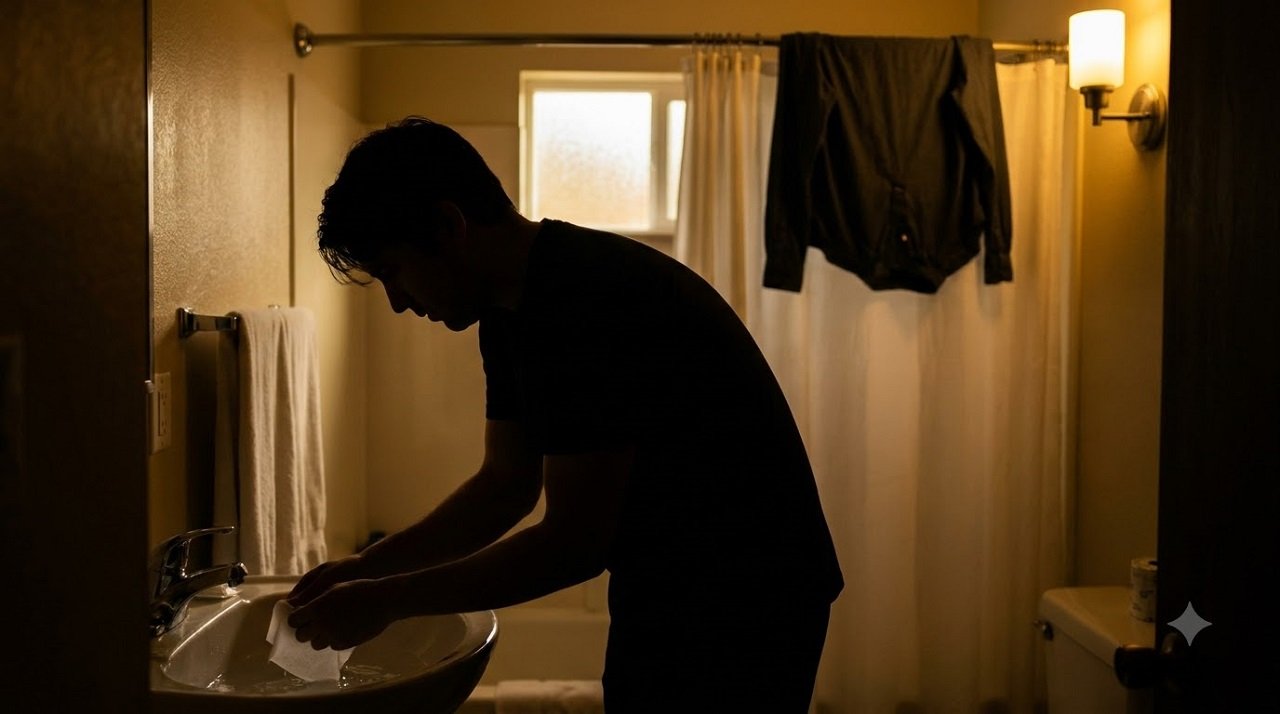
- Plug the sink and fill with warm water.
- Add a laundry sheet or a few drops of detergent.
- Submerge clothes and agitate for 2–3 minutes.
- Drain and rinse.
- Roll in a towel to remove excess water.
- Hang to dry overnight.
Why Laundry Sheets Work for Travel
Laundry sheets are TSA-compliant because they are not liquid. They are lightweight, mess-free, and ideal for sink washing or keeping clothes fresh in your bag.
Drying Tips
- Quick-dry fabrics dry overnight in most climates.
- Merino wool can be worn multiple times between washes because it resists odor.
- Hang clothes near ventilation, not in a closed bathroom.
- Avoid cotton for travel where possible — it dries slowly and holds odor.
How Often to Wash
On a one-week trip, plan one laundry session mid-trip. That reduces clothing needs by roughly half and is the single biggest reason one-bag travel works.
A Complete One-Week Example
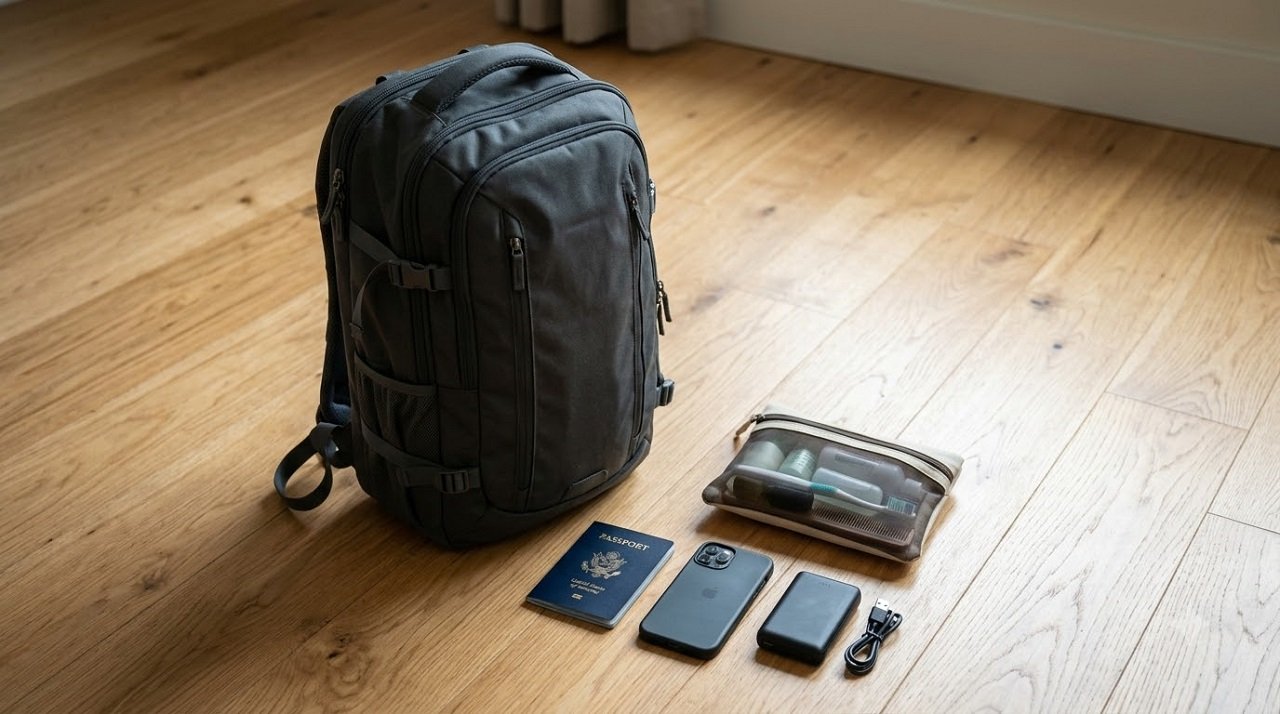
Here is what a full one-week carry-on looks like for a mixed-weather city trip.
| Category | Items | Quantity |
|---|---|---|
| Tops | T-shirts, one button-up | 5 |
| Bottoms | Trousers, lighter trousers, shorts | 3 |
| Layers | Hoodie or sweater, packable jacket | 2 |
| Underwear/socks | Quick-dry | 5 + 5 |
| Shoes | Walking shoes (worn), sandals | 2 |
| Toiletries | Solid shampoo, laundry sheets, toothbrush, deodorant, sunscreen | 6 items |
| Tech | Phone, charger, power bank, adapter, earbuds | 5 items |
| Documents | Passport, wallet, insurance, copies | 4 items |
| Comfort | Water bottle, eye mask, snacks | 3 items |
Total clothing items: 15 pieces. Total bag volume: fits in a 30–36L carry-on.
This is not minimalism for its own sake. It is a system that removes decisions, reduces weight, and eliminates baggage fees.
Conclusion
Overpacking is not a personality trait. It is the predictable result of packing without a constraint.
Set the volume first. Build a capsule where every piece works with at least two others. Use compression where it actually helps. Plan one laundry session. And leave the “just in case” items at home.
If you are heading to a destination where costs add up quickly, our Japan trip cost breakdown shows how much a checked bag fee or an extra pair of shoes can matter over a week. If you are backpacking through multiple countries, the Southeast Asia budget backpacking guide covers laundry, climate, and gear for that route specifically.
And if you are worried about navigating a new place with less stuff and no familiar language, our guide to navigating language barriers will help you prepare.
One bag is not a sacrifice. It is a faster, cheaper, and less stressful way to travel.
Frequently Asked Questions
How do I pack a carry-on for a week?
Start with a 30–36L bag, build a 15-piece capsule wardrobe in one neutral color palette, use compression cubes for bulky items, and plan one laundry session mid-trip. The key is setting the bag size before you choose clothes.
What should I pack in a carry-on for 7 days?
Five tops, three bottoms, two layers, five sets of underwear and socks, two pairs of shoes, solid toiletries, a phone and charger, a power bank, documents, and a water bottle. Adjust quantities for climate, but keep the structure.
Do packing cubes actually save space?
Regular packing cubes save about 5–10%, mostly by organizing rather than compressing. Compression cubes save 20–50% by pushing air out, with most tests showing 20–30% per cube.-31
How do I wash clothes while traveling?
Wash in a hotel sink with a laundry sheet or a few drops of detergent, agitate for 2–3 minutes, rinse, roll in a towel, and hang overnight. Laundry sheets are TSA-compliant and lightweight.
Sources
- Euronews. Revealed: Travellers’ worst travel mistakes – and their best hacks. Published August 19, 2026. Global Rescue survey: 38% of experienced travelers say overpacking is their worst mistake, up from 32% in 2025 and 35% in 2024/2023; 74% in February 2020. https://www.euronews.com/travel/2026/08/19/revealed-travellers-worst-travel-mistakes-and-their-best-hacks
- Horizn Studios. Minimalist Packing: Travel Light Without Losing Anything. Published May 5, 2026. Radical Storage data: 71.7% of travelers report overpacking; 40% return with clothes never worn; volume-first framework and bag size recommendations. https://horizn-studios.com/blogs/journal/minimalist-packing
- 1ABEL. Ultimate Travel Capsule Wardrobe: Carry-On Only Packing Guide. Published January 16, 2026. 42% of travelers prefer carry-on only, up from 28% in 2019; 15-piece capsule formula; checked bag fee data. https://www.1abel.com/blog/ultimate-travel-capsule-wardrobe-carry-on-only-packing/
- The Scotsman. One in five travellers cram a week’s worth of luggage into a carry-on to save money. Published August 28, 2026. OnePoll survey of 2,000 adults: packing habits and smartphone use. https://www.scotsman.com/read-this/holiday-luggage-packing-travel-smartphone-8946144
- Kayak. How to pack a carry-on. Published June 26, 2026. Carry-on checklist; capsule wardrobe advice; 5-4-3-2-1 and 2-5-1 formulas. https://www.kayak.com/news/how-to-pack-a-carry-on/
- Medium / Submit Chronicle. Do Packing Cubes Really Save Space in Luggage? Here’s the Real Answer. Published July 21, 2026. Independent tests: regular cubes 5–10%; compression cubes 20–50%. https://medium.com/@williammayaer123/do-packing-cubes-really-save-space-in-luggage-heres-the-real-answer-0c7175c23386
- Organizing.tv. Do Packing Cubes Actually Work? (An Honest Answer). Published April 10, 2026. Compression cubes deliver 20–30% volume savings per cube in product tests. https://organizing.tv
- AARP. How to Wash Your Clothes While Traveling. Published February 21, 2025. Sink washing method and laundry sheets. https://www.aarp.org
- Yahoo / Creators. The everyday household item travelers are tossing in their suitcases this summer. Published June 30, 2026. Laundry sheets are TSA-compliant and ideal for sink washing. https://creators.yahoo.com
- Woolmark / CSIRO. Wool is naturally odour resistant. CSIRO odour-wearer trials: wool retained 66% less body odour than polyester and 28% less than cotton. https://www.woolmark.com
- Camli. Checked Baggage Fees by Airline (2026). Most US airlines charge $30–$45 for a first checked bag on domestic flights. https://camli.com
- Recommend.com. Airlines Raise Bag Fees. Published April 10, 2026. First checked bag $45 prepaid online, $50 at airport on major US carriers. https://recommend.com
- SITA / aeroTELEGRAPH. Baggage IT Insights 2026. Global average 4.9 mishandled bags per 1,000 passengers; Europe 10.5 per 1,000; Africa 12.1 per 1,000. https://www.aerotelegraph.com
- Cabinzero. Carry On Luggage Size: Updated 2026 Guide. Most airlines allow 22 × 14 × 9 inches (56 × 45 × 25 cm). https://www.cabinzero.com
- Horizn Studios. Carry-On Size Rules by Airline: 2026 Guide. Published May 5, 2026. Airline-specific carry-on dimensions and weight limits. https://horizn-studios.com