


All advisory systems, survey figures, and insurance rules in this guide reflect research published in 2025 and 2026. Advisory levels change frequently, sometimes overnight.
If you are reading this in a later year, treat the frameworks and warning signs as still valid — the principles do not expire. But always check your government’s official advisory page for your destination on the day you book and again before you fly.
This guide is general information, not safety, legal, or insurance advice. Your actual coverage is governed by your policy wording and your government’s current advisory, not by this article.
Official portals: US State Department · UK FCDO · Smartraveller. All sources used in this guide are listed at the end.
Introduction
Travel advisories are the most trusted safety information in travel. They are also the most misunderstood.
A 2026 Global Rescue survey found that 49% of travelers name government travel advisories as their most important source of information before an international trip. Another 21% rely on news reports, and 16% use travel security providers .-13
Trust in advisories is high. Literacy is not.
The same body of research shows the gap clearly. 85% of travelers say they are concerned about geopolitical instability, yet most proceed with their plans anyway . In Australia, 64% of young travelers were aware of the Smartraveller website, but only 37% actually reviewed destination-specific advice before their last trip .
In Canada, just 28% knew that a change in advisory level could void their travel insurance, while 56% did not know and 16% were unsure .-2-11-31
That last number matters more than the others. An advisory is not just a safety warning. It can be a coverage switch. A region moving from one level to the next can invalidate an existing policy, strand an evacuation claim, and leave you personally liable for costs that would otherwise be covered .-21
This guide explains what the major advisory systems actually mean, how to read them properly, how they interact with insurance, and the common misreads that put travelers at risk. It is written for people who want to use advisories as a planning tool — not just glance at a color and guess.
If you have not arranged insurance yet, our guide to what travel insurance actually covers explains the policy terms that advisories affect. If you are traveling alone, our safe solo travel guide covers the risk decisions that advisories feed into.
Why Advisories Matter More Than Most Travelers Think
They Are Not Just Warnings
A travel advisory is a government assessment of risk in a destination. It combines crime data, political instability, terrorism threats, health risks, natural hazards, and legal conditions into a single published rating.
That rating is used by three groups:
- Travelers, to decide whether and how to go.
- Insurers, to decide what they will cover and what they will exclude.
- Consular services, to decide how much help they can realistically provide if something goes wrong.
Most travelers only think about the first. The second and third are where the financial consequences live.
The Insurance Link
Insurance policies commonly exclude or void coverage for travel to regions under the highest advisory levels. The exact trigger varies by insurer and by country, but the pattern is consistent:
- At the highest levels — “Do Not Travel” or equivalent — standard travel insurance is usually void .-21
- At the level below — “Reconsider your need to travel” or “Advise against all but essential travel” — many standard policies are also void, and specialist high-risk coverage may be required .
- At moderate levels, most policies still apply, but specific exclusions may match the identified risk, such as civil unrest .
This is why the Canadian survey finding matters. If you do not know that advisories can void coverage, you can buy a policy, travel to a destination that has since been upgraded, and discover at the point of claim that you were never covered.
They Affect Consular Help Too
Advisories also signal how much practical help your embassy can provide. In destinations under “Do Not Travel” advisories, consular assistance is severely limited . Smartraveller states this plainly: in such places, “our ability to provide consular assistance in these places is extremely limited. In almost all cases, you also won’t be covered by travel insurance” .-21-31
That is not a reason to panic. It is a reason to read the advisory before you book, not after.
The Three Main Advisory Systems, Side by Side
Most international travelers rely on one of three systems: the US State Department, the UK Foreign, Commonwealth & Development Office (FCDO), and Australia’s Smartraveller (DFAT).
They look similar. They are not identical.
US State Department: Four Numbered Levels
The US system uses four levels, updated at least every 12 months, with immediate updates triggered by major events .
| Level | Meaning | Practical Implication |
|---|---|---|
| Level 1 | Exercise Normal Precautions | Travel as normal |
| Level 2 | Exercise Increased Caution | Research safe areas, avoid high-risk zones |
| Level 3 | Reconsider Travel | Serious risks; consider whether the trip is necessary |
| Level 4 | Do Not Travel | Highest risk; standard insurance likely void |
The US system also uses clear labels, which makes it the easiest to understand at a glance. The trade-off is that the four-level scale compresses a lot of nuance into a single number.
UK FCDO: No Numbers, More Nuance
The UK FCDO does not use a numbered scale. It uses descriptive categories and geographic specificity .
| FCDO Category | What It Means | Insurance Impact |
|---|---|---|
| No advisory | No specific warning; normal precautions | Full coverage applies |
| Some risk | Specific risks identified — crime, unrest, disease, hazards | Most policies apply; check exclusions |
| Advise against all but essential travel | Serious risks; non-essential travel not advisable | Many standard policies void |
| Advise against all travel | Do not travel; leave if present | Standard insurance void |
The FCDO’s strength is regional detail. Its advisories often apply to specific regions within a country, not the whole country . That matters for large countries where risk is concentrated in one area.
Australia Smartraveller: Four Levels With Plain Names
Smartraveller uses four levels with descriptive names, plus detailed guidance .
| Level | Meaning |
|---|---|
| Exercise normal safety precautions | Lowest risk |
| Exercise a high degree of caution | Heightened risk |
| Reconsider your need to travel | Serious risk |
| Do not travel | Highest risk |
Smartraveller also publishes destination-specific advice, safety information, and registration for updates. Its research shows that among travelers who were aware of the service, 88% said its advice influenced their choice of destination, and 83% said it influenced their insurance decisions .-31
Why the Differences Matter
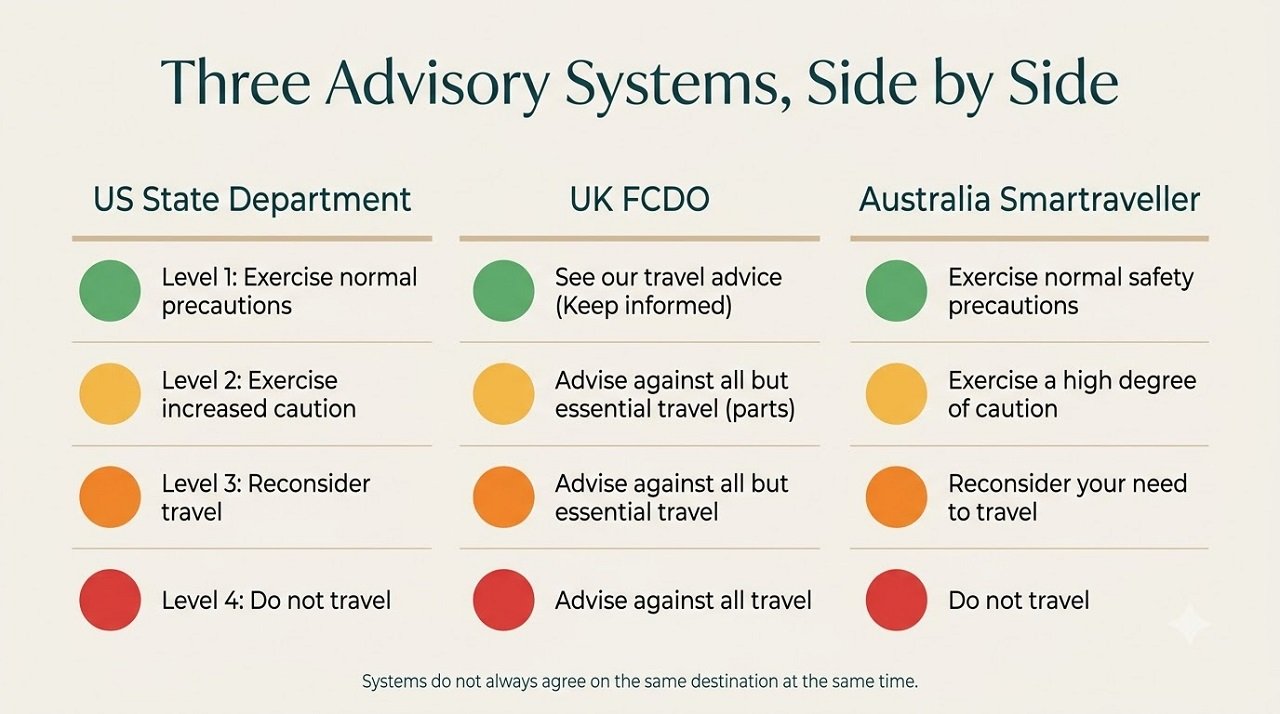
The three systems do not always agree on the same destination at the same moment. One government may rate a country Level 3 while another uses a “some risk” category with regional caveats.
This is not a flaw. It reflects different intelligence, different national interests, and different thresholds for warning. The practical takeaway is: read more than one, and read the detail, not just the headline.
If you are booking through a third-party platform and want to understand how booking channel affects your flexibility if plans change, our guide to booking direct versus third-party covers cancellation and refund risks.
What Each Level Actually Means in Practice
Advisory levels are not a simple risk ladder. Each level changes what you should do, what you should buy, and what you should expect if something goes wrong.
Level 1 / Normal Precautions
What it means: The lowest advisory level. No specific elevated risk identified beyond ordinary travel conditions.
What to do: Travel as normal. Follow general safety guidance. Buy standard insurance.
Insurance: Full coverage typically applies .
Level 2 / Increased Caution
What it means: A heightened risk exists — crime, terrorism, civil unrest, health, or natural hazards. Travel is not discouraged, but awareness is required .
What to do: Research specific neighborhoods and risk areas. Avoid high-risk zones. Enroll in your government’s traveler registration program. Buy insurance with medical and evacuation cover.
Insurance: Most policies still apply, but check for exclusions that match the identified risk — particularly civil unrest .-21
Level 3 / Reconsider Travel
What it means: Serious risks are present. The government is not saying “never,” but it is saying “think carefully about whether this trip is necessary” .
What to do: Only travel if your purpose is essential. Have a personal emergency and evacuation plan. Check your insurance policy’s wording on Level 3 destinations before you pay.
Insurance: Many standard policies are void at this level. Specialist high-risk or crisis-zone coverage may be required .
Level 4 / Do Not Travel
What it means: The highest risk level. Usually issued for active conflict, severe security threats, or major natural disasters. Governments typically advise citizens to leave and no new arrivals .
What to do: Do not travel. If already present, leave by the safest available route and contact your embassy.
Insurance: Standard travel insurance is void. Specialist war or conflict-zone coverage exists but is rarely purchased in advance. Consular assistance may be severely limited .-21
The Gap Between Levels Is Not Linear
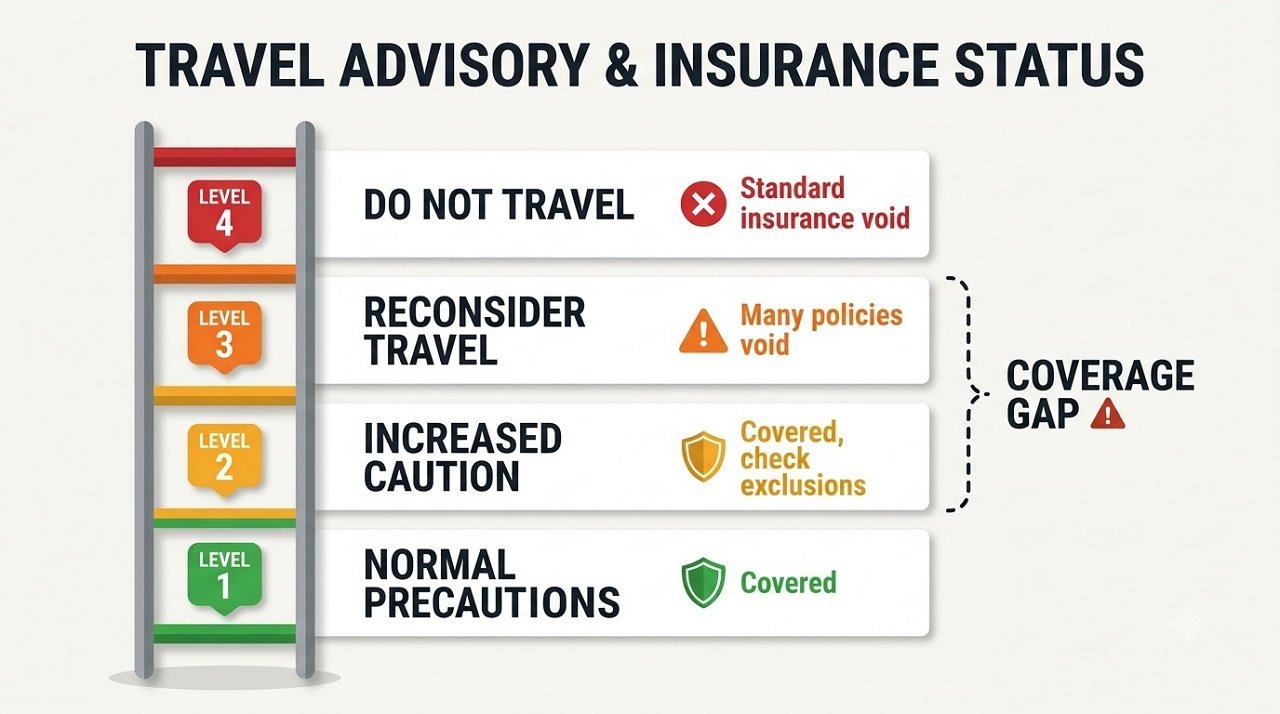
The jump from Level 2 to Level 3 is not just “more risk.” It is often the point where insurance stops working. That is the single most important thing to understand about advisories.
If you are traveling solo, our solo travel safety guide covers how to build a personal risk plan around this. If you are worried about scams and fraud in unfamiliar destinations, our guide to common travel scams covers the on-the-ground risks that advisories do not always capture.
The Misconceptions That Cause the Most Damage
Most advisory-related problems come from six common misreads.
Misconception 1: “The advisory covers the whole country”
It often does not. FCDO advisories in particular are frequently regional, applying to specific areas within a country rather than the entire territory . A Level 4 region and a Level 1 region can exist in the same country at the same time.
Fix: Read the regional breakdown, not just the headline level.
Misconception 2: “If it’s Level 3, my insurance still covers me”

This is the most expensive misconception. Many standard policies are void at Level 3, and some exclude coverage for destinations under “advise against all but essential travel” .
Fix: Check your policy wording before you buy, and check it again if the advisory changes before departure.
Misconception 3: “One government’s rating is enough”
The three systems do not always agree. Different intelligence and different national thresholds produce different ratings for the same destination.
Fix: Compare at least two systems, and read the detail behind each.
Misconception 4: “Advisories are updated rarely”
US State Department advisories are updated at least every 12 months, with immediate updates triggered by major events . An advisory you read three months ago may not be current.
Fix: Check again before you book and again before you fly. Save the date you last checked.
Misconception 5: “The advisory tells me whether it’s safe”
An advisory is a government risk assessment, not a personal safety guarantee. It cannot account for your specific itinerary, health, experience, or risk tolerance.
Fix: Use the advisory as one input, not the answer. Combine it with destination-specific research and your own judgment.
Misconception 6: “If I’m already there, the advisory doesn’t matter”
If an advisory changes while you are abroad, it can affect your insurance coverage mid-trip. It also signals that consular assistance may be more limited than you assumed.
Fix: Register for advisory updates before you travel, and monitor them while you are away.
If you are heading to a destination where language will be a barrier in an emergency, our guide to navigating language barriers covers how to prepare essential phrases and emergency communication before you go.
A Practical Framework for Using Advisories
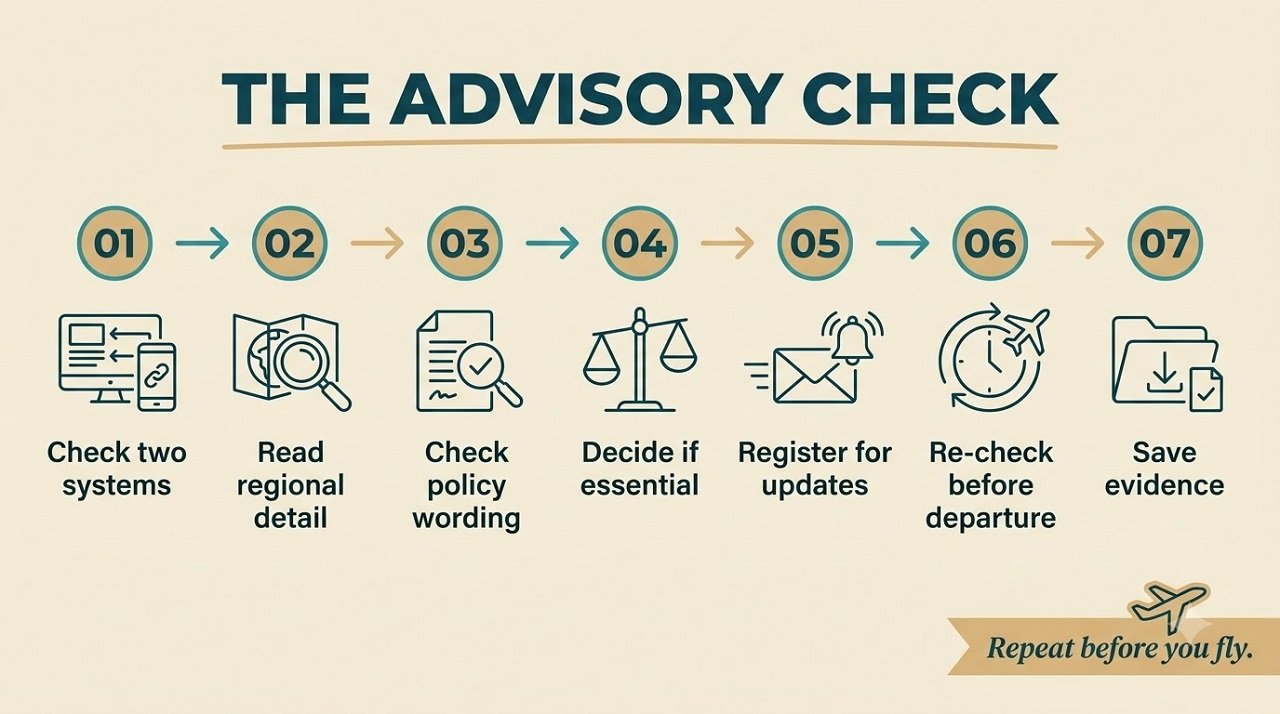
Use this sequence before you book and again before you fly.
Step 1: Check Two Systems
Open your own government’s advisory and one other. Compare the level and read the detail. If they disagree, that disagreement is information.
Step 2: Read the Regional Breakdown
Look for specific areas, cities, or regions that carry a different rating from the rest of the country. Note them.
Step 3: Check Your Insurance Policy Wording
Find the section that deals with government advisories. Look for the specific level at which coverage is void or excluded. Do this before you buy, not after.
Step 4: Decide Whether the Trip Is Essential
At Level 3, the question is not “is it safe?” but “is this trip necessary?” Be honest about the answer.
Step 5: Register for Updates
Enroll in your government’s traveler registration program. The US uses STEP, the UK uses FCDO LOCATE, and Australia uses Smartraveller registration. These programs send advisory updates and can help locate you in an emergency.
Step 6: Re-Check Before Departure
Advisories can change quickly. Check again in the week before you fly. If the level has changed, review your insurance position before you board.
Step 7: Save the Evidence
Keep a screenshot or PDF of the advisory you checked and the date you checked it. If a claim dispute arises later, this record helps establish what the advisory was when you made your decision.
If this is your first international trip, our essential travel tips for novice explorers covers the broader preparation steps that advisories fit into.
Advisories, Insurance, and the Upgrade Problem
The most important advisory scenario is not the one you check before booking. It is the one that changes after you book.
What Happens When a Level Changes Mid-Trip
If a destination is upgraded from Level 2 to Level 3 or 4 while you are there, several things can happen:
- Your policy may no longer cover the risk that materialises, depending on the wording.
- Evacuation claims may be denied if the insurer determines the advisory level voided coverage at the time of the event.
- Consular assistance may become more limited as the government restricts its operations.
This is not hypothetical. The Canadian survey report specifically warns that “misunderstanding insurance implications may expose travellers to unintended financial and safety risks” .-2
What to Do

- Buy insurance early and read the advisory clause. Know the exact level at which your policy stops covering you.
- Choose a policy with clear wording. Vague clauses are harder to enforce at claim time.
- Monitor advisories during your trip. Registration programs send updates.
- Keep records. Save advisory screenshots and correspondence with your insurer.
- Consider specialist coverage if you are traveling to a destination near a threshold level.
If you have not compared policies yet, our guide to what travel insurance actually covers explains the benefit categories that matter most for advisory-related risk, including evacuation and medical limits.
Conclusion
Travel advisories are not a simple traffic light. They are a risk assessment, an insurance trigger, and a signal of how much help you can expect if something goes wrong.
The data shows that travelers trust advisories more than any other safety source. It also shows that most do not read them closely, do not check whether they affect insurance, and do not re-check before departure.
That gap is fixable with a short routine: check two systems, read the regional detail, check your policy wording, register for updates, and re-check before you fly.
If you remember one rule, make it this: the most important advisory level is the one that changes after you book. Check it again before you go.
If you are packing for a one-bag trip and want to avoid baggage fees that can compound a disrupted itinerary, our carry-on packing list covers the practical side. If you are planning a specific destination and want to see how costs and advisories fit into a real budget, the Japan trip cost breakdown shows the framework in practice.
Frequently Asked Questions
What do travel advisory levels mean?
Level 1 means exercise normal precautions. Level 2 means exercise increased caution. Level 3 means reconsider travel. Level 4 means do not travel. The UK FCDO uses descriptive categories rather than numbers, including “advise against all but essential travel” and “advise against all travel.”
Do travel advisories affect insurance?
Yes. Many standard policies are void at Level 3 and Level 4, and some exclude coverage for destinations under “advise against all but essential travel.” A 2026 Canadian survey found that only 28% of respondents knew advisory changes could void their insurance.
Is it safe to travel to a Level 3 country?
Level 3 means the government advises reconsidering travel, not that travel is prohibited. Safety depends on your specific itinerary, purpose, risk tolerance, and insurance coverage. Many standard policies are void at Level 3, so verify coverage before booking.
How often are travel advisories updated?
US State Department advisories are updated at least every 12 months, with immediate updates triggered by major events. FCDO and Smartraveller advisories are also updated regularly and can change quickly. Check again before departure.
What is the difference between US, UK, and Australian travel advisories?
The US uses four numbered levels. The UK FCDO uses descriptive categories with detailed regional breakdowns. Australia’s Smartraveller uses four levels with plain-language names. They often agree on the broad risk but differ in detail and timing.
Should I register my trip with my government?
Yes. Registration programs such as STEP, FCDO LOCATE, and Smartraveller send advisory updates and help authorities locate you in an emergency. Registration is free and takes a few minutes.
Sources
- TravelDealForge. How to Read and Interpret Government Travel Advisories (2026 Guide). Published March 13, 2026. Comparison of FCDO, US State Department, and DFAT levels; insurance implications at each level; regional advisory specificity. https://traveldealforge.com/travel-intelligence/how-to-read-government-travel-advisories
- TravelPulse. Why One-Third of International Travelers Have Altered or Canceled Travel Plans This Year. Published August 26, 2026. Global Rescue survey: 29% changed or postponed trips; 49% trust government advisories most; 21% rely on news; 16% use security providers. https://www.travelpulse.com/news/impacting-travel/why-one-third-of-international-travelers-have-altered-or-canceled-travel-plans-this-year
- Elliott Advocacy. Travelers are ignoring the advice of professionals. Here’s why that could be a mistake. Published May 11, 2026. Global Rescue survey: 85% concerned about geopolitical instability yet proceeding. https://www.elliott.org/on-travel/travelers-are-ignoring-the-advice-of-professionals-heres-why-that-could-be-a-mistake/
- Smartraveller (Australian Government). Adventure over preparedness: travel trends among young Australians. Published October 21, 2025. 64% aware of Smartraveller, only 37% reviewed destination-specific advice; 58% unaware insurance may not cover Level 3/4 destinations; 88% said advice influenced destination choice. https://www.smartraveller.gov.au/news-and-updates/travel-trends-among-young-australians
- RD News Now / The Canadian Press. Many Canadians don’t know federal travel advisories can void their insurance: survey. Published August 5, 2026. Only 28% aware advisory changes can void insurance; 56% unaware; 16% unsure; 1,850 Canadians surveyed. https://rdnewsnow.com/2026/08/05/many-canadians-dont-know-federal-travel-advisories-can-void-their-insurance-survey/
- Travel Risk Calculator. Travel advisory guide: how to read US, UK, Canadian and Australian advisories. US State Department four tiers; FCDO no numeric tier; update cadence. https://www.travelriskcalculator.com
- Global Rescue. Government Travel Advisories Shape Travel Plans and Perceptions. Published September 19, 2025. 63% of experienced travelers say advisories influence destination choice at least moderately; women and younger travelers more affected. https://www.globalrescue.com
- Voyage Manager. Country risk ratings from Voyage Risk — one programmatic feed, three official sources. Published May 18, 2026. Comparison of US, UK, and Australian advisory scales. https://www.voyagemanager.com
- US Department of State. Travel Advisories. Official advisory portal, updated regularly. https://travel.state.gov/content/travel/en/traveladvisories/traveladvisories.html
- UK Foreign, Commonwealth & Development Office. Foreign travel advice. Official advisory portal. https://www.gov.uk/foreign-travel-advice
- Smartraveller. Destinations. Official Australian advisory portal. https://www.smartraveller.gov.au/destinations