

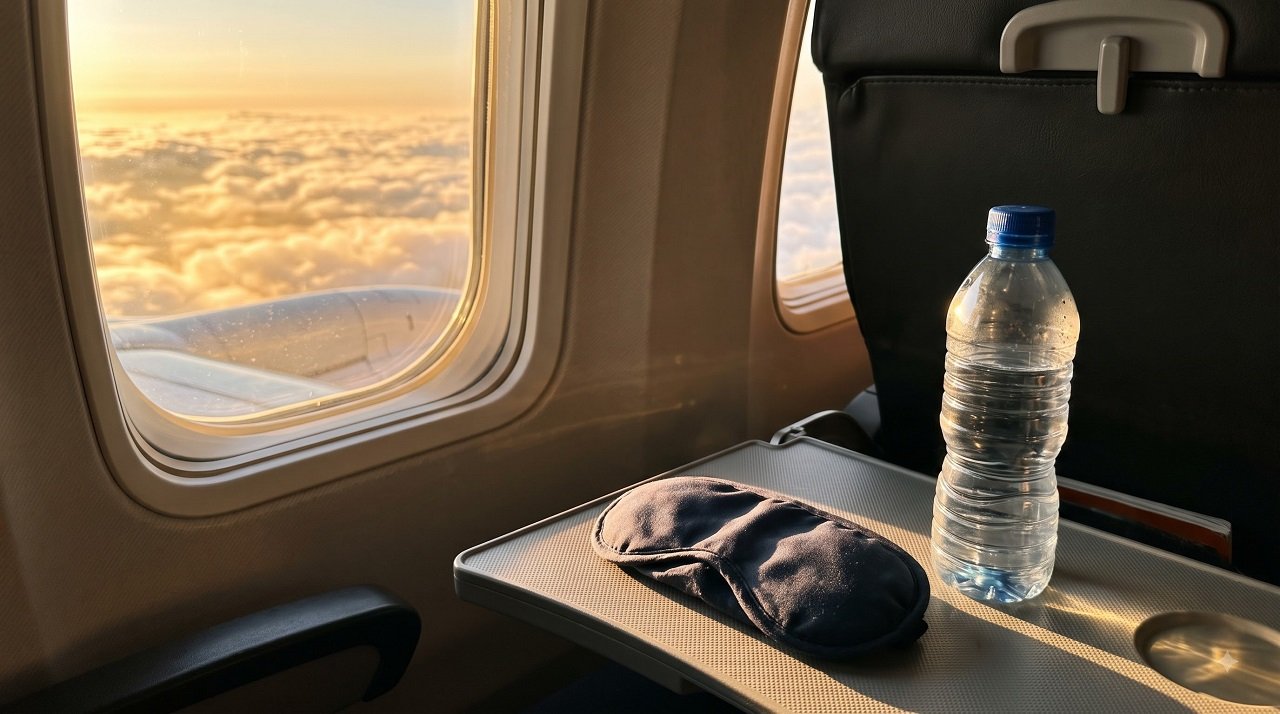
All adaptation rates, dosing ranges, and research findings in this guide reflect publications from 2025 and 2026. Circadian science is still developing, and individual responses vary significantly.
If you are reading this in a later year, treat the frameworks as still useful — the principles of light timing and circadian adaptation do not expire. But check current guidance before relying on any specific dose or protocol.
This guide is general information, not medical advice. Melatonin is a supplement, not an approved treatment for jet lag. Talk to a clinician before using it, particularly if you are pregnant, taking other medication, or managing epilepsy or a clotting disorder.
All sources used in this guide are listed at the end.
Introduction
Jet lag advice is everywhere. Most of it is wrong.
Not because the people giving it are lying, but because they are treating jet lag as a sleep problem. It is not. It is a body clock problem. Your circadian rhythm is still running on home time, and no amount of chamomile tea will change that.
The CDC’s Yellow Book — the reference guide used by travel medicine professionals — states the point directly: jet lag cannot be fixed with generic sleep advice, exercise, hydration, dietary supplements, special diets, or fasting. None of those approaches will quickly adjust a traveler’s circadian clock to a new time zone.-40
What does work is more specific. Timed light exposure. Timed light avoidance. Low-dose melatonin taken at the right hour. And a plan that accounts for which direction you are flying, because east and west are not the same problem.
This guide breaks down what the research actually shows: why eastward travel is harder than westward, how long recovery really takes, which remedies have evidence and which do not, and how to build a plan that fits your flight.
If you are preparing for a long-haul trip, our essential travel tips for novice explorers covers the broader preparation sequence. If you are travelling solo and need to stay sharp on arrival, the solo travel safety guide covers the practical side.
Jet Lag Is Not a Sleep Problem
The confusion starts with the name. “Jet lag” sounds like tiredness from flying. It is actually a mismatch between two clocks.
Your circadian clock — a cluster of cells in the brain’s hypothalamus — controls when you feel awake, when you feel sleepy, when you digest food, and when your body releases hormones. It runs on a roughly 24-hour cycle, and it takes its main cue from light.-39
When you fly across time zones, the light-dark cycle changes faster than the clock can follow. Jamie Zeitzer, an associate professor of sleep medicine at Stanford University, describes it simply: jet lag is “the delay between your internal clock and your new time zone”.
Steven Lockley, a neuroscientist at Harvard and co-founder of Timeshifter, explains why this is unnatural: “Never in nature would you have experienced a change in the light-dark cycle of, say, seven hours in a day… It’s completely unnatural, and your brain doesn’t know how to cope with it”.-39
Why This Matters for What You Try
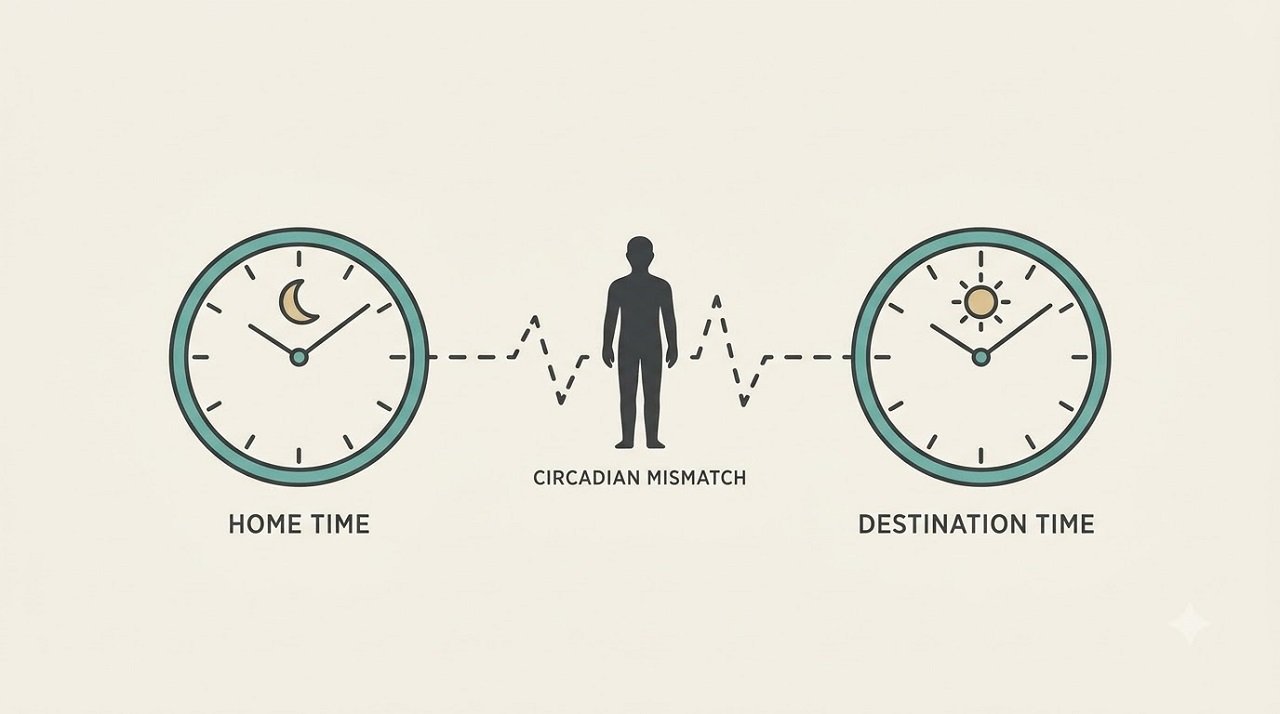
Once you understand that jet lag is a clock problem, the useless remedies become obvious.
A sleeping pill knocks you out. It does not reset your clock. A homeopathic tablet does nothing to the timing of light, which is the main driver of how long jet lag lasts. Vitamin C, B vitamins, magnesium, and cherry extract have all been sold for jet lag, but none has evidence that it resets the clock.-1
The only lever with strong evidence is timing — of light, darkness, and melatonin. Everything else is either supportive or irrelevant.
Direction Matters More Than Distance
Most travelers assume jet lag scales with distance. It does not. It scales with direction.
East Is Harder Than West
The research on this is consistent. Most travelers experience more severe jet lag after flying east than after flying west. A study of over 20 years of Major League Baseball data found that jet lag impaired performance more after eastward travel than westward travel.-11
Korean research on sleep-wake cycles found that eastbound travel caused more disturbance and daytime dysfunction than westbound travel, and concluded that symptom severity depends on travel direction.
Why the Asymmetry Exists
Your circadian clock runs slightly longer than 24 hours in most people. That means it is naturally easier to delay the clock — to push bedtime later — than to advance it.
Flying west asks your body to delay. You “gain” time, and your clock shifts later. This aligns with its natural tendency.
Flying east asks your body to advance. You “lose” time, and your clock must shift earlier. This fights the clock’s natural drift.
The Adaptation Rates
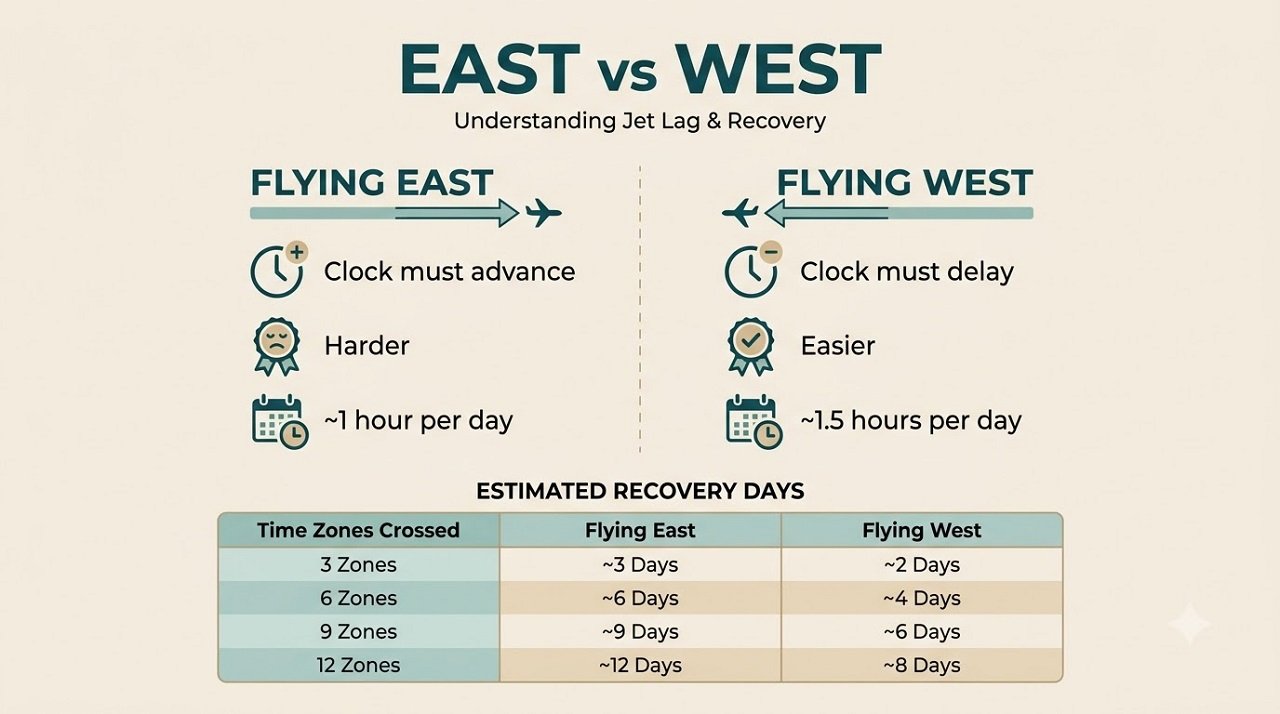
The CDC’s travel health guidance puts circadian adaptation at roughly 1 hour per day travelling east and 1.5 hours per day travelling west.-2
Studies that followed real travelers landed in the same range: about 57 minutes per day after eastward flights and 92 minutes per day after westward flights.
That gives you a simple way to estimate recovery:
| Time Zones Crossed | Flying East | Flying West |
|---|---|---|
| 3 zones | ~3 days | ~2 days |
| 5 zones | ~5 days | ~3–4 days |
| 6 zones | ~6 days | ~4 days |
| 8 zones | ~7–10 days | ~5–6 days |
Source: Welltory, based on CDC guidance.-2
The Short-Trip Exception
If your trip is only a day or two, the math changes. Adjusting to local time takes days you do not have, and you will spend the whole trip recovering just in time to fly home and recover again.
For short trips, the Sleep Health Foundation recommends staying on home time — eating, sleeping, and avoiding light on your home schedule rather than trying to adapt.
The practical rule: adapt for trips longer than about three days. Stay on home time for shorter ones.
If you are booking a long-haul trip and want to understand how fare timing affects your schedule, the guide to finding cheap flights covers booking windows and flexibility.
The Only Lever That Really Works — Light
Light is the primary signal that resets the circadian clock. But light is not a blunt instrument. When you see it determines which direction your clock moves.
The Phase Response Curve
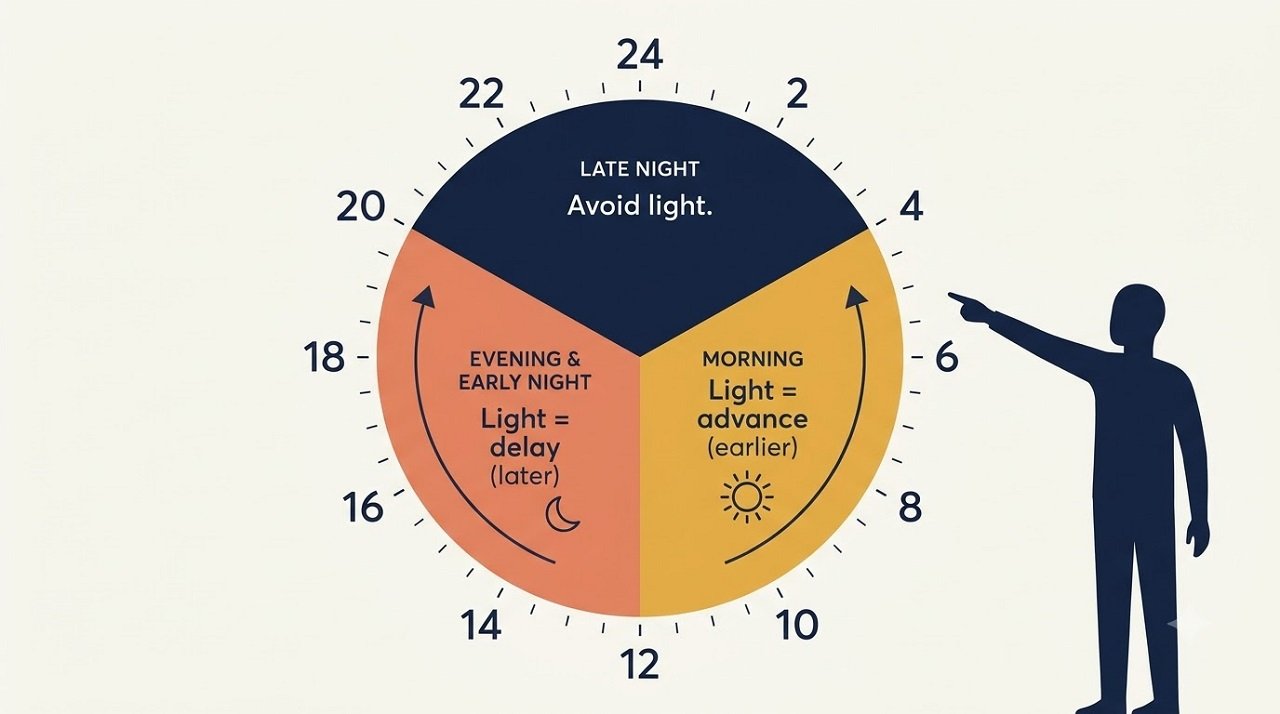
Exposure to bright light in the evening and early night pushes the clock later — a phase delay. Exposure in the late night and morning pushes it earlier — a phase advance.
This means the same sunlight can help or hurt, depending on the hour and the direction you are travelling.
Eastward Travel: Seek Morning Light
Flying east requires a phase advance — your clock must move earlier. Morning light does that.
Harvard Health recommends morning sunlight after eastward travel to help you wake earlier.-23
What to do:
- On arrival, get outside in the morning.
- Avoid bright light in the late afternoon and evening — it pushes your clock the wrong way.
- Keep your room dark in the evening.
Westward Travel: Seek Late-Afternoon Light
Flying west requires a phase delay — your clock must move later. Late-afternoon and evening light does that.
Harvard Health recommends late-afternoon sunlight after westward travel to help shift to a later schedule.-23
What to do:
- On arrival, get outside in the late afternoon and early evening.
- Avoid bright morning light if you are trying to sleep in.
- Use blackout curtains if early sunrise wakes you too soon.
The Warning About Generic “Get Sunlight” Advice
This is where most travel advice fails. “Get sunlight” sounds harmless. But if you get light at the wrong time, you push your clock in the wrong direction and make jet lag worse.
The CDC’s Yellow Book is explicit: if the traveler’s timing is wrong, it will make their jet lag worse.-40
Light is not a cure. It is a tool that works only when timed correctly.
If you are heading somewhere with a very different daily rhythm and language, our guide to navigating language barriers covers how to prepare for the first days.
Melatonin — What the Evidence Shows
Melatonin is the most widely sold jet lag remedy. It is also the most misunderstood.
What It Is
Melatonin is a hormone your body produces to signal that it is time to sleep. It is available as a supplement in most countries, though in some places it is regulated as a drug.-30
The Evidence
The Merck Manual states that some scientific evidence supports melatonin for minimizing jet lag, especially in people travelling eastward over 2 to 5 time zones.-30
That is a meaningful endorsement. But note the specificity: eastward, moderate distance. It is not a universal cure.
Dose: Lower Than You Think
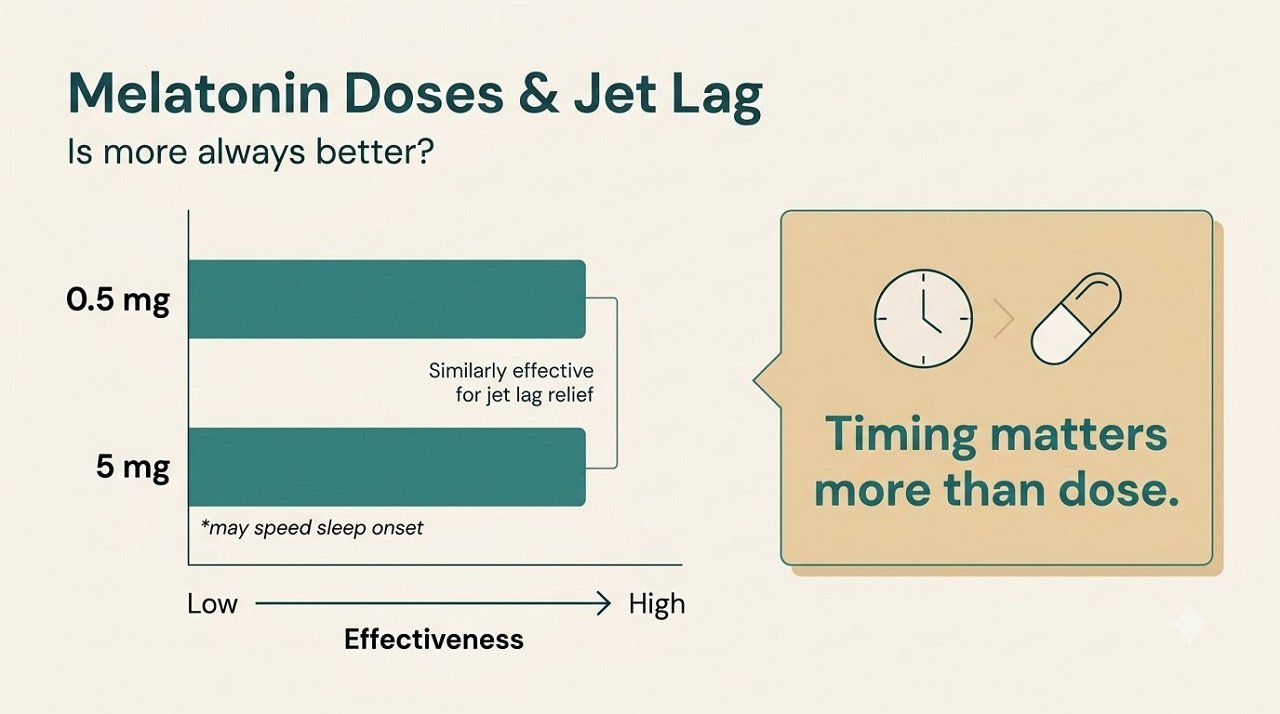
Standard dosage is not established. The Merck Manual gives a range of 0.5 to 5 mg, taken one hour before usual bedtime on the day of travel and for two to four nights after arrival.
Research comparing doses found that 0.5 mg and 5 mg were similarly effective at reducing jet lag, though participants fell asleep faster with the higher dose. A separate review found 5 mg immediate-release melatonin was more effective than 2 mg slow-release.
Timeshifter recommends 1–3 mg of fast-release, melatonin-only product from a reputable pharmacy, and stresses that timing matters more than dose.-1
The practical takeaway: start low. The hour matters more than the milligrams.
Timing: The Part Most People Get Wrong
Melatonin is not a sleeping pill. It is a clock signal. Taking it at the wrong time can shift your clock in the wrong direction, just like light.
Most guidance suggests taking it 1 to 2 hours before your target bedtime at the destination.
Some protocols are more specific. One approach suggests 0.5 mg about 4.5 hours before target sleep onset — earlier than most people take it, and the timing is deliberate.
For westward travel, Norwegian guidance suggests taking melatonin at bedtime in the destination time zone, 3–6 mg per day for 3–7 days. For eastward travel, it suggests taking it at midnight on day one.
The exact protocol depends on your itinerary and chronotype. The principle is consistent: melatonin is a timing tool, not a knockout drop.
If you have not arranged travel insurance yet and want to understand what is covered if illness disrupts your trip, our guide to what travel insurance actually covers explains the relevant benefits.
What Does Not Work (and What Makes It Worse)
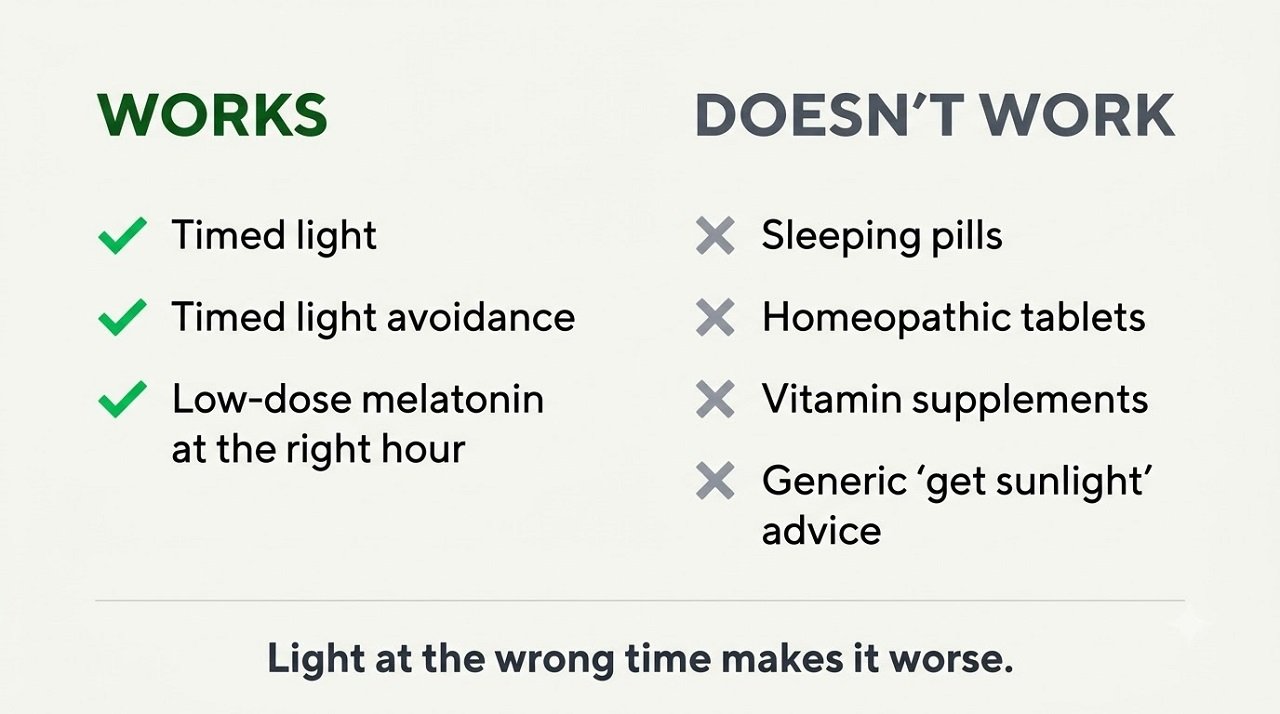
Several popular remedies have no evidence for clock resetting. Some actively interfere.
Sleeping Pills
Sleeping pills may help you sleep on the plane, but they do not shift your circadian clock. They can also make you sleep through the light you need to reset it.
Homeopathic Tablets
Products like No-Jet-Lag and Jetzone are sold for jet lag symptoms. They are not designed to reset the circadian clock and do nothing about light timing.
Supplements Sold for Jet Lag
Vitamin C, B vitamins, omega-3, magnesium, tryptophan, and cherry extract have all been marketed for jet lag. None has evidence that it resets the clock.-1
Alcohol and Caffeine in Flight
Harvard Health recommends avoiding caffeine and alcohol during the flight. Both promote dehydration, which worsens jet lag symptoms, and both can disturb sleep.-23
Caffeine does not reset the clock, but small, well-timed doses can help you stay awake when you need to see light. The problem is timing: caffeine late in the day can prevent the sleep you need.
Alcohol is worse. It is dehydrating and disrupts sleep quality, even if it makes you fall asleep faster.
Generic “Get Sunlight” Advice
As Part 3 explained, light at the wrong time makes jet lag worse. “Get sunlight” is not advice. “Get sunlight in the morning if you flew east, and in the late afternoon if you flew west” is advice.
The Pre-Flight Protocol
Preparation before departure can reduce the severity of jet lag, especially for eastward travel.
Shift Your Schedule Gradually
Harvard Health recommends moving mealtimes and bedtime incrementally closer to the destination schedule for several days before departure. Even a partial switch may help.
A practical example for eastward travel: three days before departure, go to bed 30 minutes earlier. The next night, one hour earlier. The night before, 90 minutes earlier.-23
For westward travel, shift later instead.
Start Melatonin Before You Fly (If Appropriate)
Some protocols begin melatonin on the day of travel, one hour before the target bedtime. If you are using melatonin, discuss the timing with a clinician, especially if you take other medication.
Choose Your Flight Times Strategically
A daytime flight reduces the risk of arriving exhausted and disoriented. If you can choose, arriving in the morning gives you daylight hours to anchor your clock.
If you are packing for a long-haul trip and want to avoid baggage delays that compound fatigue, our carry-on packing guide covers how to travel with one bag.
A Practical Day-by-Day Framework
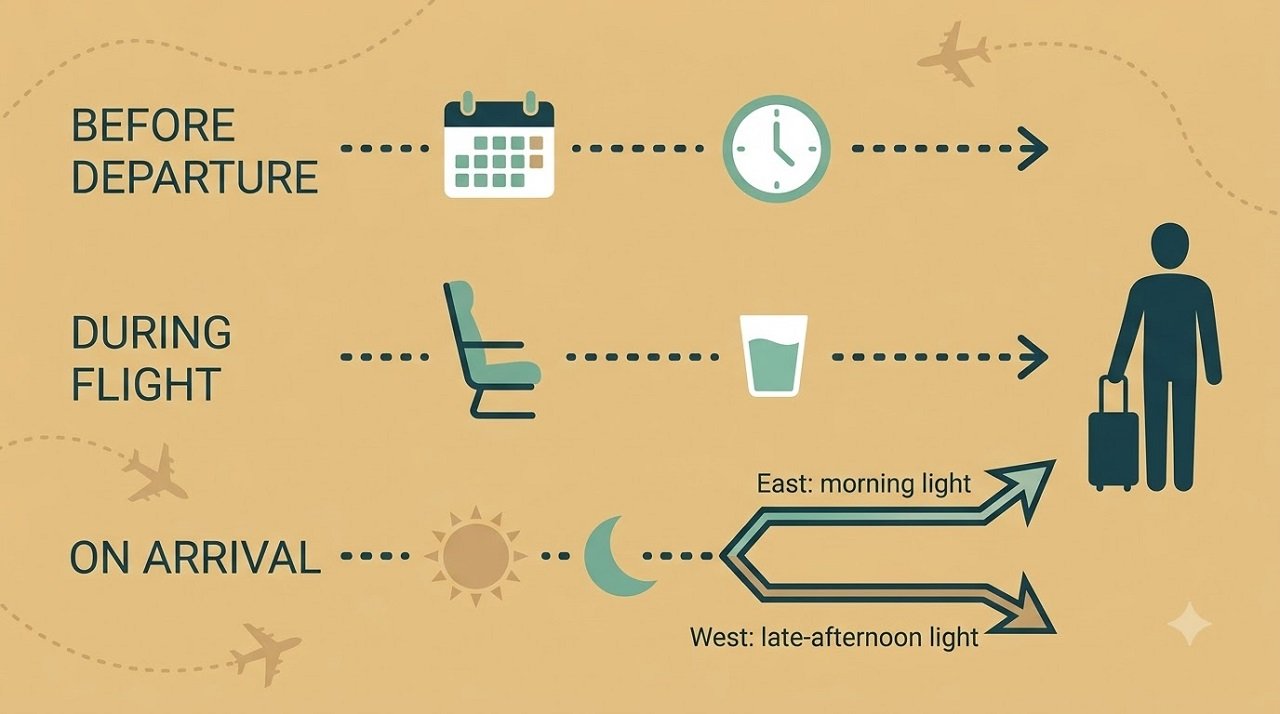
Here is a simple structure you can adapt to your flight. It is not a personalised plan — those require your chronotype and exact itinerary — but it covers the core levers.
Before Departure (2–3 Days)
- Shift bedtime and mealtimes toward the destination schedule by 30–60 minutes per day.
- Get morning light if flying east; get evening light if flying west.
- Avoid starting the trip sleep-deprived.
During the Flight
- Stay hydrated with water.
- Avoid alcohol. Limit caffeine and time it early.
- Sleep if it matches destination nighttime. Stay awake if it matches destination daytime.
- Use an eye mask and earplugs to control light and noise.
On Arrival
- If you flew east: seek morning light. Avoid late-afternoon and evening light. Take melatonin 1–2 hours before target bedtime if using it.
- If you flew west: seek late-afternoon and evening light. Avoid bright morning light if trying to sleep in. Take melatonin at destination bedtime if using it.
- If the trip is under three days: consider staying on home time instead of adapting.
- Keep naps short — 20–30 minutes, before 3 pm local time.-6
- Switch meal times to local schedule immediately.
For the First Few Nights
- Keep the room dark.
- Avoid screens late at night.
- Be patient. Recovery takes roughly one day per time zone east, and about 1.5 time zones per day west.
If you are travelling to a destination with significant safety considerations, the guide to reading government travel advisories covers how to check conditions before you go.
Conclusion
Jet lag is not a mystery, and it is not a test of willpower. It is a measurable mismatch between your internal clock and the clock on the wall.
The research points to three things that actually matter:
- Direction. East is harder than west. Plan for it.
- Light timing. Morning light for eastward travel, late-afternoon light for westward travel. Wrong timing makes it worse.
- Melatonin timing, not dose. Low-dose, fast-release, taken at the right hour. It is a clock signal, not a sleeping pill.
Everything else — the supplements, the homeopathic tablets, the generic “get sunlight” advice — is either unsupported or actively unhelpful.
If you remember one rule, make it this: jet lag is a clock problem, not a sleep problem. Treat the clock, not the tiredness.
If you are planning a specific long-haul trip and want to see how recovery time fits into a real itinerary, the Japan trip cost breakdown shows how arrival timing affects a one-week plan.
Frequently Asked Questions
How long does jet lag last?
Your body clock adapts at roughly 1 hour per day flying east and 1.5 hours per day flying west. Six time zones east takes about six days; six time zones west takes about four. Direction matters more than distance.
Is jet lag worse flying east or west?
East is generally worse. Most travelers experience more severe jet lag after eastward travel because the body clock must advance, which fights its natural tendency to run slightly longer than 24 hours.
Does melatonin actually work for jet lag?
The Merck Manual states that some scientific evidence supports melatonin for jet lag, especially for eastward travel over 2–5 time zones. Low doses (0.5–5 mg) are effective, and timing matters more than dose. Melatonin is a supplement, not an approved treatment — talk to a clinician before using it.
What is the fastest way to get over jet lag?
There is no instant fix. The fastest approach is timed light exposure in the correct direction, low-dose melatonin at the right hour, immediate switching to local meal and sleep times, and patience. Recovery rate is roughly fixed at about 1 hour per day east and 1.5 per day west.
Should I stay on home time for a short trip?
Yes. For trips of a day or two, the Sleep Health Foundation recommends staying on home time — eating, sleeping, and avoiding light on your home schedule — rather than trying to adapt and then re-adapt.
Do sleeping pills help with jet lag?
Sleeping pills may help you sleep on the plane, but they do not reset your circadian clock and can make you sleep through the light you need. They are not a jet lag treatment.
Sources
- Timeshifter. Jet lag remedies: pills, supplements & what works. Updated October 8, 2026. Light timing, light avoidance, low-dose melatonin, what does not work, caffeine timing. https://www.timeshifter.com/jet-lag/jet-lag-remedies
- Timeshifter. CDC Yellow Book 2026 features the Timeshifter jet lag app. Published June 24, 2025. CDC statement that generic advice, exercise, hydration, supplements, diets, and fasting do not reset the circadian clock; light timing is the key. https://www.timeshifter.com/news/the-cdc-features-the-timeshifter-jet-lag-app-in-its-yellow-book-2026
- Welltory. Jet lag calculator: how many days, and what to do on each day. Published October 20, 2026. CDC adaptation rates (1 hour/day east, 1.5 hours/day west); real-traveler data (57 and 92 minutes); east-west asymmetry; short-trip strategy; direction table. https://welltory.com/blog/jet-lag-calculator
- Harvard Health. How to avoid jet lag: Tips for staying alert when you travel. Adapted from Boosting Your Energy, Medical Editor Anthony L. Komaroff, MD. Pre-flight schedule shifting, hydration, caffeine and alcohol avoidance, direction-specific light exposure. https://www.health.harvard.edu/brain-health/how-to-avoid-jet-lag-tips-for-staying-alert-when-you-travel
- Merck Manual Professional Edition. Melatonin. Full review July 2025. Dosage range 0.5–5 mg, timing, evidence for eastward travel over 2–5 time zones. https://www.merckmanuals.com/en-ca/professional/special-subjects/dietary-supplements/melatonin
- mindbodygreen. Most Jet Lag Advice Doesn’t Work: Here’s Why + What To Do On Your Next Flight. Published March 14, 2026. Jamie Zeitzer (Stanford) and Steven Lockley (Harvard) on circadian mismatch and why generic advice fails. https://www.mindbodygreen.com/articles/most-jet-lag-advice-does-not-work-heres-why-what-to-do-on-your-next-flight
- Journal of Theoretical Biology. Reentrainment of the circadian pacemaker during jet lag: East-west asymmetry and the effects of north-south travel. Volume 437, January 21, 2018. Mathematical model explaining why eastward travel is worse than westward. https://www.sciencedirect.com/science/article/abs/pii/S0022519317304575
- Sleep Health Foundation (Australia). Tips to Help Combat Jet Lag. Published January 12, 2024. Recommendation to stay on home time for short trips. https://www.sleephealthfoundation.org.au
- Ubie Health. Jet Lag Recovery: How to Reset Your Internal Clock Faster. Published April 13, 2026, reviewed July 9, 2026. Pre-travel schedule shifting, direction-specific light exposure, nap duration, post-arrival reset techniques. https://ubiehealth.com/doctors-note/jet-lag-fatigue-time-zone-reset-clock-faster-tz-4242e1
- FASS. Aritonin (melatonin) product summary. Published January 14, 2026. 0.5–5 mg doses similarly effective; 5 mg may speed sleep onset. https://fass.se
- Examine. Can melatonin help with jet lag or shift work? Published May 16, 2025. 0.5 mg and 5 mg similarly effective at reducing jet lag; 5 mg may speed sleep onset. https://examine.com
- UCSF CME. Melatonin for jet lag: double-blind placebo-controlled field trials. Doses 0.5–10 mg, typically at local bedtime; 5 mg immediate-release more effective than 2 mg slow-release. https://www.ucsfcme.com