


All survey figures, cost ranges, and percentage estimates in this guide reflect research published in 2025 and 2026. Prices, airfares, and currency rates change constantly, and costs vary enormously by destination and season.
If you are reading this in a later year, treat the method as still correct — the order of steps and the formulas do not expire. But replace every example price with a current quote before you commit.
This guide is general information, not financial advice. Your own circumstances, income, and obligations should govern what you decide to spend.
All sources used in this guide are listed at the end.
Introduction
Most travel budgeting advice gives you numbers. This guide gives you a method.
The difference matters, because the numbers clearly are not working.
A TopCashback survey of US adults found that 94% of respondents spend more on vacation than they originally planned. More than 65% typically overspend by at least $250. And for more than half, the overspend comes with guilt attached.
Those results are not a discipline problem. They are a sequence problem.
Personal finance coach Carol Glynn, speaking to The National, explains the mechanism: “Research consistently shows that people spend more when they commit to a purchase first and calculate later. Booking flights before setting a full trip budget is one of the biggest drivers of overspending.”
Read that again. The most common budgeting mistake happens before the spreadsheet exists. People book a flight, then build a budget around it. The budget is not a plan — it is a justification for a decision already made.
This guide fixes the sequence. It covers how to set a ceiling before you look at a single price, the seven lines that capture almost every trip cost, the hidden layer that adds 25–40% if you ignore it, the buffer math most people get backwards, and the daily allowance formula that tells you what you can actually spend once you arrive.
If you are planning a specific destination and want to see the method applied to real numbers, the <a href=”https://gototraveldestinations.com/how-much-does-a-trip-to-japan-cost-one-week-2026/”>Japan trip cost breakdown</a> works through a full week category by category. If you are heading to Southeast Asia, the <a href=”https://gototraveldestinations.com/backpacking-southeast-asia-on-a-budget-ultimate-guide/”>backpacking budget guide</a> covers the low-cost end of the range.
Why Travel Budgets Fail
Before the method, the failure points. Most blown budgets trace back to one of six causes.
Cause 1: Booking Before Budgeting
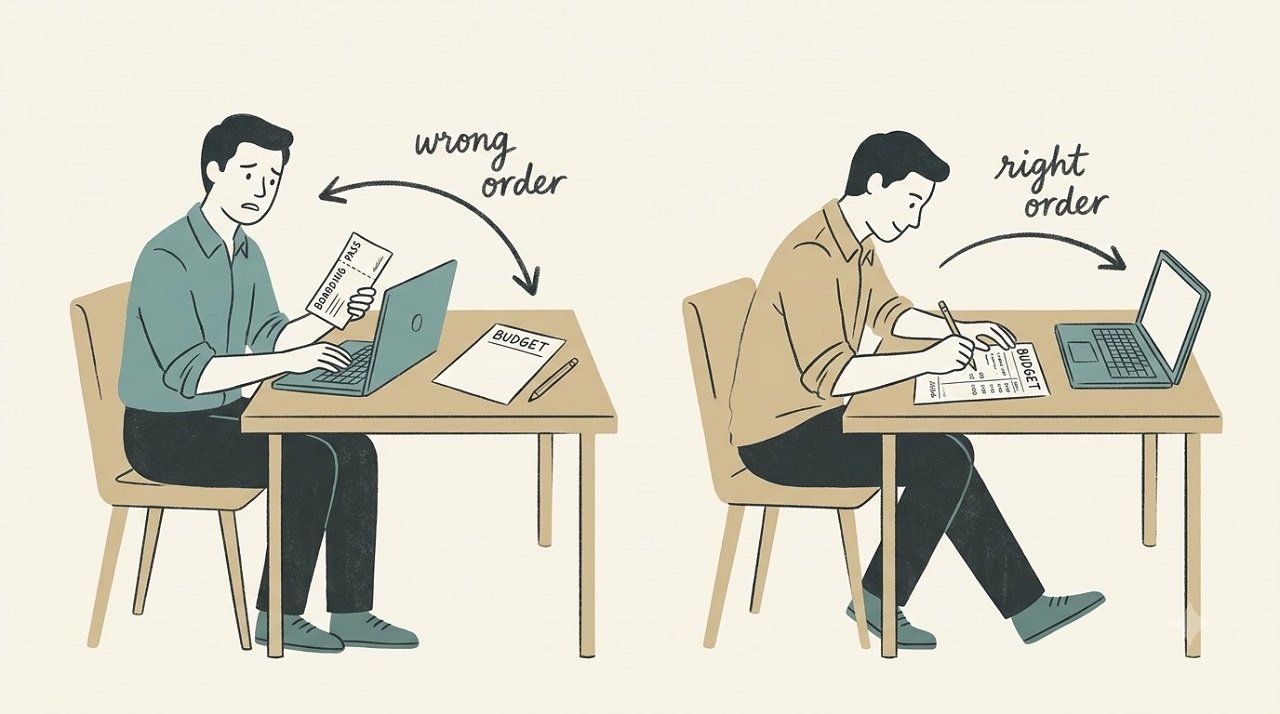
The flight gets booked because the price looked good. The accommodation gets booked because it was nearby. By the time a total is calculated, the expensive decisions are already locked in.
Glynn’s point is that this reverses the logic of a budget. A budget is supposed to constrain spending. If it is built after the big commitments, it can only describe them.
Cause 2: A Wishful Number Instead of a Ceiling
Most people start with a number they hope will work. Then they squeeze the trip until it fits — or fail to, and spend anyway.
A ceiling is different. It is the maximum you can pay without financial stress. It is a constraint, not an aspiration. The travel planning resource TravelDeck puts it bluntly: if your true ceiling is $1,200, do not build a $1,450 plan and hope discipline saves you later.
Cause 3: Mixing Fixed and Daily Costs
Fixed costs are booked once — flights, insurance, a rail pass. Daily costs keep leaking after you land — food, local transport, museum tickets, the second coffee.
When these sit in the same list, the trip always looks cheaper than it is. A $600 flight feels like the big number. Seven days of $45 food spending is $315, and it does not feel like a decision.
Cause 4: The Forgotten Admin Layer
Visas. Travel insurance. eSIM data. Airport transfers. Baggage fees. Foreign transaction markups. These are not optional extras. They are part of the trip.
Cause 5: No Buffer
A budget with zero slack is not a budget. It is a forecast that assumes nothing goes wrong. Something usually does.
Cause 6: No Daily Anchor
Even a well-built budget fails at the point of spending if there is no number to check against. Without a daily allowance, every purchase is judged in isolation — and in isolation, almost everything seems affordable.
If you want to understand how booking channel choices affect what you can change later, the comparison of <a href=”https://gototraveldestinations.com/booking-direct-vs-third-party-travel-savings/”>booking direct versus third-party platforms</a> covers the cancellation and refund trade-offs.
Step 1 — Set the Ceiling Before You Look at Prices
This is the step that most guides skip, and it is the one that determines whether the rest works.
How to Find Your Real Ceiling
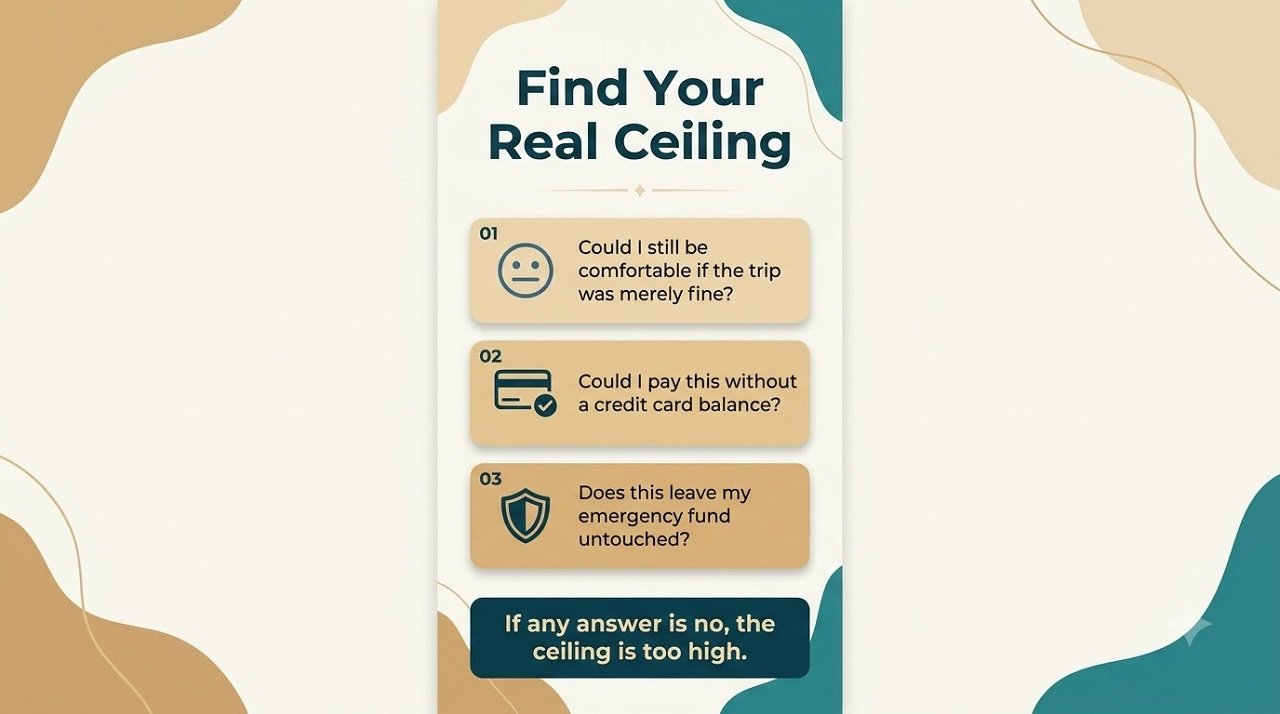
Ask a different question than “what will this trip cost?” Ask: what is the most I can pay for this trip without borrowing, dipping into emergency savings, or feeling regret afterwards?
Answer it with a specific number. Not a range.
Then test it:
- Would I still be comfortable if I spent this and the trip was merely fine?
- Can I pay this without carrying a credit card balance?
- Does this leave my emergency fund untouched?
If the answer to any of those is no, the ceiling is too high.
Why the Ceiling Comes Before the Destination
This feels backwards. Most people pick a destination, then find out what it costs, then decide whether they can afford it.
The problem is that by then, the destination has become emotionally real. Abandoning it feels like a loss, so people stretch the budget instead. Setting the ceiling first protects you from that pressure.
The Distinction That Matters
A ceiling is not the same as a target. A target is what you would like to spend. A ceiling is what you cannot exceed. Write the ceiling down somewhere you will see it when you are tempted.
The TravelDeck worksheet framing is useful here: write down your destination and exact travel month, your number of nights, how many people are travelling and whether costs are shared, your trip style, three must-do expenses you will not skip, and your maximum all-in number. That last line is the ceiling.
If the destination you want does not fit the ceiling, the honest options are to change the destination, shorten the trip, change the season, or change the trip style. All four are legitimate. None of them involve borrowing.
If you are choosing where to go and want to understand how costs vary by country, daily budget ranges differ enormously — a comfortable day in Vietnam can run around $35, while the same comfort level in Switzerland can run $180. Our guide to <a href=”https://gototraveldestinations.com/unveiling-the-hidden-treasures-exploring-underrated-adventure-travel-destinations/”>underrated adventure destinations</a> covers places where your budget stretches further.
Step 2 — Build the Seven-Line Budget
Once the ceiling is set, price the trip in seven lines. This is the TravelDeck structure, and it works because it forces every cost into a category you can check.
The Seven Lines
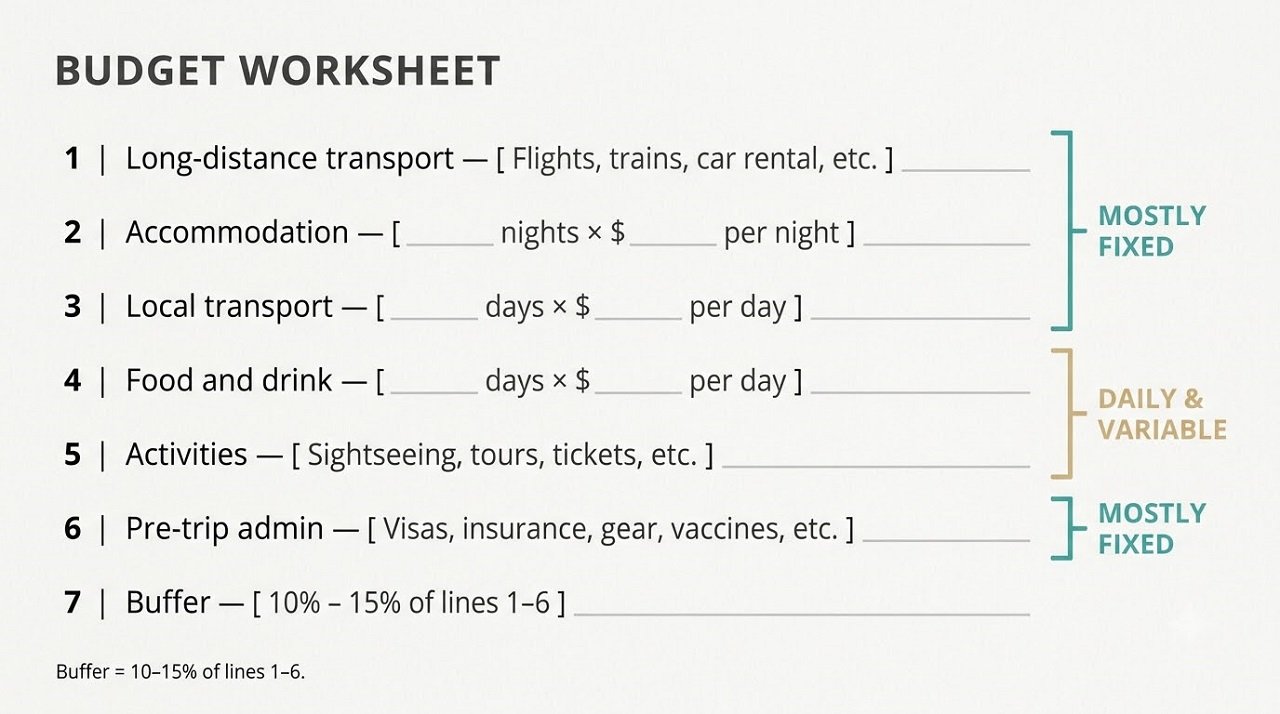
| # | Line | What It Includes | How to Calculate |
|---|---|---|---|
| 1 | Long-distance transport | Flights or trains, plus baggage and seat fees | Fare + fees per person |
| 2 | Accommodation | Room rate, city tax, resort fees | Nightly rate × nights, then add taxes |
| 3 | Local transport | Airport transfer, metro, buses, fuel, parking | Transfer + daily rate × days |
| 4 | Food and drink | Restaurants, groceries, snacks, coffee | Daily average × days |
| 5 | Activities | Must-do tickets, tours, passes | Sum of confirmed plans |
| 6 | Pre-trip admin | Passport, visa, insurance, eSIM, gear, pet sitting | Sum of actual quotes |
| 7 | Buffer | Contingency | 10–15% of lines 1–6 |
Lines 1–3 and 6 are mostly fixed. Lines 4 and 5 are daily and variable. The buffer sits outside both.
Why This Order Matters
Price line 1 first, then line 2. These two categories typically consume 60–70% of a total travel budget, according to budgeting guidance from Remitbee. If they blow the ceiling, nothing else matters — you need to change the trip, not trim the coffee budget.
Only after the fixed costs fit should you move to daily estimates.
A Note on Percentages
Different sources suggest different splits. Common ranges:
- Transport: 30–50% (higher for long-haul international, lower for domestic)
- Accommodation: 20–35%
- Food: 15–25%
- Activities: 10–20%
- Miscellaneous: 5–10%
Treat these as sanity checks, not targets. If your transport is 60% of the total, that is fine for a long-haul trip — but it should be a deliberate choice, not an accident.
If you are flying and want to reduce line 1 without sacrificing the trip, the guide to <a href=”https://gototraveldestinations.com/how-to-find-cheap-flights-data-backed-guide/”>finding cheap flights</a> covers booking windows, midweek departures, and why the day you fly matters more than the day you book. If you want to eliminate baggage fees entirely, the <a href=”https://gototraveldestinations.com/carry-on-packing-list-one-week-minimalist-system/”>carry-on packing system</a> covers how to travel with one bag.
Step 3 — The Hidden Layer Nobody Budgets For
This is where most budgets quietly fail. Not on the flight, and not on the hotel — on the layer of costs that sit between the two.
The 25–40% Problem
Travel industry analysis reported by The Economic Times estimates that overlooked charges — visa fees, card markups, optional tours, tips, local transport, and paying tourist prices for things locals buy cheaply — can add 25–40% to a planned holiday cost.
Separately, foreign currency card markups alone can add 4–5% to overseas spending, depending on the card and how it is used.
These are not rare edge cases. They are standard costs that sit outside the headline price.
The Hidden Layer, Itemised
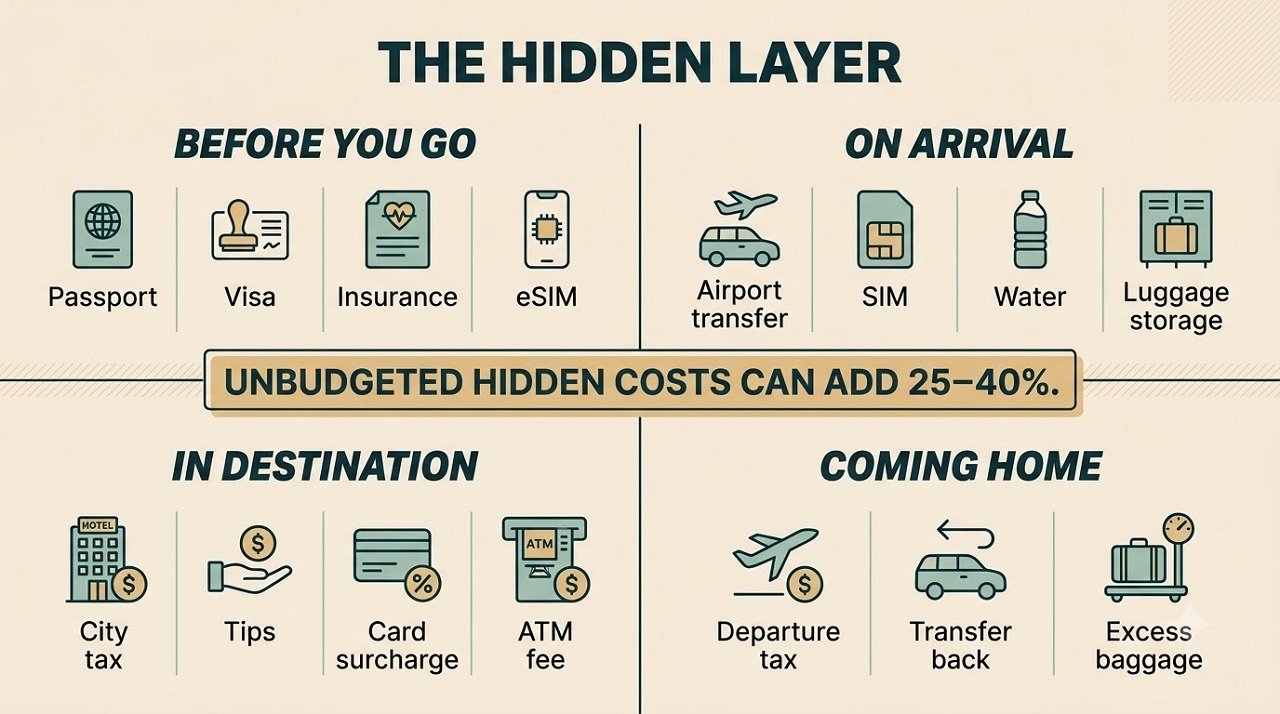
Pre-departure costs
- Passport renewal or first passport
- Visa application fees, plus any agent or courier fees
- Travel insurance
- eSIM or local SIM data
- Vaccinations or medication, if required
- Airport parking or a night-before hotel
- Pet sitting or house sitting
Arrival costs
- Airport transfer — train, bus, taxi, or ride-share
- SIM card purchase if not arranged in advance
- First-night grocery run or water
- Luggage storage if arriving before check-in
In-destination costs
- City tax or tourist tax, often paid at the property
- Tips, where expected
- Public toilet charges in some countries
- Card surcharges at smaller businesses
- ATM withdrawal fees, both local and home-bank
Return costs
- Departure tax, where applicable
- Airport transfer back
- Any excess baggage
How to Price the Hidden Layer
You will not get every line exact. You do not need to. What matters is that the layer exists in your budget as a number, not a surprise.
Use a rule: if you cannot itemise it, estimate it at 8–12% of lines 1 and 2 combined and treat that as a separate line. It will not be perfect. It will be closer than zero.
If insurance is part of your admin line and you have not compared policies yet, the guide to <a href=”https://gototraveldestinations.com/travel-insurance-guide-what-it-covers/”>what travel insurance actually covers</a> explains which benefits are worth paying for and which are not.
Step 4 — The Buffer, and the Math Most People Get Backwards
Everyone says “add a buffer.” Almost nobody explains how, and the standard advice is mathematically wrong if you are working to a ceiling.
The Standard Advice
Add 10–15% to your subtotal. Lonely Planet’s own editors are blunter still: one recommends expecting to go 20–30% over budget, on the reasoning that emergencies and irresistible souvenirs will throw the original number off.
TravelDeck’s worksheet recommends a buffer of 10–15% of lines 1 through 6. The National’s expert advice is a 10–15% buffer on top of the full calculation.
The Problem
If your ceiling is $2,000, and you build lines 1–6 to total $2,000, then add a 12% buffer, your plan costs $2,240. You have already broken the ceiling before you leave.
The buffer has to come out of the ceiling, not on top of it.
The Backwards Buffer Calculation
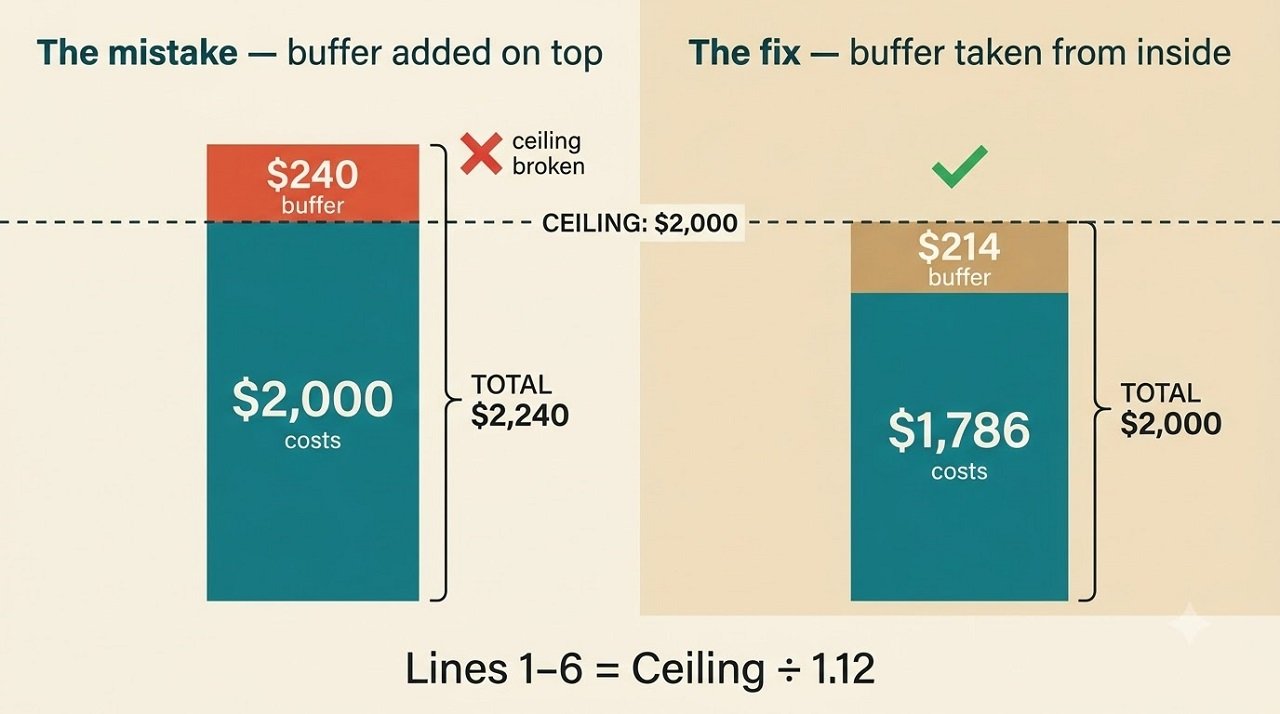
Divide, do not multiply.
Lines 1–6 = Ceiling ÷ (1 + buffer rate)
At a 12% buffer and a $2,000 ceiling:
$2,000 ÷ 1.12 = **$1,786**
So lines 1–6 must total about $1,786. The buffer is $214. Together they equal $2,000.
If you use 15% instead:
$2,000 ÷ 1.15 = **$1,739**
Buffer: $261. Total: $2,000.
This single adjustment prevents the most common budgeting error — building a plan that cannot fit inside the number you set.
What the Buffer Is For
The buffer is not for splurging. It is for the things you cannot predict:
- A flight change or extra night caused by disruption
- A medical or pharmacy expense
- A replacement for something lost or broken
- A price increase between budgeting and booking
If the buffer survives the trip, it rolls into the next one. That is not a failure. That is the system working.
Two Buffers, Not One
A useful refinement: run a small daily buffer and a single trip buffer.
The daily buffer is built into your food and local transport estimates — add $3–$5 per day. The trip buffer sits at the end for genuine emergencies.
This stops small daily overspends from eating the emergency reserve.
Step 5 — Fund the Trip Before You Book It
A budget tells you what the trip costs. A funding plan tells you whether you can actually pay for it without debt.
The Cost of Not Funding It
The National’s reporting is specific on this: carrying a credit card balance at typical rates — often 35% to 46% annually — can make a holiday 20% to 30% more expensive over time.
That is the real cost of “book now, pay later.” A trip that fits your budget on paper can cost 25% more than the number you planned.
Build the Timeline Backwards
Take the total from your seven-line budget. Divide by the number of months until departure. That is your monthly saving requirement.
If the monthly figure is not affordable, you have three options, and only three:
- Move the departure date further out.
- Change the trip — shorter, closer, or lower-cost style.
- Reduce the total by cutting specific lines.
There is no fourth option that involves spending money you do not have.
Budgeting guidance from Remitbee recommends starting to save at least six months before a trip where possible, so you can watch fares and research accommodation without last-minute pressure.
Make It Automatic
The consistent advice across personal finance guidance is to automate the saving.
- Open a separate account labelled for travel, ideally one that earns interest.
- Schedule a transfer on payday, not at the end of the month when the money is already gone.
- Send windfalls — bonuses, refunds, gifts — straight to the fund.
A separate account also has a practical travel benefit: a dedicated debit card means that if it is lost or stolen, it is not connected to your main account.
The Percentage Rule
A common guideline is to allocate roughly 5% to 10% of income to a dedicated travel fund. For some budgets that is realistic; for others it is not. Use it as a starting reference, not a rule.
What Not to Do
- Do not fund travel from your emergency reserve. The emergency fund exists for events you cannot plan. A trip is a planned event.
- Do not treat a credit limit as a budget. A limit is what a lender will allow. A budget is what you can repay.
- Do not skip insurance to protect the budget. An uninsured medical event or evacuation costs far more than the premium. The math is covered in our <a href=”https://gototraveldestinations.com/travel-insurance-guide-what-it-covers/”>travel insurance guide</a>.
Step 6 — The Daily Allowance Formula
This is the number you use while travelling, and it is the one most budgets never produce.
The Formula
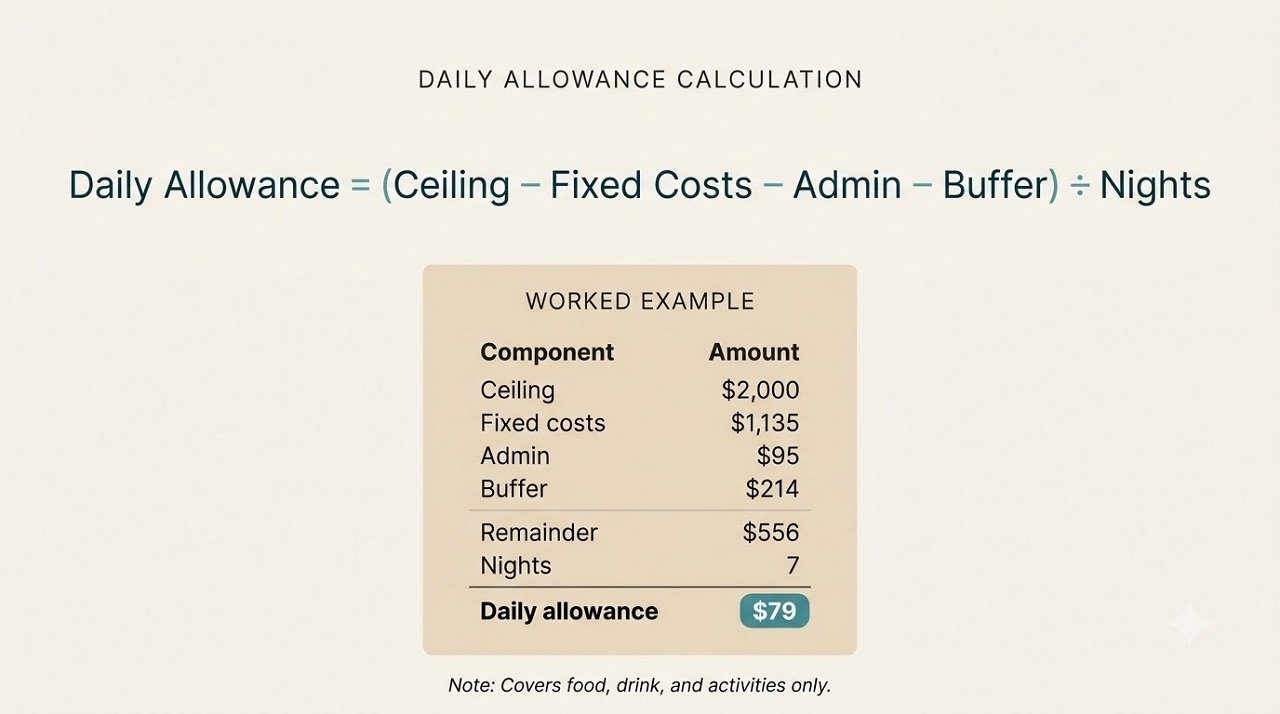
Daily allowance = (Ceiling − Fixed costs − Admin − Buffer) ÷ Nights
Where:
- Fixed costs = lines 1, 2, and 3 (transport, accommodation, local transport)
- Admin = line 6 (visa, insurance, eSIM, gear)
- Buffer = the trip buffer
Worked Example
Ceiling: $2,000. Trip: 7 nights.
- Long-distance transport: $620
- Accommodation: $450
- Local transport: $65
- Admin: $95
- Buffer: **$214** (12% of the $1,786 pre-buffer total, calculated backwards)
Remaining for food and activities:
$2,000 − $620 − $450 − $65 − $95 − $214 = $556
Daily allowance:
$556 ÷ 7 = **$79 per day**
That $79 covers food, drink, and activities. Not accommodation, not transport, not the buffer.
Why This Number Works
It converts an abstract total into a decision rule you can apply at lunch. Before you sit down, you know roughly what the day costs. If yesterday ran at $105, today has $53 of headroom to stay on track.
It also makes trade-offs visible. A $60 tour is not “worth it or not” in the abstract — it is a decision about what the rest of the day looks like.
Track It Simply
You do not need an app. Two methods work:
The envelope method: Withdraw the week’s daily allowance in cash. When it is gone, it is gone.
The single-number method: Each morning, note the running total spent. Each evening, add the day. Compare against the cumulative allowance.
The second is more flexible and safer than carrying large amounts of cash. Our guide to <a href=”https://gototraveldestinations.com/common-travel-scams-how-to-avoid/”>common travel scams</a> covers the card and cash security practices that matter if you are carrying either.
The Method Applied to Two Very Different Trips
Same method, different numbers. This is the point: the method does not change with the destination, only the prices do.
Trip A: Seven Nights in Thailand, Budget Style, Solo
| Line | Calculation | Cost |
|---|---|---|
| Long-distance transport | Return flight, carry-on only | $620 |
| Accommodation | $28/night × 7 + tax | $210 |
| Local transport | $15 transfer + $6/day × 7 | $57 |
| Food and drink | $22/day × 7 | $154 |
| Activities | Two day trips, temple entries | $65 |
| Pre-trip admin | Insurance $38, eSIM $12, visa $25 | $75 |
| Subtotal (lines 1–6) | $1,181 | |
| Buffer | 12% | $142 |
| Total | $1,323 |
Daily allowance after fixed costs, admin, and buffer: roughly $31 per day for food and activities.
Published daily budget ranges for Thailand put budget travellers at roughly $30–45 per day excluding flights. The allowance lands inside that range, which is a useful cross-check.
Trip B: Seven Nights in Switzerland, Mid-Range, Couple Sharing
Per person:
| Line | Calculation | Cost |
|---|---|---|
| Long-distance transport | Return flight + checked bag | $470 |
| Accommodation | $185/night × 7 ÷ 2 people + tax | $708 |
| Local transport | $35 transfer + $28/day × 7 | $231 |
| Food and drink | $75/day × 7 | $525 |
| Activities | Cable cars, museum passes | $240 |
| Pre-trip admin | Insurance $55, eSIM $15 | $70 |
| Subtotal (lines 1–6) | $2,244 | |
| Buffer | 12% | $269 |
| Total | $2,513 |
Daily allowance after fixed costs, admin, and buffer: roughly $109 per day for food and activities.
The published comparison is stark: a comfortable day in Vietnam can cost around $35**, while the same comfort level in Switzerland runs about **$180. Same method. Very different ceiling.
What the Two Examples Show
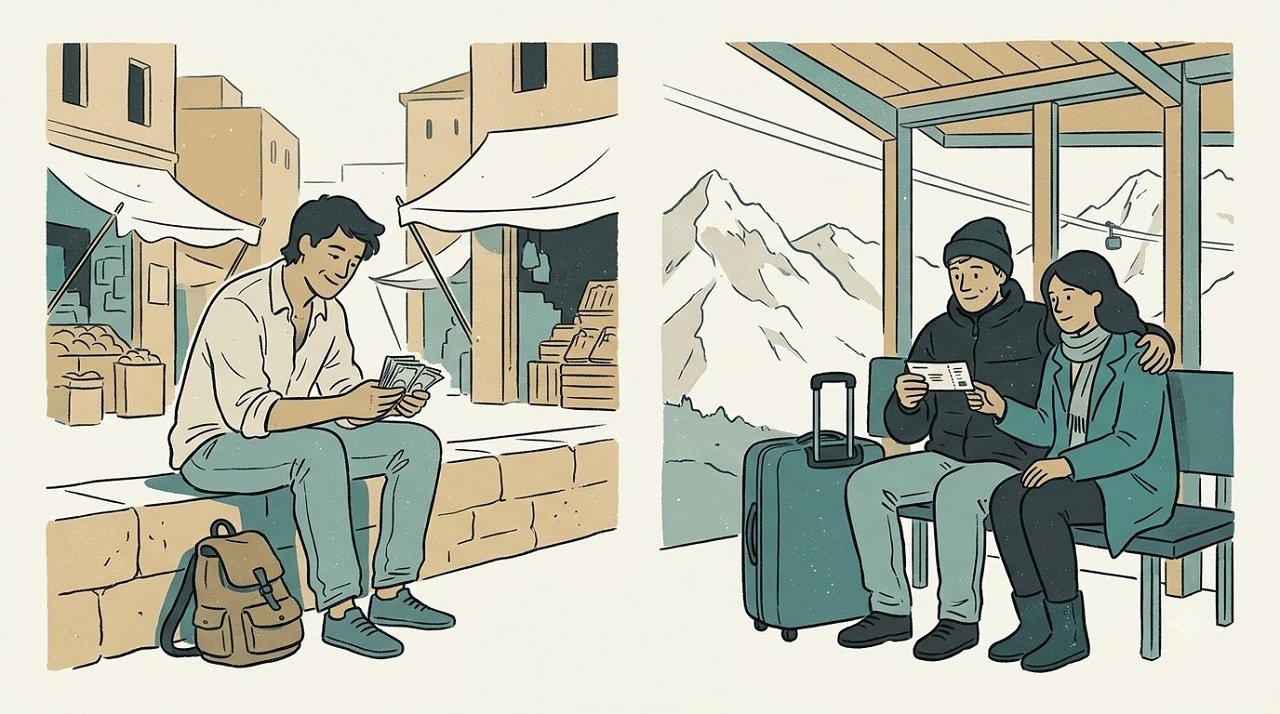
- The structure holds. Seven lines, one buffer, one daily number.
- Sharing changes the math. Accommodation and transport divide; food and activities often do not.
- Daily ranges are a check, not a plan. Published daily figures usually exclude flights, insurance, and visas. Use them to validate your daily allowance, not to replace the whole budget.
If you are travelling alone and want to see how solo costs differ in practice, our <a href=”https://gototraveldestinations.com/solo-travel-bliss-tips-safe-enjoyable-solo-adventures/”>solo travel guide</a> covers the cost structure and safety considerations together.
The Five Mistakes That Undo a Good Budget
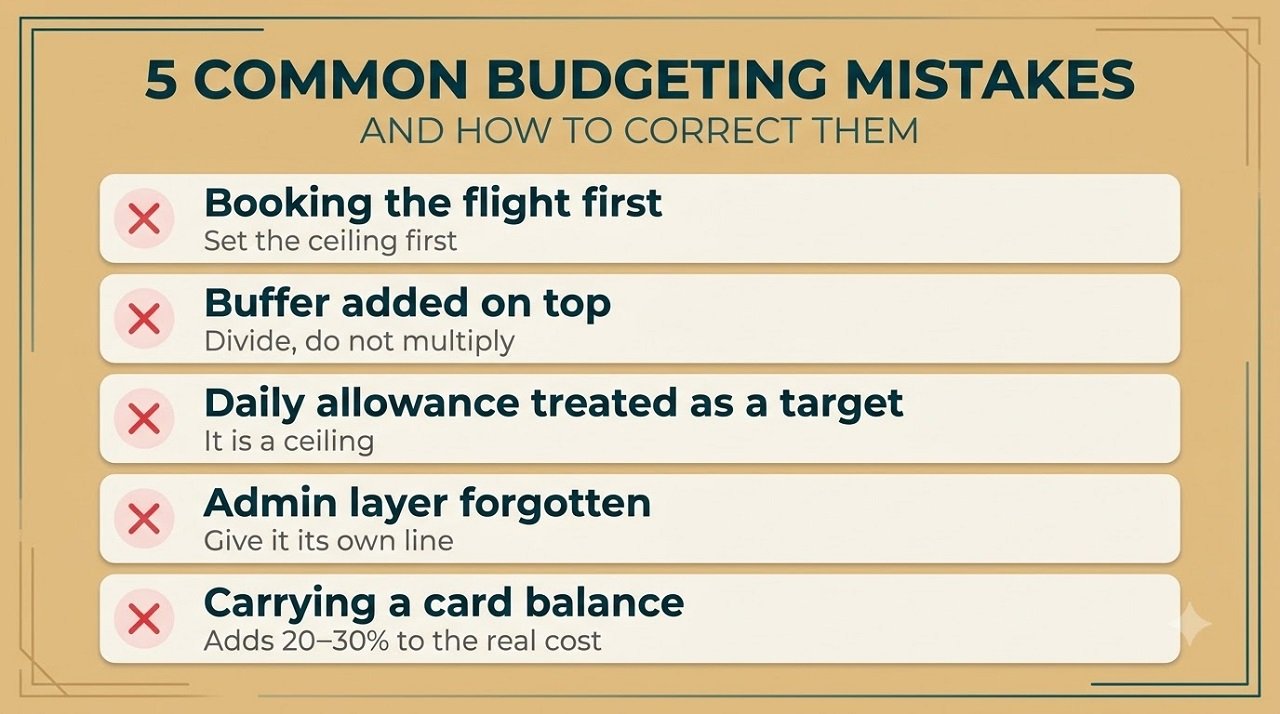
Even a well-built budget can fail in execution. These are the failure points worth watching.
1. Booking the flight first. The single biggest driver of overspending, according to the finance professionals quoted in the reporting above. Set the ceiling and price the fixed costs before you commit.
2. Adding the buffer on top of the ceiling. Divide, do not multiply. Lines 1–6 = ceiling ÷ 1.12.
3. Treating the daily allowance as a target to spend. It is a ceiling, not an instruction. Days under the allowance are what fund the days over it.
4. Forgetting the admin layer. Visas, insurance, eSIM, and transfers add 25–40% if unbudgeted. Give the layer its own line.
5. Paying with a credit card balance. At typical interest rates, a carried balance adds 20–30% to the real cost of the trip. If you cannot pay it off, the budget was never affordable.
The One-Minute Version
If you remember nothing else:
- Set the ceiling before you look at prices.
- Price seven lines: transport, accommodation, local transport, food, activities, admin, buffer.
- Calculate the buffer backwards: lines 1–6 = ceiling ÷ 1.12.
- Divide the remainder by nights to get your daily allowance.
- Save before you book, and pay it off before you fly.
Conclusion
Travel budgeting is not an exercise in restriction. It is an exercise in sequencing.
Set the ceiling first. Price the fixed costs before the fun ones. Give the hidden layer a line of its own. Calculate the buffer backwards so it lives inside the ceiling rather than on top of it. Turn the remainder into a daily number you can actually use.
The data on overspending — 94% of a surveyed US sample spending more than planned — is not evidence that people are bad with money. It is evidence that the standard advice, which starts with a flight search, produces predictable results.
Start somewhere else. Start with the number you can afford.
If this is your first time planning a trip independently, our <a href=”https://gototraveldestinations.com/essential-travel-tips-for-novice-explorers/”>essential travel tips for novice explorers</a> covers the wider preparation sequence that the budget sits inside.
Frequently Asked Questions
How do I budget for a trip for the first time?
Set a maximum you can pay without borrowing, before you look at any prices. Then price seven lines — long-distance transport, accommodation, local transport, food, activities, pre-trip admin, and a buffer. Calculate the buffer backwards from your ceiling, then divide what remains by the number of nights to get a daily allowance.
How much buffer should I add to a travel budget?
Most guidance recommends 10–15% of the pre-buffer total. Critically, if you are working to a ceiling, divide the ceiling by 1.12 rather than adding 12% on top — otherwise your plan already exceeds the ceiling before you leave.
What expenses do people forget when budgeting for travel?
Visa fees, travel insurance, eSIM data, airport transfers, city or tourist taxes, card foreign transaction markups, ATM fees, tips, baggage fees, and departure taxes. Industry estimates suggest unbudgeted hidden costs can add 25–40% to a planned trip cost.
How far in advance should I save for a trip?
Budgeting guidance commonly recommends starting at least six months before departure where possible, so you can watch fares and research accommodation without last-minute pressure. Divide the total by the number of months available to find your monthly saving requirement.
Should I add a buffer per day or one for the whole trip?
Both. A small daily buffer of $3–$5 built into food and transport estimates absorbs normal overspending. A separate trip buffer of 10–15% covers genuine emergencies. Keeping them apart stops small daily overspends from consuming the emergency reserve.
Is it cheaper to pay for a trip with a credit card?
Only if you clear the balance. Carrying a balance at typical rates of 35–46% annually can make a holiday 20–30% more expensive over time. A credit card is useful for consumer protection if you repay in full — not as a way to fund a trip you cannot currently afford.
Sources
- TopCashback via NewsBreak. Guilty spending: Survey finds most vacationers overspend, feel guilty. Published July 10, 2026. Survey of US adults 18+ via Prolific: nearly 94% spend more on vacation than planned; more than half feel guilt. https://www.newsbreak.com
- TopCashback via Manchester Journal. Vacation Hangover: The Financial Stress Travelers Feel After the Trip. Published August 24, 2026. Nearly 94% spent more than planned; over 65% typically overspend by at least $250. https://www.manchesterjournal.com
- Helm. Americans overspend on vacations due to rising costs, with 94% exceeding their budget. Published August 24, 2026. 94% overspend; 65%+ by at least $250; 83% travelling less frequently due to rising costs. https://helm.news/2026-08-24/americans-overspend-vacations-due-rising-costs-exceeding-their-budget.html
- ConsumerAffairs. Over half of Americans are overspending on summer travel, survey reveals. Published May 29, 2026. BestMoney survey of 1,000 Americans: more than half expect to overspend or travel without a firm budget; 75% say vacations are important for mental health; 63% say worth financial sacrifices; spending becomes emotional during travel. https://www.consumeraffairs.com/news/over-half-of-americans-are-overspending-on-summer-travel-survey-reveals-052926.html
- The National. How to travel smarter and cheaper in 2026, according to experts. Published May 19, 2026. Carol Glynn (personal finance coach) on committing to purchases before calculating; 10–15% buffer; credit card rates of 35–46% annually making holidays 20–30% more expensive; open-jaw tickets; midweek departures. https://www.thenationalnews.com/travel/2026/05/19/how-to-travel-smarter-and-cheaper-in-2026-according-to-experts/
- Lonely Planet. 29 Ways We Budget for Travel. Updated September 1, 2026. Editor advice including expecting to go 20–30% over budget; separate vacation savings account; listing fixed costs. https://www.lonelyplanet.com/articles/how-to-budget-for-travel
- TravelDeck. Travel Budget Worksheet 2026: The 7-Line Trip Cost Plan. Published October 1, 2026. Seven-line worksheet structure; fixed versus daily cost separation; 10–15% buffer on lines 1–6; trip frame including maximum all-in number; risk of pricing a fantasy trip. https://traveldeck.ai/blog/travel-budget-worksheet-2026-7-line-trip-cost-plan-ac3n
- TravelDeck. Trip Cost Breakdown 2026: Build a Budget That Fits Real Life. Published June 4, 2026. Total trip budget formula: transport + accommodation + food + activities + local transport + admin costs + buffer; small-leak failure pattern. https://traveldeck.ai/blog/trip-cost-breakdown-2026-build-a-budget-that-fits-real-life-03m2
- Remitbee. Travel Budgeting 101: Plan an Affordable Trip Without Overspending. Published December 15, 2025. Transport and accommodation typically 60–70% of total budget; six-month saving timeline; core budget categories including emergency fund. https://www.remitbee.com/blog/finances/budgeting/travel-budgeting-101-plan-for-an-affordable-trip
- The Economic Times. Hidden cost of travel: Visa fees, card markups, optional tours and tips that can add 25–40% to budget. Published October 2026. Unbudgeted visa fees, currency markups, optional tours, tips, local transport, and tourist pricing add 25–40%; credit cards can add 4–5% in forex markup; experts recommend 10–15% reserve. https://m.economictimes.com
- Allianz Partners via Tornos News. Travelers Cut Costs, Not Trips — Trends for 2026. Published May 20, 2026. 61% cutting other non-essential expenses; 47% reducing scope or duration; average global spend €1,572 per person. https://tornosnews.gr
- Travel Agent Central. Survey: Travelers Pressing On Despite Cost, Geopolitical Fears. Published May 21, 2026. Anticipated per-person spend roughly $1,825 globally; Swiss ~$3,000; Americans $2,625; Chinese $2,580. https://www.travelagentcentral.com
- MMGY Travel Intelligence. Survey Signals a Defining Split in Asia-Pacific Outbound Travel. Published February 3, 2026. Expected mean spend per international leisure trip: Chinese $7,748; Australian $7,124; Indian $5,154. https://mmgyintel.com
- WithAutopilot. Daily Travel Budget by Country: What a Trip Actually Costs in 2026. Published June 16, 2026. Thailand budget $30–45, mid-range $70–100; Vietnam budget $25–35, mid-range $55–80; Indonesia budget $25–40. https://withautopilot.com
- TravelTimers. Daily Travel Budget by Country (2026). Published March 19, 2026. A comfortable day in Vietnam costs about $35; the same comfort level in Switzerland runs about $180. https://traveltimers.com
- Maxiom Wealth. Travel Budget Calculator. Transport 40–50% for international, 20–30% domestic; accommodation 25–35%; food 15–20%; activities 10–15%; shopping and miscellaneous 5–10%. https://maxiomwealth.com
- GoodShare. Vacation Budget Planning for Couples. Published January 27, 2026. Transport 30–40%; accommodation 25–35%; food 15–25%; activities 10–20%. https://goodshare.app
- Investopedia. Set It and Forget It: How to Automate Your Travel Fund. Published June 30, 2025. Automated monthly transfers into a dedicated high-yield account. https://www.investopedia.com
- MoneyLion. How To Save for Vacation All Year Without Feeling Broke. Published July 2, 2026. Payday transfer rituals; round-up tools; separate vacation fund. https://www.moneylion.com
- Yahoo Finance. Gen Z Is Cutting Back on Travel Spending — How To Build a Vacation Fund. Published October 19, 2026. Schedule transfers for payday; adjust destination or timeline if the monthly amount is unaffordable. https://finance.yahoo.com
- LinkedIn (Muskkan Samtani). Building a Travel Fund for Financial Freedom. Published July 26, 2026. 5–10% of income benchmark; dedicated sinking fund rather than general cash flow. https://www.linkedin.com