


All fees, processing times, and document requirements in this guide reflect research published in 2025 and 2026. Consular procedures, passport fees, and embassy capacity change regularly and vary by nationality and location.
If you are reading this in a later year, treat the sequence below as still correct — the order of steps does not change. But confirm current fees and requirements with your own embassy before you pay anything.
This guide is general information, not legal or consular advice. Only your embassy or consulate can tell you what applies to your specific nationality and situation.
Official portals: US State Department · UK emergency travel document · Smartraveller. All sources used in this guide are listed at the end.
Introduction
Losing your passport abroad is not a rare misfortune. It is a routine consular event.
In the 2025–26 financial year, more than 4,200 Australian passports were reported lost or stolen overseas, and the Australian Passport Office issued 8,900 emergency travel documents to help travellers continue their journey or get home . In the UK, the Passport Office reported that almost 370,000 passports were reported lost or stolen in 2025 — a 62% increase on 2024 .-22
Those numbers matter because they tell you something useful: the system is designed for this. Embassies and consulates handle passport loss every working day. There is a procedure. It works.
What makes the experience worse than it needs to be is not the loss itself. It is not knowing the order of steps, not having copies of your documents, and discovering too late that your visa died with your passport.
This guide covers the full sequence — from the first hour to the flight home — including the parts most articles skip: the visa reissue problem, the difference between an emergency travel document and a full replacement, what insurance actually pays for, and the one preparation step that saves days.
If you have not arranged travel insurance yet, our guide to what travel insurance actually covers explains the benefits that apply to document loss. If you are travelling alone, the solo travel safety guide covers the additional risks that come with having no companion to help.
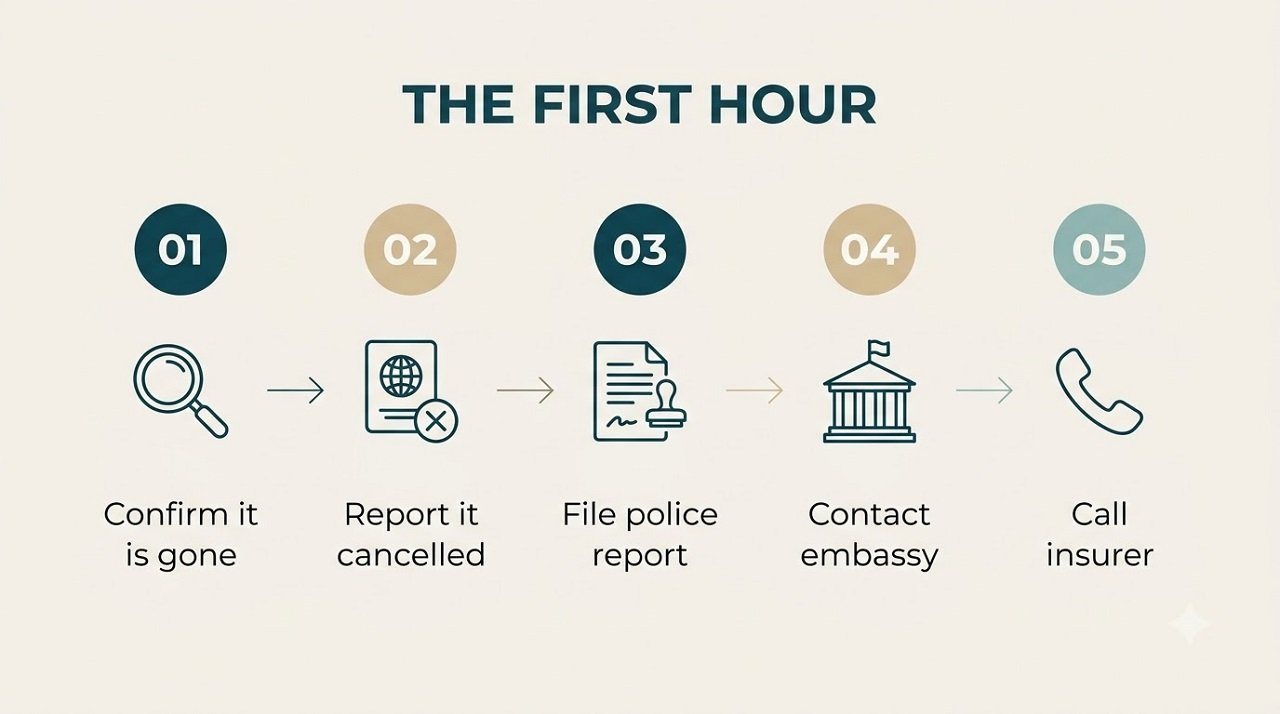
The First Hour — Before You Panic
Step 1: Confirm It Is Actually Gone
Most “lost” passports are misplaced, not stolen. Before you involve anyone, do a systematic check.
- Check every pocket of every bag you have used today.
- Check the hotel safe, the room drawer, and inside shoes or laundry.
- Call the last restaurant, taxi company, or attraction you visited.
- Check with your hotel reception — items are handed in regularly.
This step is not wasted time. It is faster than the alternative, and it prevents the worse outcome of reporting a passport stolen when it is in your suitcase.
Step 2: If It Is Genuinely Missing, Report It Fast
Once you are confident the passport is gone, speed matters — especially if it was stolen. An unreported passport is a usable identity document. A reported one is cancelled.
For US citizens, the State Department allows you to report the loss online, and the passport is cancelled within one business day . After that, it is no longer valid for international travel, and attempting to use it can result in denied entry or denied departure .-31
If it was stolen, also:
- Freeze any cards that were taken with it.
- Change passwords if your phone was also taken.
- Note anything else missing — you will need this for the police report and insurance claim.
Step 3: File a Police Report
This is the single most important document in the entire process, and its necessity varies by nationality.
The US State Department states plainly that police reports are not mandatory but can help confirm the circumstances of the loss or theft . Many other countries take a stricter line: consular staff in several systems will not process a replacement without an official police report .-13-31
Treat the police report as required, regardless of your nationality. The cost is an hour. The cost of not having one can be days.
What to ask for:
- A written copy, not just a verbal acknowledgment.
- A reference or report number.
- An English translation, or a certified translation, if the report is issued in another language. Some embassies explicitly require this — India’s embassy in Iceland, for example, requires the original police report with a notarised English translation attested by the local foreign ministry .
If you are in a country where language is a barrier, our guide to navigating language barriers covers how to communicate at a police station and how to get written information you can actually use.
Emergency Travel Document vs Full Replacement
At the embassy or consulate, you will usually be offered two options. They are not interchangeable, and choosing wrongly costs time or money.
Option A: Emergency Travel Document (ETD)
An ETD — sometimes called an emergency passport, emergency certificate, or temporary passport — is a limited-validity document designed to get you moving.
What it is good for:
- Returning directly home.
- A single journey, or a single return journey in some systems.
- Continuing a trip where no further visa is required.
What it is not good for:
- Onward travel to additional countries that require a visa.
- Long-term use. Some emergency passports are valid for days or weeks; others, like the US emergency passport, can be valid for up to one year .
Processing time: Typically 24–48 hours when documentation is complete . Some major embassies in tourist hubs issue them same-day or next-day .-13-15
UK specifics: A UK Emergency Travel Document costs £125 and can usually be collected after two working days . It is typically valid for a single or return journey . The UK requires you to need to travel within six weeks to qualify .-43
Option B: Full Replacement Passport
A full replacement is a standard passport with standard validity — usually 5 or 10 years depending on your age and country.
Processing time: Typically 7–21 days, or “a few days up to two weeks” depending on location and verification needs . UK full replacement abroad can take up to six weeks .
When you need one:
- You have multiple destinations left on your trip.
- You will need to enter countries that require a visa.
- You hold long-term visas in the lost passport that must be reissued.
- You are a long-term traveller or digital nomad .
The Comparison
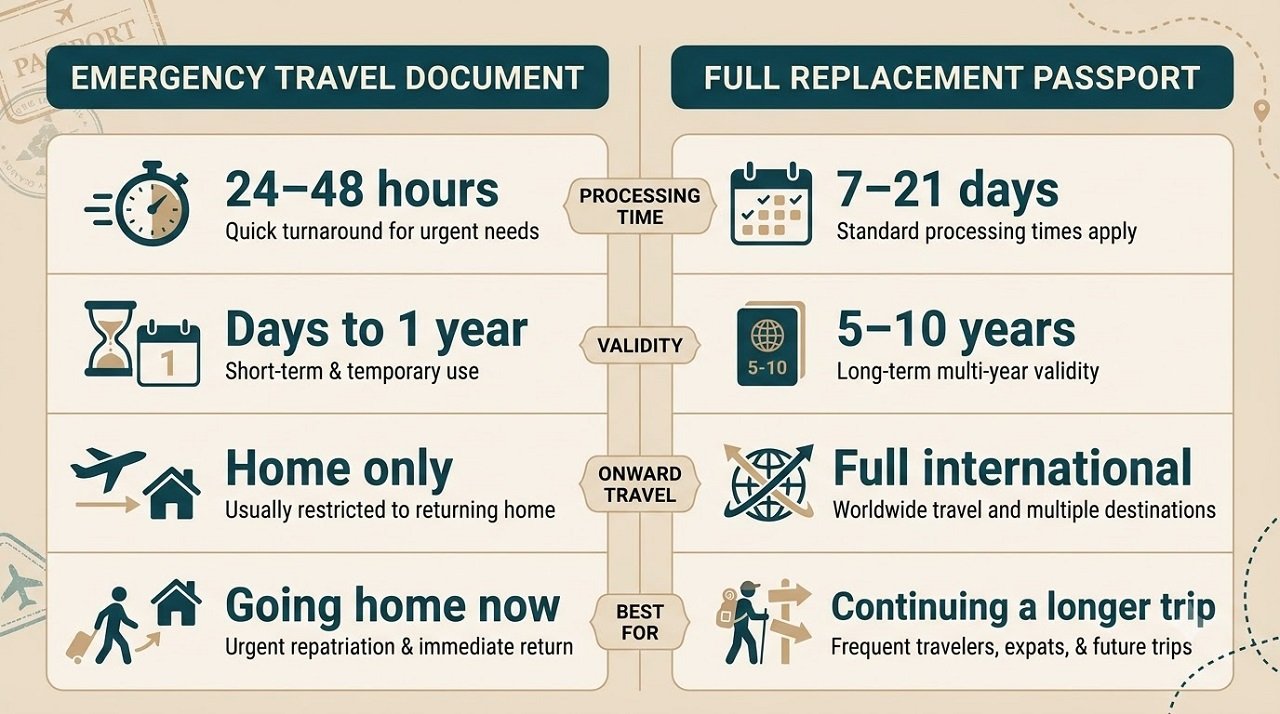
| Emergency Travel Document | Full Replacement | |
|---|---|---|
| Processing time | 24–48 hours | 7–21 days (UK: up to 6 weeks) |
| Validity | Days to 1 year | 5–10 years |
| Onward travel | Usually home only | Full international travel |
| Cost | Lower (UK: £125) | Standard passport fee |
| Best for | Going home now | Continuing a longer trip |
A Note on Fees
Replacement passports generally cost the same as any other passport in your country . Emergency documents are usually cheaper but vary widely.
Comparative figures reported in 2026: Australian emergency passport AUD $189** (about 2 business days), full replacement **AUD $308 (about 10 business days) . Canadian emergency passport CAD $75 .-13
Treat these as reference points, not quotes. Confirm current fees with your embassy before you pay.
If you booked your trip through a third-party platform and need to change dates while waiting, our guide to booking direct versus third-party covers how cancellation and change rules differ by channel.
What to Bring to the Embassy
Bring more than the minimum. Every missing document adds a day.
Core Documents
- Police report — original copy, plus translation if required.
- Passport photos — correct size for your country (US: 2×2 in / 5×5 cm) .
- Photo identification — driver’s licence, national ID, or an expired passport if you still have one .
- Proof of citizenship — birth certificate, citizenship certificate, or a photocopy of the missing passport .
- Travel itinerary — flight bookings, train tickets, or proof of your planned departure .
- Completed application form — for US citizens, Form DS-11; details of the loss go on the form or on Form DS-64 if more space is needed .
- Payment — bring at least two reliable methods, as accepted payment varies by post .-15
Documents That Speed Things Up
- A scan or photocopy of the lost passport — the single most valuable item you can have .
- Scans of any visas in the lost passport .
- Proof of legal stay — hotel booking, entry stamp photo, accommodation address.
- A trusted contact at home who can send documents if needed .
What If You Have Nothing?
This happens, particularly if your bag was stolen. Consular staff can still help, but the process slows.
The US State Department is explicit that even if you cannot present all the documents, consular staff will do their best to help you get a new passport quickly . Ask what alternatives they accept — a verbal verification, a call to a family member, or a check against records.
If you prepared a carry-on packing system with a document pouch, this is the moment it pays off. Our carry-on packing guide covers the document backup routine.
The Visa Problem — The Part Nobody Warns You About
This is the gap in most lost-passport advice, and it causes the longest delays.
Visas Do Not Transfer
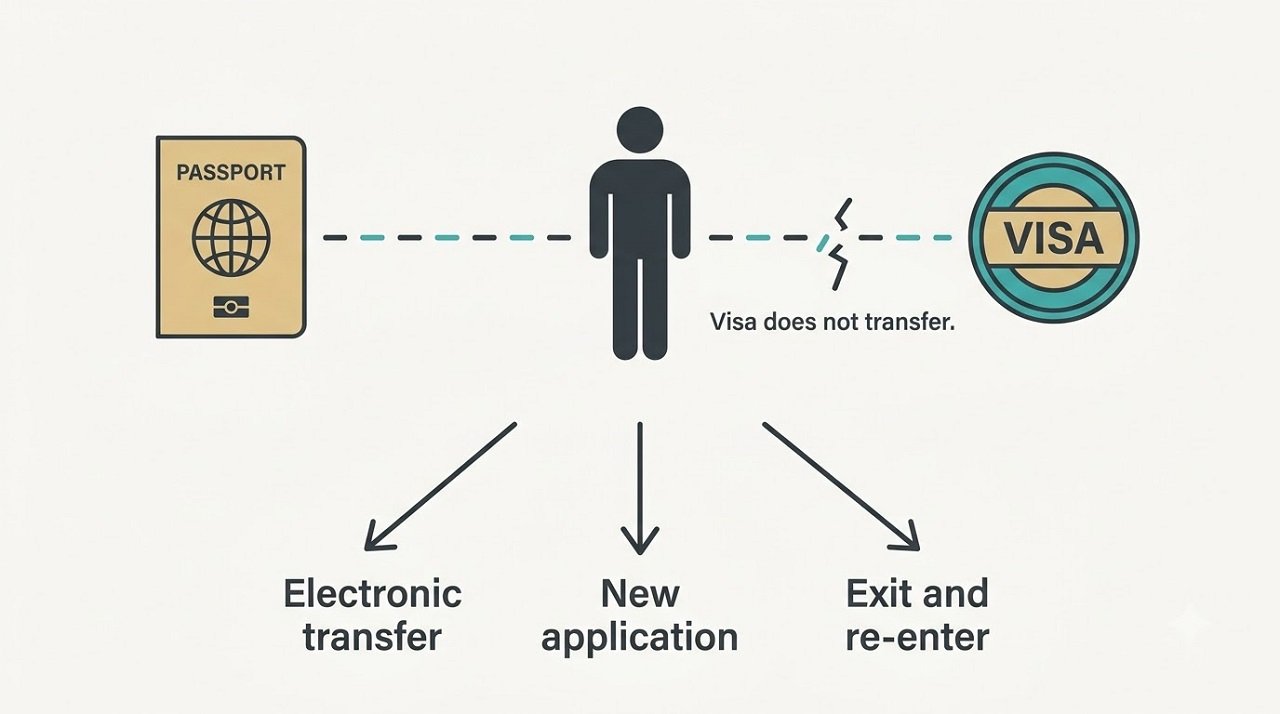
A visa is tied to a specific passport number. When the passport is gone, the visa does not automatically move to the new one .-13
If your lost passport held a valid visa, you now have two problems: a missing passport and a missing permission to be in the country.
What Happens Next Depends on the Country
- Some countries can electronically verify the visa and transfer it to the new passport number .
- Others require a completely new visa application and fee .
- Some simply need the new passport number to update a digital record .
- A few require you to exit and re-enter to obtain a new visa .
The Critical Question to Ask Early
Before you leave the embassy, ask:
“Will this document allow me to depart this country, and will I need a visa reissue or an exit permit before I can board?”
In some jurisdictions, leaving is not automatic. Travellers may need a visa reissue or a special note from local immigration before boarding a plane on the new document .
Long-Stay and Work Visas
These are more complex and more valuable. Expect to contact the immigration authority of the country that issued the visa, provide the police report, the new passport, and any original approval documents, and pay a transfer fee. Processing can take several weeks .
For US visas specifically, the issuing embassy or consulate can verify the record and may issue a replacement. The replacement fee is $160 for most categories .
The Practical Takeaway
Ask about the visa before you accept the emergency document. If the answer is “you will need a reissue to leave”, factor that into your timeline — it can add days or weeks .
If your destination has advisory restrictions that affect your ability to stay or move, our guide to reading government travel advisories explains how to check conditions before you make decisions.
Money, Flights, and Accommodation While You Wait
A lost passport usually means a missed flight and an extra hotel night. Both have workarounds.
Flights
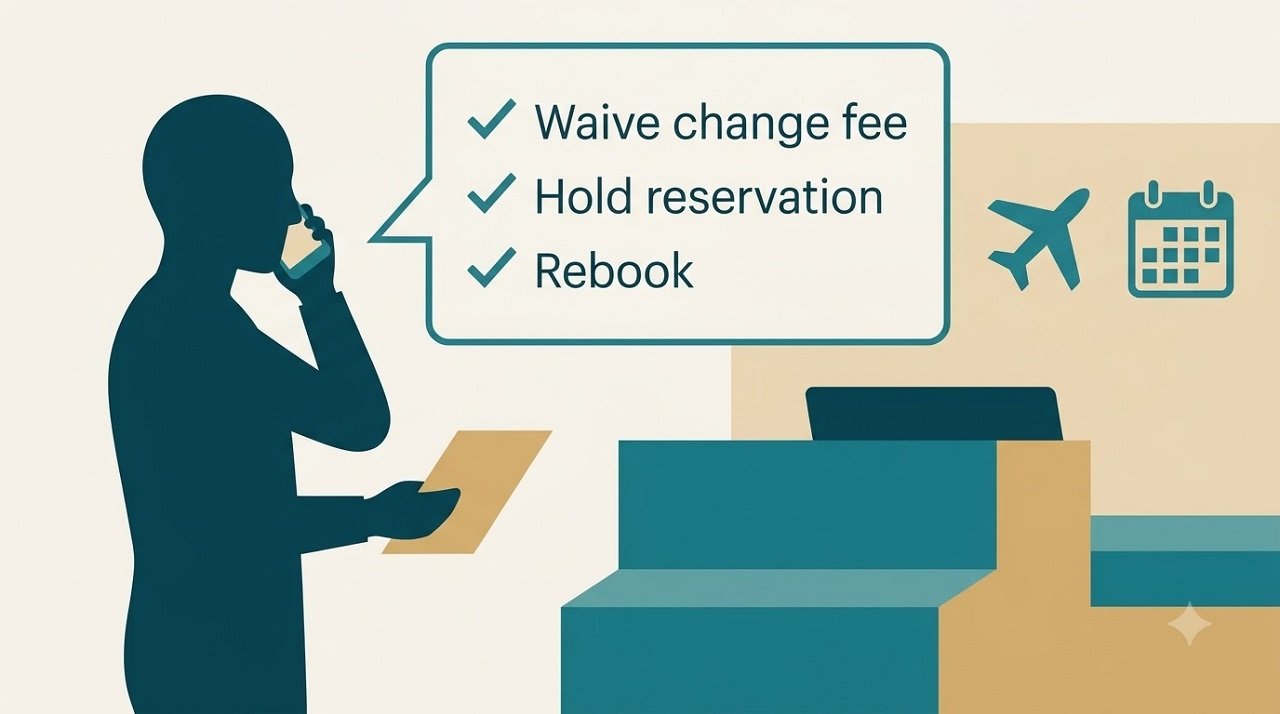
Contact the airline immediately — before the flight, not after. Explain the situation and ask about:
- Waiving change fees due to emergency circumstances (many airlines grant this) .
- Holding the reservation while the passport is replaced .
- Rebooking once the document is issued.
Airlines may ask for the police report, embassy appointment confirmation, or the emergency document once issued . Proactive contact helps more than waiting until after the departure.
Accommodation
Negotiate directly with the hotel. Explain the emergency and ask about:
- A reduced rate for the extension.
- Storing valuables while you are at the embassy.
- Help contacting the embassy or arranging transport .
Most hotels would rather extend a guest at a lower rate than lose the booking entirely.
Money
If your wallet went with the passport, you need cash access before you can pay for anything.
Options, in rough order of speed:
- Money transfer from home via Western Union or MoneyGram — available within hours .
- Travel insurance emergency cash advance — often the fastest option if your policy includes it .-13
- Embassy emergency loan — available for genuine crisis, must be repaid, and only covers minimum necessities .
If you are travelling solo, the solo travel safety guide covers the backup arrangements worth setting up before you leave.
What Travel Insurance Actually Covers
Insurance rarely replaces the full cost of a ruined trip, but it usually covers the specific expenses of document loss.
What Is Typically Covered
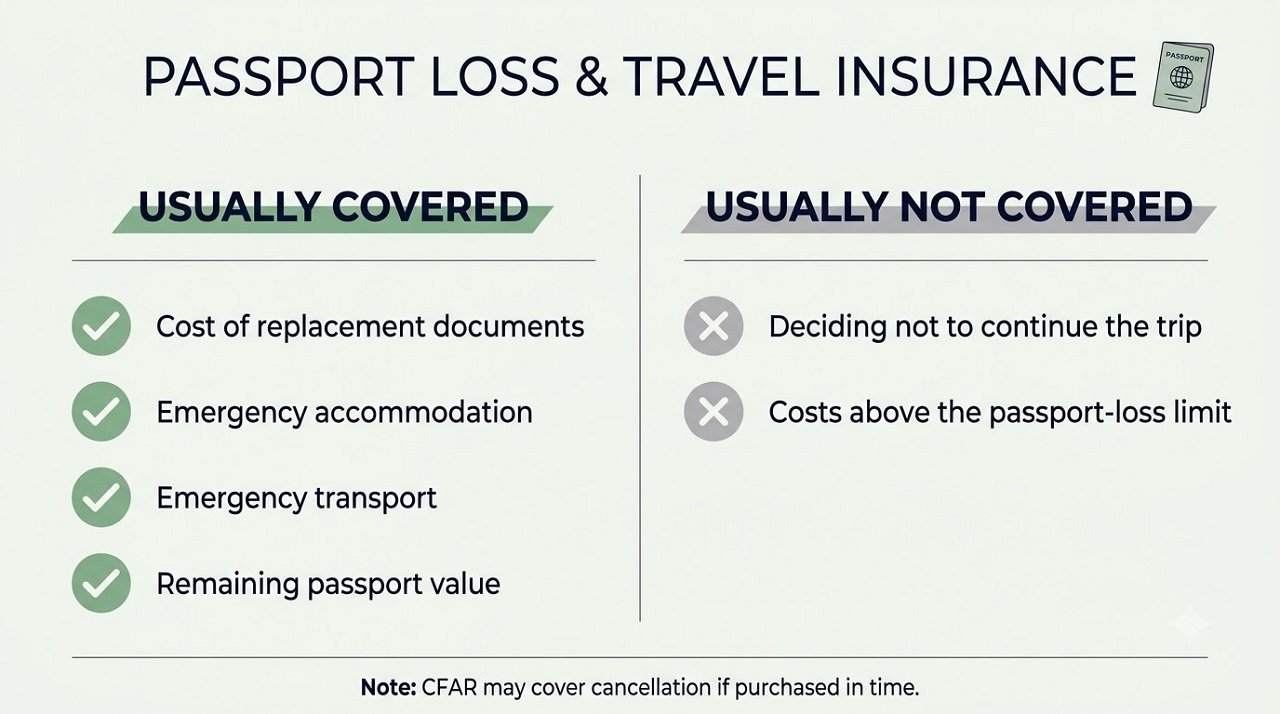
- Cost of obtaining temporary or replacement documents — the fees you pay the embassy .
- A refund of the remaining value of the lost passport — some policies include this .
- Emergency accommodation and transport incurred because of the delay .-4
- Emergency cash assistance in some policies .
What Is Not Covered
- The value of your trip if you simply decide not to continue. Standard cancellation coverage does not pay out because you lost your passport.
- Anything above the policy’s passport-loss limit. These limits are often modest — some UK policies cap loss of passport cover at £300, with an excess of £50 .
The Cancel for Any Reason Exception
If you cannot get a replacement in time and need to cancel the rest of the trip, CFAR coverage may reimburse a portion of prepaid, non-refundable costs — provided you purchased CFAR early enough to qualify .
Without CFAR, a lost passport is generally not a covered cancellation reason.
The One Call Worth Making First
Some insurers operate 24/7 international helplines that can direct you to approved translators, photo services, and sometimes embassy contacts. Call before you start spending money — it may change what you do first.
Our guide to what travel insurance actually covers explains the benefit categories and limits in more detail.
Prevention — The 10 Minutes That Save Days
Almost everything that makes passport loss painful is avoidable with preparation before the trip.
Before You Fly
- Photograph your passport bio page and any visa pages. Store them in cloud storage and email them to yourself .-4
- Leave a copy with someone at home .
- Save your embassy’s address, phone number, and after-hours line in your phone and on paper.
- Note your passport number separately from the passport itself.
- Carry a second photo ID — a driver’s licence that stays in a different bag.
While You Travel
- Use the hotel safe for the passport when you do not need it .
- Carry a photocopy, not the original, on routine days out where ID is not legally required.
- Be careful in crowded transit hubs, where passports are most often misplaced .
- Do not hand your passport to anyone who is not a uniformed official or a legitimate hotel receptionist.
The Backup That Costs Nothing
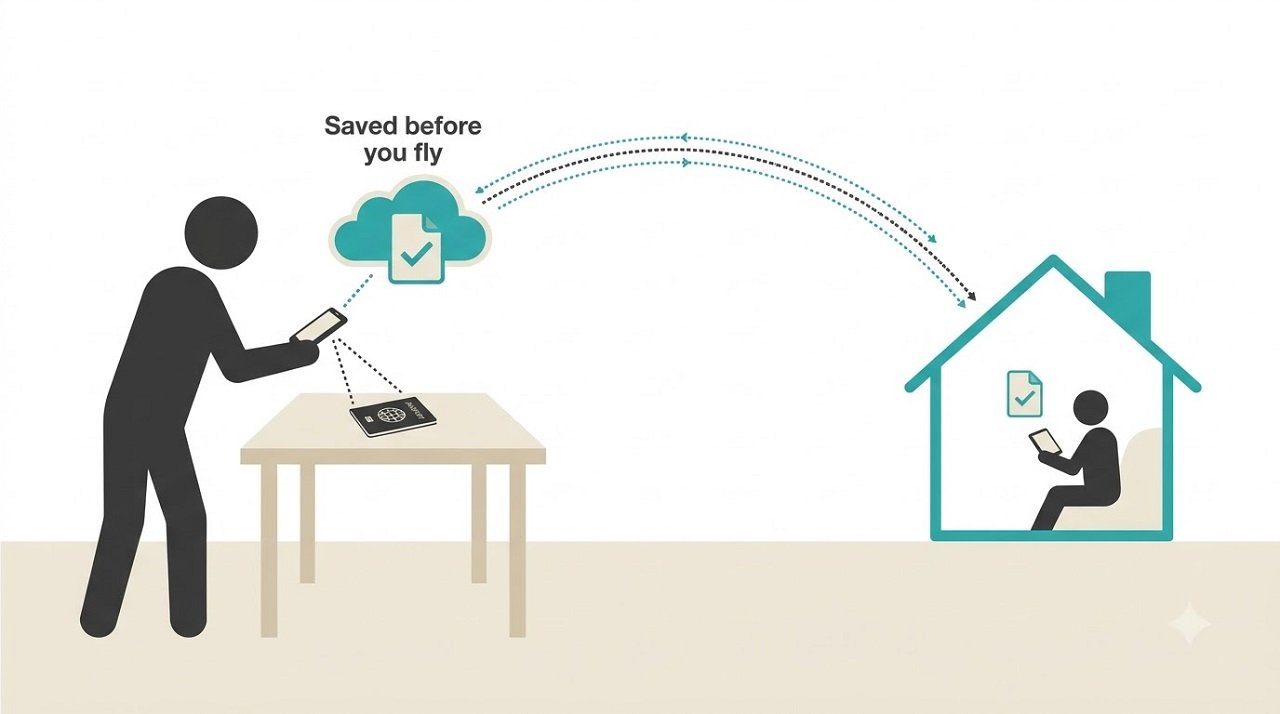
A single photograph of your passport bio page, saved to cloud storage, can cut hours off the embassy process. It gives consular staff your passport number, issue date, and personal details immediately .
Ten seconds of preparation. Potentially two days saved.
If you are building a document pouch for future trips, the carry-on packing guide covers the document backup routine, and our guide to common travel scams covers the theft scenarios that most often lead to passport loss.
Conclusion
Losing a passport abroad is a problem with a procedure. It is stressful, it costs money, and it can derail a trip. But it is not a crisis without an exit.
The sequence is consistent:
- Confirm it is genuinely gone.
- Report it immediately so it is cancelled.
- File a police report and get a copy — even if your country says it is optional.
- Contact your embassy with your itinerary and documents in hand.
- Ask the visa question before you accept any document.
- Call your insurer before you start spending.
- Contact your airline early rather than after the flight.
And do the one thing that makes all of this faster: photograph your passport before you fly.
If you remember one rule, make it this: the passport is replaceable. The visa in it is the harder problem. Ask about both at the embassy, in that order.
If you are planning a longer trip and want to understand the documents and insurance you need before departure, our guide to essential travel tips for novice explorers covers the full preparation sequence.
Frequently Asked Questions
What is the first thing to do if you lose your passport abroad?
Retrace your steps to confirm it is genuinely missing, then report it immediately so it is cancelled, and file a police report. Contact your embassy or consulate the same day. If it was stolen, freeze any cards that were taken with it.
How long does it take to get an emergency passport?
Emergency travel documents are typically issued within 24–48 hours when documentation is complete. UK Emergency Travel Documents can usually be collected after two working days. Full replacement passports usually take 7–21 days, and up to six weeks in some cases.
Do I need a police report for a lost passport?
Requirements vary. The US State Department says police reports are not mandatory but can help. Many other countries require an official report before processing a replacement. Treat it as required — the cost of not having one can be days of delay.
Can I travel with an emergency travel document?
Usually only for the journey it was issued for — often a single or return trip home. It generally cannot be used for onward travel to countries that require a visa. Check the validity and permitted countries before you book anything.
Does travel insurance cover a lost passport?
Many policies cover the cost of obtaining replacement documents, emergency accommodation and transport caused by the delay, and sometimes a refund of the remaining validity of the lost passport. Limits are often modest. Standard cancellation coverage does not pay out simply because you lost your passport — only CFAR may.
What happens to the visas in my lost passport?
Visas do not transfer automatically. You must contact the embassy or immigration authority of the country that issued the visa to request a transfer or reissue. Some countries can update records electronically; others require a full new application. Ask about departure permission before you leave the embassy.
Sources
- US Department of State. Lost or Stolen Passport Abroad. Report online, passport cancelled within 1 business day; police report not mandatory but helpful; required documents; DS-11 and DS-64; emergency passport valid up to 1 year; replacement fees generally match standard passport fees. https://travel.state.gov/en/international-travel/help-abroad/lost-stolen-passport.html
- Australian Passport Office. Blue whales, emergency passports and 16 million Australians. Published September 28, 2026. More than 4,200 Australian passports reported lost or stolen overseas in 2025–26; 8,900 emergency travel documents issued. https://www.passports.gov.au/news/blue-whales-emergency-passports-and-16-million-australians
- Co-operative Group via PublicNow. Travel troubles: Rise in the number of lost or stolen passports. Passport Office reported almost 370,000 UK passports lost or stolen in 2025, a 62% increase on 2024. https://ebs.publicnow.com
- DMC Quote. Lost Passport Procedures: How to Help Stranded Clients Abroad. Published December 5, 2025. Emergency travel document vs full replacement; processing times; country-specific procedures for US, UK, Canadian, Australian, and EU citizens; visa reissue; airline and hotel handling; emergency cash options. https://dmcquote.com/blog/post/lost-passport-procedures-stranded-clients
- VisaVerge. Lost Passport Abroad? Essential Steps and Replacement Timelines. Published September 25, 2025. Emergency documents 24–48 hours; full replacement days to two weeks; police report often required; visa reissue adds days or weeks; preparation checklist. https://www.visaverge.com/passport/lost-passport-abroad-essential-steps-and-replacement-timelines/
- GOV.UK. British Deputy High Commission Chennai and British Consulate General Sydney — Get an emergency travel document. Published September 2026. ETD eligibility when passport is lost, stolen, damaged, or expired and a replacement cannot be obtained in time. https://www.gov.uk/emergency-travel-document
- Daily Express. Brits going on holiday warned of extra £125 fee. Published April 27, 2026. FCDO warning: UK ETD costs £125, usually collected after two working days; valid for a single or return journey; must need to travel within six weeks; plans may change and require reapplication. https://www.express.co.uk/travel/articles/2198848/brits-going-holiday-warned-extra
- Chronicle Live. UK passport holders risk £125 charge on holiday as travellers issued warning. Published March 14, 2026. ETD valid for a single or return journey; travel must be within six weeks. https://www.chroniclelive.co.uk
- News18. Lost Your Passport While Travelling? Here’s Exactly What To Do Next. Published July 26, 2026. Confirm loss, file police report, contact embassy, two options (replacement vs emergency certificate), no duplicate passports issued, visa reissue, notify airline and insurer. https://www.news18.com/amp/photogallery/lifestyle/travel/lost-your-passport-while-travelling-heres-exactly-what-to-do-next-ws-e-10234303.html
- Times Now News. Lost or Stolen Passport While Traveling? Here’s How to Replace It Fast. Published September 8, 2025. Replacement passport minimum one week; emergency certificate for return or onward travel; documents required including Annexure F for Indian applicants. https://www.timesnownews.com/travel/news/lost-or-stolen-passport-while-traveling-heres-how-to-replace-it-fast-article-106641705
- Embassy of India, Reykjavik. Lost Passport. Published March 25, 2026. Requires online application, original police report with notarised English translation attested by the local foreign ministry. https://indianembassyreykjavik.gov.in
- Squaremouth. Does Travel Insurance Cover a Delayed Passport? Published September 3, 2026. CFAR may reimburse prepaid non-refundable costs for missing passports if purchased in time. https://www.squaremouth.com/travel-advice/does-travel-insurance-cover-a-delayed-passport
- Allianz Assistance. Travel Insurance — Loss of passport. Covers costs to obtain temporary documents plus refund of the remaining value of the lost passport. https://www.allianz-assistance.co.uk
- Freedom Travel Insurance. Policy summary — Section 6: Loss of Passport. UK policy example: £300 limit with £50 excess. https://quote.freedominsure.co.uk
- Care Insurance. What to Do if Your Passport is Lost Abroad? Published February 23, 2026. Sequence of steps including police complaint and embassy contact. https://www.careinsurance.com
- eHalal. Emergency passports and emergency travel documents. Published December 26, 2024. ETDs take much less time than full replacements — often just hours — and can be expedited with a copy of the original. https://ehalal.io
- SafeTravel (New Zealand). You have lost your passport or belongings. Published December 15, 2025. Guidance for urgent travel within the next few days. https://www.safetravel.govt.nz