
All prices, plan structures, and survey figures in this guide reflect research verified in 2026. Carrier rates, eSIM vendor prices, and plan terms change frequently and vary by country.
If you are reading this in a later year, treat the decision framework as still correct — the trade-offs between the three options do not change. But check current prices with your carrier and your chosen vendor before you buy.
This guide is general information, not a recommendation of any specific provider. No vendor has paid for inclusion.
All sources used in this guide are listed at the end.
Introduction
Most advice about using your phone abroad is one sentence long: get an eSIM, it’s cheaper.
That advice is usually right on price and almost always wrong on detail. It skips the three questions that actually determine whether your trip goes smoothly: does your phone support it, will it work in every country on your route, and what happens when it fails?
The data shows the gap between expectation and reality is wide. In a 2026 survey, 86.7% of travellers reported at least one frustration with mobile internet abroad. Slow or unreliable access affected 57.1%. Nearly half — 46.6% — had been hit by unexpected roaming charges, and 46.3% lost coverage when moving between countries.-10
Almost all of them knew about roaming charges beforehand: 91.6% said they were at least somewhat aware, and 57.5% said they were very aware. Awareness is not the problem. Choosing the right tool for the specific trip is.-10
This guide breaks down the three real options — travel eSIM, carrier roaming, and a local SIM — with current pricing, coverage behaviour, and the failure modes nobody warns you about. It ends with a decision framework you can apply in about five minutes.
If you are building a trip budget, connectivity is a line item worth planning rather than discovering. Our trip budgeting method shows where it fits. If you are travelling alone and rely on your phone for safety, the solo travel safety guide covers the backup arrangements worth having.
Understand What an eSIM Actually Is
An eSIM is a chip soldered into your phone. Instead of swapping a plastic card, you download a profile from a provider and activate it digitally.
That is the whole concept. Two practical consequences follow.
You Keep Your Home Number Active
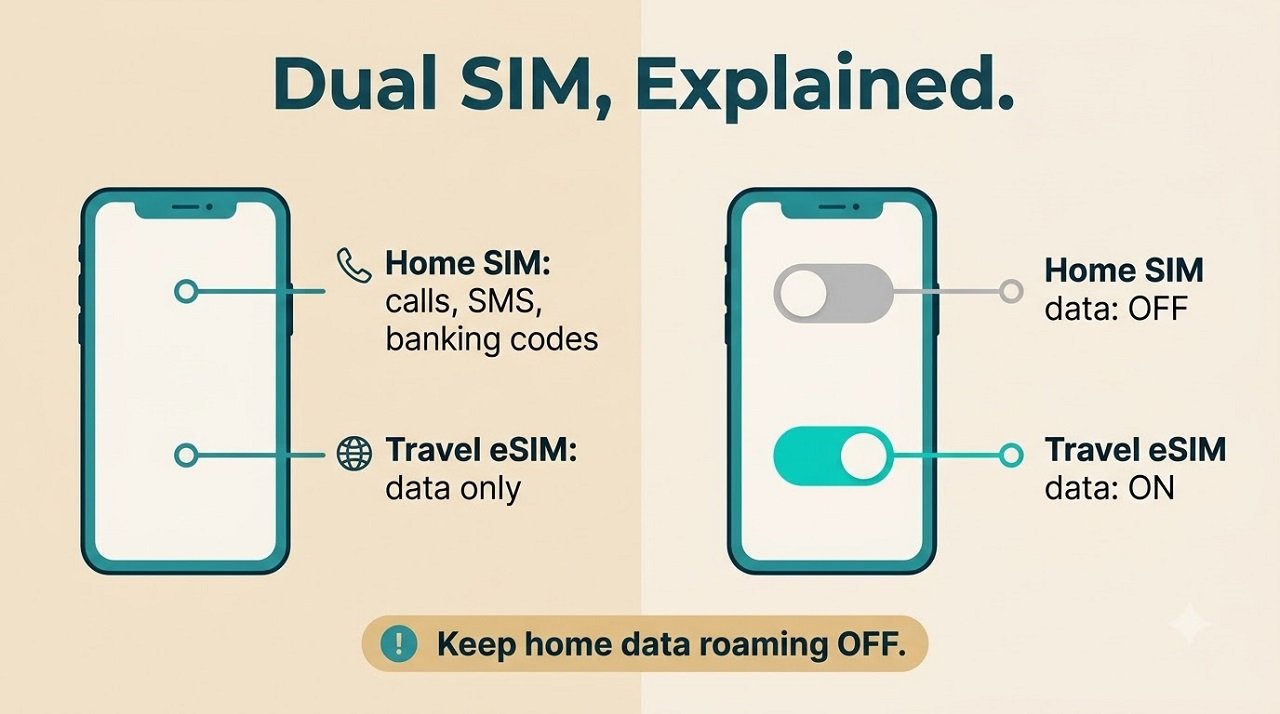
Most modern phones support dual SIM — one physical SIM and one eSIM, or two eSIMs. That means you can run your travel data on the eSIM while keeping your home number active for banking verification codes and two-factor authentication.
This is the feature most people undervalue. Turning off your home line entirely to save money can lock you out of your own bank.
Your Phone Must Be Compatible and Unlocked
Two checks before you buy anything:
- Is your phone eSIM-capable? Most flagship phones since roughly 2018–2020 are, but not all mid-range and budget models are.
- Is your phone carrier-unlocked? A phone locked to your home network will not accept a foreign eSIM profile.
Check both in your phone settings or with your carrier before you spend money on a plan you cannot install.
What an eSIM Is Not
An eSIM is not a magic local connection. Most travel eSIM traffic is technically roaming, routed through wholesale aggregators — the same basic architecture as traditional roaming.
Opensignal’s analysis is direct on this: the quality ceiling is set by the aggregator’s geographic footprint, not by the brand on the eSIM.-2
That single fact explains most of the complaints in Step 4.
Compare the Three Options Honestly
There is no universal winner. Each option solves a different problem.
Option A: Travel eSIM
How it works: Buy a data-only plan before you fly, install it, activate on arrival. No phone number, usually no calls or texts — data only.
Current adoption: In 2026, 31.1% of travellers intended to use an eSIM for summer trips, up 9.1 percentage points from 2025. In Spain, eSIM reached 38.7% of trips abroad, overtaking roaming (32.6%) and local SIM (22.4%) for the first time.-1-3
Strengths:
- Buy and install before departure, so you arrive connected
- Predictable cost — you pay upfront for a fixed bundle
- One plan can cover multiple countries on a regional package
- No queue at a SIM shop
Weaknesses:
- Data only — no local number for calls or local SMS
- Quality depends on the provider’s wholesale agreements
- Coverage can drop when you cross into a country outside the plan’s footprint
- Setup complexity is a real complaint (28.9% of travellers)-10
Option B: Carrier Roaming
How it works: Use your existing plan abroad, either pay-as-you-go or by buying a day pass or add-on from your home carrier.
Where it wins: Inside regulated zones. In the EU, “Roam Like at Home” means your domestic plan works across member states at domestic prices. That is why roaming still holds 40.9% of European trips within Europe.-3
Strengths:
- Zero setup — it works when you land
- Keeps your number, calls, and texts
- Best option inside the EU and similar reciprocal zones
- Day passes are simple to understand
Weaknesses:
- Expensive outside regulated zones
- Day passes sell days, not data — a light user massively overpays
- Bill shock is a documented consumer problem
Option C: Local SIM
How it works: Buy a physical SIM from a local carrier on arrival.
Strengths:
- Often the cheapest per gigabyte for long stays
- Gives you a local number, useful for local calls and deliveries
- Strong local network coverage
Weaknesses:
- Requires finding a shop, ID registration in many countries, and setup time
- You lose your home number unless you have dual SIM
- Useless for short trips — the time cost exceeds the saving
The Side-by-Side
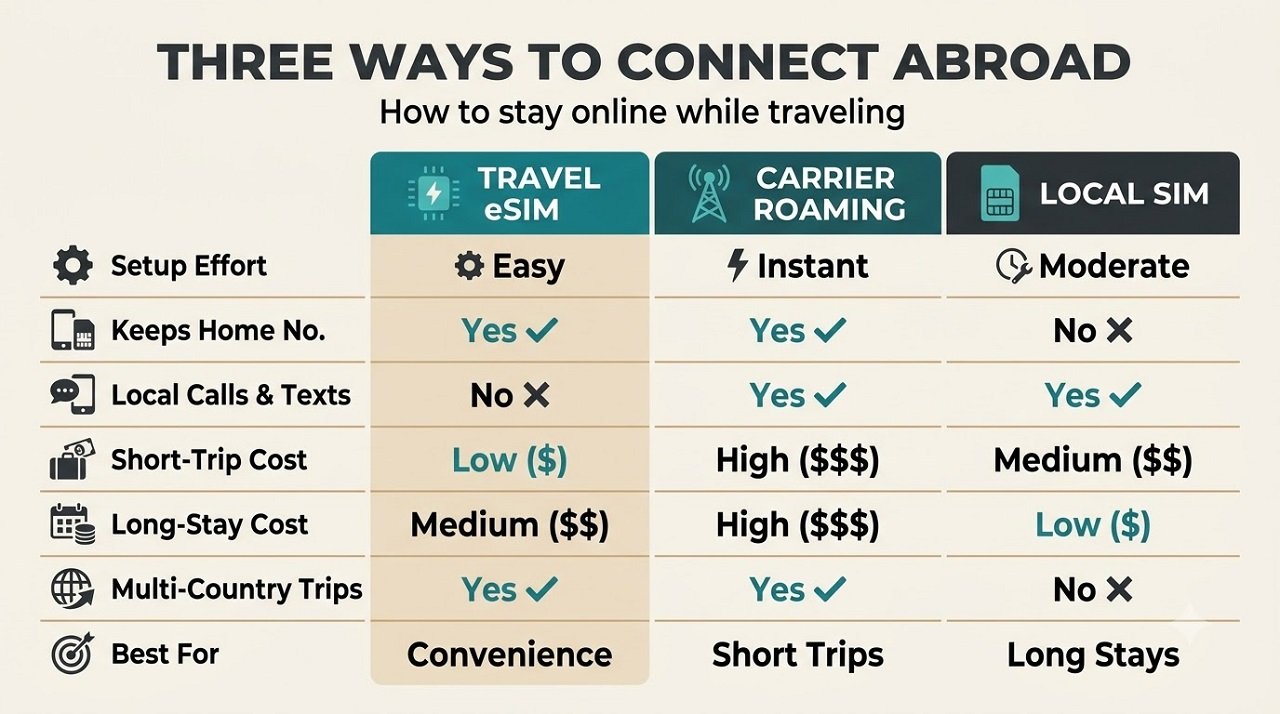
| Travel eSIM | Carrier Roaming | Local SIM | |
|---|---|---|---|
| Setup effort | Low (before you fly) | None | High |
| Keeps home number | Yes (dual SIM) | Yes | Usually no |
| Local calls/texts | No | Yes | Yes |
| Cost for a short trip | Low | High outside EU | Medium |
| Cost for a long stay | Medium | Very high | Lowest |
| Multi-country trips | Strong (regional plans) | Varies | Poor |
| Best for | Most international trips | EU/reciprocal zones | Long stays, one country |
Do the Cost Maths Properly
The pricing structures are not comparable. That is the whole problem.
Day Passes Sell Days. eSIMs Sell Gigabytes.
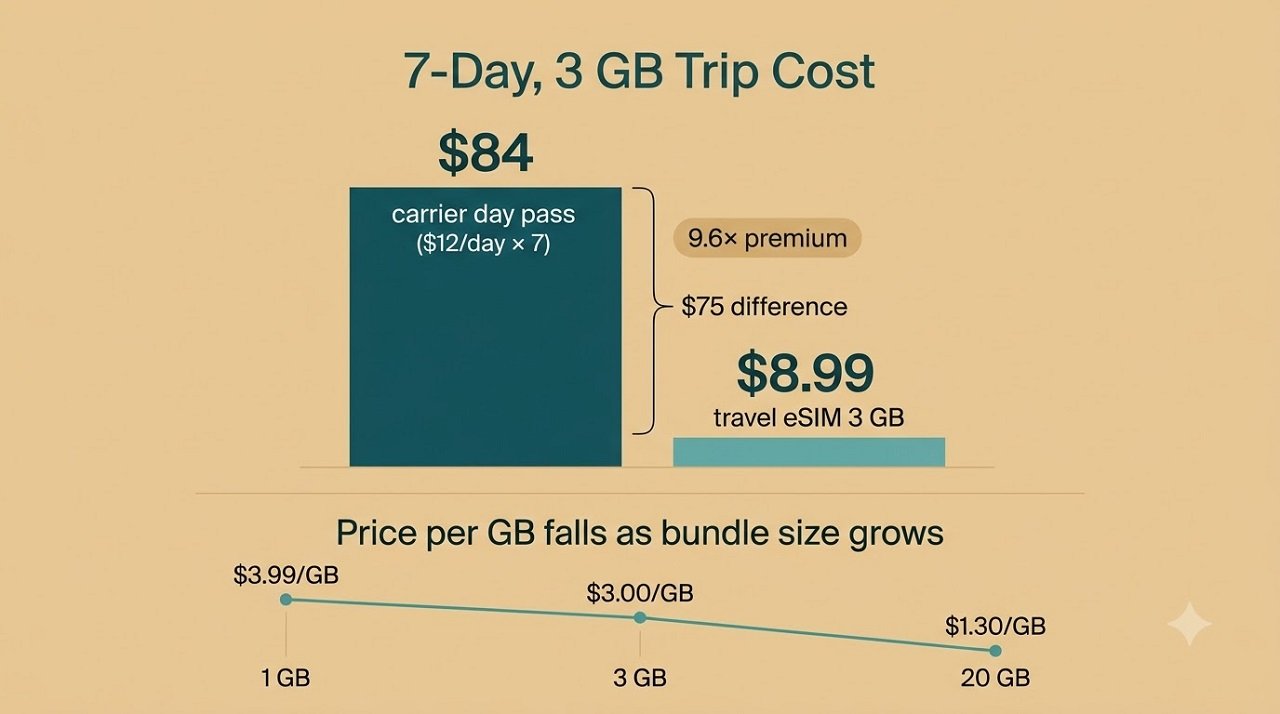
A US carrier day pass costs $12 per day**. Over seven days, that is **$84. It includes a large daily data allowance — Verizon’s TravelPass gives 5 GB per day at high speed before throttling.
A traveller using 3 GB across an entire week pays $84 for a resource they consumed once.
A published travel eSIM plan for the same 3 GB costs $8.99.-14
That is a gap of $75, and a premium ratio of roughly 9.6 times.
The Per-Gigabyte Curve
eSIM pricing follows a consistent shape: the entry gigabyte is expensive, and the price per gigabyte falls sharply as the bundle grows.
| Plan | Data | Price (USD) | Per GB |
|---|---|---|---|
| Entry plan (France/Italy/US) | 1 GB | $3.99 | $3.99 |
| Mid plan (multi-country) | 3 GB | $8.99 | $3.00 |
| Japan | 3 GB | $8.50 | $2.83 |
| Japan | 20 GB | $26.00 | $1.30 |
Source: vendor published prices, September 2026.-14
The 1 GB plan is not a trip plan. It is a trial size. If you buy it and run out on day three, you will pay more in irritation — and often in top-up pricing — than the few dollars you saved.
Practical rule: buy one tier above what you think you need.
The Carrier Price Gap Is Enormous
The same destination can cost wildly different amounts depending on your provider.
A 2026 analysis of the UK’s four largest networks found a pricing gap of up to 1,714% for the same destination. In South Korea, one provider charged £120 per GB while another charged £7.-11
Average per-GB roaming costs by destination:
| Destination | Average per GB |
|---|---|
| South Korea | £53.63 |
| UAE | £39.63 |
| Japan, Thailand, Turkey, South Africa, Singapore, China, India | £11.88 |
| USA | £5.75 |
| EU | £2.20 |
Source: Good Business Travel analysis of UK networks, 2026.-11
If you are on a plan without an add-on, pay-as-you-go rates in some corridors reach $15 per megabyte** — not per gigabyte. At that rate, loading a single Google Maps route (~3 MB) costs **$45.-16
The Bill Shock Is Real
UK survey data of 2,000 adults found:
- 34% had been charged unexpected roaming fees.
- 22% of those paid £50 or more extra from a single trip.
- 1.5 million travellers faced bills over £100.
- 48% said the surprise cost negatively affected their holiday.
- 40% switched mobile data off entirely to avoid it.
- 30% felt disconnected from friends and family as a result.
Source: iD Mobile / OnePoll, 2026.-15
In the US, the FCC has found international roaming bill shock remains one of the top three mobile-billing complaints, with an average disputed bill exceeding $485.-16
Where the Money Lands
Kaleido Intelligence data shows the market has already responded: average travel eSIM spend per trip rose 133% year on year to around $28**, while roaming spend per trip **fell 9% to $42.
The gap is closing, but roaming is still the more expensive route on average outside regulated zones.
If airfare and data both sit in your budget, the cheap flights guide covers where the real savings are.
The Problem Nobody Warns You About
This is the part missing from almost every eSIM article.
Coverage Drops Between Countries
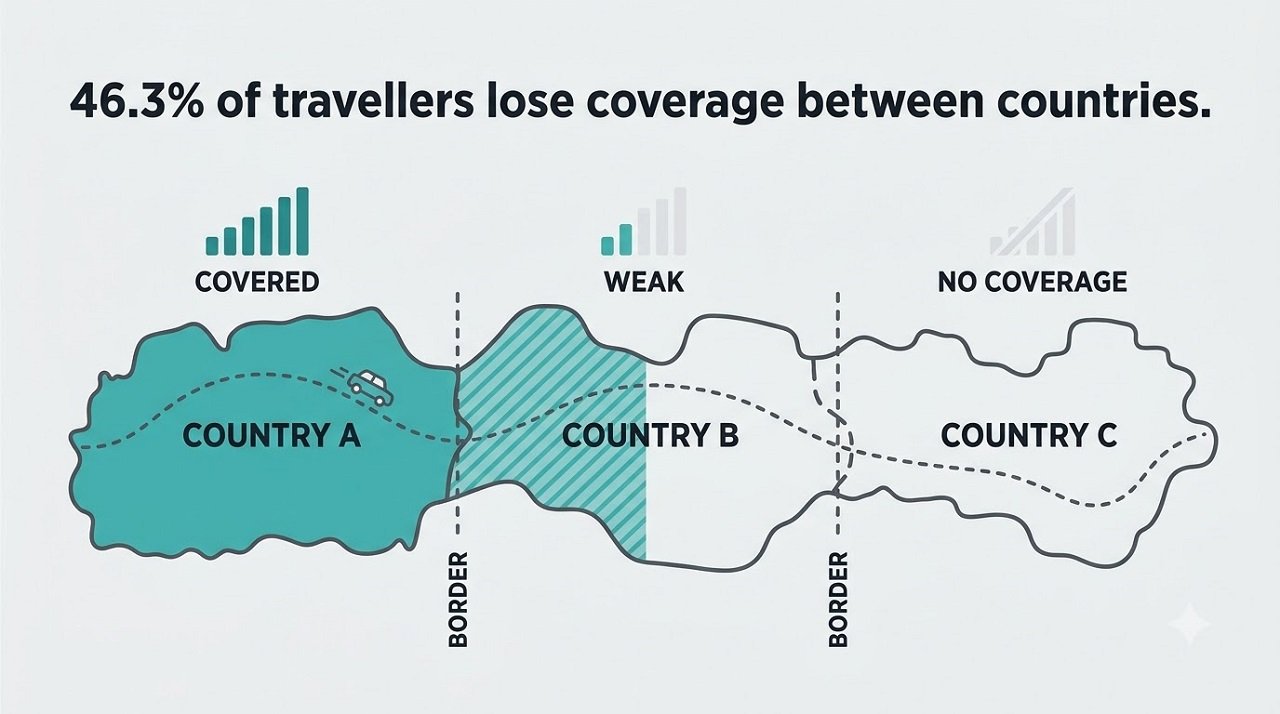
46.3% of travellers report losing coverage when moving between countries.-10
The reason is structural. A travel eSIM is often a regional plan built on a wholesale aggregator’s footprint. When you cross a border, your device may need to renegotiate a local network — and if the aggregator does not have a strong agreement in that country, you get weak signal, slow data, or nothing at all.
This hits multi-country trips hardest. It is also the exact segment where eSIMs are most popular: multi-country travellers are 1.5 times more likely to use one, and long-haul travellers are 2.5 times more likely.-2
Quality Is Not Uniformly Better
The honest picture from network testing:
- For long-haul trips, travel eSIMs outperform roaming on connection quality (a Network Quality Index of 75 versus 70).
- For regional travel, traditional roaming retains an edge.
- On packet loss, travel eSIMs often lag, because they do not control the full routing path.-2
So “eSIM is better” is only true on the routes where it is designed to win.
The Practical Safeguards
- Check the plan’s country list before you buy, not after. A “Europe” plan may exclude the UK, or a “Asia” plan may exclude Japan.
- Prefer regional plans over single-country plans if your itinerary crosses borders — but verify each country is named.
- Keep your home SIM active as a fallback for the first hours in a new country, with data roaming switched off so it costs nothing.
- Screenshot your plan details and provider support contact before you fly. You may not have data when you need them most.
When It Fails, What to Do
- Toggle airplane mode on and off to force a network re-scan.
- Manually select a different local network in your phone settings.
- Check the eSIM is set as the mobile data line, not just installed.
- Contact the provider — most have chat support that works over Wi-Fi.
- Fall back to your home carrier’s day pass for 24 hours if you need connectivity immediately, then resolve it.
If you are dealing with a provider that will not resolve a failed plan, the documentation and escalation approach in our guide to common travel scams applies to chargebacks too.
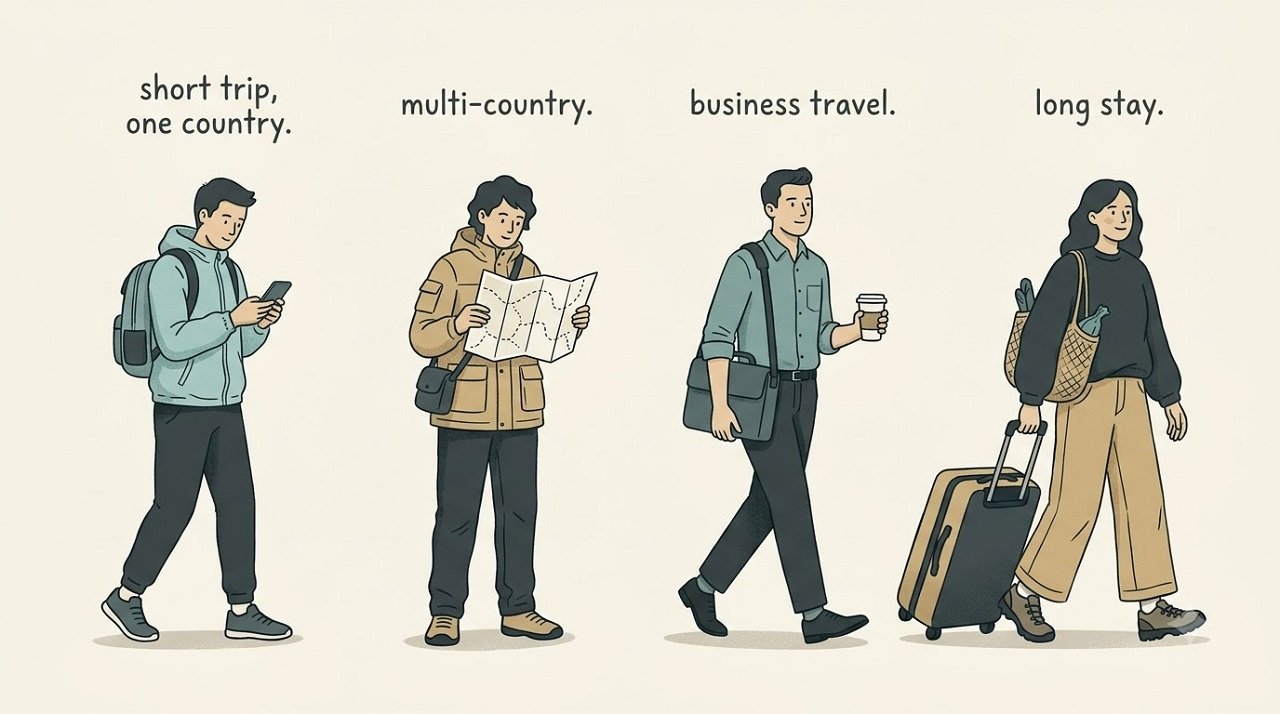
Choose by Trip Type
Stop asking “which is best” and start asking “which fits this trip.”
Short trip, one country, outside the EU
Choose: travel eSIM.
The setup is done before you fly, the cost is predictable, and the day-pass alternative is disproportionately expensive for a light data user.
Multi-country trip
Choose: a regional travel eSIM — with the country list verified.
This is the highest-risk scenario for coverage gaps. Check every country on the plan. Keep your home line active as a fallback.
Travel inside the EU or a reciprocal zone
Choose: carrier roaming.
“Roam Like at Home” means your domestic plan works at domestic prices. There is no reason to buy anything. Roaming holds 40.9% of intra-European trips for exactly this reason.
Long stay, one country
Choose: local SIM, if you need a local number.
For a month or more, the per-gigabyte cost of a local SIM usually wins, and a local number is genuinely useful for deliveries, bookings, and local calls. The setup effort amortises over time.
Business travel
Choose: eSIM if your employer’s policy allows it, but check the expense and security rules first.
Business travellers face the widest provider price spread and often need transparent billing. eSIM spend is fixed and reportable; roaming charges are not.
The Five-Minute Decision Test
- Is my phone eSIM-capable and unlocked? If no, eSIM is off the table.
- Am I staying inside a roam-like-home zone? If yes, roam and change nothing.
- Does my itinerary cross borders? If yes, verify each country on the plan.
- How much data will I actually use? Estimate 1–3 GB per week for maps, messaging, and light browsing. Buy one tier above.
- Do I need a local phone number? If yes, local SIM or a plan with calls.
If you are packing and want your documents, charger, and backup plan organised before you fly, the carry-on packing system covers the tech and document routine.
Set Up Before You Fly
The setup is where most problems are actually created.
Before Departure
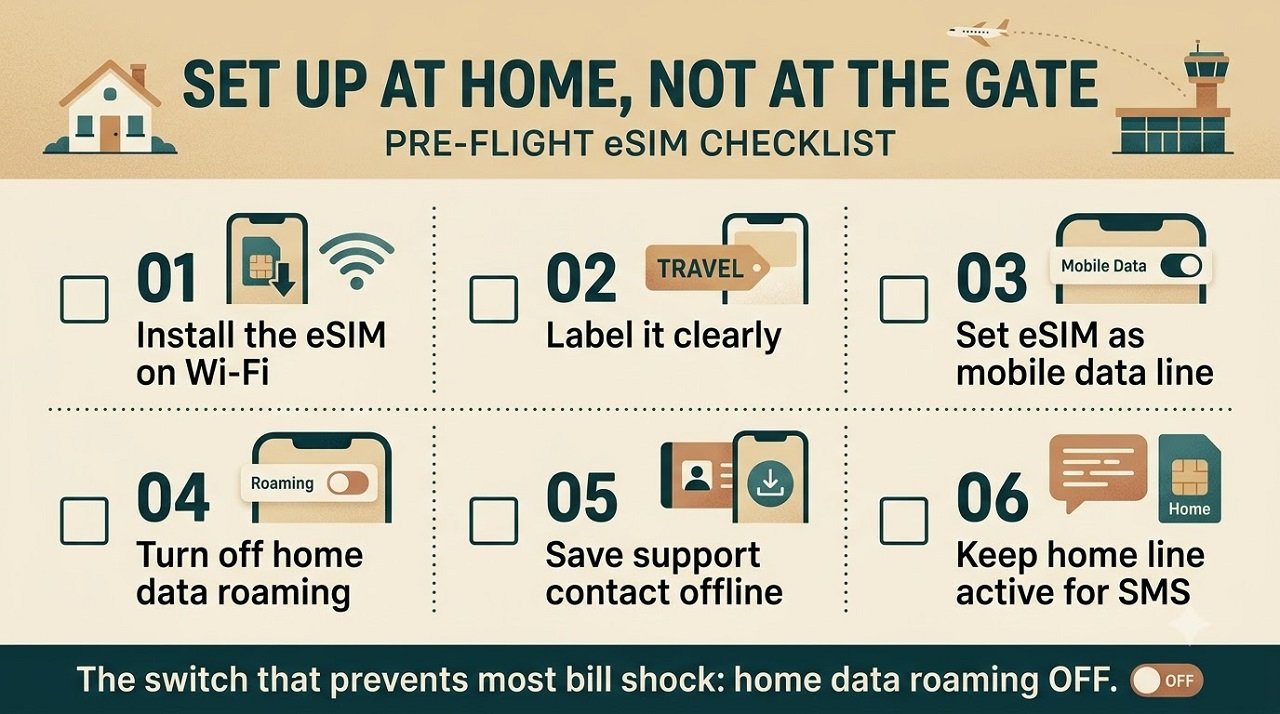
- Install the eSIM at home, on Wi-Fi. Do not leave installation until you land.
- Label it clearly in your phone settings so you do not confuse it with your home line.
- Set your travel eSIM as the mobile data line, and your home SIM as the line for calls and SMS.
- Turn off data roaming on your home SIM. This is the single most important switch. It prevents background data from billing at pay-as-you-go rates.
- Turn on “data roaming” for the eSIM line only if your provider requires it — some do, some do not. Check the instructions.
- Save the provider’s support contact and your plan details offline.
On Arrival
- Wait for the eSIM to register on a local network. This can take a few minutes.
- Test with a simple load — open a map, send a message.
- If it fails, toggle airplane mode before assuming the plan is broken.
What to Keep Switched Off
- Home line data roaming. Always off.
- Automatic app updates over mobile data.
- Background photo and video backup until you are on Wi-Fi.
These three settings account for most unexpected data consumption.
If you are travelling to a destination where you have checked the safety situation and want a backup communication plan, the guide to reading government travel advisories covers what to prepare.
Conclusion
The phone-abroad decision is not complicated once you separate the three options properly.
- Roaming wins inside regulated zones and for zero-setup convenience.
- A local SIM wins for long stays in one country where you need a local number.
- A travel eSIM wins for most other international trips — provided you check compatibility, verify the country list, and buy one tier above your estimate.
The data shows the market is moving fast. eSIM adoption has overtaken roaming in several major markets, and roaming spend per trip is falling. But 86.7% of travellers still report connectivity frustrations, and 46.3% lose coverage between countries.
The technology is not the problem. The problem is buying the wrong plan for the trip.
If you remember one rule, make it this: check the country list, not just the price. A cheap plan that drops coverage at the border is not cheap.
Frequently Asked Questions
Is an eSIM cheaper than roaming?
Outside regulated zones, usually yes. A seven-day, 3 GB trip costs about $84 on a US carrier day pass and about $8.99 on a published travel eSIM plan. Inside the EU, roaming is usually cheaper because “Roam Like at Home” applies your domestic plan at domestic prices.
What is the best way to use my phone abroad?
It depends on the trip. Use carrier roaming inside the EU and similar zones. Use a travel eSIM for most other international trips, especially multi-country ones. Use a local SIM for long stays in one country where you need a local number.
Why does my eSIM lose coverage between countries?
Most travel eSIM traffic is technically roaming, routed through wholesale aggregators. When you cross a border, your device must renegotiate a local network. If the aggregator lacks a strong agreement in that country, coverage weakens or drops. Around 46% of travellers report this problem.
Do I need a local SIM or an eSIM?
You need a local SIM if you require a local phone number for calls, deliveries, or bookings, or if you are staying a month or more. An eSIM is better for shorter trips, multi-country itineraries, and anyone who wants connectivity set up before landing.
Will my eSIM work in every country on my trip?
Not automatically. Check the plan’s country list before you buy. A “Europe” plan may exclude the UK; an “Asia” plan may exclude Japan. Verify each country by name, and keep your home line active as a fallback.
Can I keep my home number while using an eSIM?
Yes, if your phone supports dual SIM. Run your travel data on the eSIM and keep your home SIM active for calls, SMS, and banking verification codes — with data roaming switched off on the home line to avoid charges.
Sources
- Telco Magazine. Holafly: The Rapid Rise of Travel eSIMs. 31.1% of travellers intended to use an eSIM in summer 2026, up 9.1 percentage points; local SIM at 22.4%. https://telcomagazine.com
- Europa Press. El uso de la eSIM en viajes al extranjero se dispara y ya supera al roaming. 38.7% eSIM share, 32.6% roaming, 22.4% local SIM; intra-Europe roaming at 40.9%. https://www.europapress.es
- Opensignal. Travel eSIM Reality Check. Travel eSIM users rose from 1.7% to 3.3% year-on-year; long-haul travellers 2.5× more likely, multi-country 1.5×. https://insights.opensignal.com
- Holafly. Nine in ten travelers still experience connectivity issues abroad. 86.7% report at least one frustration; 46.3% lost coverage between countries. https://esim.holafly.com
- Axis Intelligence. Travel eSIM Statistics 2026. Seven-day 3 GB trip: $84 on US carrier day pass versus $8.99 on travel eSIM; Travel Roaming Premium Index 9.6. https://axis-intelligence.com
- Travel Daily News. Business travellers face roaming charges of up to £120 per day. £120 per GB maximum; 1,714% gap between cheapest and most expensive provider. https://www.traveldailynews.com
- Gloucestershire Live. Third of Brits hit with high phone bills after travelling abroad. 34% charged unexpected roaming fees; 22% paid £50 or more. https://www.gloucestershirelive.co.uk
- Simology. Data Roaming Horror Stories 2026. Pay-as-you-go rates up to $15 per MB in some corridors; average disputed bill over $485. https://simology.io
- Kaleido Intelligence. The State of International Roaming: Traveller Survey. Survey of over 5,000 respondents across 20 markets; average travel eSIM spend per trip up 133% year-on-year. https://kaleidointelligence.com
- GSMA Intelligence. eSIM smartphone penetration at 5% at end-2025, forecast to reach 10% by end-2026. https://www.gsma.com