All rules, permit processes, and country restrictions in this guide reflect guidance published in 2025 and 2026. Drug classifications and import rules change without notice, and they differ by nationality, transit route, and quantity.
If you are reading this in a later year, treat the sequence as still correct — check legality, get documents, pack properly, declare. But confirm your specific medication against the destination’s drug regulator and your embassy before you travel.
This guide is general information, not medical or legal advice. Never stop, switch, or ration a prescribed medicine to satisfy a border rule. Talk to your prescribing clinician first.
All sources used in this guide are listed at the end.
Introduction
Almost half of travellers carry medication. One study of 218 travellers found 47.7% were taking medication for a chronic condition, and a separate survey found 58% took daily medication. This is not a niche problem for people with unusual conditions. It is a mainstream one.
Yet the preparation is routinely skipped.
The Australian Government’s travel insurance survey found that one in five travellers who carried prescription medication did not check whether it was legal at their destination, or whether they needed to carry evidence. Among uninsured travellers, that figure rose to 38%, against 18% of insured travellers.-26
The cost of that gap is not abstract. The CDC’s Yellow Book lists the consequences of carrying a prohibited or restricted medicine as delay in travel, confiscation of the medication, denial of entry, or arrest.-3
And the medicines that trigger this are ordinary. Not exotic. Not recreational. Adderall, Sudafed, codeine cough syrup, melatonin, CBD oil, a sleeping tablet.
This guide covers the full sequence: how to check whether your medicine is legal on every leg of your route, what document actually satisfies a customs officer, how to pack it, whether to declare it, and what happens if it is taken. It also covers the part almost nobody mentions — the fact that travel insurance will not replace your pills.
If you are planning the wider preparation for a trip, our essential travel tips for novice explorers covers the sequence this fits into. If you are travelling solo and managing a condition alone, the solo travel safety guide covers the additional planning that requires.
Step 1: Check the Law in Every Country on Your Route
The Assumption That Gets People Stopped
Most travellers check their destination. Almost nobody checks the country they change planes in.
The CDC advises travellers to check with the destination’s embassy and the embassies of countries where they have layovers. A medicine that is legal in your destination can be illegal in a two-hour transit stop, and transit areas are still subject to local law.-4
Legal at Home Does Not Mean Legal There
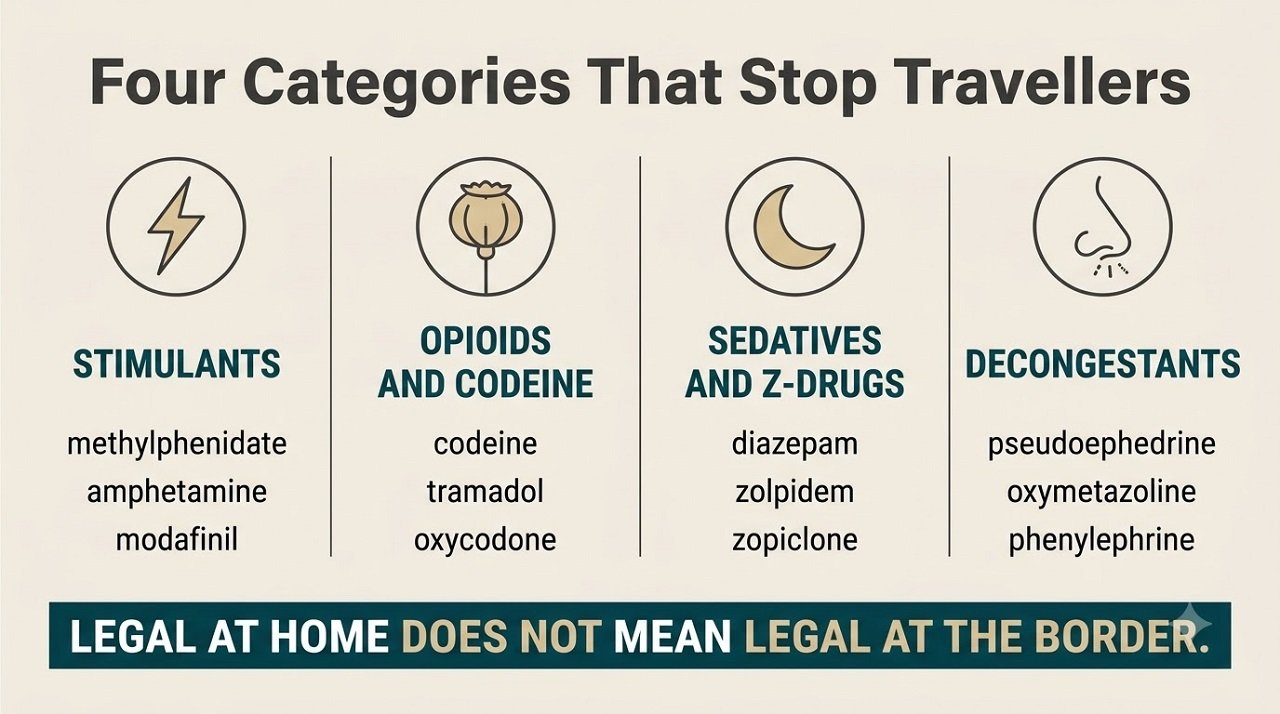
This is the central principle. The CDC is explicit that even if a medicine is not controlled in the United States, it still may be prohibited in another country.-3
Four categories cause most of the problems:
| Category | Common examples | Why it flags |
|---|---|---|
| Stimulants | Adderall, Vyvanse, Ritalin, modafinil | Treated as illegal stimulants in some countries |
| Opioids and codeine | Oxycodone, hydrocodone, tramadol, codeine combinations | Controlled narcotics requiring permits |
| Sedatives and Z-drugs | Diazepam, alprazolam, zolpidem | Psychotropics; permission required in some countries, prohibited in others |
| Decongestants | Pseudoephedrine (Sudafed, Actifed) | Classified as a stimulant precursor in some jurisdictions |
The CDC specifically names hydrocodone, oxycodone, alprazolam, and diazepam as medicines requiring particular caution, and notes that zolpidem — commonly used for jet lag — requires permission in some countries and is prohibited in others.-3
Three Destinations That Enforce Strictly
Japan. Australia’s Smartraveller states that Japan has strict rules covering both imports and medicines carried for personal use, and that dexamphetamine (used for ADHD), pseudoephedrine, and marijuana including medicinal cannabis and CBD oil are banned. Japanese guidance confirms that Adderall, Vyvanse, and Dexedrine cannot be brought in under any circumstances, and that Sudafed and Actifed contain prohibited pseudoephedrine.-11-15
The UAE. Codeine is classified as a controlled narcotic under Federal Decree-Law No. 30 of 2021. Tramadol, codeine, Xanax, and Adderall all require authorisation from the Ministry of Health and Prevention (MOHAP), alongside a valid prescription and original pharmacy packaging. Cannabis, CBD oil, and poppy seeds are banned outright.-51
Singapore. Opioids, benzodiazepines, and codeine-containing medicines face strict controls and generally require pre-approval.-2
How to Actually Check
- Search the destination’s drug regulator, not a blog. Japan’s Ministry of Health, Labour and Welfare, the UAE’s MOHAP or Emirates Drug Establishment portal, and Singapore’s HSA all publish classification guidance.
- Search by generic name, not brand. Brand names differ between countries.
- Check the embassy page for your nationality — some publish medication guidance directly.
- Check every transit country on your booking, including short connections.
- Write down what you found and the date. If a rule is disputed at a border, a dated note helps.
If you are heading somewhere with a fragile security or health situation, the guide to reading government travel advisories covers how to check conditions that affect medical access.
Step 2: Get the Right Document for Your Medication Class
There is no single document that covers everything. What you need depends on how the destination classifies the drug.
For Ordinary Prescriptions
For most medicines — blood pressure, cholesterol, thyroid, asthma inhalers, insulin, antidepressants — the standard bundle is:
- The medicine in its original packaging with the pharmacy label intact.
- A copy of the prescription (paper, or a PDF on your phone).
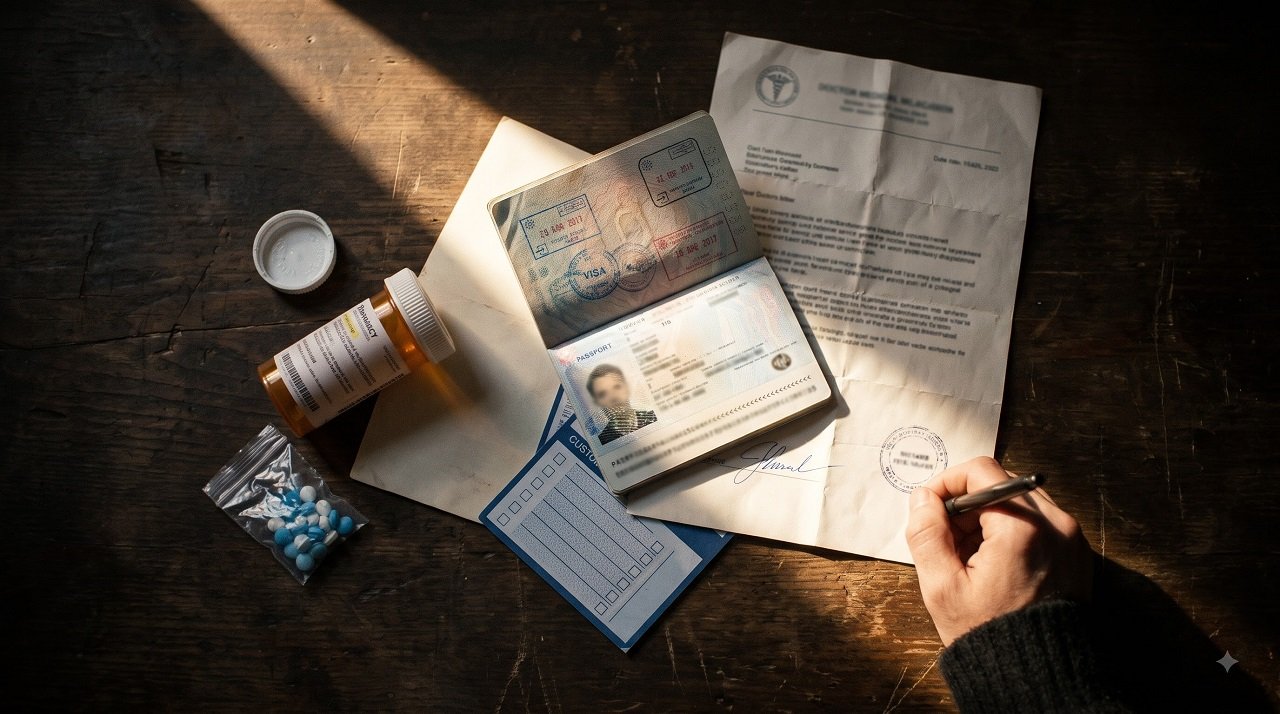
- A doctor’s letter stating the medicine, dose, condition, and your name.
The CDC recommends a letter from a travel medicine specialist or your own physician listing each medication by generic name, dosing specifics, and indication, and publishes a template letter for the purpose.-3
For Controlled Substances
The default bundle is not enough. Controlled medicines generally require a pre-arrival permit or authorisation from the destination’s health authority, and in some cases advance declaration through an online form.-2
Practical examples of what that looks like:
- Japan: the Yunyu Kakunin-sho (import certificate) from the Ministry of Health, Labour and Welfare. Required for psychotropics above the one-month limit and for any quantity of narcotics.-15
- Japan, narcotics: a separate Narcotic Certificate for codeine, morphine, and oxycodone. Without it, authorities may confiscate the medication.-11
- UAE: a MOHAP approval certificate, plus a medical report dated within the last three months, plus the prescription and passport ID page.-51
What the Doctor’s Letter Must Contain
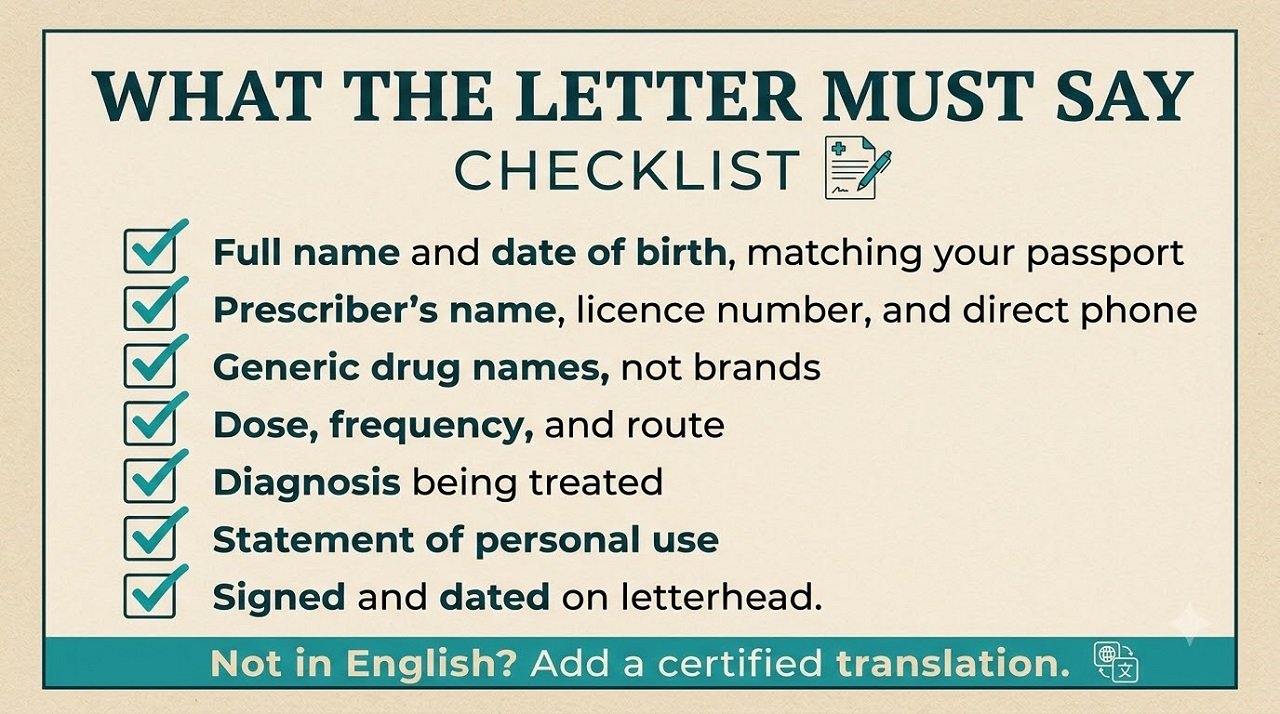
A casual note will not survive scrutiny. The elements that matter:
- Your full name and date of birth, matching your passport exactly.
- The prescriber’s full name, title, licence number, clinic address, and direct phone number.
- The generic name of each medicine — not the brand.
- Dose, frequency, and route of administration.
- The diagnosis or condition being treated.
- A statement that the medicine is for your personal use.
- Signature and date, on official letterhead.
The CDC template follows this structure, and guidance on controlled-substance letters adds that a letter not in English needs a certified translation.-3-22
Timeline Matters More Than You Think
Permits are not issued at the airport.
- Japan: apply for the import certificate at least 14 days ahead, and 2–4 weeks is the safer planning window.-2-15
- UAE: the medical report must be dated within three months of arrival.-51
- Doctor’s letter: reissued annually is generous; every two years is the minimum useful.-2
If you are budgeting the trip, permits and medical certificates are real costs. The trip budgeting method treats pre-trip admin as its own line for exactly this reason.
Step 3: Pack It So It Clears Security
Carry-On Only, Always
Medication belongs in your cabin bag. Not because it is valuable, but because checked baggage can be delayed, misdirected, or lost — and you cannot retrieve a pill from a bag that is in another country.
The CDC notes that medicines required at customs on arrival belong in the cabin, never in checked baggage you cannot reach. Travel insurance analysis is blunt on the same point: medication should never be in a checked bag, and baggage delay benefits are not written for it.-37
Keep It in the Original Packaging
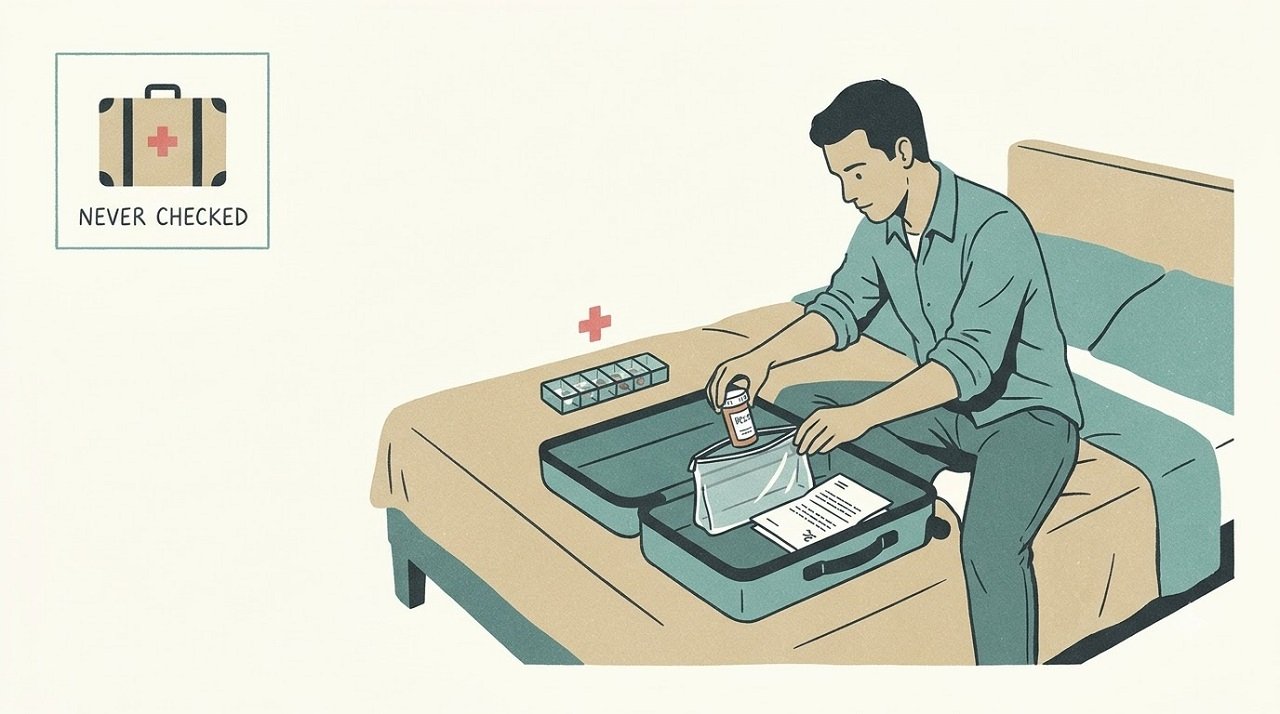
The CDC states that travellers should always keep medications in their original, labelled containers. Customs and Border Protection guidance is that the pharmacy label should match the prescription and the doctor’s letter.-3-22
Pill organisers are risky. They remove the label that proves what the drug is and who it was prescribed to. Some jurisdictions accept them with strong documentation. Most border officers would rather see the bottle.
Get the Quantity Right
| Situation | Practical rule |
|---|---|
| Ordinary prescription | 30–90 days’ supply is widely accepted |
| More than 90 days | Starts to look commercial |
| Long trips | Split the supply; plan a destination pharmacy for the rest |
| Controlled substances (UAE, visitors) | Up to three months with approval |
Sources: Goods Across Borders quantity guidance; UAE MOHAP visitor allowance.-2-51
Carrying six months of tablets for a two-week trip invites questions. Dr Sundar Krishnan, a consultant in internal medicine, puts it directly: if you are travelling for two weeks but carrying six months’ worth, officials may question the purpose — particularly with nervous-system medicines, strong painkillers, or injectables.-4
Liquids, Needles, and Cold Storage
- Medically necessary liquids are exempt from the 100ml cabin rule in the US, UK, EU, Canada, and Australia, but must be declared at screening.
- Insulin pens and vials are routinely allowed in carry-on, and ice packs for diabetics are accepted.-2
- Needles and injectables may attract additional scrutiny. The CDC recommends separating these items for screening and providing a doctor’s note for needle-containing supplies.-3
Split the Supply
If you are travelling with a companion, split the medication between two bags. If you are alone, keep a few days’ supply in a separate bag from the main stock. Losing one bag should not mean losing every dose.
If you are travelling with only a cabin bag, the carry-on packing system covers the liquid and document organisation that makes this workable.
Step 4: Declare It, Do Not Hope
The Default Should Be Declare
If you are carrying a controlled substance, declare it. The CDC lists the downside of being caught with a prohibited or restricted medicine as delay, confiscation, denial of entry, or arrest. There is no upside to silence.-3
For the UAE, guidance is explicit: declare every medication at customs with your approval certificate, prescription, and medical report.-51
Keep the Paperwork Reachable
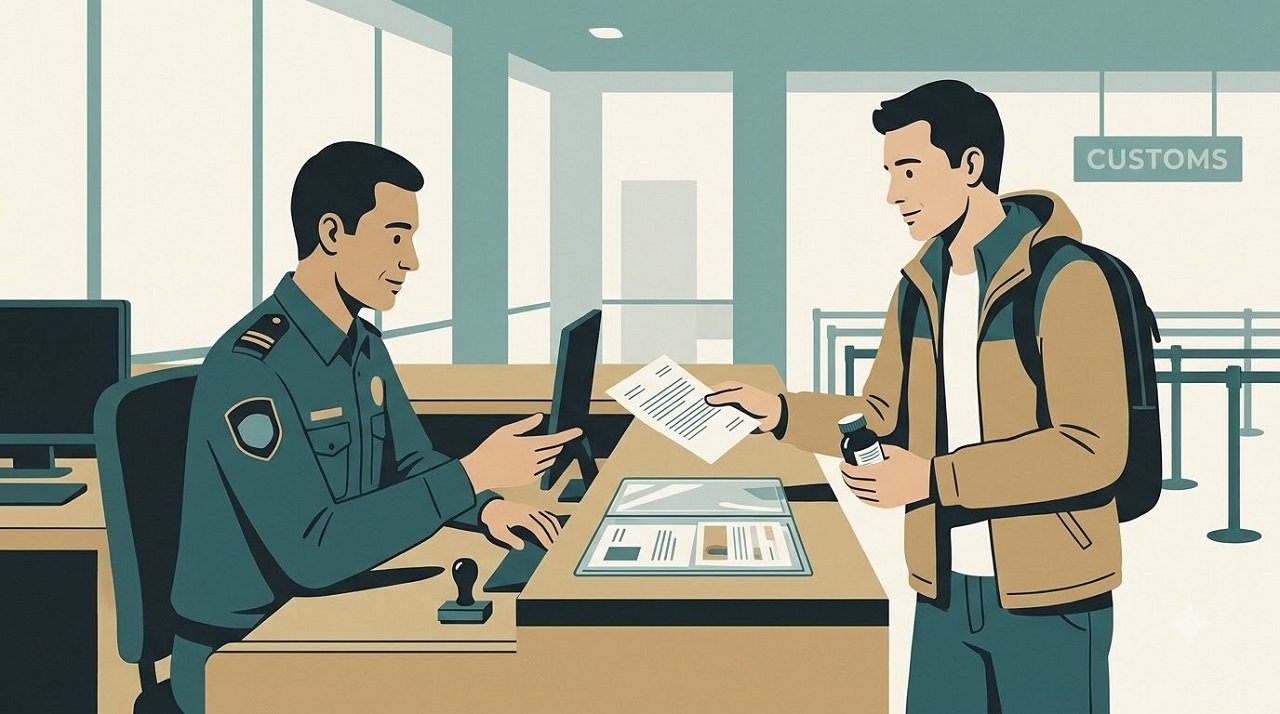
Put the documents where you can produce them without unpacking:
- Doctor’s letter and prescription copy in a plastic sleeve at the top of your bag.
- Permit or certificate printed, plus a photo on your phone.
- A one-page summary listing every medicine, dose, and condition — useful at a border and far more useful in a hospital where nobody speaks your language.
If you are heading somewhere you do not speak the language, our guide to navigating language barriers covers how to prepare written medical information in advance.
If You Are Stopped
- Stay calm and produce the documents.
- Do not argue about whether the rule is reasonable. The officer is applying the law of that country.
- Ask for the medication to be held rather than destroyed, where that is an option.
- Ask for a written record of any seizure, including the medicine name and quantity. You will need it for insurance and for your doctor.
If the interaction turns into a demand for payment, the patterns in our guide to common travel scams cover how to distinguish an official process from an unofficial one.
If It Is Lost, Stolen or Confiscated
What Insurance Actually Does — and Does Not
This is the section most travellers discover too late.
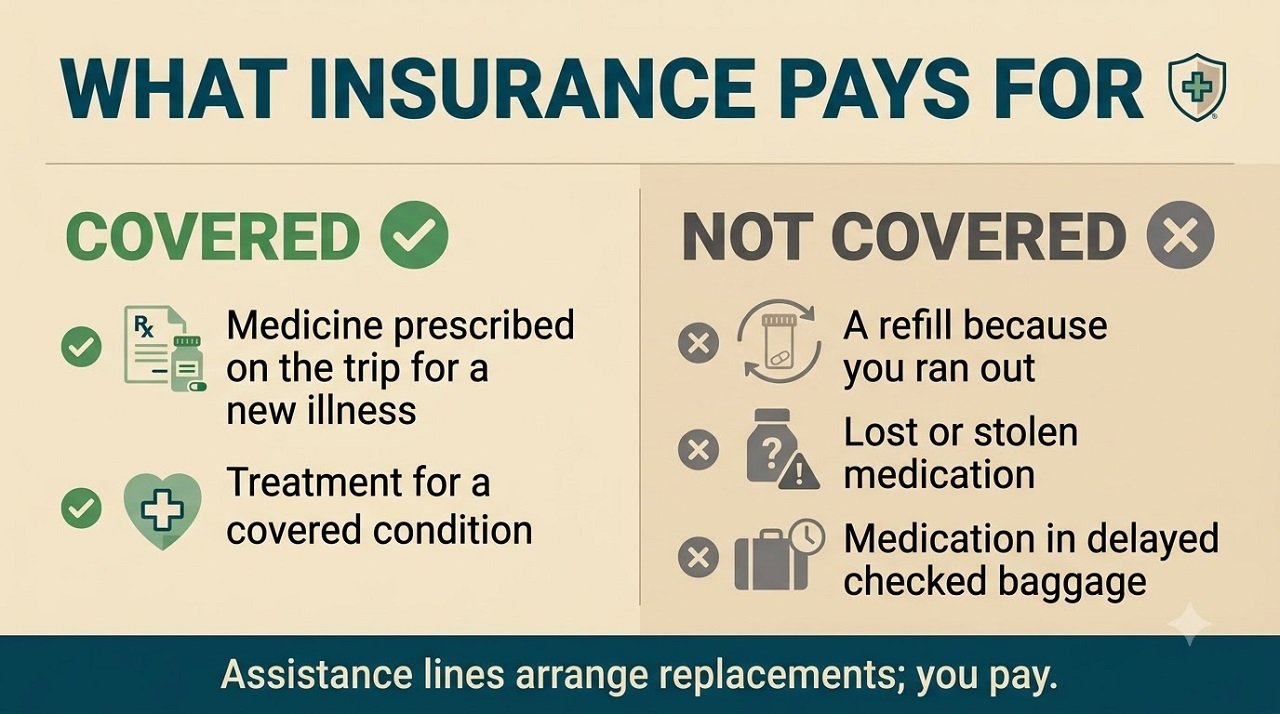
Travel insurance covers prescription drugs in one situation: a doctor on the trip prescribes medicine for a new illness or injury that is itself covered, and the medical benefit pays for it as part of treatment.-37
It does not cover:
- Refills because you are running out. The assistance line will help you find a prescription; the cost is yours.–
- Lost or stolen medication. An analysis of fifteen plans found that all of them excluded prescribed medications from the baggage benefit in explicit terms, and no plan paid to replace them.
- Medication lost in delayed checked baggage. Baggage delay pays for clothing and toiletries, not medication.-37
The assistance line is still worth calling. It can arrange a replacement prescription where local law allows. It just will not pay for it.
There is one piece of good news. A stable daily prescription does not automatically make a condition pre-existing. On most plans, the condition is not pre-existing if it was controlled by the same prescription through the look-back period — with no dose change, no new drug, and no new treatment. Look-back periods are commonly 60 days, 90 on some plans, and up to 180 on others.
Our guide to what travel insurance actually covers explains the benefit categories and limits in more detail.
Replacing a Prescription Abroad
- Contact your insurer’s assistance line first. They can identify a local clinic or pharmacy that will accept a foreign prescription.
- Expect to see a local doctor. Most countries will not fill a foreign prescription directly; you will need a local consultation and a local prescription.
- Bring the generic name, the dose, and the original packaging or a photo of it. This is what a local clinician needs.
- Keep every receipt. If the underlying condition is covered and the treatment is for a new problem, some costs may be claimable.
If your documents were stolen along with the medication, the process overlaps with replacing identification. Our guide to what to do if you lose your passport abroad covers the police report and embassy sequence.
The Pre-Trip Contingency
Three things make a loss survivable:
- A photograph of every prescription and every label, stored in the cloud.
- A few extra days of medication, within reasonable limits, in case of travel delay. Guidance for people with diabetes, thyroid conditions, blood pressure issues, asthma, and heart conditions recommends carrying a little extra for exactly this reason.-4
- A written list of generic names and doses that any pharmacist in any country can read.
The Over-the-Counter Trap
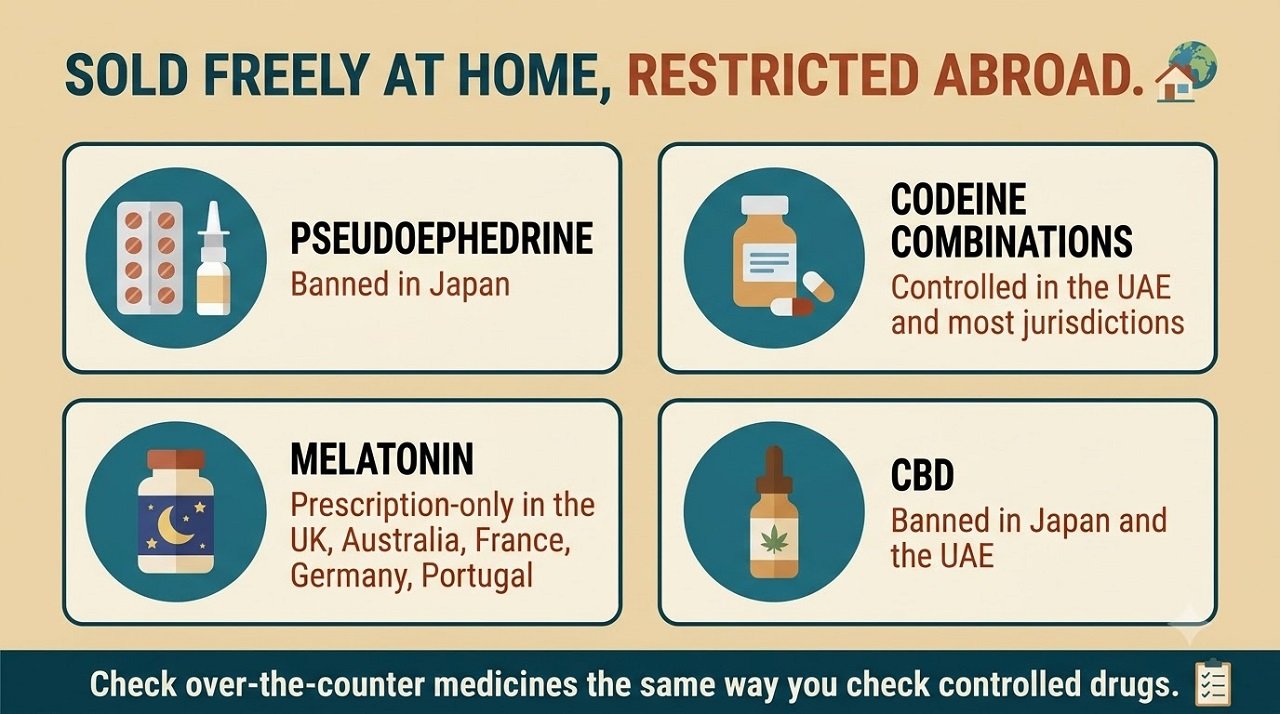
The medicines most likely to cause a problem are the ones nobody thinks to check.
Pseudoephedrine
Sold over the counter in Australia, Canada, much of Europe, and the US. Banned in Japan, where Sudafed and Actifed cannot be brought in. It is also restricted or prescription-only in many other destinations.-2-15
Codeine Combinations
Co-codamol, Nurofen Plus, and codeine-based cough syrups are controlled in most jurisdictions. In the UAE, codeine has led to confiscation, detention, and in some cases prosecution under narcotics law. In Japan, quantities above the one-month personal allowance need documentation, and many over-the-counter cough medicines containing codeine are stopped at customs.-15
Melatonin
Sold freely in the US and Canada. Regulated as a prescription-only medicine in Australia, France, the UK, Germany above 0.5mg per dose, and Portugal.-55
Japan does not approve melatonin as a pharmaceutical at all, and personal import is subject to a two-month quantity limit. Of 25 country rules indexed by one reference service, 16 were restricted to some degree.
If you take melatonin for jet lag, read our guide to what the research says about beating jet lag — and check the destination’s rules before you pack it.
CBD and Medicinal Cannabis
Even where prescribed at home, cannabis-derived products are illegal to import in many countries. Japan bans them explicitly, including CBD oil. The UAE enforces a zero-tolerance policy with fines, jail time, or deportation.-11-51
The Rule for All of Them
A medicine being sold without a prescription at home tells you nothing about its status abroad. Check it the same way you would check a controlled drug. The effort is a search; the alternative is a customs conversation.
Conclusion
Travelling with medication is not complicated, but it is unforgiving of assumptions.
The sequence is short:
- Check the law in every country on your route, including transit stops, using generic names.
- Get the right document for the class — a letter for ordinary prescriptions, a permit for controlled substances.
- Pack it in carry-on, in original packaging, in a sensible quantity.
- Declare it.
- Assume insurance will not replace it, and carry a photograph, a written list, and a few extra days.
The data is clear that most people skip at least one of these. One in five travellers carrying medication never checked whether it was legal. And the medicines most likely to be confiscated are the ones sold over the counter at home.-26
If you remember one rule, make it this: the brand name on your box means nothing at a border. Generic name, original packaging, and a document that matches your passport.
If you are planning a longer trip and want the full preparation sequence in order, our essential travel tips for novice explorers covers it end to end.
Frequently Asked Questions
Do I need a doctor’s letter to travel with medication?
For ordinary prescriptions it is strongly recommended and often requested. For controlled substances it is effectively mandatory, alongside a permit from the destination’s health authority. The letter should list generic drug names, doses, your diagnosis, and your passport details, and be signed on official letterhead.
Can I take my prescription medication abroad?
Usually yes, for personal use in reasonable quantities with the right documentation. The exceptions are medicines the destination prohibits outright — such as amphetamine-based ADHD drugs and pseudoephedrine in Japan, or codeine and CBD in the UAE without authorisation.
Which countries ban common prescription drugs?
Japan bans dexamphetamine, Adderall, Vyvanse, pseudoephedrine, and cannabis-derived products including CBD oil. The UAE requires MOHAP authorisation for codeine, tramadol, benzodiazepines, and ADHD medicines, and bans cannabis and poppy seeds outright. Singapore restricts opioids, codeine, and benzodiazepines.
Does travel insurance cover lost medication?
Generally no. Analysis of fifteen plans found all excluded prescribed medications from the baggage benefit, and none paid to replace them. The assistance line will help arrange a replacement prescription, but the cost is yours.
How much medication can I carry abroad?
A 30–90 day supply is widely accepted for ordinary prescriptions. More than 90 days starts to look commercial. Controlled substances face separate limits — the UAE, for example, permits visitors up to a three-month supply with approval.
Is melatonin legal to travel with?
It depends entirely on the destination. It is sold over the counter in the US and Canada but is prescription-only in Australia, France, the UK, Germany above 0.5mg, and Portugal. Japan does not approve it as a pharmaceutical and limits personal import.
Sources
- CDC Yellow Book 2026. Traveling with Prohibited or Restricted Medications. Consequences of carrying prohibited medicines; controlled substance cautions including hydrocodone, oxycodone, alprazolam, diazepam, zolpidem, amphetamines, and pseudoephedrine; letter requirements. https://www.cdc.gov
- Smartraveller (Australian Government). Japan — destination advice. Japan’s strict medication rules; banned substances including dexamphetamine, pseudoephedrine and CBD. https://www.smartraveller.gov.au
- Nomedic. Japan’s Banned Medicines & Yunyu Kakunin-sho Guide. Import certificate required for psychotropics above one-month supply; application takes 2–3 weeks. https://nomedic.co
- Pharmacydirectory.ae. Bringing Medication to UAE 2026: MOHAP Permit, Banned Drugs and Quantity Limits. MOHAP authorisation; three-month visitor supply; three-month medical report requirement. https://www.pharmacydirectory.ae
- OCNAT. Doctor’s Letter for Controlled Substances: International Travel Guide. Required letter elements aligned with INCB standards. https://ocnat.org
- Covertrip. Does travel insurance cover prescription drugs? Coverage only when a doctor on the trip prescribes for a covered illness; refills and lost medication are not covered. https://covertrip.com
- Nomedic. Melatonin Prescription-Only Countries: Travel Rules. Prescription-only in Australia, France, UK, Germany above 0.5mg, and Portugal. https://nomedic.co
- Indian Express. Travelling with medication: Why your regular pills could get flagged at airport customs. Dr Sundar Krishnan on unlabelled strips and excess quantities. https://indianexpress.com
- Goods Across Borders. Travelling with prescription medication. Default documentation bundle; 30–90 day quantity guidance; controlled substance categories. https://goodsacrossborders.com
- James Cook University. Pharmaceutical care model to assess the medication-related risks of travel. Medications for chronic diseases taken by 47.7% of 218 travellers. https://researchonline.jcu.edu.au