All requirements, prices, and outbreak figures in this guide reflect guidance published in 2025 and 2026. Entry rules change, outbreaks move, and vaccine prices vary widely by country and clinic.
If you are reading this in a later year, treat the sequence as still correct — check what is required, check what is recommended, check the timing, then budget. But verify your specific destination against an official source before you travel.
This guide is general information, not medical advice. Only a clinician with your medical history can tell you which vaccines are appropriate for you.
All sources used in this guide are listed at the end.
Introduction
Most travel vaccination advice is vague in exactly the wrong way. It tells you to “check what you need” without explaining that only one vaccine is ever legally required for entry, and it rarely mentions that the recommended ones take weeks to work.
The gap between what travellers think and what is true is measurable. Boots research found that 54% of travellers admit leaving it too late to check vaccination requirements, or not checking at all. Over 40% said they were unsure what the requirements were for the destinations they visit. Among 18–24-year-olds, that rose to 60%, and 35% of that age group decided not to get a recommended vaccination at all.
The reasons given are practical, not careless: worries about side effects (30%), not thinking it was needed (24%), and lack of time (21%).
This guide addresses all three. It separates what is legally required from what is merely wise, explains why the six-to-eight-week window exists, gives real cost ranges, and covers what to do if your flight is in ten days and you have done nothing.
If you are managing an existing condition alongside a trip, our guide to travelling with prescription medication covers the documentation side. If you are building a trip budget, the trip budgeting method treats pre-trip health costs as their own line for exactly this reason.
Step 1: Separate What Is Required From What Is Recommended
This is the distinction that clears up most confusion.
The Only Vaccine That Can Be Legally Required
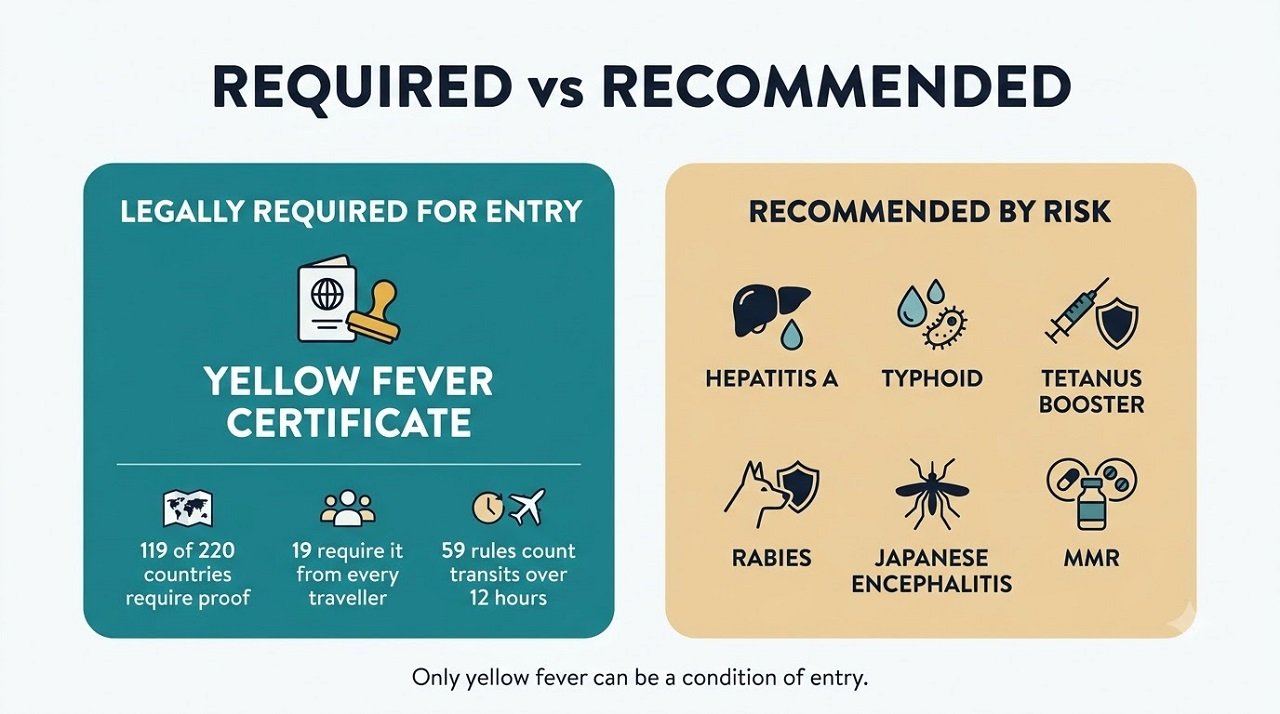
Under the International Health Regulations, yellow fever is the only vaccination a country may routinely require for entry.
The numbers are larger than most travellers expect. Of 220 countries and territories, 119 (54.1%) required yellow fever proof from some travellers. Of those, 100 required it from arrivals coming from risk countries, and 19 required it from every traveller — all but one of those in Africa.
Two details matter in practice:
- Transit counts. Of the 100 arrival-based rules, 59 counted transits of more than 12 hours. A long layover in a risk country can trigger the requirement even if you never leave the airport.
- The list is dated. Only 36% of states parties responded to the 2022 survey that underpins much of the published guidance, and 65% of entries were last confirmed in 2021 or 2022. Do not rely on a static list. Check the destination’s own health authority.
What Is Recommended but Not Required
Everything else falls into the “recommended” category. These are not entry conditions. They are risk-reduction measures based on what is circulating where you are going.
The common ones:
| Vaccine | Typically recommended for | Notes |
|---|---|---|
| Hepatitis A | Most destinations outside Western Europe, North America, Japan, Australia, New Zealand | Two-dose series for long-term protection |
| Typhoid | South Asia, Southeast Asia, parts of Africa and Latin America | Injectable or oral; neither is lifelong |
| Tetanus/diphtheria/polio booster | Everyone, every 10 years | Often the one people have lapsed on |
| Rabies | Long stays, rural areas, cycling, work with animals | Expensive; three-dose series |
| Japanese encephalitis | Rural Asia, longer stays, rice-growing regions | Not needed for typical city itineraries |
| Hepatitis B | Long stays, healthcare work, some regions | Often part of childhood schedule already |
| Cholera | Outbreak areas, humanitarian work | Rarely needed by tourists |
| Measles (MMR) | Anyone not fully vaccinated | See the outbreak note below |
The One People Forget: Routine Vaccines
Travel clinics increasingly check whether your routine vaccinations are current, not just the travel-specific ones.
That matters in 2026. The United States recorded 2,255 confirmed measles cases in 2025 — its worst year in over three decades — with 416 cases by late January 2026. Canada reported 5,463 probable and confirmed cases in 2025. Tokyo identified 41 cases in 2026, already exceeding its 2025 total. New South Wales recorded 60 measles cases between January 2025 and March 2026, predominantly linked to overseas travel.
Measles is highly contagious and spreads in airports, terminals, and crowded accommodation. Two documented MMR doses are the standard. If you cannot remember whether you had them, that is worth resolving before you fly.
If you are travelling to a destination with current health or security concerns, our guide to reading government travel advisories explains how to check conditions alongside vaccination requirements.
Step 2: Get the Timing Right
The single most common failure is timing. Vaccines are not instant.
The Six-to-Eight-Week Rule
Travel medicine guidance converges on the same window. A pre-travel consultation is ideally held four to six weeks before departure, with several sources recommending six to eight weeks to allow for multi-dose series and time to develop immunity.
Boots’ superintendent pharmacist puts the practical version plainly: get vaccinated at least six to eight weeks before departure for the best chance of protection.
Why the Window Exists
Three reasons, and all three are mechanical rather than bureaucratic:
- Some vaccines need multiple doses. Hepatitis A, hepatitis B, and rabies all require a series spread over weeks or months. A single dose before you fly gives partial, not full, protection.
- Immunity takes time. Several vaccines need roughly two weeks to become effective. A jab the day before you fly does very little.
- Some need to be started early. Oral typhoid and some other products have specific schedules. Malaria tablets — not a vaccine, but part of the same consultation — often need to be started one to two weeks before entering a risk area.
The Realistic Timeline
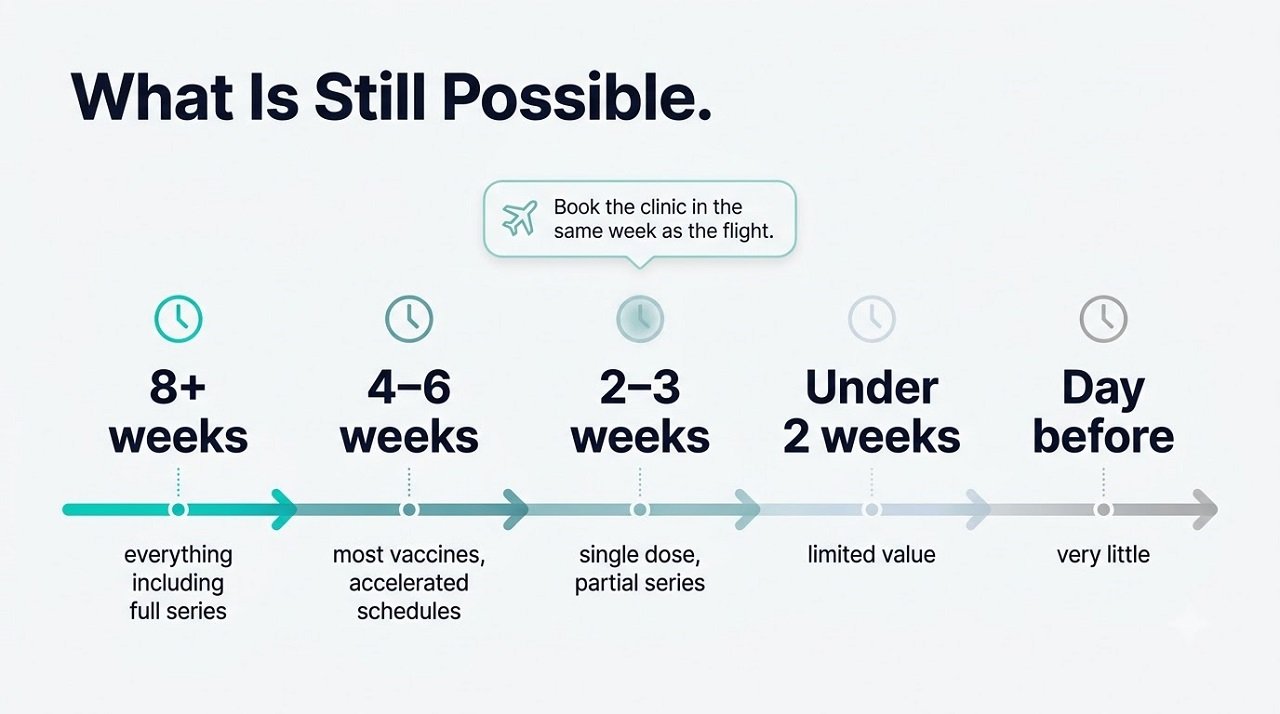
| Time before departure | What is still possible |
|---|---|
| 8+ weeks | Everything, including full multi-dose series |
| 4–6 weeks | Most vaccines; accelerated schedules for some |
| 2–3 weeks | Single-dose vaccines; partial series |
| Under 2 weeks | Limited. Some vaccines still worth giving; others not |
| Day before | Very little protective value |
If You Have Left It Late
It is not pointless. It is just limited.
- Still go to a clinic. Some protection is better than none, and a clinician can tell you which jabs are worth giving at short notice.
- Prioritise the required ones. If a yellow fever certificate is an entry condition, that is the one that blocks the trip entirely.
- Ask about accelerated schedules. Some series can be compressed for imminent travel, though protection may be partial.
- Plan around behaviour instead. If you cannot be fully vaccinated, the food, water, and insect precautions in the next section become more important, not less.
If your trip involves a long-haul flight and you want to reduce the strain on arrival, our guide to what the research says about beating jet lag covers recovery timing. If you are travelling alone and managing health decisions without a companion, the solo travel safety guide covers the additional planning.
Step 3: Understand What Vaccines Do Not Cover
Vaccination is one layer. It is not the whole defence, and the biggest travel illness is not vaccine-preventable at all.
Traveller’s Diarrhoea Is the Most Likely Thing to Hit You
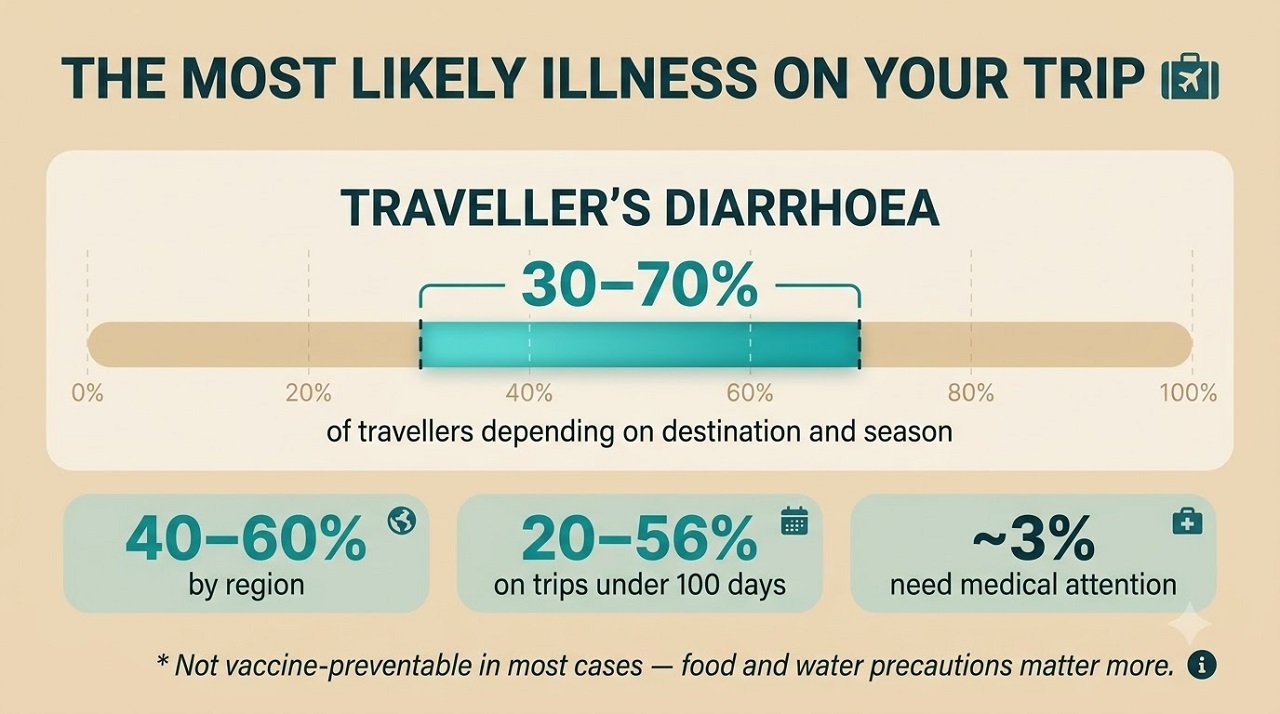
Depending on destination and season, traveller’s diarrhoea affects between 30% and 70% of travellers. Estimates put it at 40–60% depending on region, and a 2024 systematic review found 20–56% of international travellers can expect it on trips under 100 days.
Most cases are mild. Only about 3% involve disruption to normal activities or require medical attention. Symptoms typically begin 12 to 72 hours after consuming contaminated food or water and last three to five days.
The most common bacterial cause is enterotoxigenic E. coli, accounting for roughly 30% of cases. Norovirus and Giardia are the most common viral and parasitic causes.
There is no routine vaccine for most of this. The defence is behavioural: safe water, peeled fruit, hot food served hot, and hand hygiene.
The Food and Water Rules That Actually Matter
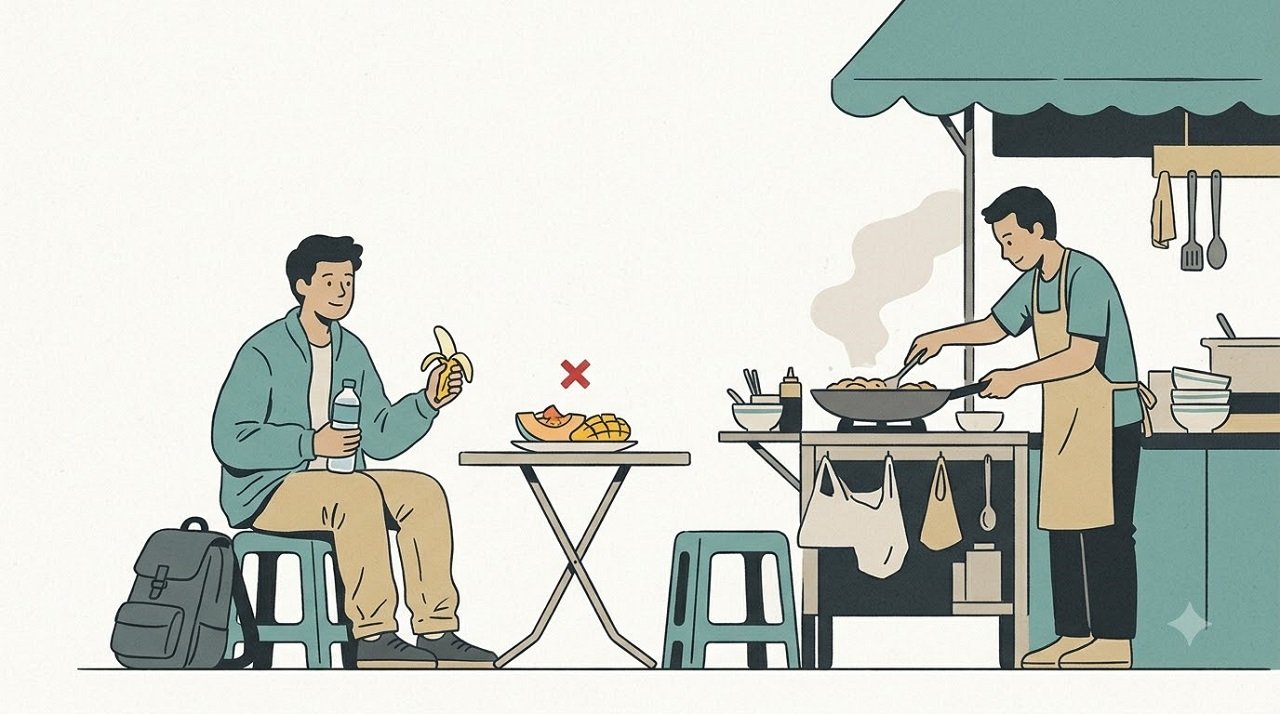
- Drink bottled or treated water where tap water is not safe. Avoid ice made from tap water.
- Eat food that is hot and freshly cooked. Buffet food that has been sitting is a risk.
- Peel fruit yourself. Pre-cut fruit and salads are common culprits.
- Be cautious with raw or undercooked seafood, especially in regions where traveller’s diarrhoea is common.
- Wash or sanitise hands before eating. This sounds trivial. It is not.
Outbreaks Move
Vaccination decisions based on last year’s risk map can be wrong this year. Two 2026 examples:
- Cyclospora: 67 cases were reported among returning travellers in England, Scotland, and Wales between 30 April and 15 July 2026, a sharp rise linked to Mexico travel.
- Shigellosis: over 1,000 confirmed and possible cases of shigellosis and other gastrointestinal infections were detected in travellers returning from Cabo Verde to EU/EEA countries by March 2026.
Neither is vaccine-preventable. Both are food and water risks. This is why the behavioural layer matters even for fully vaccinated travellers.
If you are heading to a region where food and water risk is high and want the budgeting side, our Southeast Asia backpacking guide covers costs and practical logistics for that route.
Step 4: Budget for It Properly
Vaccine costs vary enormously by country, clinic, and product. This is the line most trip budgets underfund.
Real 2026 Price Ranges
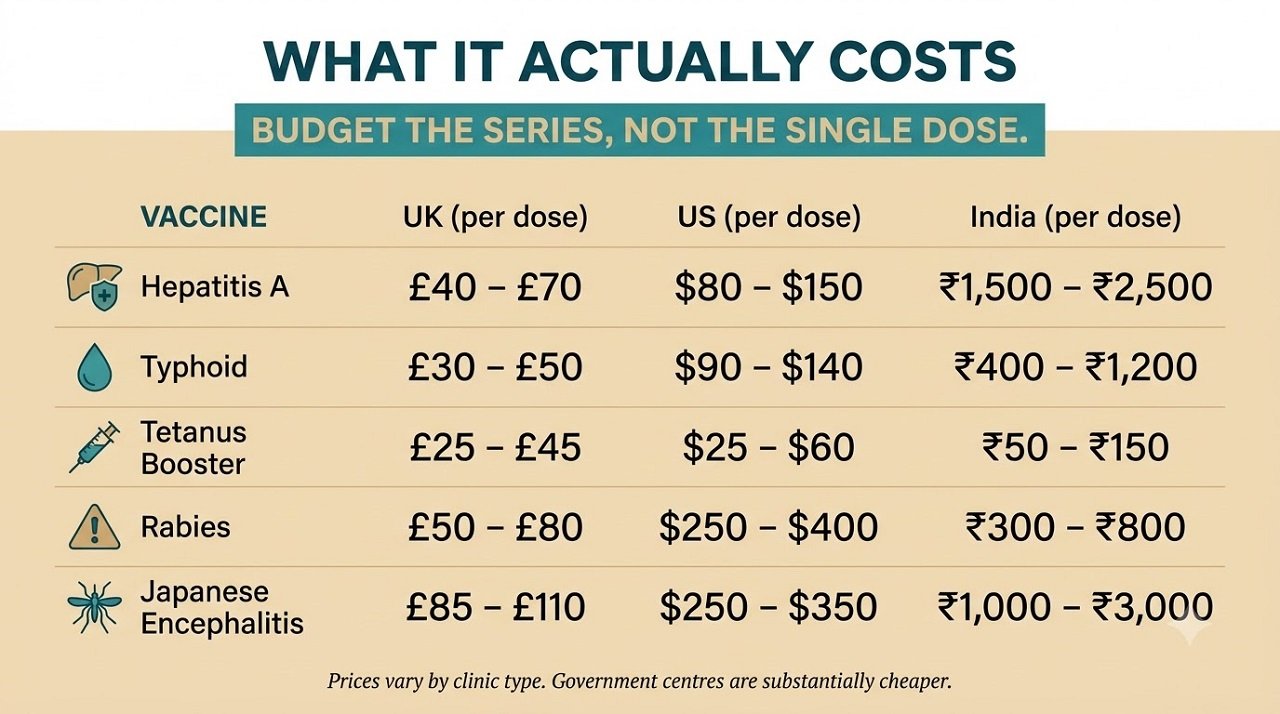
United Kingdom (private clinics, per dose):
| Vaccine | Typical price |
|---|---|
| Hepatitis A | £45–£65 |
| Typhoid | £30–£35 |
| Tetanus/diphtheria/polio booster | £30–£35 |
| Hepatitis B | £55 |
| Rabies | £100 |
| Japanese encephalitis | £95 |
| Yellow fever | Variable; often £60–£90 |
| Malaria tablets | From £30 |
United States (per dose):
| Vaccine | Typical price |
|---|---|
| Hepatitis A | $135 |
| Typhoid (injection) | $215 |
| Typhoid (oral) | $195 |
| Rabies | $475 |
Yellow fever specifically: a proposed clinic fee of $222 per dose**, with common multi-vaccine sets at **$287 to $994, according to 2026 published analysis.
India (for comparison): hepatitis A around ₹1,200–₹1,800 at private hospitals, ₹800–₹1,200 at smaller hospitals, and free or ₹50 at government centres. A standard pre-trip set of hepatitis A, hepatitis B, typhoid, and a tetanus booster comes to roughly ₹3,500–₹6,500.
Why the Range Is So Wide
- Clinic type. Government or public health centres are far cheaper than private travel clinics.
- Country of purchase. The same vaccine can cost five times more in one market than another.
- Product type. Oral versus injectable typhoid, for example, differ in price.
- Series length. Rabies is three doses. Hepatitis A is two. The per-dose price is not the total.
The Practical Budget Line
For a typical traveller needing hepatitis A, typhoid, and a tetanus booster:
- UK private clinic: roughly £105–£135.
- US travel clinic: roughly $350–$500, plus a consultation fee.
Add rabies or Japanese encephalitis and the total can exceed $1,000 in the US.
This is a real cost, and it belongs in the pre-trip admin line rather than emerging as a surprise. If you have not compared travel insurance yet either, our guide to what travel insurance actually covers explains which benefits are worth paying for.
Does Insurance Cover Vaccinations?
Usually not. Standard travel insurance covers treatment for illness during the trip, not preventative measures before it. A small number of policies include a vaccination benefit, but it is uncommon.
Check the policy wording before assuming. Do not buy insurance expecting it to refund your jabs.
Special Cases
Immunocompromised Travellers
Guidance from the Indian Academy of Pediatrics is direct: immunocompromised travellers have special needs. Live vaccines are often contraindicated, and the response to inactivated vaccines may be reduced.
This is a conversation with a clinician, not a decision to make from a web page. Bring your medication list and your diagnosis.
Pregnancy
Some vaccines are not recommended in pregnancy; others are. Yellow fever in particular requires a risk-benefit discussion. Again: clinician, not article.
Travelling With Children
Schedules differ by age. Some vaccines are not given below certain ages, and the yellow fever threshold is commonly 9 months or 1 year depending on the destination. The 2026 data shows 61 countries used a 1-year threshold and 54 used 9 months.
Last-Minute Travellers
Covered in Step 2. The short version: go anyway, prioritise the required vaccine, and lean harder on behaviour.
If you are preparing documents alongside vaccinations, our guide to what to do if you lose your passport abroad covers the backup routine — including the photograph of your passport that makes an emergency easier.
Where to Keep the Record
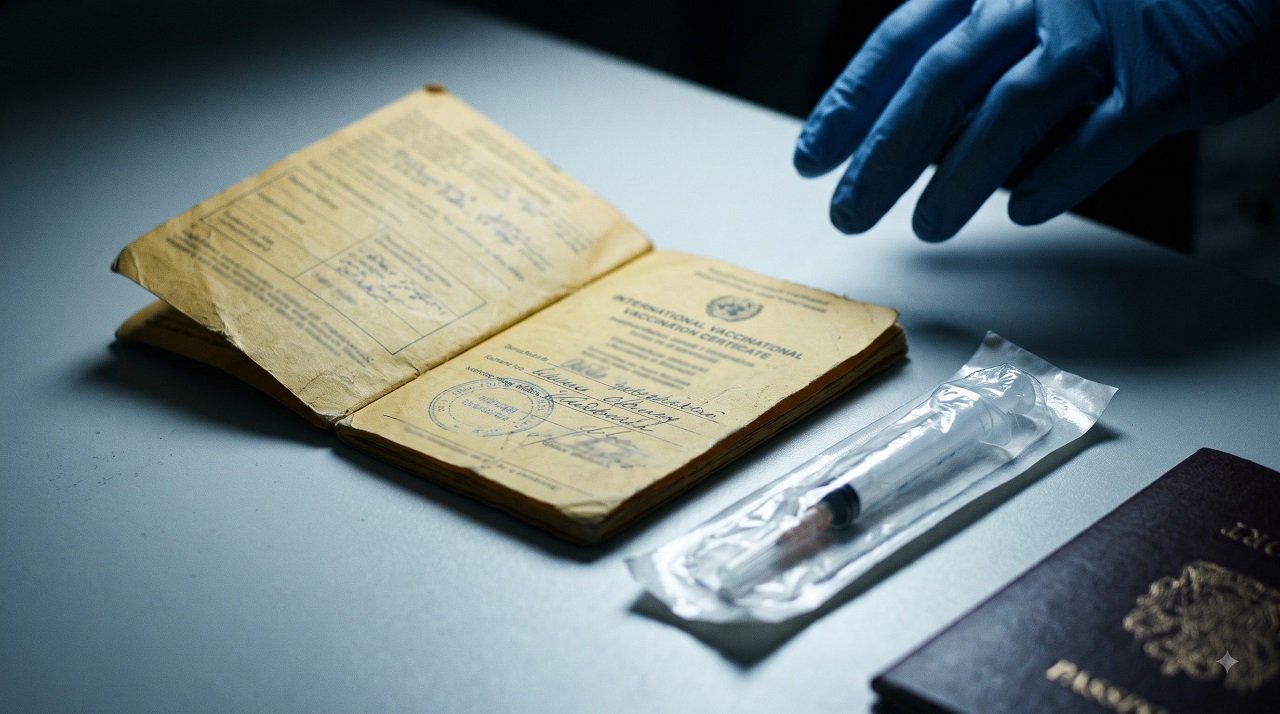
- The yellow fever certificate is a physical document. It is an official International Certificate of Vaccination. Carry the original, not just a photo.
- Keep a digital copy of every vaccination record in cloud storage.
- Screenshot your vaccination dates so you can answer a clinic’s questions abroad.
If you are packing documents and medication together, the carry-on packing system covers the pouch and backup routine.
The Four Mistakes That Cause Most Problems
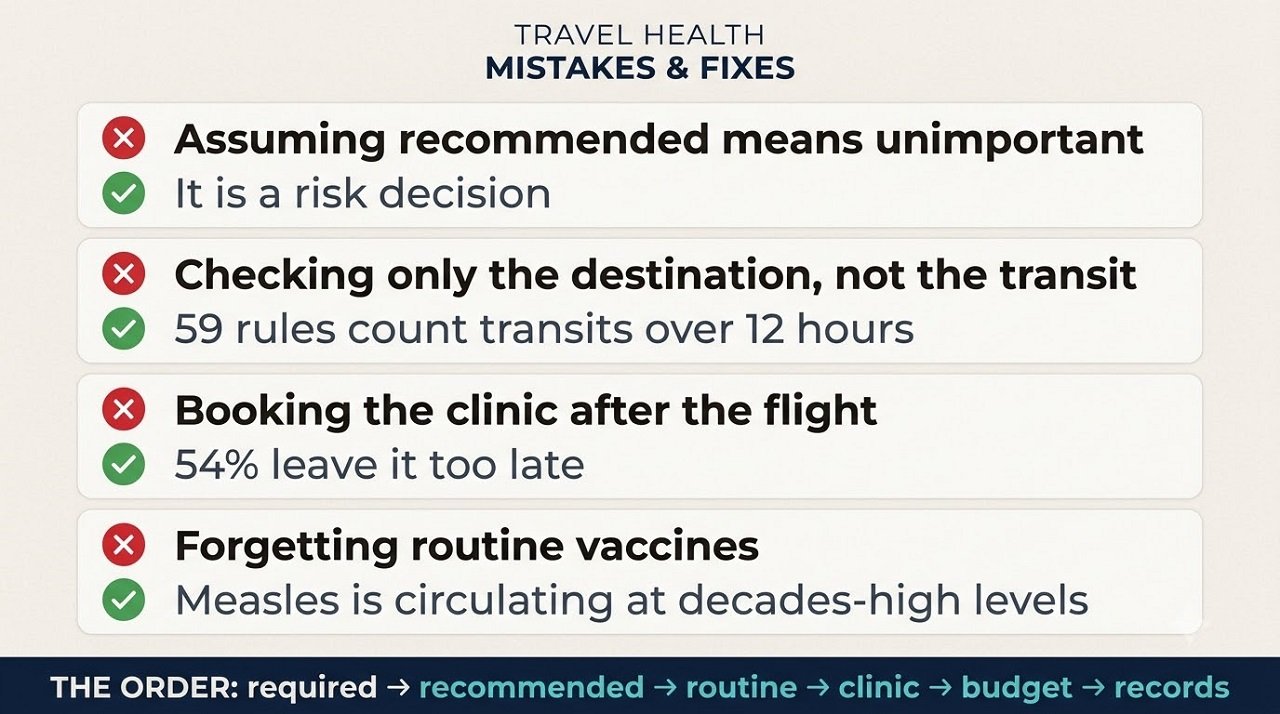
1. Assuming “recommended” means “not important.” Recommended vaccines are not entry conditions, but hepatitis A and typhoid are the two most common vaccine-preventable illnesses in travellers. Skipping them is a risk decision, not a neutral one.
2. Checking only the destination, not the transit. 59 of 100 arrival-based yellow fever rules count transits over 12 hours. A long layover can trigger a requirement you did not plan for.
3. Booking the clinic after booking the flight. 54% of travellers leave vaccination checks too late. The consultation should sit in the same week as the flight booking, not after it.
4. Forgetting routine vaccinations. Measles is circulating at levels not seen in decades in several countries. Two MMR doses are the standard, and many adults cannot confirm theirs.
The Order to Do Things
- Check what is required for the destination and every transit point.
- Check what is recommended for the region, season, and your activities.
- Check your routine vaccinations — especially MMR and tetanus.
- Book a travel clinic 6–8 weeks before departure.
- Budget the series, not the single dose.
- Keep the certificate and records with your travel documents.
Conclusion
Travel vaccination decisions get easier once you separate the three questions that are usually mixed together: what is required, what is recommended, and what is realistic given your timeline.
The requirement list is shorter than most people think — yellow fever is the only vaccine a country can routinely demand for entry, though it applies to more destinations than travellers expect. The recommended list is longer but route-specific. And the timing rule is fixed: six to eight weeks, because immunity takes time and some series take months.
The most likely illness on your trip is not vaccine-preventable at all. Traveller’s diarrhoea affects 30–70% of travellers depending on destination and season. Vaccination does not replace the food and water precautions; it sits alongside them.
If you remember one rule, make it this: book the clinic in the same week you book the flight. The cost is real, but the cost of discovering a requirement at check-in is higher.
If you are planning the full preparation sequence, our essential travel tips for novice explorers covers it end to end.
Frequently Asked Questions
Which travel vaccinations do I actually need?
Only yellow fever can be legally required for entry, and only for certain destinations and arrival routes. Everything else — hepatitis A, typhoid, rabies, Japanese encephalitis, hepatitis B — is recommended based on your destination, season, activities, and health. A travel clinic can match the recommendations to your specific itinerary.
How far in advance should I get travel vaccines?
Aim for four to eight weeks before departure, with six to eight weeks being the commonly recommended window. Some vaccines require multiple doses over weeks, and most need about two weeks to become effective. Under two weeks, options are limited.
Do I need a yellow fever certificate to travel?
Possibly, even if you are not going to a risk country. Of 220 countries and territories, 119 required yellow fever proof from some travellers — 100 from arrivals from risk countries and 19 from every traveller. Critically, 59 of those 100 rules count transits longer than 12 hours.
How much do travel vaccinations cost?
It varies widely. In the UK, hepatitis A runs £45–£65, typhoid £30–£35, and rabies £100 per dose. In the US, hepatitis A is around $135, typhoid $195–$215, and rabies $475 per dose. A yellow fever dose has been estimated at around $222, with common vaccine sets at $287–$994.
Does travel insurance cover vaccinations?
Usually not. Standard policies cover treatment during the trip, not preventative measures before it. A few policies include a vaccination benefit, but it is uncommon. Check the wording before assuming.
What is the most common illness travellers get?
Traveller’s diarrhoea, which affects 30–70% of travellers depending on destination and season. Most cases are mild and last three to five days. It is not vaccine-preventable in most cases, so food and water precautions matter more than jabs for this particular risk.
Sources
- Boots UK. Boots research reveals more than half of holiday-goers are leaving travel vaccination checks too late, or not checking at all. Published 21 May 2026. 54% leave checks too late or don’t check; over 40% unsure of requirements, 60% among 18–24s; 35% of that group skip a recommended jab; recommendation of 6–8 weeks before departure.
https://www.boots-uk.com/newsroom/news-item/boots-research-reveals-more-than-half-of-holiday-goers-are-leaving-travel-vaccination-checks-too-late-or-not-checking-at-all/ - Travel Statistics Bureau (Zenodo). Which Countries Require Travel Vaccines? Yellow Fever Entry Rules, Malaria Prevention, Vaccine Coverage and Cases, 1980–2026. Published 4 October 2026. Yellow fever the only routinely required vaccine under IHR; 119 of 220 countries require proof from some travellers; 100 arrival-based and 19 all-traveller; 59 of 100 count transits over 12 hours; yellow fever dose estimated $222, sets $287–$994.
https://zenodo.org/records/23146905 - Indian Academy of Pediatrics. IAP Presidential Action Plan 2026 — Vaccination Guidelines in Travelers. Pre-travel consultation ideally 4–6 weeks before departure; immunocompromised travellers have special needs.
https://iapindia.org/pdf/action-plan-2026/Vaccinology/007-Vaccination-Guidelines-in-Travelers.pdf - Acibadem Health Point. Travel Health: Vaccines, Medicines, and Safe Planning Before a Trip. Published 19 September 2026. Pre-travel visit ideally 4–8 weeks before departure; some vaccines need multiple doses or time to become effective.
https://www.acibademhealthpoint.com/blog/travel-health-vaccines-medicines-and-safe-planning-before-a-trip/ - AMBOSS. Travel medicine. Published 20 February 2026. Pre-travel consultation indicated for all international travellers, ideally ≥6 weeks before travel; vaccine effects not immediate; malaria prophylaxis started 1–2 weeks before entering high-risk areas.
https://www.amboss.com/us/knowledge/travel-medicine - Baylor College of Medicine. Travel medicine clinics can help families prep for international vacations. Visit 4–6 weeks prior; some vaccines take at least two weeks to become effective, others require multiple doses.
https://bcmd8.bcm.edu/news/travel-med-clinics-prep-international-trips - MedPath Trial. Pre-Travel Health Planning Essential as Summer Travel Surges, Experts Warn. Published 6 June 2026. Four to six weeks before departure to allow for multi-dose vaccines and preventive medications.
https://trial.medpath.com/news/pre-travel-health-planning-essential-as-summer-travel-surges-experts-warn - Research and Markets / Expert Market Research. Traveler’s Diarrhea Epidemiology Forecast 2026–2035. Affects 30–70% of travellers depending on destination and season; only about 3% require medical attention; ETEC accounts for ~30% of cases; symptoms begin 12–72 hours and last 3–5 days.
https://www.researchandmarkets.com/reports/6102499/travelers-diarrhea-epidemiology-forecast - UK Health Security Agency / GOV.UK. Sharp rise in cyclospora infections linked to Mexico travel. Published 30 July 2026. 67 cases in returning travellers in England (30), Scotland (27), and Wales (10) between 30 April and 15 July 2026.
https://www.gov.uk/government/news/sharp-rise-in-cyclospora-infections-linked-to-mexico-travel - European Centre for Disease Prevention and Control. Epidemiological update: Shigellosis and other gastrointestinal infections in travellers returning from Cabo Verde. Published 18 March 2026. Over 1,000 confirmed and possible cases across EU/EEA countries.
https://www.ecdc.europa.eu/en/news-events/epidemiological-update-shigellosis-and-other-gastrointestinal-infections-travellers-returning-cabo-verde - Springer / Tropical Diseases, Travel Medicine and Vaccines. Measles outbreak associated with an infectious travel. Published 13 April 2026. US recorded 2,255 confirmed measles cases in 2025, highest since 1992; 416 confirmed cases by late January 2026.
https://link.springer.com/article/10.1186/s40794-026-00296-1 - Pan American Health Organization. Reinforcing measles control in the Americas amid mass gatherings. More than 184,000 measles/rubella cases reported worldwide in 2026; pre-travel vaccination essential.
https://journal.paho.org/es/node/6537 - NSW Health. New report shows measles surge linked to Southeast Asia. Published 12 March 2026. 60 measles cases notified in NSW between 1 January 2025 and 7 March 2026, predominantly linked to overseas travel.
https://www.health.nsw.gov.au/news/Pages/20260312_00.aspx - Kansas Department of Health and Environment. News Flash — Measles activity remains elevated. Two cases confirmed in Kansas in 2026 as of 14 September; Canada recorded 5,463 probable and confirmed measles cases in 2025; Tokyo identified 41 cases in 2026.
https://www.kdhe.ks.gov/CivicAlerts.aspx?AID=1769 - Sandwell Pharmacy Group. Travel Vaccines for India. Published 21 August 2026. UK pricing: hepatitis A £65 (child £55), typhoid £35, tetanus booster £35, rabies £100 per dose, hepatitis B £55 per dose, Japanese encephalitis £95 per dose, malaria tablets from £30.
https://sandwellpharmacygroup.co.uk/travel-vaccines-for-india/ - NY Center for Travel Medicine. Travel Vaccines for India. Published 21 September 2026. US pricing: oral typhoid $195, injectable typhoid $215, hepatitis A $135, rabies $475 per dose.
https://www.travelhealth.net/travel-vaccines-for-india/ - Ealing Travel Clinic. Travel Vaccines for Goa. Published 29 June 2026. Hepatitis A £45, typhoid £30, DTP booster £30 — £105 total including consultation.
https://ealingtravelclinic.co.uk/travel-vaccines-for-goa/ - BanAnarchy. Travel Vaccinations for Southeast Asia: Indian Guide. Published 17 July 2026. Hepatitis A ₹1,200–₹1,800 at private hospitals, ₹800–₹1,200 at smaller hospitals, free or ₹50 at government centres; standard four-jab set ₹3,500–₹6,500.
https://bananarchy.in/travel-vaccinations-for-southeast-asia-indian-guide/