
All rules, amounts, and deadlines in this guide reflect legislation and guidance current in 2026. Air passenger rights are being reformed. A new EU regulation has been published but airlines have a transition period, so the rules below describe what applies now and flag what changes.
If you are reading this in a later year, treat the sequence as still correct — check coverage, separate the claim types, file it yourself, escalate. But verify the current amounts and deadlines with the regulator in the country you flew from.
This guide is general information, not legal advice. Your entitlement depends on your specific booking, route, carrier, and the reason for the disruption.
All sources used in this guide are listed at the end.
Introduction
On 8 September 2026, a technical failure in the UK’s air traffic control flight planning system grounded and delayed hundreds of flights in a single day. Passengers lost holidays, missed connections, and slept in terminals.
Most of them were not owed a penny in compensation.
The UK Civil Aviation Authority set this out in writing: disruption caused by the National Air Traffic Services outage was “likely to be considered the result of ‘extraordinary circumstances'”, and passengers were therefore “unlikely to be entitled to compensation” — although airlines still had to look after them, and still had to offer a refund or rerouting.
That single case explains why so much flight compensation advice fails. It treats delay as the whole question. It is not. The question is delay plus cause plus route plus carrier, and getting one of those wrong turns a valid claim into a rejection.
This guide covers the sequence properly: whether your flight is covered at all, the three separate things you can claim (they are not the same), how to file it yourself without giving away a third of the money, how to escalate, and the specific circumstances where the airline is genuinely right to refuse.
If a disruption has left you needing to rearrange your trip, our guide to booking direct versus third-party covers who controls your booking when plans change.
Step 1: Check Whether Your Flight Is Covered at All
Compensation rules are territorial. If your flight falls outside them, nothing else in this article applies.
The EU and UK Rules
The framework comes from Regulation (EC) 261/2004. It applies in two situations:
- Any flight departing from an EU airport, regardless of the airline’s nationality.
- A flight arriving at an EU airport, but only if operated by an EU carrier.
The UK kept the same structure after Brexit as “UK261,” covering flights departing UK airports and flights arriving into the UK on UK or EU carriers.
The practical effect: a flight from Bangkok to London on a Thai carrier is not covered. The same route on British Airways is.
The Common Misread
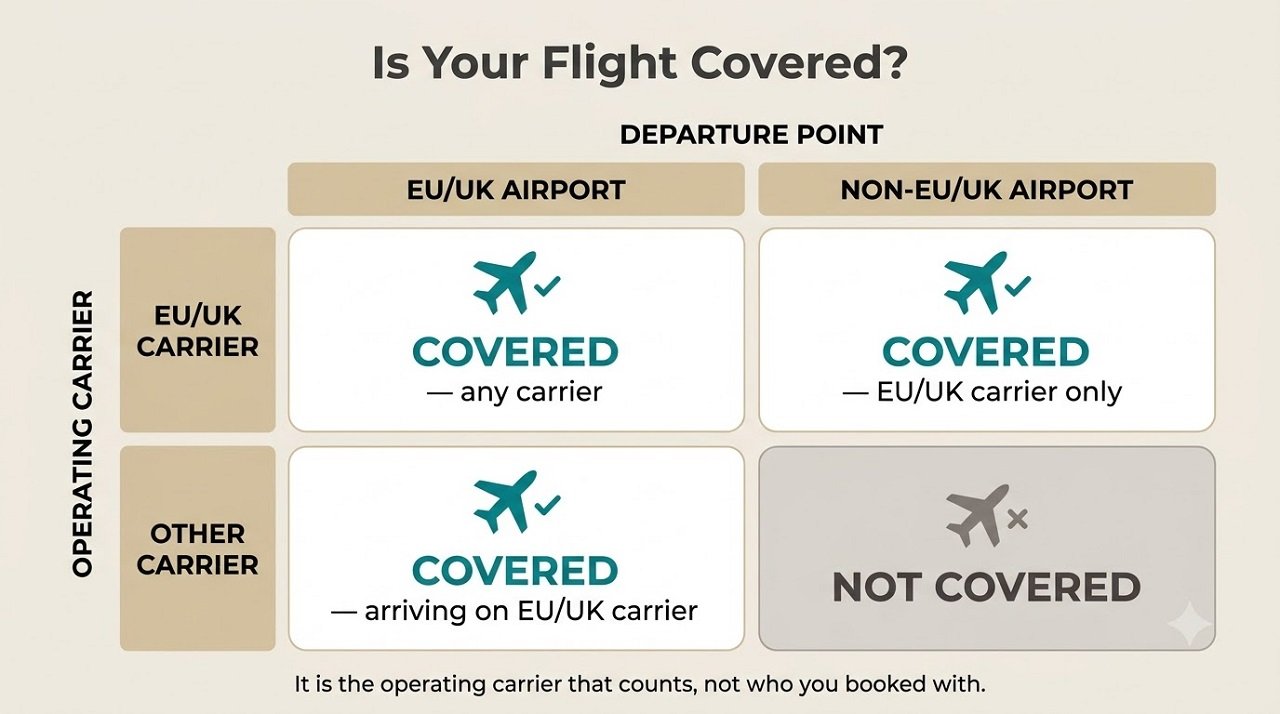
Passengers often assume that a European carrier means European rules. It does not. A European airline flying from New York to Frankfurt is covered. The same airline flying from New York to Bangkok is not.
What Is Not Covered
- Flights between two non-EU countries on a non-EU carrier
- Flights on a non-EU carrier into the EU from outside it
- Domestic flights outside the EU or UK
If you are unsure whether your itinerary qualifies, our guide to reading government travel advisories explains how to identify the operating carrier — which is what determines coverage, not the airline you booked through.
Step 2: Separate the Three Things You Can Claim
This is where most people lose money. Compensation, refund, and care are three different entitlements. You can be owed one, two, or all three — and choosing one can forfeit another.
1. Compensation: A Fixed Amount, Based on Distance
This is the cash payment people mean when they say “compensation.” It is set by law, not by the airline, and does not depend on what you paid for the ticket.
Under Article 7 of the regulation, the amounts are:
| Flight distance | Compensation |
|---|---|
| 1,500 km or less | €250 |
| Intra-EU flights over 1,500 km, and all other flights 1,500–3,500 km | €400 |
| All flights over 3,500 km | €600 |
The UK applies the same three-tier structure in sterling.
Two conditions must also be met: you must arrive at your final destination at least three hours late, and the cause must not be an extraordinary circumstance. The three-hour threshold comes from case law rather than the original text, and it is measured at arrival, not departure — a detail that matters on multi-leg itineraries.
2. Refund: Your Ticket Money Back
If your flight is cancelled, the airline must offer you a choice between a refund, rerouting at the earliest opportunity, or rerouting at a later date.
The refund covers the full cost of the ticket for the parts you have not used, and the regulator expects it within seven days.
The trap: choosing a refund means you are no longer entitled to rerouting or care. The CAA is explicit about this — “Do not choose a refund of your flight if you still wish to travel.”
3. Care: Meals, Hotel, and Calls
Care is separate from both. While you are waiting, the airline owes you:
- Meals and refreshments proportionate to the delay
- Hotel accommodation if the delay runs overnight
- Transport to and from the hotel
- Two calls or emails
Under the incoming rules, this becomes more specific: a refreshment for every two hours of waiting, a meal after three hours and then every five hours, up to three per day, and hotel accommodation capped at three nights where the disruption is caused by an extraordinary circumstance.
If the airline does not provide care, you are expected to arrange it yourself and claim the reasonable cost back, with itemised receipts. The wording that matters is reasonable — a five-star hotel and a taxi ride is not the test.
The Distinction in One Line
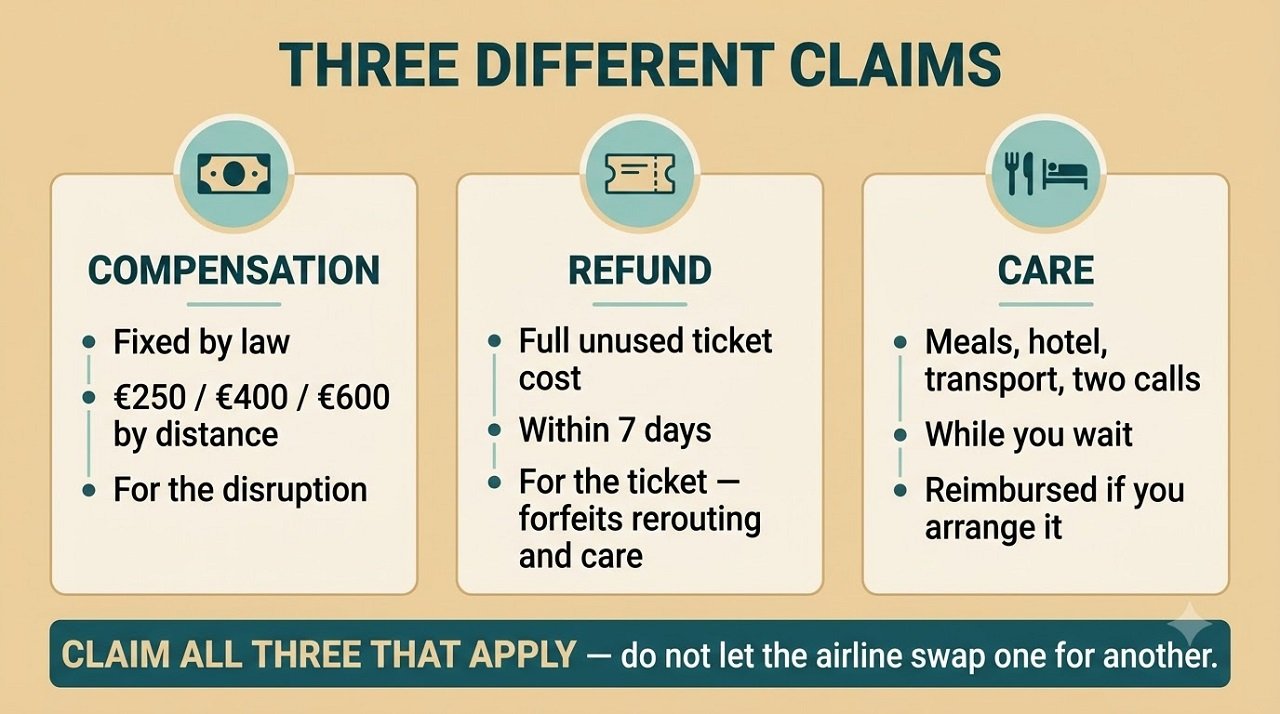
Compensation is for the disruption. Refund is for the ticket. Care is for the wait. Claim all three that apply, and do not let an airline swap one for another.
Step 3: File It Yourself Before You Pay Anyone
There is no legal requirement to use a claims company. The process is a written request to the airline, and it takes about twenty minutes.
What to Send
- Your booking reference and passenger names
- Flight numbers and dates
- Scheduled and actual arrival times — the arrival time, not the departure time
- The reason given for the disruption, if you were told one
- Your bank details for payment
- Receipts for any care costs you paid yourself
Send it to the airline’s customer relations address, not the general enquiries inbox, and keep a copy.
What the Airline Has to Do
Under the incoming rules, the airline must acknowledge a compensation request immediately and either pay or give a reasoned refusal within 30 calendar days. If it refuses, it must say which extraordinary circumstance it is relying on and explain how that circumstance caused this specific flight’s disruption.
You also have a deadline to claim: nine months from the date of departure shown on your ticket.
Both are improvements. Under the old regime, airlines could let claims sit indefinitely, and many did.
The Two Mistakes to Avoid
Accepting a voucher as settlement. In the EU framework, compensation is meant to be paid by bank transfer unless you expressly agree otherwise — and the burden of proving you agreed sits with the airline. A voucher is not compensation unless you genuinely want the voucher.
Waiting for the airline to contact you. Some carriers now have to proactively contact disrupted passengers, but you should not rely on it. File first.
Step 4: Escalate — and Know When a Claim Firm Is Worth 35%
If the airline refuses or ignores you, there are two routes.
Route One: The National Enforcement Body
Every EU country, plus the UK, has a regulator that handles complaints about passenger rights. In the UK it is the CAA. These bodies can investigate and pressure airlines, and their decisions carry weight.
The limitation is that they do not award you money directly. They rule on whether the airline complied.
Route Two: Court or Small Claims
This is where claims companies make their money, and where the arithmetic matters.
A typical claims firm charges a 35% service fee on any compensation recovered, plus a further 15% legal action fee if the case has to go to court.
On a €600 claim:
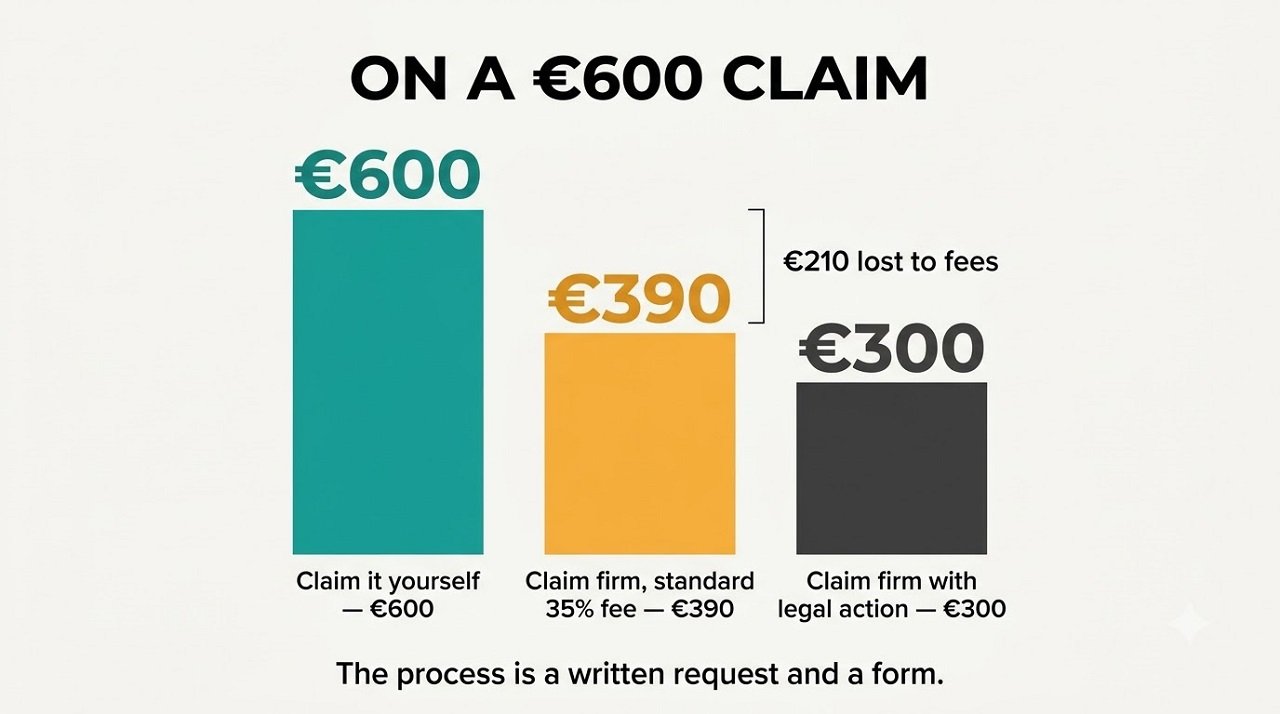
| Route | You receive |
|---|---|
| Claim it yourself | €600 |
| Claim firm, standard fee | €390 |
| Claim firm with legal action | €300 |
You are handing over roughly €210 — about a third of the money — for a process that is largely form-filling.
When a Firm Might Be Worth It
There are genuine cases:
- The airline is in a jurisdiction you cannot easily enforce against
- The itinerary is complex, with multiple carriers and legs
- The airline has made a specific factual claim you need technical evidence to rebut
- Court proceedings are needed in a country you do not live in
Outside those, filing yourself and escalating to the regulator costs nothing.
When the Airline Is Actually Right: Extraordinary Circumstances
This is the defence behind most refusals, and it is both overused and misunderstood.
The Legal Test
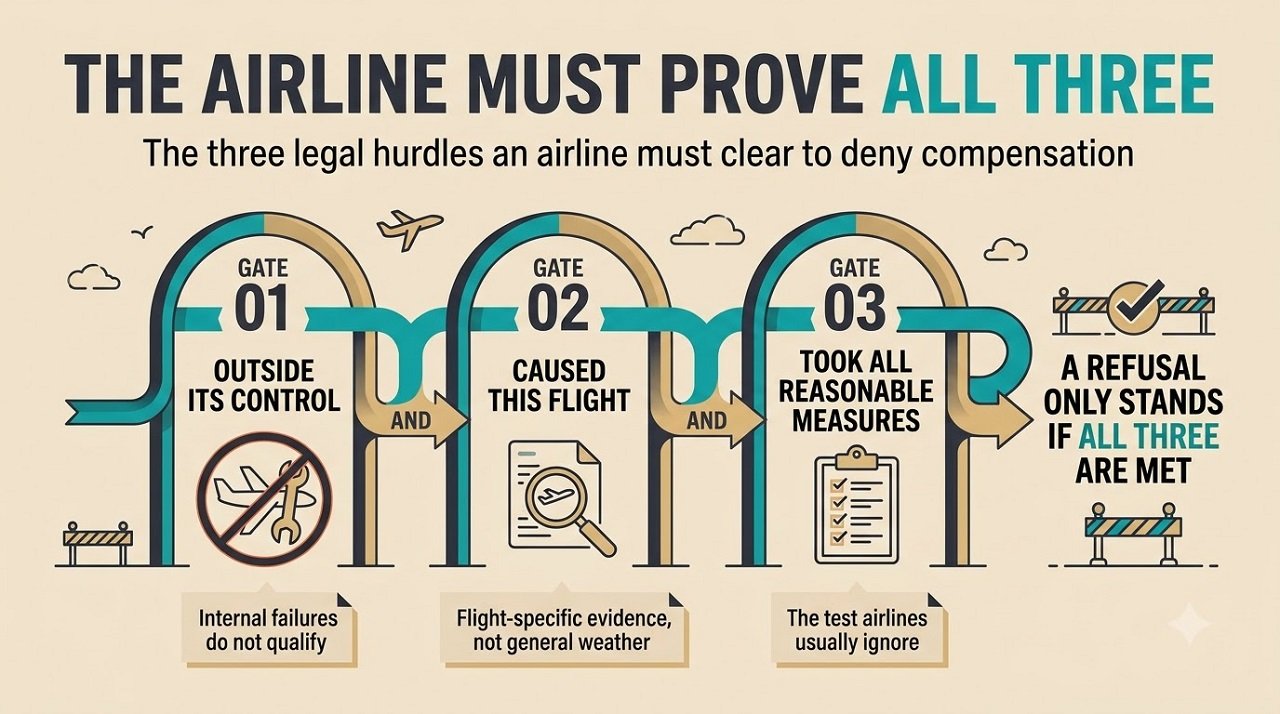
The airline escapes paying compensation only if it can prove the disruption was caused by extraordinary circumstances which could not have been avoided even if all reasonable measures had been taken.
Three things must be true, and the airline must prove all three:
- The event was genuinely outside its control. Internal operational failures do not qualify.
- The event actually caused this specific flight’s disruption, evidenced with flight-specific records — not a general reference to bad weather that day.
- The airline took all reasonable measures to avoid or mitigate it. This is a separate test, and airlines routinely ignore it in refusal letters.
What Qualifies
- Severe weather that made the flight physically impossible — thunderstorms directly over the airport, fog below operational minimums, winds outside the aircraft’s certified limits
- Air traffic control restrictions and airspace closures
- Political instability and security risks
- Strikes by external parties, such as air traffic controllers
- Hidden manufacturing defects that affect flight safety
- Sabotage and terrorism
What Usually Does Not
Technical faults. The Court of Justice held in Wallentin-Hermann v Alitalia that technical problems are not automatically extraordinary, because they are inherent in the normal exercise of running an airline. A CAA guidance document sets out the test and quotes the judgment directly.
The narrow exception is where the fault stems from something outside normal operations — a manufacturer-disclosed hidden defect, sabotage, or terrorism.
This distinction matters because it is the single most common rejection basis. An analysis of rejected claims found that 4% cited “technical problems” as the cause.
The Weather Nuance
Weather is the most cited and most misapplied circumstance.
- Qualifies: confirmed severe conditions at your origin, destination, or route that prevented operation.
- Does not qualify: routine bad weather other flights operated through, weather at a different airport, weather that had cleared before your delay began, or a previous leg’s weather cited as justification for a later delay.
The Practical Move
If you are refused on extraordinary circumstances grounds, ask two questions in writing:
- Which specific circumstance are you relying on, and what flight-specific evidence supports it?
- What reasonable measures did you take to avoid or mitigate the disruption?
Most refusals do not survive the second question, because no answer exists.
The Cancellation Trap Nobody Mentions
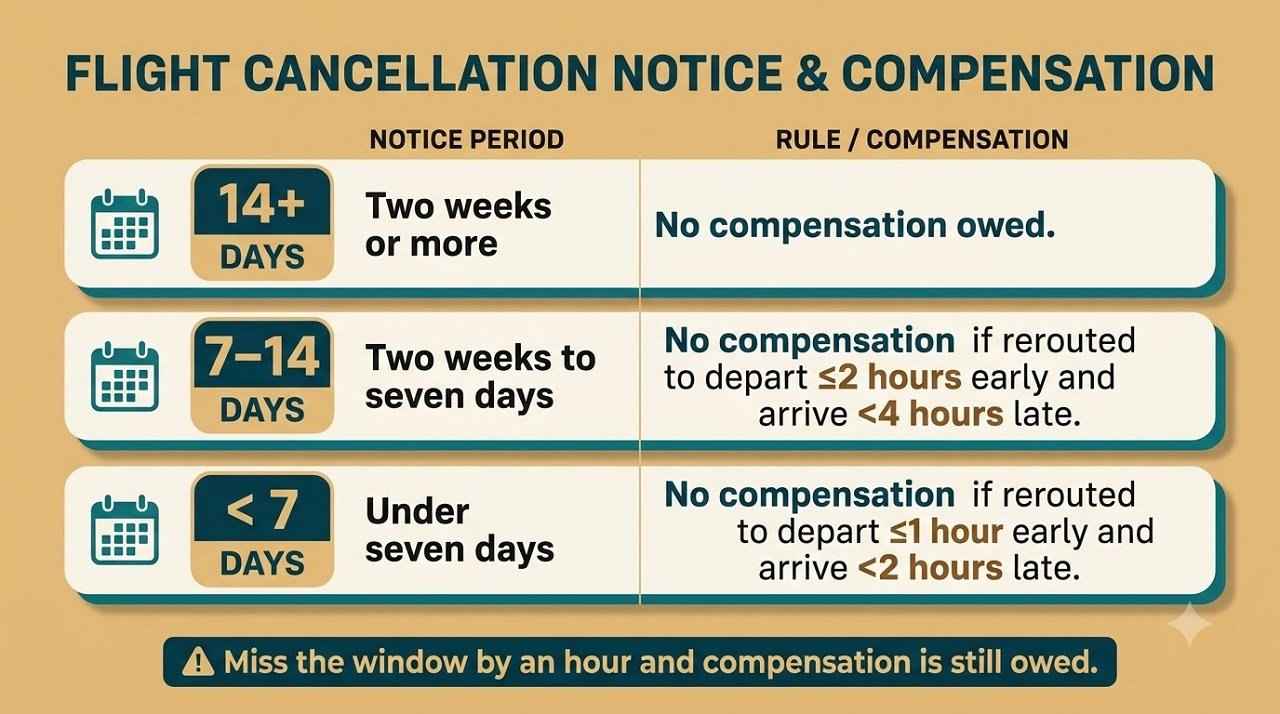
If your flight is cancelled rather than delayed, the airline can avoid compensation entirely in three situations — and most passengers do not know the thresholds.
| Notice given | Compensation avoided if… |
|---|---|
| Two weeks or more before departure | Always |
| Between two weeks and seven days | You are rerouted to depart no more than 2 hours early and arrive less than 4 hours late |
| Less than seven days | You are rerouted to depart no more than 1 hour early and arrive less than 2 hours late |
These are precise windows, and airlines apply them precisely. A rerouting that arrives five hours late, offered three days before departure, does not meet the test — and compensation is still owed.
This is worth checking yourself rather than accepting a refusal letter that simply says “you were notified in advance.”
If You’re Flying to, from, or Within the US
The United States works differently. There is no fixed statutory compensation for delay. What you have instead is a strong refund right.
Under the Department of Transportation’s rule, carriers and ticket agents must provide a full and prompt refund — including taxes and ancillary fees — when a flight to, from, or within the United States is cancelled or significantly delayed or changed, and the passenger chooses not to fly or accept rebooking.
Three things make this stronger than it sounds:
- It applies to non-refundable tickets. The rule exists precisely for those.
- It is automatic. If you do not respond to an offer of a rebooking or a voucher, the refund is still due.
- It includes fees. Baggage fees, seat selection, and other ancillaries come back too.
What it does not do is pay you for the inconvenience. A six-hour delay in the US typically produces a refund of your ticket if you abandon the trip — not €600.
If you are repacking around a disrupted itinerary and want to avoid baggage charges compounding the cost, our carry-on packing system covers how to travel with one bag.
The Two-Minute Checklist
Before you contact anyone, confirm these:
- Did the flight depart from the EU/UK, or arrive there on an EU/UK carrier?
- Did you arrive at your final destination more than three hours late?
- Was it cancelled with less notice than the thresholds above, without a compliant rerouting?
- Did the airline give a reason in writing?
- Have you kept receipts for meals, hotels, and transport you paid for?
- Are you within nine months of departure?
- Have you asked for compensation, refund, and care separately?
If you can answer all seven, you have a claim. File it yourself first.
If the disruption involved a stolen bag or lost documents rather than a delay, the sequence in our guide to what to do if you lose your passport abroad covers the police report and insurance steps.
Conclusion
Flight compensation is not complicated, but it is conditional. The money depends on where you flew, which carrier operated the flight, how late you arrived, and — critically — why the disruption happened.
The most common mistakes are not small:
- Treating a refund as compensation, and losing the rerouting you needed
- Accepting a voucher for a claim that should have been paid in cash
- Taking a refusal letter at face value when the airline has not shown flight-specific evidence
- Handing a third of the money to a claims firm for a form you can file yourself
And the most important lesson is the one the NATS outage teaches: a long delay is not automatically a compensable one. Read the reason before you assume.
If you remember one rule, make it this: ask which specific circumstance the airline is relying on, and what evidence supports it. That question is where most refusals fall apart.
If you are planning around a trip that has already been disrupted, our guide to budgeting for a trip from scratch covers how to rebuild the numbers without losing the buffer.
Frequently Asked Questions
How much compensation do I get for a delayed flight?
Under EU and UK rules, €250 for flights of 1,500 km or less, €400 for intra-EU flights over 1,500 km and other flights between 1,500 and 3,500 km, and €600 for flights over 3,500 km. You must arrive at least three hours late, and the cause must not be an extraordinary circumstance.
Can I claim flight compensation myself?
Yes. There is no legal requirement to use a claims company. Send the airline your booking reference, flight details, scheduled and actual arrival times, and bank details in writing. Claims firms typically charge 35% of the compensation, plus 15% more if legal action is needed.
What counts as extraordinary circumstances?
Events genuinely outside the airline’s control that could not have been avoided by reasonable measures — severe weather that prevented operation, air traffic control restrictions, airspace closures, political instability, security risks, and external strikes. Technical faults generally do not qualify, following the Wallentin-Hermann judgment.
Do I get a refund if my flight is cancelled?
Yes. You are entitled to choose between a refund, rerouting at the earliest opportunity, or rerouting later at your convenience. The refund should be paid within seven days. Choosing a refund means you give up rerouting and care.
How long do I have to claim compensation?
Under the incoming EU rules, nine months from the date of departure shown on your ticket. The airline must acknowledge your request immediately and either pay or give a reasoned refusal within 30 calendar days.
Can the airline refuse compensation because of bad weather?
Sometimes, but not generally. Weather must be severe enough to have actually prevented your specific flight from operating, at your origin, destination, or route. Routine bad weather that other flights operated through, or weather at a different airport, does not qualify.
Sources
- UK Civil Aviation Authority. Guidance on Regulation 261/2004 — extracts from Article 5, Article 7, and European case law including Wallentin-Hermann v Alitalia. Article 7 compensation amounts; Article 5(1)(c) cancellation notice thresholds; Article 5(3) extraordinary circumstances defence; paragraph 26 on hidden manufacturing defects and sabotage. https://www.caa.co.uk/publication/download/15108
- UK Civil Aviation Authority. Guidance to Industry — 9 September 2026 (NATS outage). Delays and cancellations caused by the NATS technical issue on 8 September 2026 “likely to be extraordinary circumstances”; passengers “unlikely to be entitled to compensation”; airlines still obliged to offer refund, rerouting at earliest opportunity, or rerouting later; care obligations including meals, refreshments, hotel, and reimbursement of reasonable self-arranged costs. https://www.caa.co.uk/media/sfbpdvum/nats-outage_september-2026.pdf
- UK Civil Aviation Authority. Consumer travel advice – Summer 2026. Three options on cancellation (refund, rerouting at earliest opportunity, rerouting later); refund within 7 days; warning not to choose a refund if you still wish to travel, as it forfeits rerouting and care; care obligations and reimbursement of reasonable self-arranged costs with itemised receipts. https://www.caa.co.uk/newsroom/news/consumer-travel-advice-summer-2026/
- US Code of Federal Regulations, 14 CFR § 260.6. Refunding fare for flights cancelled or significantly delayed or changed by carriers. Full and prompt refund including taxes and ancillary fees; automatic refund obligation where the consumer does not accept the rebooking or voucher; applies to nonrefundable tickets on flights to, from, or within the United States. https://www.ecfr.gov/current/title-14/chapter-II/subchapter-A/part-260/section-260.6
- DLA Piper. Agreement reached on EC261 reform to strengthen passenger rights. 23 June 2026. Airline must acknowledge Article 7 requests immediately and pay or give a reason within 30 days; complaint acknowledged within 7 working days and reasoned reply within one month; refreshment every 2 hours; meal after 3 hours then every 5 hours up to 3 per day; hotel capped at 3 nights for extraordinary circumstances; self-arranged rerouting reimbursed up to 400% of ticket price within 14 days; new rules likely in force in 2027.
https://www.dlapiper.com/en-hk/insights/publications/2026/06/agreement-reached-on-ec261-reform-to-strengthen-passenger-rights - AirHelp. EC 261 reform 2026: what the new air passenger rights rules mean for you. 22 June 2026. Compensation table of €250, €400, and €600 by distance; nine months to file a claim from the flight date; new rules expected to take effect in practice around late 2027 after a 12-month airline adaptation period; free personal item under the seat; right to disembark after two-hour tarmac delay. https://web.airhelp.app/en-int/blog/what-ec261-reform-means-for-you/
- Claim Catalyst. What Extraordinary Circumstances Actually Means Under EU261: A Complete Reference. Article 5(3) framework; the three cumulative tests of external control, actual causation with flight-specific evidence, and reasonable measures; weather qualification and non-qualification examples. https://claim-catalyst.com/insights/what-extraordinary-circumstances-actually-means-under-eu261-a-complete-reference
- AirHelp. Untersuchung über die Ablehnung von Entschädigungsanfragen. 26 June 2026. Analysis of rejected compensation claims finding that 24% cited “technical problems” as the cause. https://www.airhelp.ch/blog/untersuchung-ber-die-ablehnung-vonentschdigungsanfragen-350/
- AirHelp. Our Fees — Service Fees and Compensation Payment Information. Standard service fee of 35% of total flight compensation including VAT; legal action fee of 15% applied in approximately 3% of cases; no fee where no compensation is obtained. https://web.airhelp.app/en/price-list/
- AirHelp. Why do so many compensation claims get wrongfully rejected? Analysis of 2024 eligible claims: 52% wrongfully rejected at first response; rejection reasons include ignored 26%, weather 21%, documents 13%, air traffic control 9%, no reason 8%, technical issues 4%, insufficient delay 3%, previous flight 3%.
https://web.airhelp.app/en/blog/wrongful-claim-rejections/