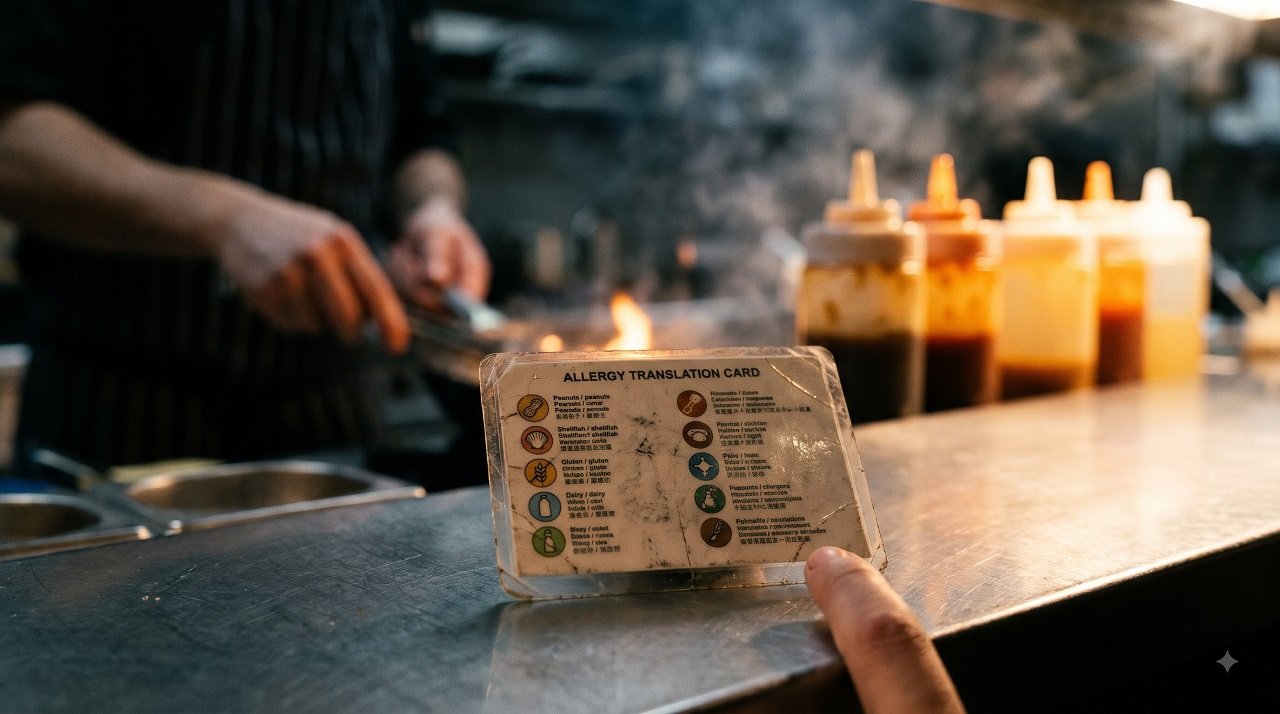
All survey figures, airline policies, and insurance rules in this guide reflect research published in 2025 and 2026. Airline allergy policies change, and insurance terms vary by provider and country.
If you are reading this in a later year, treat the sequence as still correct — understand the risk, prepare the documents, handle the flight, handle the restaurant, get the insurance right. But confirm your specific airline policy and policy wording before you rely on any detail here.
This guide is general information, not medical advice. Your allergy action plan should be written by your own clinician. In an emergency, use your prescribed epinephrine and call local emergency services.
All sources used in this guide are listed at the end.
Introduction
For most travellers, food is a pleasure. For travellers with food allergies, it is the most dangerous part of the trip.
The numbers are not marginal. A 2026 survey of families managing food allergies found that 45% had given up travelling entirely because of dietary restrictions . The two reasons tied for first place were “concerns could not be resolved” and “differences in language and food labeling rules” — both cited by 78% of respondents .
That second reason is the whole problem in one phrase. Food allergy travel is not primarily a medical challenge. It is a communication challenge. And the communication breaks down exactly where the risk is highest.
A 2026 scoping review in Tropical Diseases, Travel Medicine and Vaccines found that allergic reactions during travel ranged from 6.9% to 10.0%, with peanuts and tree nuts accounting for up to 75% of reported cases . Most reactions during international travel occurred in non-English speaking countries and in Europe .
Separate research from the Safer Tourism Foundation found that one in seven travellers (15%) reported a food-related allergic reaction on holiday — up from one in eight six months earlier, a 25% increase .
And a global survey of more than 4,700 food-allergy patients and caregivers found that 98% said their allergy added anxiety to air travel, while almost 10% had experienced an allergic reaction during a flight . Of those reactions, about 40% were not reported to flight crew or the airline at all .
This guide addresses the communication problem directly. It covers what actually goes wrong, how to build a translation card that works when a phone screen does not, how to handle the flight, how to order food without hoping, and the insurance declaration that decides whether a claim survives.
If you are travelling with regular medication, our guide to travelling with prescription medication covers the documentation and border rules that apply to your auto-injectors. If you are preparing for a trip where language will be a barrier, the guide to navigating language barriers covers the wider communication strategy.
Step 1: Understand What Actually Goes Wrong
Most food allergy travel advice focuses on the restaurant. The data says the risk is broader and starts earlier.
The Risk Is Concentrated in Three Places
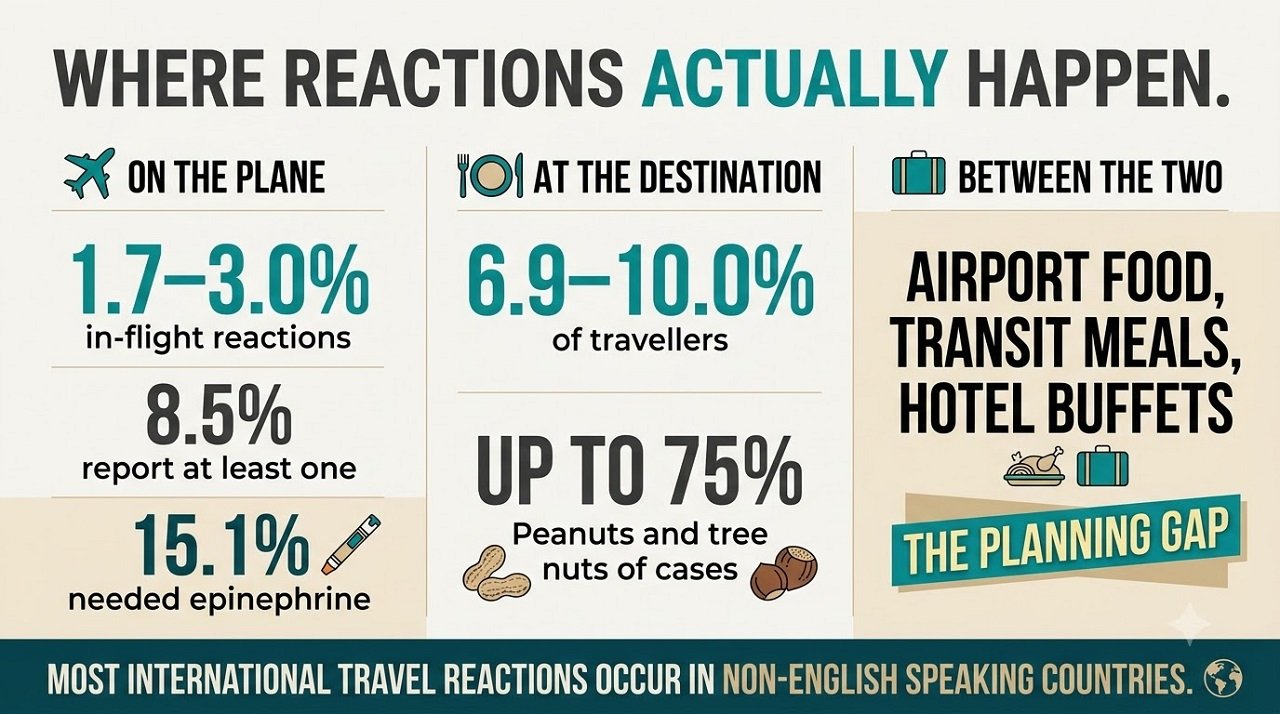
On the plane. In-flight reactions affect 1.7% to 3.0% of travellers with food allergy, according to the scoping review . The global survey found 8.5% reported at least one in-flight reaction, with peanut (3.9%), tree nuts (2.4%), and milk (0.6%) the most common triggers . Epinephrine was administered in 15.1% of those reactions, and was self-carried in 91.7% of them .
At the destination. Reactions during travel range from 6.9% to 10.0% . The scoping review notes that a lack of food labelling, multiple mixed ingredients in local dishes, unfamiliar cuisine, and language barriers are the recurring difficulties .
In the gap between them. Airline and airport food, transit meals, and hotel breakfast buffets sit outside both the “restaurant” and “flight” categories, and are where planning tends to be thinnest.
Why Language Is the Actual Failure Point
The MIMARU/matoil survey is blunt about this. When families were asked why they gave up on overseas travel, the two top reasons were unresolved concerns (78%) and language and food labelling differences (78%) .
The scoping review reaches the same conclusion from the clinical literature: most reactions during international travel occurred in non-English speaking countries .
This is not a coincidence. An allergen that is obvious in your own language is invisible in another. “May contain traces of nuts” has no reliable equivalent in a language you cannot read, and a menu that says “vegetarian” tells you nothing about cross-contamination.
The Concealment Problem
One of the strangest findings in the research is how many people choose not to disclose their allergy at all.
In the largest global survey of food-allergic air travellers, conducted by Northwestern University’s Center for Food Allergy and Asthma Research and published in JACI In Practice, 31% of respondents reported concealing their allergy from an airline or others while travelling .
Dr Chris Warren, the study’s lead author, described it as a “concerning trend” — passengers see disclosure as “potentially more likely to lead to inconvenience or unwanted intervention versus a helpful, informed effort to facilitate their chronic disease management” .
That calculation is understandable. More than a third of respondents reported unprofessional or insensitive behaviour from airline staff regarding their allergy, and 76% said those experiences affected their choice of airline .
But concealment is the one strategy that removes every safeguard at once. It is worth naming clearly, because the rest of this guide only works if you are willing to disclose.
If you are managing a condition that could require emergency care, our guide to what to do if you get sick or injured abroad covers the hospital and insurance sequence you would need if a reaction becomes serious.
Step 2: Build a Translation Card That Works When a Phone Screen Doesn’t
A phone with Google Translate is not a food allergy plan. The evidence on machine translation in this context is consistent and uncomfortable.
Why Machine Translation Fails Here
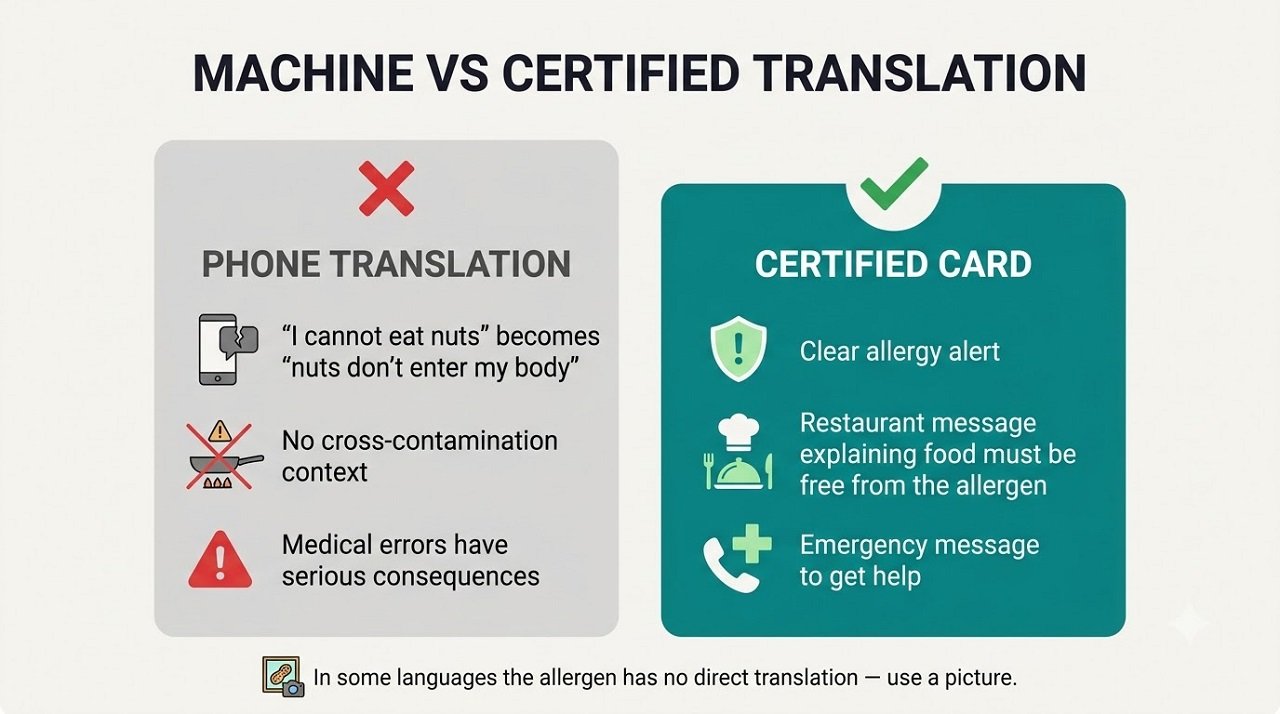
AllergyCard’s 2026 guide sets out the specific failure modes :
- Literal translation destroys urgency. “I cannot eat nuts” can translate literally as “nuts don’t enter my body” in some languages, which sounds like a preference, not a medical warning.
- Cross-contamination context is lost. A translation app will not add “please use clean equipment” or “check all sauces for hidden allergens” unless you type it — and even then the nuance can disappear.
- Medical translation errors have serious consequences. Machine translation is not designed for clinical stakes.
Allergy & Anaphylaxis Australia goes further on the practical side. Its guidance recommends getting a human speaker to translate your card rather than an app like Google Translate, because apps can sometimes be inaccurate . The organisation’s own cards use a certified translation service across 21 languages .
One detail from that guidance is worth knowing: in some languages, the English word for an allergen may not have a direct translation at all . A picture of the allergen may communicate more reliably than a word.
What a Proper Card Contains
Allergy UK’s cards, available in 35 languages and covering up to 200 allergens, include three separate messages on one card :
- A clear allergy alert message — what you cannot eat and how serious it is.
- A restaurant message — explaining that the food must be free from the allergen.
- An emergency message — to get help in an urgent situation.
Allergy & Anaphylaxis Australia’s cards add translated emergency phrases including “I am having a severe allergic reaction” and “Please call an ambulance” .
The Practical Rules
- Print and laminate. A physical card survives a kitchen, a wallet, and a language you cannot read. Allergy UK’s cards are made in durable plastic for exactly this reason .
- Carry multiple copies. You will not always get the card back. Allergy & Anaphylaxis Australia recommends making several copies for this reason .
- Give it to the kitchen, not just the waiter. The person who prepares the food is the person who needs the information.
- Use both languages. A bilingual card lets you confirm the translation is saying what you think it is saying.
- For non-Roman alphabets, print only. Copying and pasting can introduce errors, which is why some card templates are print-only .
If you are building a document pouch for the trip, the carry-on packing system covers how to keep cards, prescriptions, and your action plan together and accessible.
Step 3: Handle the Flight — Where the Policy Lottery Begins
Air travel is the part of the journey where you have the least control and the most anxiety. The 2026 airline comparison data explains why.
The Policy Is Genuinely Inconsistent
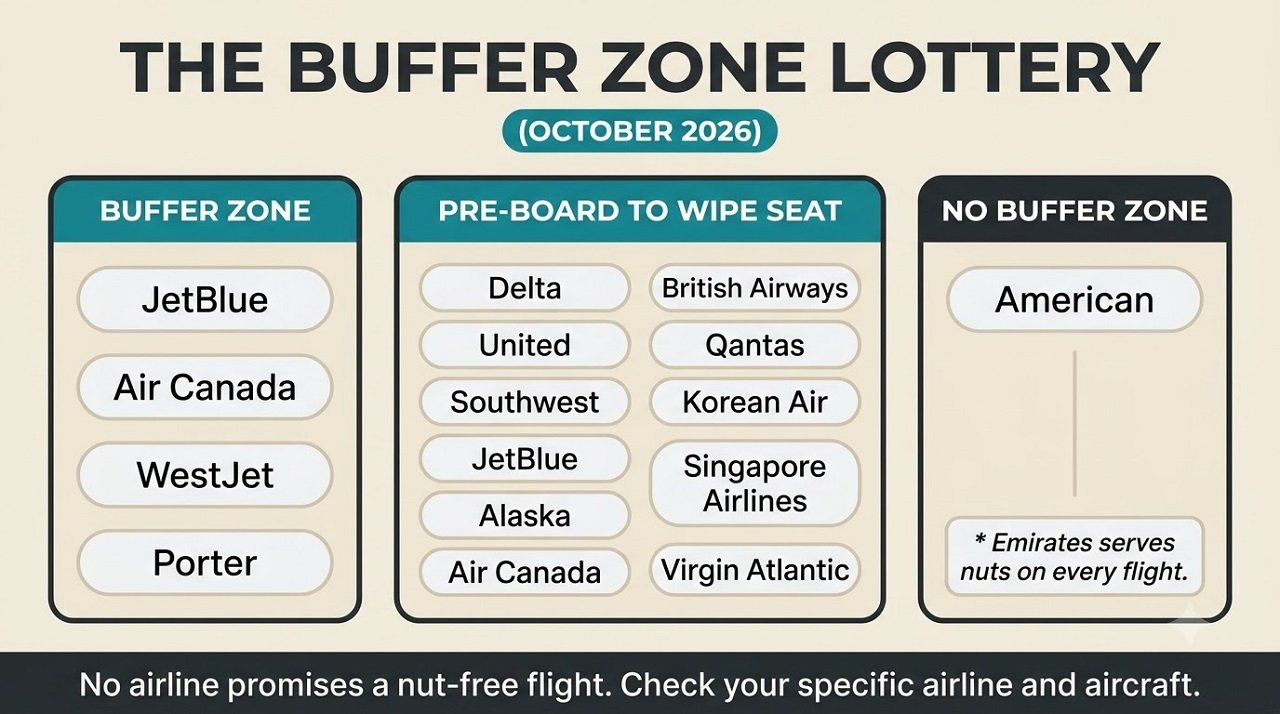
No airline promises a nut-free flight. What differs is how much they do to reduce risk: whether peanuts and tree nuts are served, whether you can pre-board to wipe your seat, and whether crew will ask nearby rows to refrain .
As of October 2026, the pattern across 26 airlines is :
| Measure | Which airlines |
|---|---|
| Buffer zone offered | JetBlue, Air Canada, WestJet, Porter |
| Pre-boarding to wipe seat | Delta, United, Southwest, JetBlue, Alaska, Air Canada, British Airways, Qantas, Korean Air, Singapore Airlines, Virgin Atlantic |
| No nut-free buffer zone | American |
| Nuts served on every flight, no allergy pre-boarding | Emirates |
| No allergy announcements, crew cannot give medication | Hawaiian |
The details matter as much as the headline. United’s kits carry epinephrine vials, not auto-injectors . Porter carries epinephrine only on E195-E2 jets, not Dash 8 aircraft . Delta began adding auto-injectors to kits in September 2026 . Air Canada requires buffer zone requests at least 48 hours before departure and does not make plane-wide announcements .
The Announcement Gap
The Safer Tourism Foundation found that just one in four travellers (26%) had been on a commercial flight where an announcement was made asking passengers to refrain from eating an allergen .
But the same research found something more encouraging: nine out of ten passengers say they will refrain from eating nuts if asked by the airline . The willingness is there. The announcement is not.
What to Do Before You Fly
- Check your specific airline’s current policy, not a general article. Policies change, and they differ by aircraft type.
- Request a buffer zone or pre-boarding at least 48 hours ahead where the airline offers it. Air Canada’s 48-hour rule is typical .
- Call, do not just book online. Allergy requests usually need a human to record them.
- Carry your own wipes and wipe the seat, tray table, and armrests yourself. Several airlines expect you to do this.
- Do not rely on the crew to have epinephrine. Carry your own, in your cabin bag.
- Tell the crew at boarding, even if you have disclosed in advance. The crew flying that day may not have seen the note.
The Auto-Injector Rules
Epinephrine auto-injectors are exempt from the TSA 3-1-1 liquids rule and do not need to be in a plastic bag . Carry them in your hand luggage, keep them in the original box with the pharmacy label attached, and carry a copy of the prescription or a doctor’s note .
There is no restriction on the number you can carry, but every device should have a prescription label . Carry at least two, and keep them accessible rather than in the overhead locker .
If you are travelling outside the US, note that some countries and airports require the device to be placed in a separate small plastic bag and declared at security . If your medication is part of a larger medical kit, our guide to travelling with prescription medication covers the documentation that should travel with it.
Step 4: Communicate at the Restaurant — The Sequence That Works
The restaurant is where most reactions happen, and where most travellers make the same three mistakes: they ask the wrong person, they ask the wrong question, and they ask once.
Who to Talk To
Ask for the chef or kitchen manager, not the waiter. In many restaurants the waiter does not prepare the food and cannot answer a cross-contamination question with confidence.
Allergy & Anaphylaxis Australia’s advice is explicit: give the chef card to the waiter or chef, and ask for it to come back with your specially prepared meal . That single instruction creates a chain of custody — the card goes to the kitchen and returns with the plate, which means the person who prepared it saw it.
What to Ask
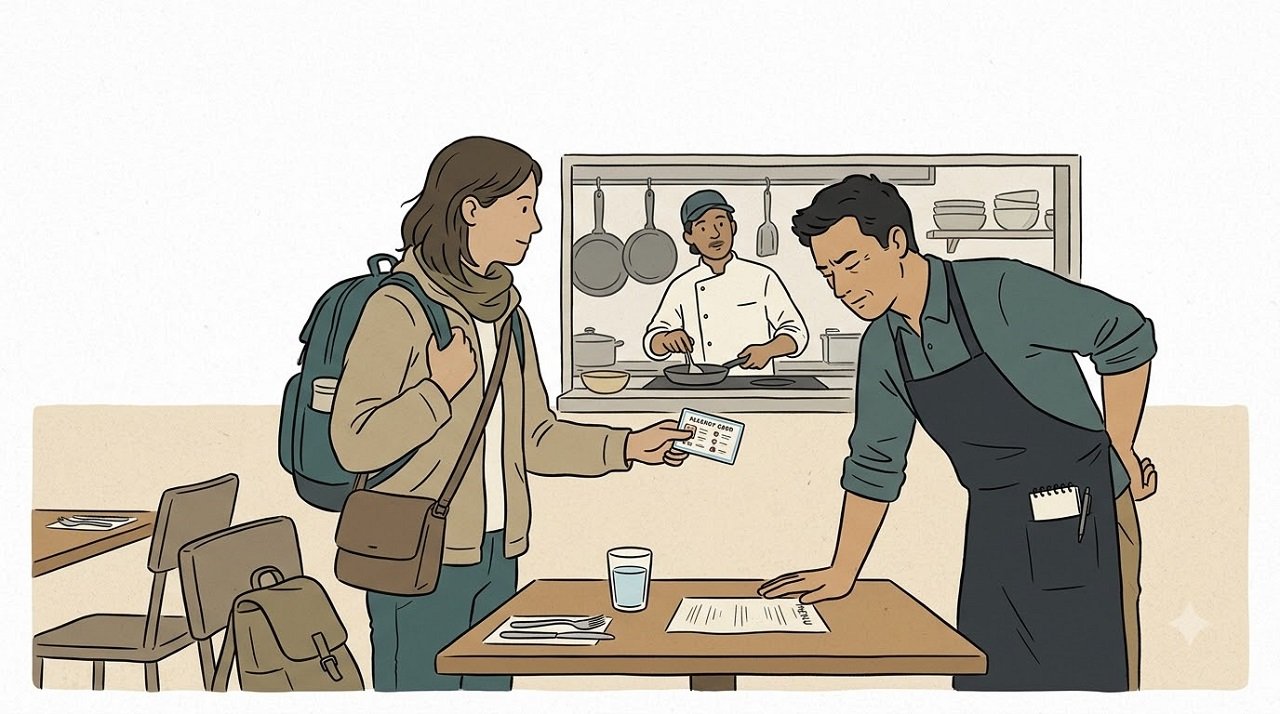
Do not ask “is this safe?” It is a yes/no question that invites a guess.
Ask instead:
- What is in this dish? (ingredients, not just the name)
- Is there any cross-contact with [allergen] in the kitchen? (shared oil, shared boards, shared utensils)
- Are any sauces, stocks, or garnishes made with [allergen]?
- Can this be prepared separately?
Cross-contamination is the question most travellers forget, and it is the one that matters most in kitchens that use the same wok, fryer, or grill for everything.
The Backup Food Rule
Always carry safe food. Allergy & Anaphylaxis Australia’s travel guidance is direct on this: carry backup snacks, because there will be situations where you do not feel confident eating local food .
This is not a failure of planning. It is the plan. A traveller who has safe food can wait for a restaurant that understands the request, rather than eating somewhere uncertain because there is no alternative.
The Cultural Dimension
In some destinations, “allergy” is not a familiar concept in the way it is at home. A request may be met with a polite nod that means “I have heard you” rather than “I understand and will act on this.”
Watch for the difference. If the response is vague, ask again in a different way, show the card, or leave. Being polite matters. Being understood matters more.
If you are somewhere the language barrier extends beyond food, our guide to navigating language barriers covers how to confirm that information has actually been understood rather than merely received.
Step 5: Get the Insurance Right — The Declaration That Decides Everything
This is the step with the highest financial stakes, and the one most people get wrong.
Declare Anaphylaxis, Not Just “Allergy”
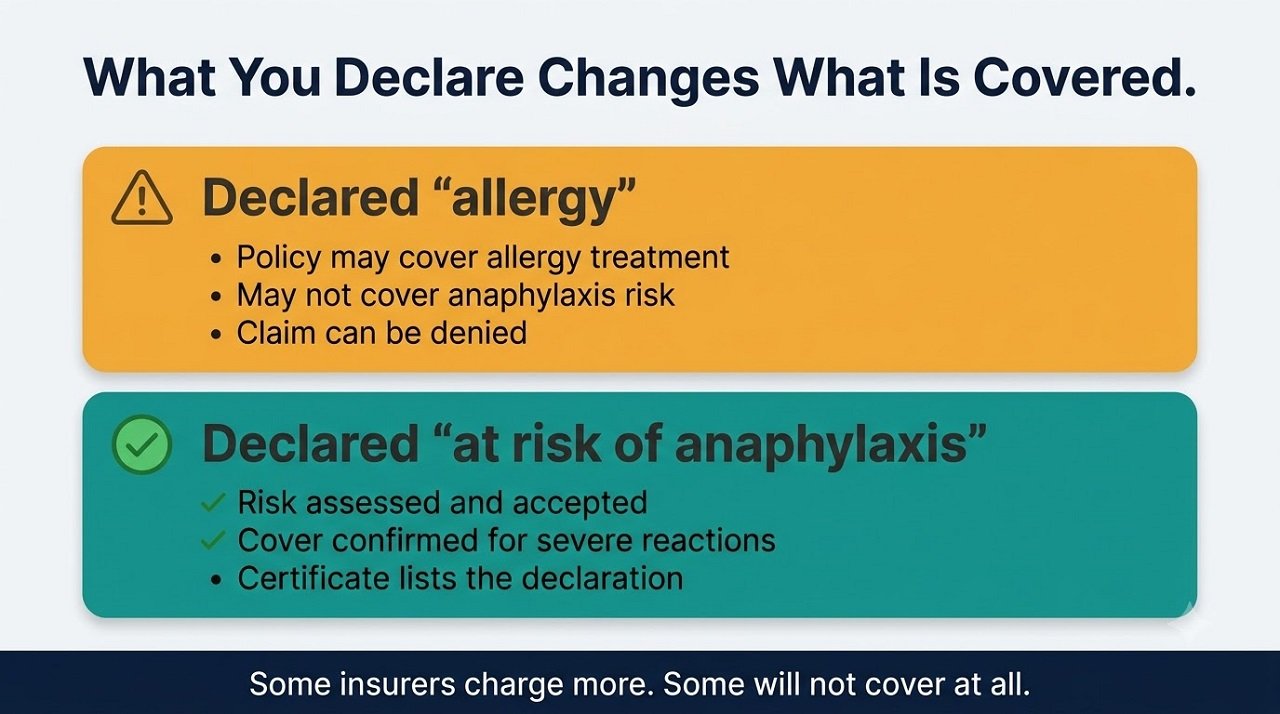
Allergy & Anaphylaxis Australia’s insurance checklist is unusually direct about this :
Declare all pre-existing medical conditions. This includes food allergy or being at risk of anaphylaxis. If you do not declare you are at risk of anaphylaxis, your claim may be denied if you have an allergic reaction while travelling. Just because the Product Disclosure Statement says allergies are covered, does not mean that being at risk of anaphylaxis is covered.
That distinction is the trap. A policy that covers “allergies” may not cover the risk of anaphylaxis unless it is specifically declared and accepted.
What the Insurer Will Ask
The checklist sets out what you need to be able to answer :
- When you last used your epinephrine device
- Whether you were treated in an emergency department only, or admitted to hospital
- Whether you have had emergency treatment for a severe allergy
- Your age, destination, and length of travel
Some insurers will cover you at standard rates. Others will charge an additional premium. Some will not provide cover at all .
The Country Rating Problem
Different countries are rated differently, and this affects the premium or whether cover is offered at all. Some locations within a country — an island, for example — may not be covered .
This is worth checking before you book, not after. If your destination is rated as higher risk, the insurance cost may change the trip budget. Our guide to budgeting for a trip from scratch treats insurance as a fixed line for exactly this reason.
The Notification Change
If you have an anaphylactic episode between taking out the insurance and your departure date, you must tell your insurer . A change in your medical history can affect your cover.
What to Keep With You
Keep the certificate of insurance listing any cover exclusions or declarations with your policy while you travel. Some countries require proof of insurance on admission to hospital .
If you have not compared policies yet, our guide to what travel insurance actually covers explains the benefit categories and exclusions that matter for medical claims.
The Emergency Plan
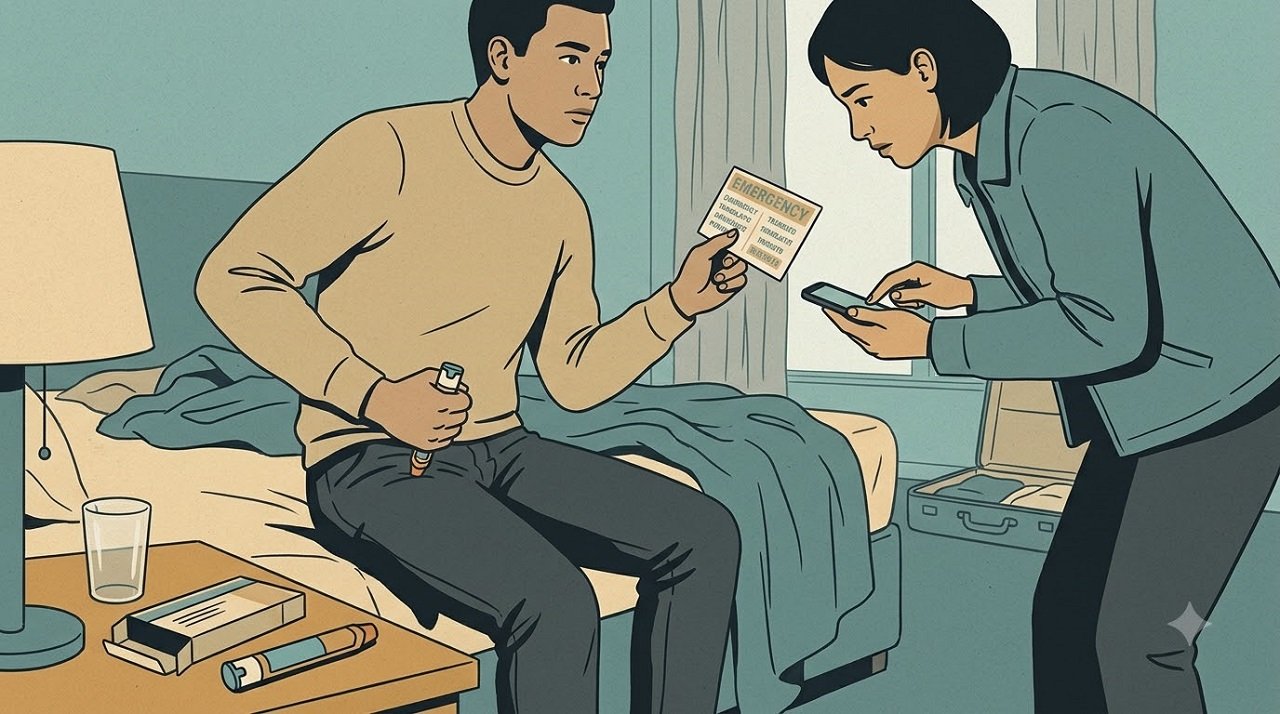
If a reaction happens, the plan should already exist — written by your clinician, carried with you, and understood by anyone travelling with you.
What the Plan Should Cover
- Recognising anaphylaxis — swelling of the face, lips, or throat, difficulty breathing, or a rapidly spreading rash
- When to use epinephrine — and the instruction not to wait for a mild symptom to become severe
- Who calls emergency services, and on what number
- What to say — a translated phrase card is the fastest route
- Where the second device is — because one may fail or be lost
The Translated Emergency Phrases
Allergy & Anaphylaxis Australia’s translated phrases include “I am having a severe allergic reaction” and “Please call an ambulance” across 21 languages . Carry them on the same card as your allergen list.
The Hospital Detail
If you end up in a hospital abroad, the insurance process has its own sequence and its own deadlines. Our guide to what to do if you get sick or injured abroad covers the notification window, the upfront payment problem, and the documents that decide the claim.
What to Carry
A practical kit, based on the sources above:
- Two epinephrine auto-injectors, in original packaging with prescription labels
- A copy of your prescription or a doctor’s note
- A written allergy action plan from your clinician
- Certified translation cards in the destination language, laminated, multiple copies
- Translated emergency phrases — “severe allergic reaction,” “call an ambulance”
- Safe backup snacks
- Your own wipes for the plane seat and tray
- Insurance certificate showing declared conditions
- A list of your allergens written in the local language, as a backup to the card
If you are packing this alongside other medical supplies, the carry-on packing system covers how to keep it all accessible rather than buried.
Conclusion
Food allergy travel is not solved by being careful. It is solved by being understood — and the places where understanding breaks down are predictable.
The data shows where the risk concentrates: on the plane, in restaurants where language fails, and in the gap where insurance was never properly declared. It also shows how many people respond by not travelling at all (45%) or by hiding their allergy (31%), both of which remove the safeguards rather than increase them.
The sequence that works is short:
- Understand where reactions actually happen.
- Prepare a certified translation card, not a phone screen.
- Handle the flight — check the specific airline, request what is available, carry your own epinephrine.
- Communicate at the restaurant — chef, cross-contamination questions, backup food.
- Declare anaphylaxis on your insurance, not just “allergy.”
If you remember one rule, make it this: the card and the declaration are the two things that decide the outcome. One gets you understood in a kitchen. The other gets you covered in a hospital.
If you are preparing the wider medical side of a trip, our guide to travel vaccinations covers the pre-trip health appointments that sit alongside this planning.
Frequently Asked Questions
How do I travel abroad with a food allergy?
Carry certified translation cards in the destination language, two epinephrine auto-injectors in original packaging with prescription labels, a written action plan, and safe backup food. Check your airline’s specific allergy policy before booking, request pre-boarding or a buffer zone where offered, and declare anaphylaxis risk on your travel insurance.
Are allergy translation cards reliable?
Cards produced with certified human translation are reliable. Machine translation is not — “I cannot eat nuts” can translate literally as “nuts don’t enter my body,” losing the medical urgency. Allergy & Anaphylaxis Australia recommends a human speaker rather than Google Translate because apps can be inaccurate.
Which airlines offer buffer zones for nut allergies?
As of October 2026, JetBlue, Air Canada, WestJet, and Porter offer buffer zones. Delta, United, Southwest, JetBlue, Alaska, Air Canada, British Airways, Qantas, Korean Air, Singapore Airlines, and Virgin Atlantic allow pre-boarding to wipe your seat. American does not offer nut-free buffer zones, and Emirates serves nuts on every flight.
Does travel insurance cover anaphylaxis?
Only if you declare the risk of anaphylaxis as a pre-existing condition and the insurer accepts it. A policy that says “allergies are covered” does not necessarily cover anaphylaxis risk. Some insurers charge extra, and some will not provide cover at all.
Can I bring an EpiPen on a plane?
Yes. Epinephrine auto-injectors are exempt from the TSA 3-1-1 liquids rule, there is no limit on the number you can carry, and they should travel in your cabin bag in original packaging with prescription labels. Keep them accessible, and tell security at the start of screening.
Why do so many travellers hide their food allergy?
In the largest global survey of food-allergic air travellers, 31% reported concealing their allergy. The lead researcher described it as a “concerning trend” — passengers see disclosure as more likely to cause inconvenience than help. More than a third reported unprofessional or insensitive behaviour from airline staff.
What should I do if I have a reaction abroad?
Use your prescribed epinephrine immediately if anaphylaxis is suspected, call local emergency services, and show your translated emergency phrase card. Contact your insurer’s assistance line as soon as possible, keep every receipt and medical document, and follow the claim notification window in your policy.
Sources
- MIMARU / matoil. [Survey] 45% of travelers have given up trips due to food concerns. Published 17 March 2026. 45% gave up travelling due to dietary restrictions from food allergies; top reasons tied at 78% for “concerns could not be resolved” and “differences in language and food labeling rules”; 58% said ease of accommodating allergies is a key factor in destination choice.
https://mimaruhotels.com/de/news/matoil_2603/ - Tropical Diseases, Travel Medicine and Vaccines (Springer). Characteristics of food-related allergic reactions during travel: a scoping literature review. Published 2026, Volume 12, article 5. In-flight reactions 1.7–3.0%; travel reactions 6.9–10.0%; peanuts and tree nuts up to 75% of cases; most international travel reactions in non-English speaking countries and Europe; two fatalities; reactions likely underestimated; food allergy prevalence 1–10% globally.
https://link.springer.com/article/10.1186/s40794-025-00282-z - RNZ. Flying with a food allergy contributes to high anxiety levels and air travel burden, survey finds. Survey of more than 4,700 food allergy patients and caregivers, published in the Journal of Allergy and Clinical Immunology. 98% said food allergy added anxiety to air travel; almost 70% of Australia/NZ respondents said “a lot”; almost 10% had an in-flight reaction; about 40% of those reactions not reported to crew; more than a third experienced unprofessional or insensitive behaviour; 76% said it affected airline choice; Dr Chris Warren on the “concerning trend” of concealment.
https://www.rnz.co.nz/news/health/535906/flying-with-a-food-allergy-contributes-to-high-anxiety-levels-and-air-travel-burden-survey-finds - Safer Tourism Foundation. 1 in 7 travellers affected by food allergies on holiday. One in seven travellers (15%) reported a food-related allergic reaction on holiday, up from one in eight (12%) six months earlier — a 25% increase; 50% more nervous about travelling; 64% take extra precautions; 33% prioritise health and safety over cost; just 26% had been on a flight with an allergen announcement; nine in ten will refrain from eating nuts if asked.
https://www.safertourism.org.uk/blog-posts/1-in-7-travellers-affected-by-food-allergies-on-holiday - Allergy & Anaphylaxis Australia. Translated chef cards & phrases for travelling. Updated May 2025. Chef cards in 21 languages using a certified translation service; English allergen words may not have direct translations; recommends a human speaker rather than Google Translate; translated emergency phrases including “I am having a severe allergic reaction” and “Please call an ambulance”; print-only for non-Roman alphabets; make several copies.
https://webarchive.nla.gov.au/awa/20241015210305/https://allergyfacts.org.au/resources/downloads/translated-chef-cards/ - Allergy & Anaphylaxis Australia. Travel to non-English speaking countries with risk of anaphylaxis. Personal account with practical strategies: print and laminate allergy cards, use a human translator rather than apps, carry backup snacks, carry two EpiPens.
https://web.archive.org/web/20251213083404/https://allergyfacts.org.au/story/travel-to-non-english-speaking-countries-with-risk-of-anaphylaxis/ - Allergy UK. Allergy UK translation cards help you deal with food allergies abroad. Cards in 35 languages covering up to 200 allergens; include an allergy alert message, a restaurant message, and an emergency message; made in durable plastic.
https://allergyuk.shop/products/Plastic-Translation-Cards-c166860900
https://allergyuk.shop/products/Digital-Translation-Cards-c166860343 - Allergy & Anaphylaxis Australia. Checklist for travel insurance. Declare food allergy or risk of anaphylaxis as a pre-existing condition; a PDS saying allergies are covered does not mean anaphylaxis risk is covered; some insurers charge extra and some will not cover; different countries and some locations within a country are rated differently; notify the insurer of any episode between purchase and departure; keep the certificate listing exclusions and declarations.
https://web.archive.org/web/20251212195701/https://allergyfacts.org.au/checklist-for-travel-insurance/ - AllergyCard. Airline Nut Allergy Policies Compared: 26 Airlines (2026). Updated October 2026. JetBlue, Air Canada, WestJet, and Porter offer buffer zones; Delta, United, Southwest, JetBlue, Alaska, Air Canada, British Airways, Qantas, Korean Air, Singapore Airlines, and Virgin Atlantic allow pre-boarding; American does not offer nut-free buffer zones; Emirates serves nuts on every flight and does not allow allergy pre-boarding; Hawaiian makes no announcements and crew cannot give medication; United kits carry epinephrine vials not auto-injectors; Porter carries epinephrine only on E195-E2 jets; Delta began adding auto-injectors to kits in September 2026.
https://allergycard.app/travel/airline-nut-allergy-policies - AllergyCard. Food Allergy Cards for Travel: The Complete 2026 Guide. Published 10 February 2026. Literal translation problems — “I cannot eat nuts” may translate as “nuts don’t enter my body”; no cross-contamination context; machine translation errors in medical contexts; verified reviewed translations.
https://allergycard.app/blog/food-allergy-card-for-travel - Drugs.com. Can you bring an EpiPen on a plane? Last updated 16 April 2025. Epinephrine auto-injectors exempt from TSA 3-1-1; carry in hand luggage; keep original box with pharmacy label; carry prescription copy or doctor’s note; no restriction on number; some countries require a separate plastic bag; keep accessible.
https://www.drugs.com/medical-answers/you-bring-epipen-plane-3573523/ - LinkedIn / Lianne Mandelbaum. Food Allergy Stigma: 31% of Travelers Hide Condition. Citing the Northwestern University Center for Food Allergy and Asthma Research global survey published in JACI In Practice: 31% of respondents reported concealing their allergy from an airline or others while travelling.
https://www.linkedin.com/posts/lianne-mandelbaum-b8a4a180_in-my-work-documenting-the-experiences-of-activity-7498125768229552128-KPCF - Mendeley / Journal of Allergy and Clinical Immunology. Understanding Experiences, Barriers, and Facilitators of Safe Airline Travel: A Global Survey of Food Allergy Patients and Caregivers. 8.5% reported one or more in-flight food-allergic reaction; peanut 3.9%, tree nuts 2.4%, milk 0.6%; epinephrine administered in 15.1% of reactions, self-carried in 91.7%.
https://www.mendeley.com/catalogue/2fabd93a-5310-33e3-8702-20b5a0e43ac0/