
All statistics, claim figures, and evacuation costs in this guide reflect research published in 2025 and 2026. Insurance terms, hospital payment practices, and notification windows vary by provider and country.
If you are reading this in a later year, treat the sequence as still correct — decide, get care, call, pay, document, claim. But confirm your specific policy terms before you rely on any figure here.
This guide is general information, not medical or legal advice. In a life-threatening emergency, call local emergency services first and read this later.
All sources used in this guide are listed at the end.
Introduction
Getting sick abroad is the single biggest fear travellers have. Global Rescue’s Winter 2026 survey of more than 1,400 experienced travellers found that 31% named illness or injury abroad as their biggest travel disruption concern — ahead of civil unrest, ahead of lost passports, ahead of everything else.
The fear is not irrational. One in six travellers files a travel insurance claim each year, and medical emergencies now account for 42% of all claims with an average payout of $5,200, nearly double the next-largest category.
But the fear produces a specific failure. The Holafly Plans Wellbeing Index 2026 found that 47.5% of frequent and long-stay travellers have delayed or avoided seeking medical care abroad even when they felt they needed it. Among those who actually experienced a health issue on the road, that figure climbs to 60.8%. Among those whose condition eventually became serious enough for a clinic or emergency room, 62.3% had hesitated first.
The reasons are consistent across the research. Travellers who worry about communicating with medical staff are 2.2 times more likely to delay. Those intimidated by foreign medical paperwork and insurance verification are 2.2 times more likely. Those anxious about cost and claims are 2.2 times more likely.
This guide removes those three frictions. It covers the sequence properly — when it is genuinely an emergency, what to bring, who to call before you pay, why hospitals demand money upfront, and the notification deadline that decides whether your claim survives.
If you have not arranged insurance yet, our guide to what travel insurance actually covers explains which benefits matter. If you are travelling alone, the solo travel safety guide covers the planning that makes an emergency survivable without a companion.
Step 1: Decide Whether It Is Genuinely an Emergency
The first decision determines everything that follows. Getting it wrong in either direction costs you — either unnecessary expense, or a delay that makes a treatable condition worse.
Call Local Emergency Services Immediately If
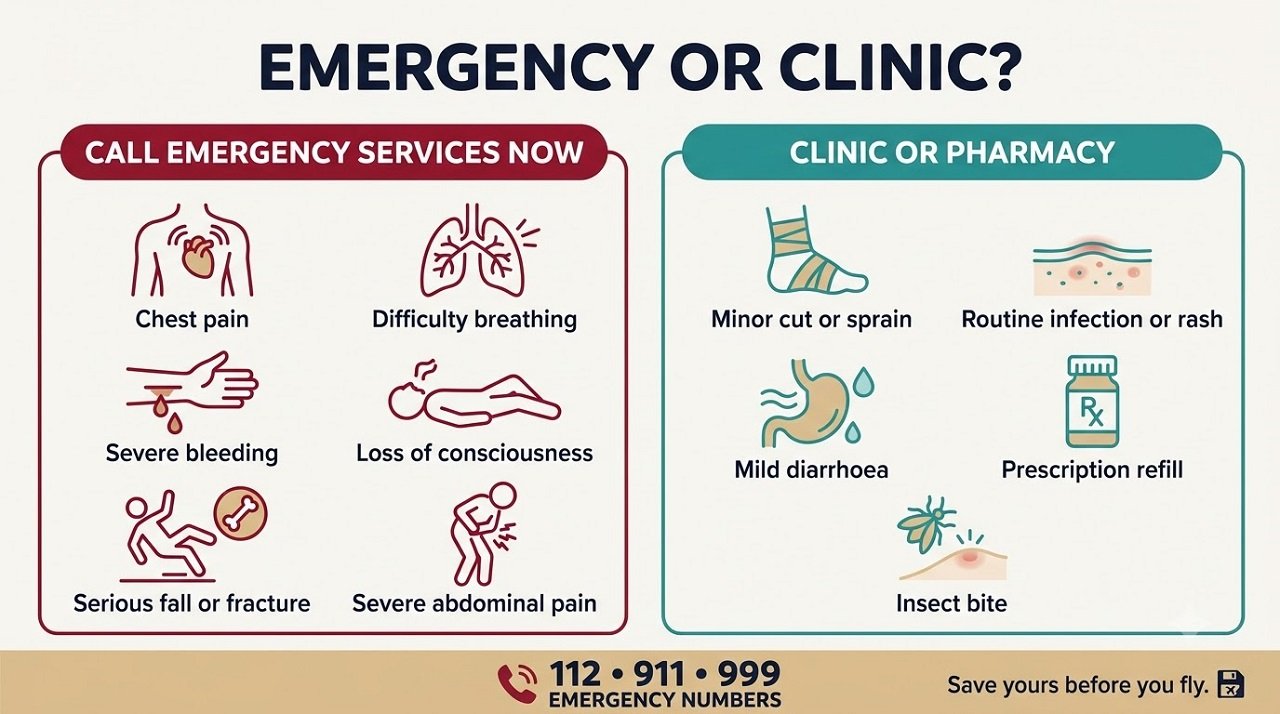
- Chest pain, difficulty breathing, or signs of a stroke
- Severe bleeding that will not stop
- Loss of consciousness, confusion, or a seizure
- A serious fall or suspected fracture
- Severe abdominal pain, or vomiting that prevents you keeping fluids down
- A high fever with a rash, stiff neck, or confusion
Emergency numbers vary. 112 works across the European Union, 911 in the US and Canada, 999 in the UK, and most countries have a local equivalent. Look yours up and save it before you fly.
Go to a Clinic or Pharmacy If
- A minor cut, sprain, or burn
- A routine infection, rash, or insect bite
- Traveller’s diarrhoea that is not severe
- A prescription refill or a minor ongoing issue
Clinics are cheaper, faster, and less paperwork. Pharmacists in most countries can handle common ailments and often speak more English than you expect.
The Delay Data
The hesitation is not trivial. Research published in the Journal of Travel Medicine found that 52.2% of ill international travellers waited until returning home to seek professional care, allowing manageable conditions to become more complex.
Part of that is cost anxiety. Part is unfamiliarity. But the clinical evidence on language is the most uncomfortable: 49.1% of adverse events involving patients facing language barriers resulted in physical harm, compared with 29.5% among native-speaking patients.
That single finding is why this guide recommends calling your insurer’s assistance line early — not just for money, but for a translator and a recommendation about where to go.
If you are somewhere you do not speak the language, our guide to navigating language barriers covers the phrases and written notes worth preparing in advance.
Step 2: Get to the Right Place With the Right Documents
What to Bring
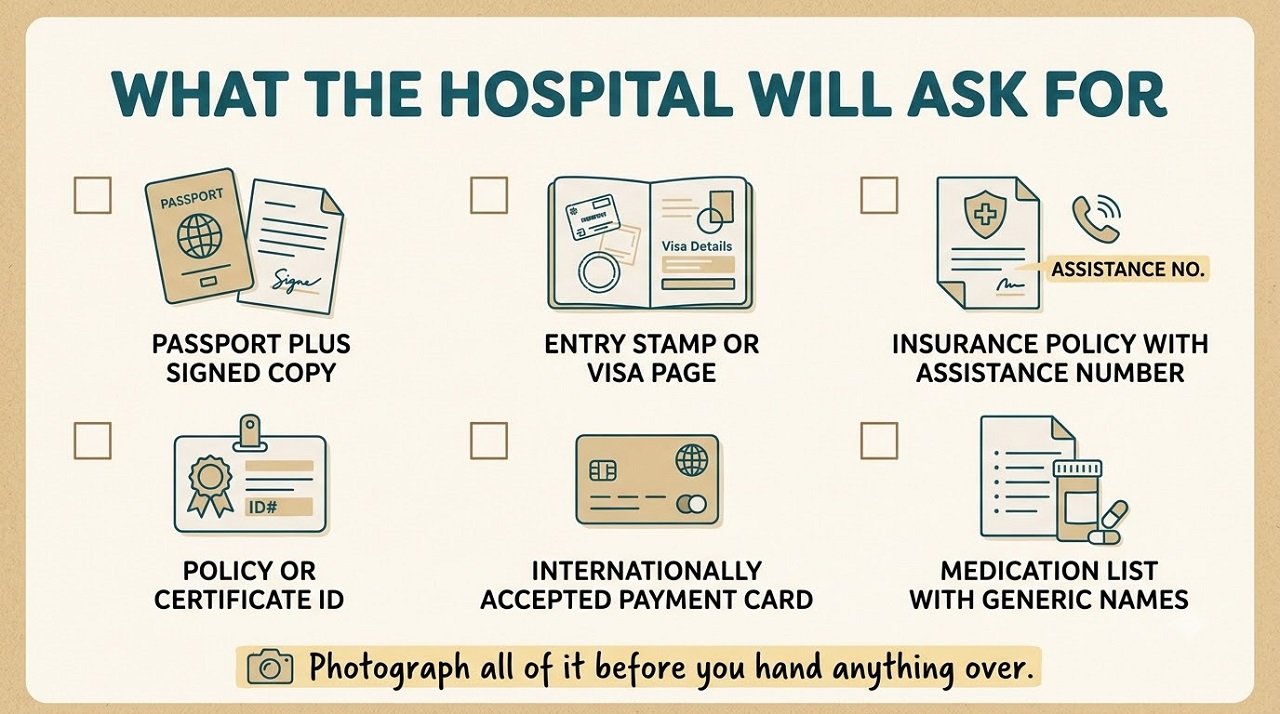
Hospitals abroad routinely ask for documents that travellers do not have on them. A Bangkok hospital’s outpatient requirements, for example, specify passport and a signed copy of the passport on arrival.
Bring:
- Passport, plus a photocopy or phone photo
- Entry stamp or visa page — some facilities require proof of legal entry
- Insurance policy or certificate, including the emergency assistance phone number
- Policy or certificate ID number
- Payment card that works internationally
- Medication list with generic names and doses
- Any relevant medical history in English, if you have it
If you take regular medication, our guide to travelling with prescription medication covers the documentation that should already be in your bag.
Public vs Private
In many countries, public hospitals are cheaper and handle emergencies well. Private hospitals are faster, more likely to have English-speaking staff, and more likely to bill your insurer directly — but they cost more.
If it is a genuine emergency, go to the nearest adequate facility. If it is urgent but not life-threatening, and you have a functioning phone, call your insurer’s assistance line first and ask which facility they work with.
The One Call That Saves Money
World Nomads states the position plainly: for emergency situations requiring hospital admission or medical evacuation, the assistance team may be able to coordinate payment with the hospital directly — but they need to know something has happened, which means you or a companion must call the 24/7 emergency assistance team as early as possible.
The earlier they are involved, the more they can do. Our guide to budgeting for a trip from scratch treats insurance as a fixed line for exactly this reason.
Step 3: Call the Assistance Line Before You Pay Anything
Why This Comes Before Payment
Most travellers assume the hospital bills the insurer. It usually does not.
ICI Traveler’s guidance is direct: many hospitals — particularly smaller clinics or facilities in remote areas — require payment before treatment or discharge. In those cases you pay by card, keep every receipt and medical record, and claim reimbursement afterwards.
Direct billing exists, but it is not guaranteed. It depends on the hospital, the country, the severity, and your policy.
What the Assistance Team Can Do
- Contact the hospital on your behalf
- Verify your benefits and explain what is covered
- Arrange a guarantee of payment where the facility accepts one
- Coordinate communication between hospital and insurer
- Arrange emergency transport if medically necessary
- Provide translators — Seven Corners Assist, for example, has translators in more than 130 languages
- Liaise with your family at home
- Locate the nearest embassy or consulate
What to Have Ready
The assistance line will ask for:
- Policy or certificate number
- Your current location and the name of the hospital or clinic
- A description of symptoms or injury
- Passport details
- A number where they can reach you
Having these written on one page before you travel turns a stressful call into a two-minute one.
The Notification Deadline
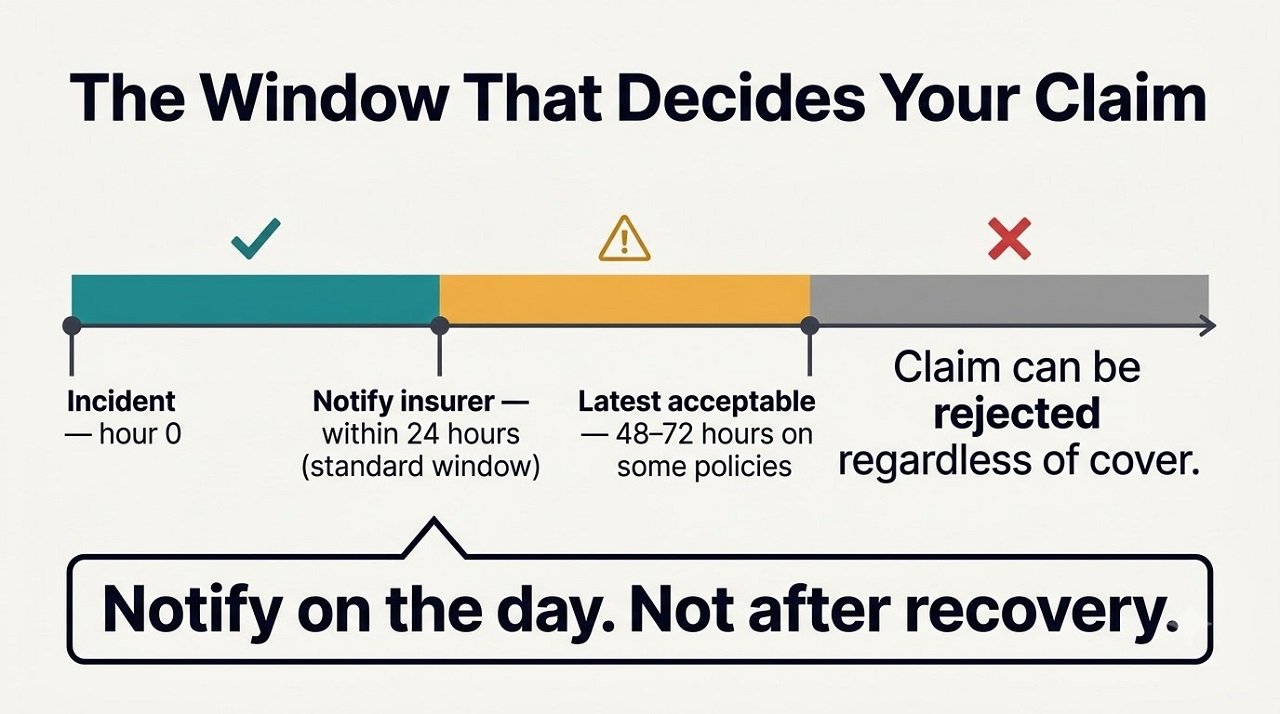
This is the detail that voids more claims than any other.
Most policies require notification within 24 to 72 hours of the incident. Economic Times reporting on Indian insurers describes 24 hours as the standard window, and notes that missing it gives insurers grounds to reject the claim regardless of whether the event was covered. Dook International’s analysis of 2026 claims puts the general range at 24–72 hours, with 24 hours typical for theft or accidents.
Notify on the day. Not after recovery. Not on the flight home.
Step 4: Understand Who Pays — and What to Do If You Must Pay Upfront
The Two Payment Models
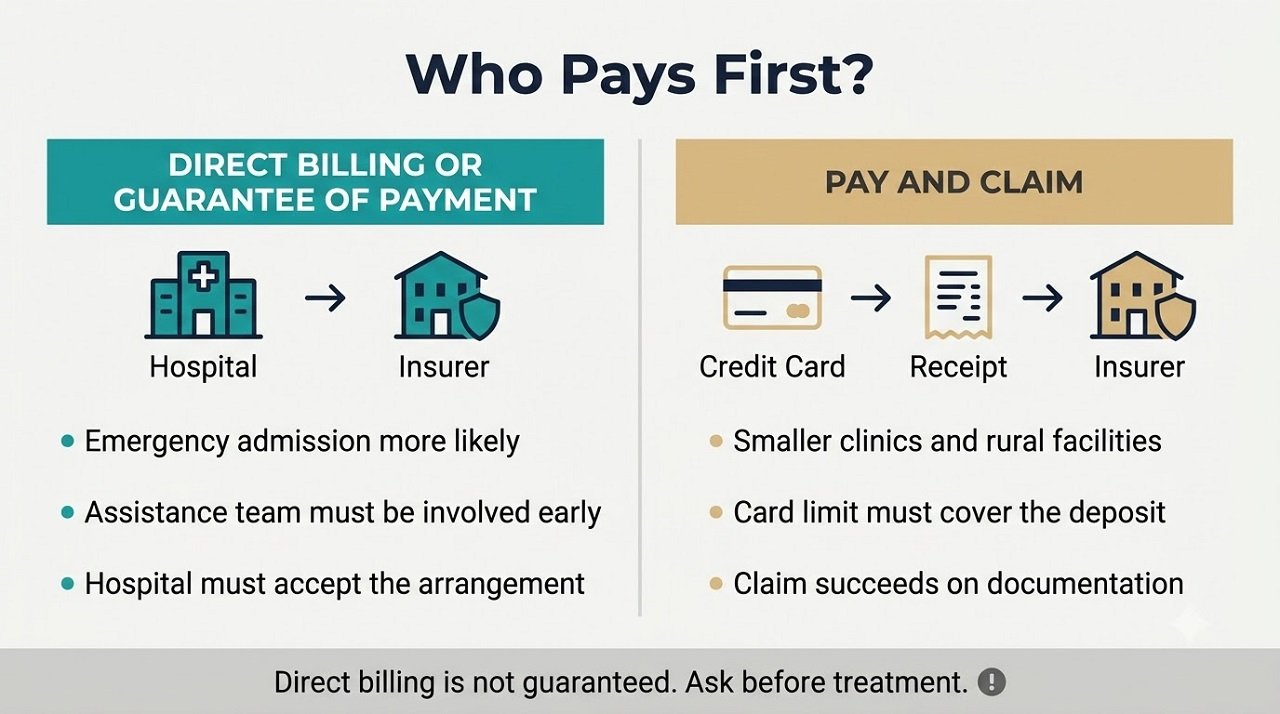
| Model | How it works | What you need |
|---|---|---|
| Direct billing / guarantee of payment | Insurer authorises the hospital and settles directly | Assistance team involved early; hospital accepts the arrangement |
| Pay and claim | You pay the hospital, then claim reimbursement | Working card with sufficient limit; every receipt and record |
Direct billing is more likely for emergency admissions and evacuations. It is less likely for walk-in clinics and rural facilities, where upfront payment is standard.
The Card Limit Problem
This is the practical trap nobody warns about.
Hospital deposits frequently exceed a card’s daily transaction ceiling. Analysis of medical payments in Thailand describes it precisely: a single transaction at hospital scale will frequently exceed a card’s daily ceiling, and a family discovering this at the cashier’s window on a Friday afternoon has a genuine problem.
Before you travel:
- Check your daily card limit and raise it if possible.
- Tell your bank you are travelling so the card is not frozen on the first large transaction.
- Carry a second card from a different provider.
- Know the deposit expectation. Many private clinics ask for a deposit of roughly 10–30% to hold a date, with the balance on arrival.
If the Insurer Will Not Authorise Direct Payment
You pay. Then you claim.
This is not a failure. It is the standard route for smaller facilities. The claim succeeds or fails on documentation, not on who paid first.
The Evacuation Question
Evacuation is not something you request. It is authorised when the treating physician or the insurer’s medical team determines that the current facility cannot provide adequate treatment and transport is medically necessary.
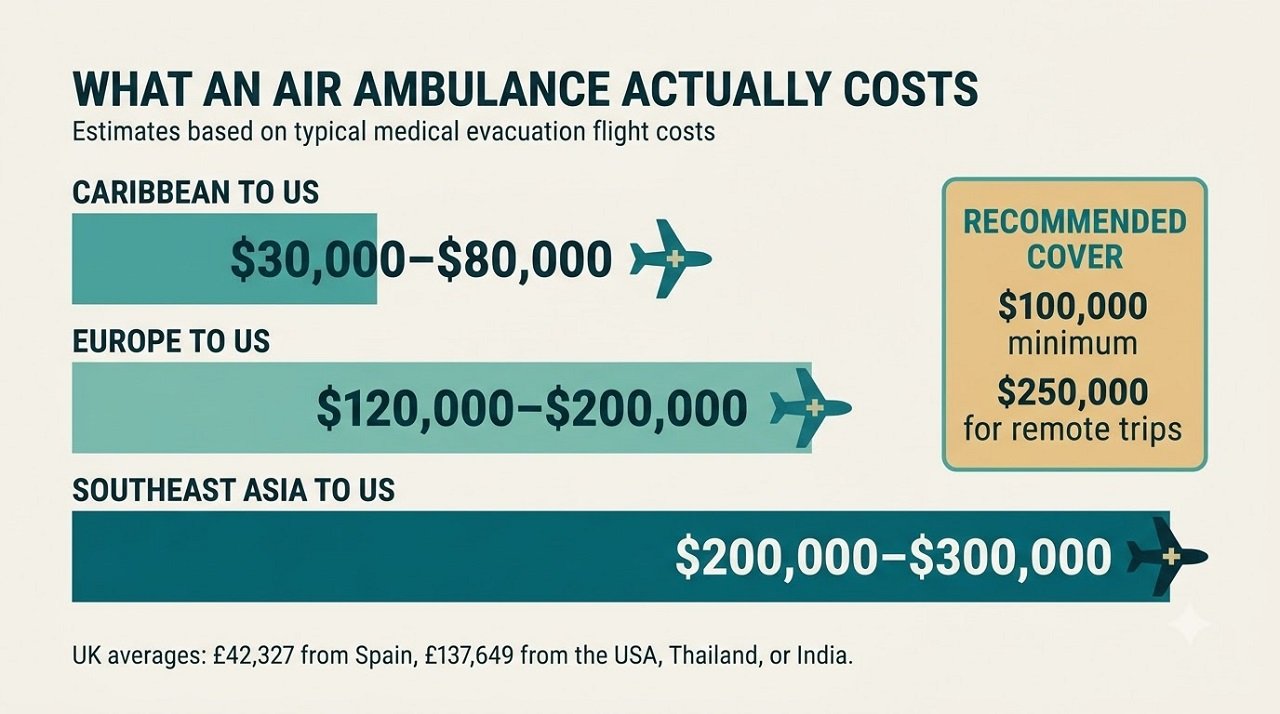
Coverage limits matter more than most travellers realise. Squaremouth recommends at least $100,000** in evacuation coverage for most trips, and **$250,000 for remote destinations, cruises, or adventure activities.
The actual costs justify those numbers:
| Route | Typical air ambulance cost |
|---|---|
| Caribbean to US | $30,000–$80,000 |
| Europe to US | $120,000–$200,000 |
| Southeast Asia to US | $200,000–$300,000 |
UK data from Staysure shows the average air ambulance from Spain at £42,327, and the average repatriation from the USA, Thailand, or India at £137,649.
Step 5: Document Everything and File Inside the Deadline
The Documentation That Decides the Claim
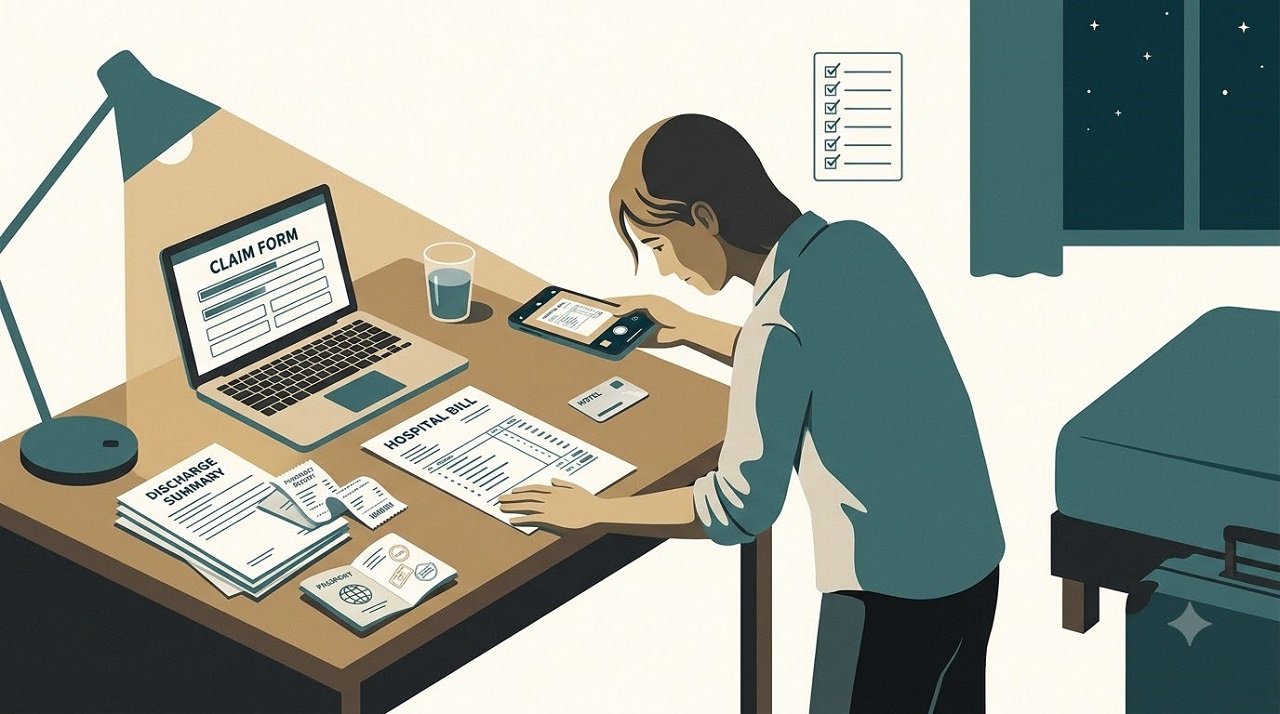
Dook International’s 2026 analysis found that 35–40% of travel insurance claim rejections are due to insufficient or missing documentation alone — not because the claim was invalid.
For a medical claim, the baseline set is:
- Completed and signed claim form
- Policy certificate
- Passport copy with entry and exit stamps
- Original tickets or boarding passes
- Hospital bills, itemised
- Discharge summary
- Pharmacy receipts
- Medical reports or doctor’s notes
- Payment receipts for anything you paid yourself
Keep the originals. Photograph everything before you hand it over.
The Filing Window
Most insurers allow 30 to 60 days from the incident to submit a claim. Waiting that long is a mistake. Documents get lost, memories fade, and hospitals stop responding to email.
File as soon as you have the full set — ideally within days of returning home.
Common Rejection Reasons Beyond Documents
- Undisclosed pre-existing condition. Any condition diagnosed or treated within roughly 48 months before the policy start date may count as pre-existing. Insurers can reject claims for seemingly unrelated incidents if a condition was not declared.
- Late notification. Covered in Step 3.
- Negligence. Leaving a bag unattended, or valuables in checked luggage, is frequently excluded under a “reasonable care” standard.
- Excluded activity. Adventure sports injuries are routinely excluded unless a rider was purchased.
If you declared nothing and take regular medication, our guide to travelling with prescription medication covers why the declaration matters. And if your documents were stolen along with your bag, the sequence in what to do if you lose your passport abroad covers the police report you will also need for the claim.
What Insurance Will Not Cover
Three exclusions cause most of the disappointment.
Routine care for a known condition. A check-up, a refill, or management of a condition you already knew about is not an emergency. Some policies cover life-threatening flare-ups of pre-existing conditions; many do not.
Treatment you could reasonably have had at home. Elective procedures and planned treatment abroad are outside the scope of travel insurance.
Incidents involving alcohol, drugs, or illegal activity. Standard exclusion, applied strictly.
The pre-existing condition waiver is the fix for the first one — but it usually requires buying the policy within 7 to 21 days of your first trip payment. Miss the window and the exclusion stands.
If the Claim Is Rejected
Do not accept the first refusal.
- Ask for the specific exclusion relied on, in writing.
- Ask what documentation would have changed the outcome. Sometimes it is a missing discharge summary, not a coverage issue.
- Escalate to the insurer’s complaints process, then to the relevant ombudsman or regulator. In India, the Insurance Ombudsman handles claims free of charge. In the UK, the Financial Ombudsman Service does the same.
- Check whether the rejection is procedural or substantive. A procedural rejection — late notification, missing paper — can sometimes be reopened with a written explanation.
If your trip was disrupted by a flight problem rather than illness, our guide to claiming flight delay and cancellation compensation covers the separate process and the deadlines that apply.
Conclusion
The fear of getting sick abroad is well-founded, and the data shows it changes behaviour in a way that makes things worse. Nearly half of long-stay travellers delay care. Among those who eventually needed a clinic or emergency room, 62.3% hesitated first.
The sequence that removes the hesitation is short:
- Decide whether it is a genuine emergency.
- Go to the right facility with your passport, policy, and card.
- Call the assistance line before you pay anything.
- Understand whether the hospital bills directly or expects payment upfront — and have a card that can handle it.
- Document everything and file inside the deadline.
The most expensive mistakes are not medical. They are procedural: 24-hour notification windows missed, 35–40% of rejections caused by missing paperwork, and card limits discovered at the cashier’s window.
If you remember one rule, make it this: call the assistance line on the day, before you pay, and keep every piece of paper. That call is the difference between a claim that works and one that does not.
If you have not compared policies yet, our guide to what travel insurance actually covers explains the benefit limits and exclusions that matter most. And if you are heading somewhere with current health or security concerns, the guide to reading government travel advisories covers how to check conditions before you go.
Frequently Asked Questions
What should I do first if I get sick or injured abroad?
If it is life-threatening, call local emergency services immediately — 112 in the EU, 911 in North America, 999 in the UK. If it is urgent but not life-threatening, contact your insurer’s 24/7 assistance line before going to a clinic. They can recommend a facility, arrange direct billing where possible, and provide a translator.
Will travel insurance pay the hospital directly?
Sometimes. Direct billing or a guarantee of payment is more likely for emergency admissions and evacuations where the assistance team is involved early. Many clinics, particularly smaller or rural facilities, require payment before treatment or discharge, and you claim reimbursement afterwards.
How long do I have to notify my insurer?
Most policies require notification within 24 to 72 hours of the incident, with 24 hours typical. Missing the window can void an otherwise valid claim regardless of whether the event was covered.
When is medical evacuation covered?
When a physician or the insurer’s medical team determines the current facility cannot provide adequate treatment and transport is medically necessary. It is not available on request or personal preference. Squaremouth recommends at least $100,000 in evacuation coverage, and $250,000 for remote destinations.
What documents do I need for a medical claim?
A signed claim form, policy certificate, passport copy with entry and exit stamps, boarding passes, itemised hospital bills, discharge summary, pharmacy receipts, medical reports, and proof of any payment you made yourself. Missing documentation causes 35–40% of rejections.
Does travel insurance cover a pre-existing condition?
Usually not unless you qualify for a pre-existing condition waiver, which typically requires buying the policy within 7 to 21 days of your first trip payment. Some policies cover life-threatening flare-ups of declared conditions; many do not.
What if my claim is rejected?
Ask for the specific exclusion in writing, ask what documentation would have changed the outcome, and escalate through the insurer’s complaints process and then to the relevant ombudsman. Procedural rejections — late notification, missing paperwork — can sometimes be reopened with a written explanation.
Sources
- Global Rescue / Travel + Leisure. This Is What Travelers Are Most Concerned About in 2026 — and How It’s Changing Their Plans. Winter 2026 Traveller Sentiment and Safety Survey, 1,400+ respondents polled 13–17 January 2026. 31% name illness or injury abroad as their biggest concern; 12% cite losing passport, cards, or wallet. https://www.travelandleisure.com/travel-safety-concerns-in-2026-11944614
- Holafly. Sick abroad: Why 47% of travellers avoid the doctor. Holafly Plans Wellbeing Index 2026. 47.5% of frequent and long-stay travellers delayed or avoided care; 60.8% among those who experienced a health issue; 62.3% of those needing clinic or ER care hesitated first; language anxiety 64.4% vs 29.3%, a 2.2× multiplier; 49.1% of adverse events with language barriers resulted in physical harm vs 29.5%; cost and insurance uncertainty 63.2% vs 28.3%, also 2.2×. https://esim.holafly.com/inside/esim-talks/sick-abroad-why-47-of-travellers-avoid-the-doctor/
- World Nomads. Does my travel insurance cover medical costs upfront or do I have to pay and claim later? Updated 1 April 2026. Emergency admission and evacuation may allow direct coordination with the hospital where the event is covered; local doctors and rural clinics may require upfront payment with reimbursement claimed afterwards. https://www.worldnomads.com/ca-en/help/insurance/emergency-claims/medical-costs-upfront
- ICI Traveler. Will Travel Insurance Pay the Hospital Directly? 14 September 2026. Direct billing depends on hospital, country, and policy; smaller clinics and remote facilities may require payment before treatment or discharge; assistance providers can verify benefits and arrange a guarantee of payment where appropriate. https://www.icitraveler.com/knowledge-base/will-travel-insurance-pay-the-hospital-directly
- Seven Corners. What to Do If You Get Sick or Injured Abroad: A Step-by-Step Guide. 12 October 2026. Emergency numbers vary by country, 112 across the EU; contact the assistance team with policy ID, location, symptom description, passport, and contact number; translators available in more than 130 languages. https://www.sevencorners.com/blog/travel-insurance-advice/sick-or-injured-abroad
- Squaremouth. Medical Evacuation Insurance (Medevac): Coverage Explained. 2 October 2026. At least $100,000 recommended for most trips and $250,000 for remote destinations, cruises, or dangerous activities; evacuation one of the few expenses insurers can pay directly rather than by reimbursement. https://www.squaremouth.com/travel-insurance-benefits/medical-evacuation-and-repatriation
- Insubuy. Emergency Medical Evacuation in Travel Insurance. 3 August 2026. Estimated air ambulance costs: $30,000–$80,000 Caribbean to US; $120,000–$200,000 Europe to US; $200,000–$300,000 Southeast Asia to US. https://www.insubuy.com/emergency-medical-evacuation-in-travel-insurance/
- Staysure. British travellers face financial challenges as repatriation costs soar. Average air ambulance from Spain £42,327.52; average repatriation from the USA, Thailand, and India £137,649; 2024 average air ambulance £58,012.44, maximum £192,212.09. https://www.staysure.co.uk/discover/rising-repatriation-costs/
- The Economic Times. Your travel insurance claim can be rejected even when you are fully covered; 5 things people get wrong. 23 June 2026. 24-hour notification is the standard window; missing it gives insurers grounds to reject regardless of coverage; baseline documents include claim form, policy certificate, passport copy with entry/exit stamps, original tickets, and bank details. https://economictimes.indiatimes.com/wealth/insure/your-travel-insurance-claim-can-be-rejected-even-when-you-are-fully-covered-5-things-people-get-wrong/slideshow/131924970.cms
- Dook International. Travel Insurance Claims: What Travellers Don’t Know Until It’s Too Late. Updated July 2026. 35–40% of 2026 claim rejections are document-related; notification required within 24–72 hours; conditions diagnosed or treated within 48 months before policy start may count as pre-existing; 30–60 days to file in most cases. https://www.dookinternational.com/blog/travel-insurance-claim-india-guide/
- Earthsims. Travel Insurance Claims Statistics 2026: What Actually Goes Wrong Abroad. 15 March 2026. 1 in 6 travellers files a claim each year; medical emergency 42% of all claims with average payout $5,200; overall average claim $3,500; 85% industry-wide approval rate. https://www.earthsims.com/insurance/travel-insurance-claims-statistics/
- Bangkok Hospital Pattaya. For Out Patient Service. Required on arrival: passport and a signed copy of the passport. https://www.bangkokhospital.com/en/pattaya/for-out-patient-service
- Asia Global Partners. Paying for Medical Treatment in Thailand (2026): Hospital Deposits, Guarantees and Insurer Billing. 14 August 2026. A single transaction at hospital scale will frequently exceed a card’s daily ceiling; confirm the deposit amount and clear card limits or transfer in advance. https://asiaglobalpartners.com/paying-for-medical-treatment-in-thailand-hospital-deposits-guarantees-and-insurer-billing/