All penalty figures in this guide reflect published fare regulations current in late 2026. Transit operators revise both fares and penalty amounts annually, and some cities are actively replacing paper tickets with contactless payment.
If you are reading this in a later year, treat the method as still correct — look for a validator, check whether your ticket is time-limited, check whether the city now accepts a bank card. But confirm the current penalty on the operator’s own site before you rely on any figure here.
This guide is general information, not legal advice. Fare conditions are set by each transit authority and enforced by its inspectors.
All sources used in this guide are listed at the end.
Introduction
There is a specific kind of bad afternoon that begins with buying a tram ticket correctly, boarding correctly, and being fined anyway.
It happens because in a large part of Europe, a ticket you have paid for is not a ticket you are allowed to travel on. It is a receipt for a ticket. It becomes valid only when a machine stamps, punches or scans it — and until then, an inspector treats it exactly as if it did not exist.
The rule is not obscure. It is printed on the ticket, in the small print, in a language most visitors do not read. It is also the single most common reason tourists are fined on European public transport, and it is the first mistake listed in every round-up of the subject.
What has changed recently is that the penalty is no longer trivial. Prague raised its on-the-spot fine from 1,000 to 1,200 Czech koruna from January 2026, with 2,000 koruna for late payment. Budapest raised its on-the-spot penalty to 15,000 forint from 2 November 2026. Rome’s administrative penalty runs from €100 to €500, plus the ticket price and procedural costs.
At the same time, a genuine solution has arrived: contactless bank card payment, which makes the ticket itself disappear. Vienna, Madrid, Strasbourg and — from mid-2026 — the Paris Metro are all moving this way. Where it exists, it eliminates the validation problem entirely, at a small price premium.
This guide covers the whole picture: why validation exists, how to know whether your ticket needs it, what the penalties actually are in three specific cities, where tap-to-pay now works and what it costs, and the six other traps that catch visitors on the same journey.
If you are budgeting a city break, our guide to building a trip budget from scratch treats local transport as its own line. If you are paying by card, our guide to avoiding ATM and card fees abroad covers what your bank may add on top.
Why a Bought Ticket Can Be Worthless
The logic behind validation is older than the machines that enforce it.
The Problem It Solved
Before electronic ticketing, a paper ticket with no date on it could be reused indefinitely. Buy one, travel all week, and the operator has no way to tell.
The stamp solves this. It prints the date and time onto the ticket, starting a validity window. That is why the practice is called composting in French and entwertung in German — literally, “cancelling” or “invalidating.” You are not endorsing the ticket. You are marking it used.
What That Means for You
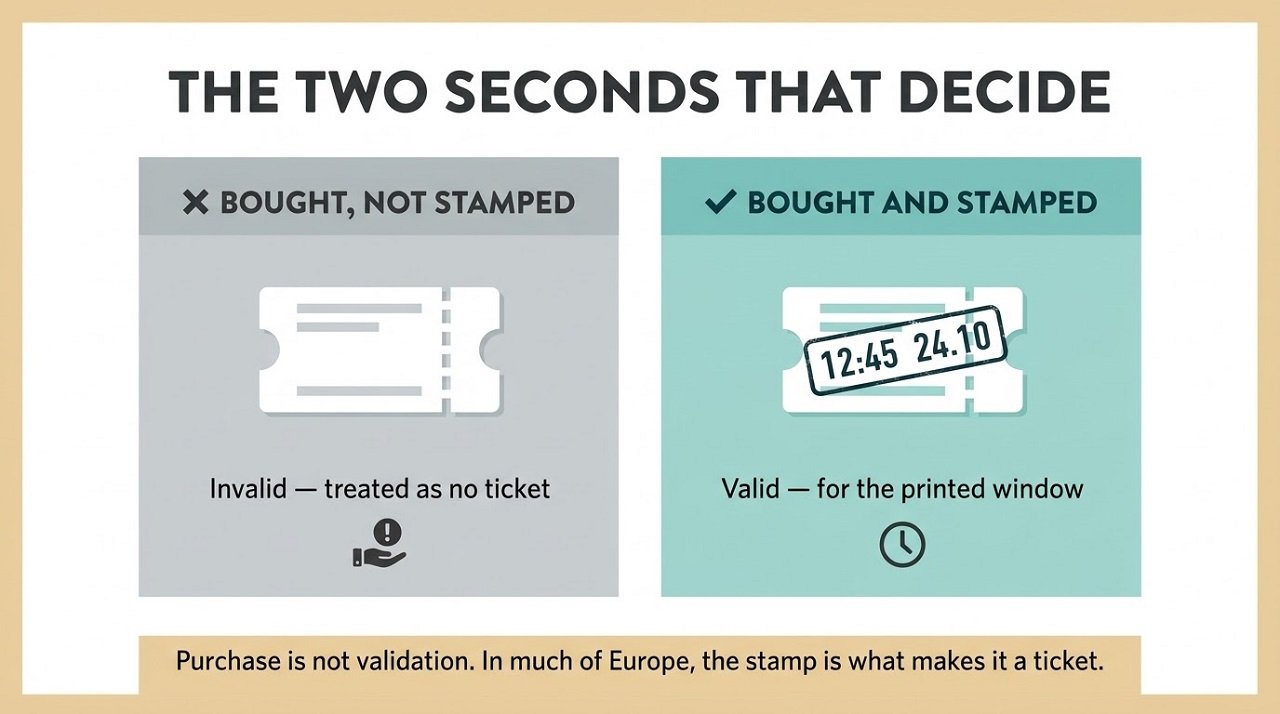
The consequence is counterintuitive: the act of validating is what makes the ticket valid. Not the purchase. Not the boarding.
In Rome, Prague, Budapest, Kraków and much of Italy and central Europe, a purchased ticket is worthless until it is stamped in a small machine at the platform entrance or inside the vehicle.
And crucially — this applies even if you hold a pass. A travel card, a multi-day ticket, a rail pass: if it has not been activated or stamped, an inspector may still issue a penalty. The visitukraine.today guide to common European transport mistakes states it plainly: failure to validate can result in a fine even with a pass in hand.
What Inspectors Actually Do
Most European systems are proof-of-payment, not barrier-controlled. There is no gate to stop you. You board, sit down, and a plain-clothes or uniformed inspector asks for your ticket somewhere between two stops.
This is why the fine feels sudden. There was no barrier to walk through, so there was no moment that forced you to think about validation.
If you are travelling alone and unfamiliar with a city’s transit etiquette, our guide to safe solo travel covers the arrival-day routine that includes checking this before you board.
How to Tell Whether Your Ticket Needs Validating
There is no single rule, but there are reliable signals.
Check the Ticket Itself
- No date and time printed on it — almost certainly needs validation.
- A blank strip, magnetic band, or arrow — a validator is expected to mark it.
- A printed date and time already on it — usually pre-validated. Do not stamp it again unless instructed; some systems invalidate it.
Look for the Machine
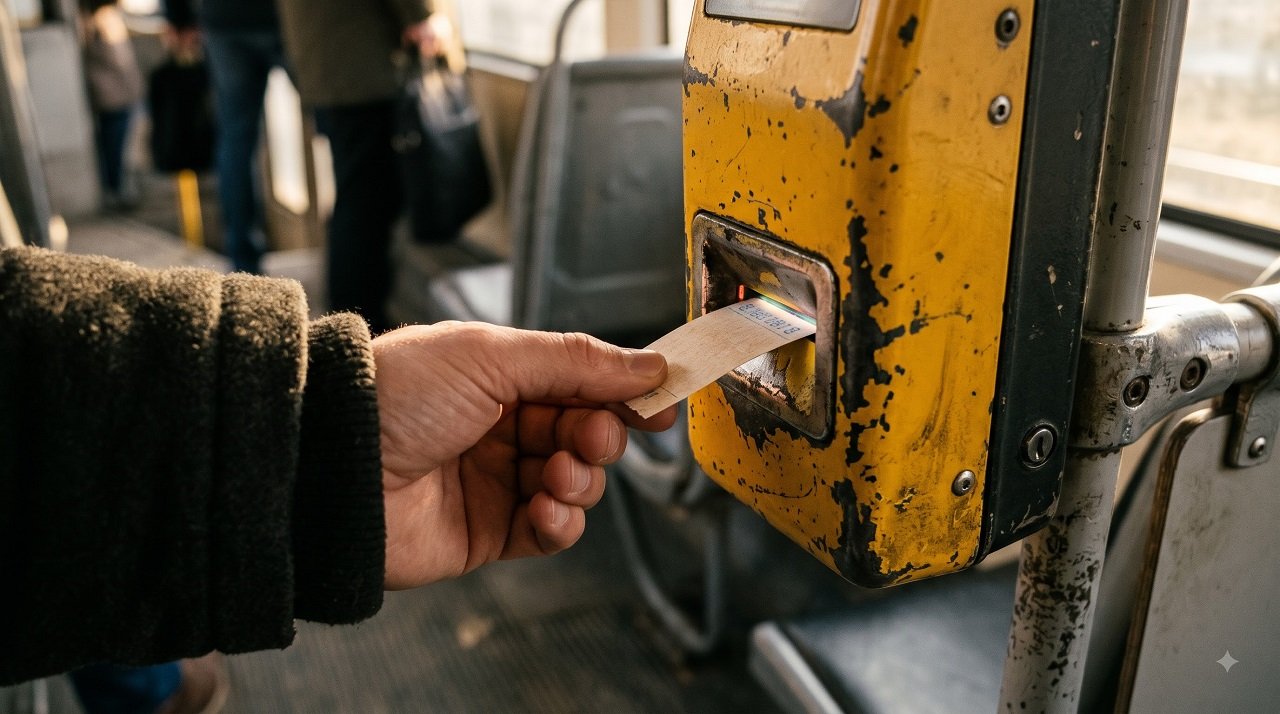
Validators are small and unremarkable: a box the size of a paperback, mounted on a pole at the platform entrance or near the doors inside the vehicle. In some cities they are yellow or green and immediately visible. In others they are grey and blend into the trim.
Where they tend to sit:
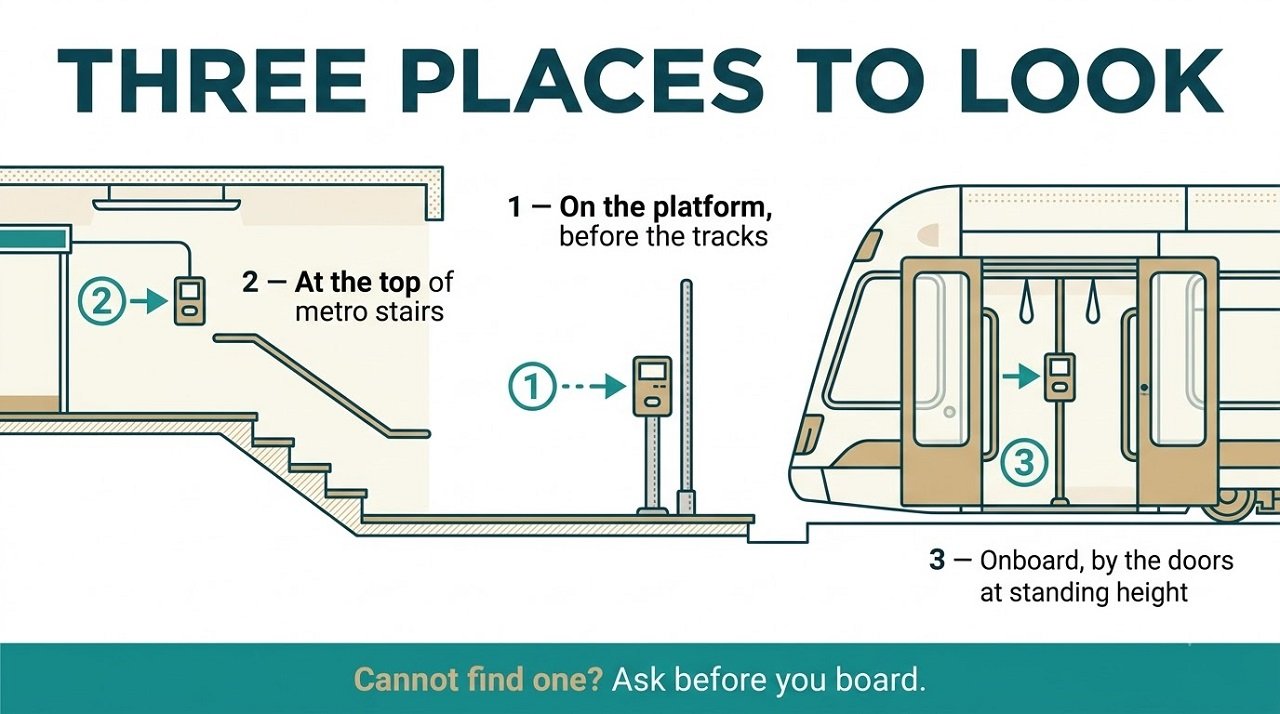
- On the platform at the entrance to the stop, before you reach the tracks
- Onboard, near the doors, at standing height
- At the top of stairs in metro stations
If you cannot find one, ask before you board. Station staff, a ticket office, or another passenger will point you to it.
The Rule When You Are Unsure
Validate. The failure mode of validating an already-valid ticket is minor — occasionally it voids it, in which case you buy another. The failure mode of not validating is a fine.
The exception: if the ticket already has a printed date and time and the validator is clearly for un-stamped tickets only, leave it alone.
When the Validator Is Broken
This is a real scenario, and the correct answer is not “travel anyway.”
- Write the date and time on the ticket by hand with a pen. This is the standard accepted workaround in several Italian cities.
- Photograph the broken machine as evidence.
- Find another validator at the next entrance, or ask staff.
If you are stopped with an unvalidated ticket and a broken machine, you will still be asked to explain. The pen and the photograph are your explanation.
What the Fines Actually Cost
Penalties vary enormously, and the difference between cities is not proportionate to the fare. Here are three, with verified figures.
Prague: 1,200 to 2,000 Koruna
Prague’s integrated transport system (PID) raised its penalty from 1 January 2026, the first increase in eleven years:
| When you pay | Amount |
|---|---|
| On the spot | 1,200 CZK |
| Within 15 days | 1,500 CZK |
| Later | 2,000 CZK |
The same revision raised single fares. A 30-minute ticket went from 30 to 39 CZK (36 CZK through the Lítačka app), and a 90-minute ticket from 40 to 50 CZK (46 CZK via the app).
The city’s finance councillor, Zdeněk Kovářík, was unusually direct about who the change targets: “only single tickets change, which are mostly used by tourists.”
The comparison worth holding in mind: a 39 CZK ticket against a 1,200 CZK fine is roughly 31 times the fare.
Rome: €54.90, or €104.90
Rome’s ATAC system has two figures, and the difference is timing.
| When you pay | Amount |
|---|---|
| Within 5 days | €54.90 |
| After 5 days | €104.90 |
The €54.90 breaks down as a €50 penalty, €3.40 in procedural costs, and €1.50 for the ticket. The €104.90 version applies the full €100 penalty.
ATAC’s general rules also state that penalties for travelling without a valid ticket can run from €100 to €500, plus the ticket price and postal costs. You have 60 days to pay before enforcement escalates.
Not validating is treated identically to not buying. The ATAC wording covers passengers “travelling without a valid ticket or with an irregular ticket” — and an unstamped ticket is irregular.
Budapest: 15,000 to 30,000 Forint
Budapest’s BKK changed its penalty structure from 2 November 2026:
| When you pay | Before | From 2 Nov 2026 |
|---|---|---|
| On the spot or within 2 working days | 12,000 HUF | 15,000 HUF |
| Within 30 days | 25,000 HUF | 30,000 HUF |
BKK’s own penalty-fare guidance explicitly covers passengers travelling “with an invalid ticket (not stamped/punched with a validating machine)” — the wording leaves no room for the argument that you paid for it.
The Pattern
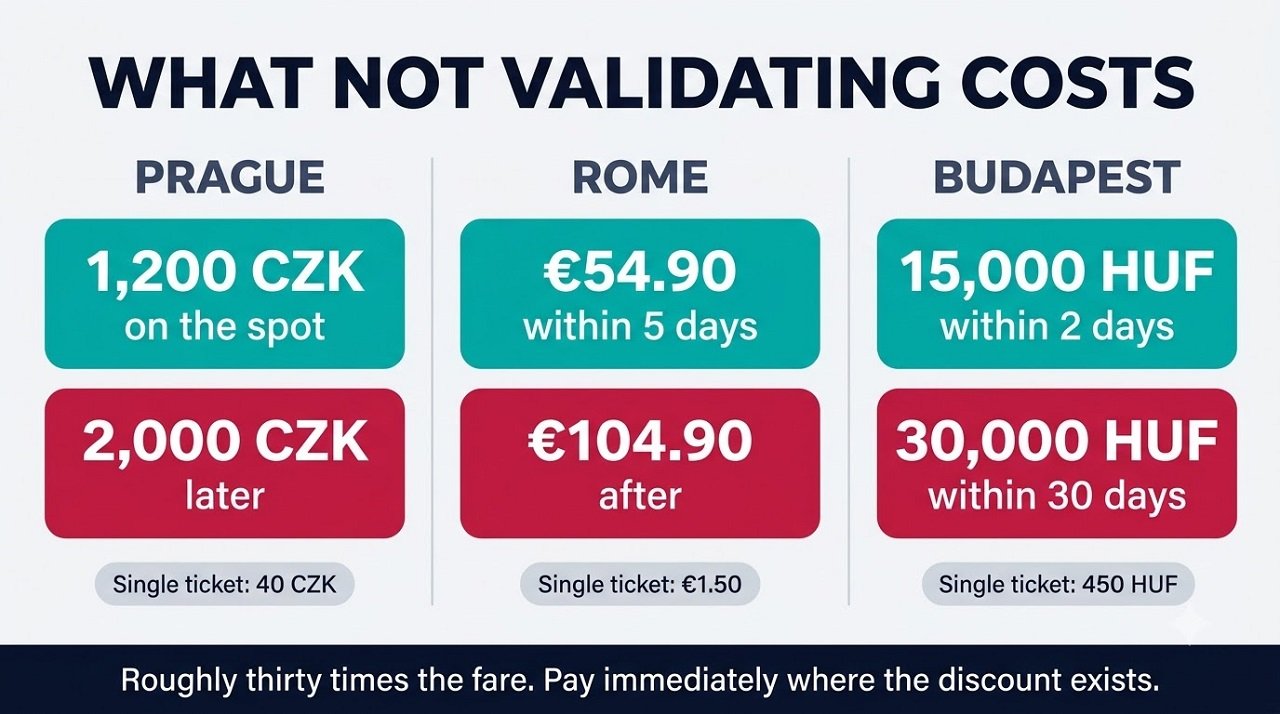
Three cities, three currencies, one structure: a reduced penalty for paying immediately, and a substantially higher one for paying later.
The immediate-payment discount is not a courtesy. It is there because chasing an unpaid penalty across borders is expensive, and operators would rather settle at the counter.
Tap-to-Pay: Where the Problem Disappears
The most significant change in European transit is the arrival of open-loop contactless payment — tapping the same bank card you use for coffee, with no ticket, no app, and no validator.
It solves validation completely, because the tap is the validation.
Where It Now Works
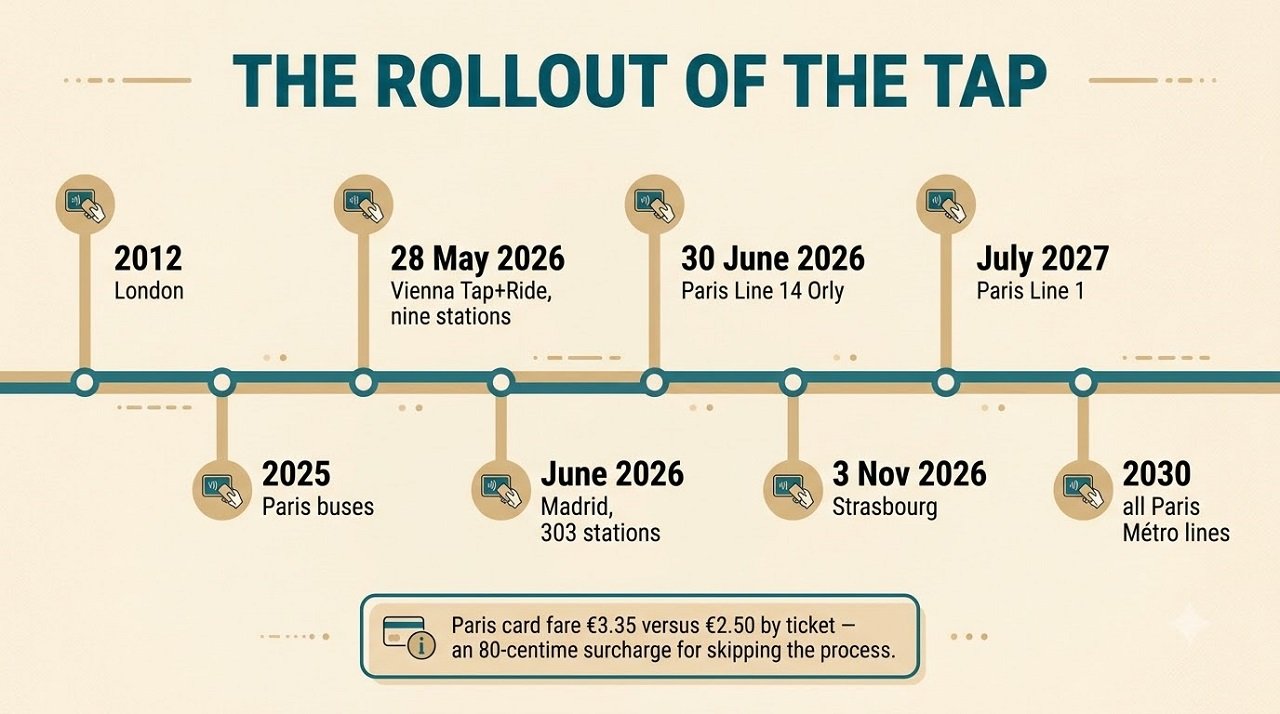
Vienna. Wiener Linien launched Tap+Ride on 28 May 2026 as a one-year pilot. You tap a debit card, credit card, phone or smartwatch on a dedicated device, and that payment method becomes your ticket for the Vienna core zone. There are currently nine stations with the devices: Südtiroler Platz–Hauptbahnhof, Westbahnhof, Bahnhof Meidling, Stephansplatz, Schwedenplatz, Spittelau, Zieglergasse, Neubaugasse and Erdberg. You can buy up to five tickets in one transaction, and inspectors verify by holding their device to your card over NFC.
Paris. The Métro has been slower, but the rollout began in 2026. From 30 June 2026 at the Orly Airport exit of Line 14, and from 8 July 2026 on the Montmartre funicular. Full line-by-line rollout starts in July 2027 with Line 1 — deliberately, the line most used by tourists — then Lines 4, 14, 15 and 18 by the end of 2027, Lines 7 and 12 by the end of 2028, and all Métro lines by 2030. Paris buses have accepted direct card payment since 2025.
Madrid. Contactless bank card entry is live across Metro de Madrid’s 303 stations.
Strasbourg. Contactless bank card payment on buses and trams from 3 November 2026, following Toulouse, Marseille, Bordeaux, Lyon and Brest.
London. The original, in place since 2012.
The Catch: It Costs More
Tap-to-pay is convenient, and it is priced accordingly.
In Paris, a bank card journey costs €3.35, against €2.50 for a ticket or app purchase and €2.04 on a travel pass. An airport journey is €14.80 by card against €14 by ticket. That is an 80-centime surcharge built into every tap.
The Île-de-France Mobilités chief, Valérie Pécresse, was explicit that the surcharge covers the cost of the system — €45 million in additional revenue needed — so that it costs regional taxpayers nothing. She also framed the purpose honestly: validation by bank card “will enable occasional users, such as tourists, to travel legally” on the network.
How to Decide
| Situation | Better choice |
|---|---|
| Two or three journeys, no desire to learn the system | Tap the card — pay the surcharge, skip the risk |
| Four or more journeys, or a multi-day stay | Buy a pass or ticket — the saving exceeds the convenience |
| City where tap-to-pay is not yet live | Buy and validate — there is no shortcut |
If you are working out how much cash to carry for transport, our guide to avoiding ATM and card fees abroad covers the withdrawal arithmetic. And if you have not yet sorted data for maps and transit apps, our guide to using your phone abroad covers eSIM, roaming and local SIM options.
Six More Traps on the Same Journey
Validation is the most expensive mistake. It is not the only one.
1. You Usually Cannot Buy On Board
In most European systems, you cannot buy a ticket from the driver or conductor. Boarding without one makes you a fare evader regardless of intent, and the fine applies whether or not you were planning to pay.
Buy from a station machine, a ticket window, a kiosk, or the official app — before you board. Even for a two-stop tram ride.
2. Integrated Tickets Are Time-Limited
Most major cities — Rome, Paris, Amsterdam, Berlin, Vienna, Madrid, Prague — run an integrated system where one ticket covers metro, bus and tram. That is genuinely useful.
But the ticket is time-limited, even when it allows transfers. A 90-minute ticket is 90 minutes of travel, not 90 minutes plus a transfer. Exceed the window and you are travelling without a valid ticket, on a ticket you validly stamped.
3. Fare Zones Change the Price of the Same Trip
London is the clearest example, but it is not alone. In London, the cost of an identical journey varies by fare zone, time of day, and payment method — the same trip can cost anywhere from £3 to £7 depending on choices made at the gate.
Check the zone map before you travel, particularly for airport journeys, which frequently sit outside the standard city zone.
4. Public Transport Is Not 24/7
Night services exist in some capitals and not others. Assuming a metro runs at 2am is a reliable way to end up paying for a taxi at four times the price.
Check the time of the last service on the day you need it, not on a weekday you assumed was typical.
5. Some Trains Require a Seat Reservation
Holding a rail pass does not exempt you. France’s TGV, Spain’s AVE, Italy’s Frecciarossa and Germany’s international ICE routes frequently require a seat reservation in addition to the ticket or pass.
Turning up without one can mean a fine, hours standing, or being removed from the train.
6. Not Every City Takes Cards
Contactless is spreading, but it is not universal. In cities without it, tickets may be cash only, and the local currency may not be the euro.
Check the currency and carry a small amount of local cash before you reach the station.
If you are dealing with a language barrier at the ticket machine, our guide to navigating language barriers covers how to get written information you can act on.
If You Are Stopped
Inspectors are usually correct on the facts and firm on the outcome. The way you handle the interaction affects the amount you pay.
What to Do
- Stay calm and hand over the ticket. Arguing that you did not know the rule does not work — it is printed on the ticket.
- Ask for the reduced on-the-spot rate. In Rome and Prague, paying immediately is materially cheaper. In Rome it is the difference between €54.90 and €104.90.
- Ask for a receipt. Always. It is your proof of payment and your route to dispute.
- Pay by card if allowed, so you have a record.
- Photograph the ticket and the receipt before you leave the interaction.
What Not to Do
- Do not walk away. In most systems the penalty escalates, and inspectors can call enforcement.
- Do not hand over your passport. Show it if asked to prove identity; do not surrender it.
- Do not pay cash to someone not in uniform or without a receipt. Fare inspection is a documented process with paperwork.
If You Believe the Penalty Is Wrong
The legitimate grounds are narrow but real: a broken validator you photographed, a ticket that was valid but misread, a machine that charged you without issuing a ticket.
Keep the receipt and the ticket. Most operators publish an appeals process, and the 60-day payment window in Rome exists partly to allow disputes to be resolved first.
If your dispute involves a card charge you believe is fraudulent, the dispute process in our guide to common travel scams covers chargebacks and documentation.
The Two-Minute Routine
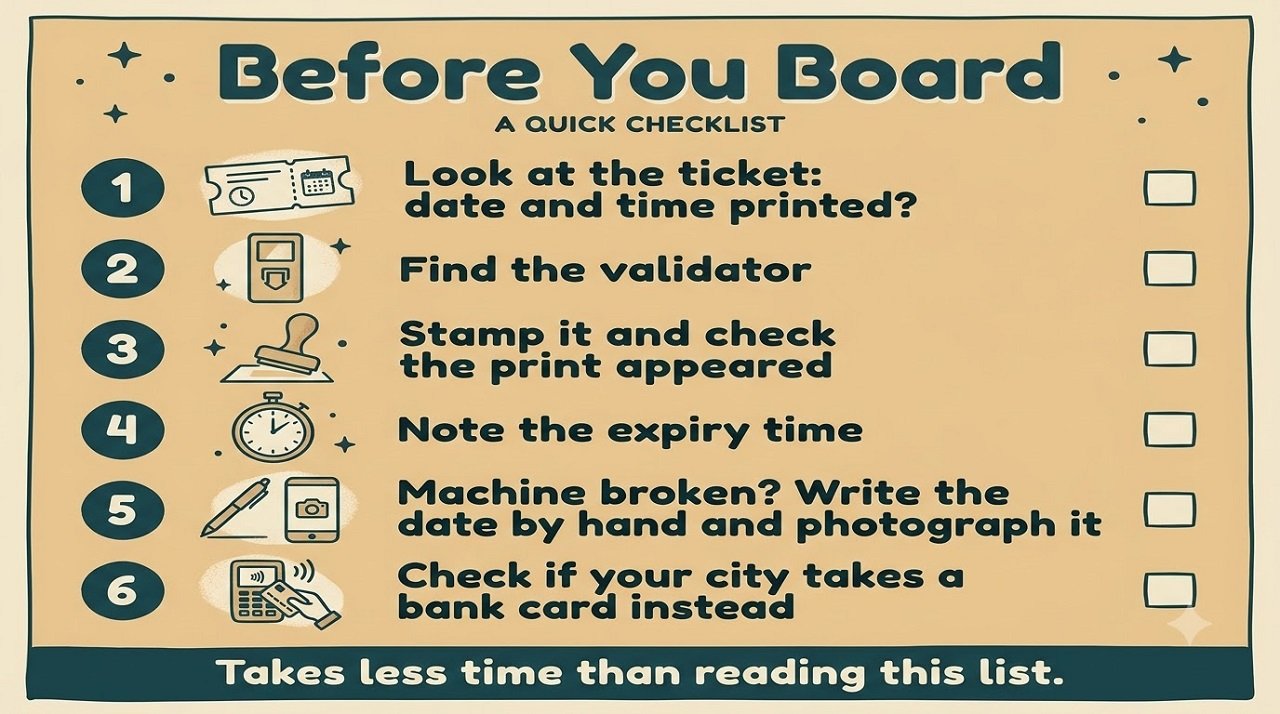
Before you board anything, anywhere:
- Look at the ticket. Does it have a printed date and time? If not, it needs validating.
- Find the validator on the platform or by the doors.
- Stamp it and check the print appeared. A faint or failed stamp is not a validation.
- Note the expiry time if the ticket is time-limited.
- If the validator is broken, write the date and time on the ticket by hand and photograph the machine.
- Check whether your city takes a bank card instead — and decide whether the surcharge is worth skipping the process.
That is the whole procedure. It takes less time than reading this section.
Conclusion
The trap is not complicated, and that is what makes it so effective. You did the right thing — you bought a ticket — and the system still treats you as a fare evader because you missed a step nobody explained.
Three things resolve it:
Validation is what makes a ticket valid, not purchase. In Rome, Prague, Budapest and much of central Europe, an unstamped ticket is an irregular ticket, and an irregular ticket earns the same penalty as no ticket at all.
The penalties are now substantial. Prague at 1,200 to 2,000 koruna, Budapest at 15,000 to 30,000 forint, Rome at €54.90 to over €100 — against fares of a few euros. The ratio is roughly thirty to one.
Tap-to-pay removes the problem where it exists. Vienna, Madrid, Strasbourg and now the Paris Métro let you tap a bank card and skip the entire ritual, at the cost of a small surcharge. Where it is live, it is the lowest-risk option available to a visitor.
If you remember one rule, make it this: find the machine before you find your seat.
If you are planning a city break and want the cost side worked out, our guide to budgeting for a trip from scratch covers how to build transport into the total. If you are visiting a destination that now restricts visitor numbers, our guide to overtourism rules covers the separate booking requirements that apply before you even arrive.
Frequently Asked Questions
Do I need to validate my ticket in Europe?
In many countries, yes — including Italy, France, Germany, Austria, the Czech Republic and Hungary. A paper ticket with no printed date and time must usually be stamped in a machine on the platform or near the vehicle doors before you travel. In Rome, Prague, Budapest and much of central Europe, an unstamped ticket is treated as invalid.
How much is the fine for not validating a ticket?
It varies widely. Prague charges 1,200 CZK on the spot, rising to 2,000 CZK for late payment. Budapest charges 15,000 HUF on the spot or within two working days, rising to 30,000 HUF within 30 days. Rome charges €54.90 if paid within five days and €104.90 after that, with a general range of €100 to €500.
Can I buy a bus ticket on board in Europe?
Usually not. Most European metros, trams and city buses do not sell tickets from the driver or conductor, and boarding without one makes you a fare evader regardless of intent. Buy from a machine, kiosk, ticket office or official app before boarding.
Does contactless bank card work on the Paris Metro?
Partially, and expanding. From 30 June 2026 it works at the Orly Airport exit of Line 14, and from 8 July 2026 on the Montmartre funicular. Full line-by-line rollout begins in July 2027 with Line 1, reaching all Métro lines by 2030. Paris buses have accepted direct card payment since 2025. A card journey costs €3.35 against €2.50 for a ticket.
What happens if the ticket validation machine is broken?
Write the date and time on the ticket by hand, photograph the broken machine, and find another validator where possible. A hand-written date is the accepted workaround in several systems, and the photograph is your evidence if you are stopped.
Is the fine the same whether I did not buy a ticket or just did not validate one?
In most systems, yes. Rome’s rules cover passengers travelling “without a valid ticket or with an irregular ticket,” and Budapest’s explicitly cover tickets “not stamped/punched with a validating machine.” An unvalidated ticket attracts the same penalty as no ticket at all.
Sources
- Český rozhlas (Czech Radio). V Praze od ledna zdraží jednorázové jízdné v MHD, zvýší se i pokuty. Published 18 August 2025. From 1 January 2026 the PID penalty for travelling without a ticket rises after eleven years from 1,000 to 1,200 CZK if paid on the spot, and to 1,500 CZK if paid within 15 days; later payment is 2,000 CZK. A 30-minute single ticket rises from 30 to 39 CZK (36 CZK via the Lítačka app) and a 90-minute ticket from 40 to 50 CZK (46 CZK via the app). Councillor Zdeněk Kovářík: “only single tickets change, which are mostly used by tourists.”
https://cesky.radio.cz/v-praze-od-ledna-zdrazi-jednorazove-jizdne-v-mhd-zvysi-se-i-pokuty-8860186 - ATAC Roma. In che modo posso pagare una multa che mi è stata fatta sui mezzi di trasporto pubblico? (FAQ). Current 2026. The reduced penalty if paid within 5 days is €54.90, comprising €50.00 penalty, €3.40 procedural costs and €1.50 for the ticket. The full penalty if paid between 6 and 60 days is €104.90, comprising €100.00 penalty, €3.40 procedural costs and €1.50 for the ticket. Passengers found travelling without a valid ticket or with an irregular ticket — including one that has not been correctly validated — receive a penalty fare from €100 to €500, reduced by 50% if paid within 5 days.
https://cmsinternet.atac.roma.it/frequently-asked-questions/in-che-modo-posso-pagare-una-multa-che-mi-è-stata-fatta-sui-mezzi-di-trasporto-pubblico
https://www.atac.roma.it/en/utility/pay-your-fines
https://www.leggo.it/roma/metropoli/roma_stretta_furbetti_biglietto_multe-9800309.html - BKK (Budapesti Közlekedési Központ). Ticket validation has become simpler on BKK’s lines in street-level transport. Published 29 October 2026. From 2 November 2026 the penalty fare paid on the spot or within two working days rises from 12,000 HUF to 15,000 HUF, and the penalty paid within 30 days rises from 25,000 HUF to 30,000 HUF.
https://bkk.hu/en/news/2026/10/ticket-validation-has-become-simpler-on-bkks-lines-in-street-level-transport.17477/ - BKK. Violation of travel terms, penalty fares. Current 2026. A penalty fare applies to a customer travelling with an invalid ticket, defined as one not stamped or punched with a validating machine, as well as to travel without any ticket.
https://bkk.hu/en/tickets-and-passes/information-about-penalty-fares/violation-of-travel-terms-penalty-fares/ - The Local (France). Paris Metro to allow passengers to use bank cards at entry gates from July. Published 12 June 2026. Contactless “tap in” by bank card from 30 June 2026 at the Orly Airport exit of Line 14 and from 8 July 2026 on the Montmartre funicular; full line rollout from July 2027 with Line 1, Lines 4, 14, 15 and 18 by end-2027, Lines 7 and 12 by end-2028, all lines by 2030; bus card terminals since 2025. Card fare €3.35 against €2.50 by ticket or app and €2.04 by pass; airport journey €14.80 by card against €14 by ticket; 80-centime surcharge. Valérie Pécresse on the €45 million additional revenue and on enabling occasional users and tourists to travel legally.
https://www.thelocal.fr/20260612/paris-metro-to-begin-using-bank-card-entry-payments - Wiener Linien. Tap+Ride: One tap and your journey begins. Current 2026. One-year pilot starting 28 May 2026; tap a debit or credit card, phone or smartwatch and the payment method becomes your ticket for the Vienna core zone; nine stations currently equipped (Südtiroler Platz–Hauptbahnhof, Westbahnhof, Bahnhof Meidling, Stephansplatz, Schwedenplatz, Spittelau, Zieglergasse, Neubaugasse, Erdberg); up to five tickets per transaction; inspectors verify via NFC by holding their device to the payment card.
https://www.wienerlinien.at/web/wl-en/tap-ride - Visit Ukraine. Common Mistakes on Public Transportation in Europe: What Do Tourists Most Often Get Fined For? Published 21 April 2026. Most major European cities including Rome, Paris, Amsterdam, Berlin, Vienna, Madrid and Prague have integrated ticketing, but such tickets are usually time-limited even when transfers are allowed. Simply buying a ticket does not make it valid — it must be activated in a validator before the trip or immediately after boarding, and failure to do so gives the inspector the right to issue a fine even where a ticket was purchased. Also notes that contactless payment is not available everywhere and that public transport does not run 24/7 in all European cities.
https://visitukraine.today/blog/8279/common-mistakes-on-public-transportation-in-europe-what-do-tourists-most-often-get-fined-for - Wanderlust Storytellers. 10 Rookie Public Transport Mistakes Tourists Keep Making in Europe (And How to Avoid Them). Published 3 November 2026. In Italy, France, Germany, Austria and the Czech Republic, buying a ticket is only the first step — it must be validated, usually by stamping it in a small yellow or green machine on the platform or near the train doors, before boarding. Skipping this step means inspectors treat the passenger exactly as a fare evader, typically a fine of €50 to €100 on the spot. Also notes that most European trains, buses and trams do not allow ticket purchase from the driver or conductor, and that seat reservations are required on France’s TGV, Spain’s AVE, Italy’s Frecciarossa and Germany’s international ICE routes even with a rail pass.
https://www.wanderluststorytellers.com/public-transport-mistakes-in-europe/