All fee figures, ATM data, and exchange-rate margins in this guide reflect research published in 2025 and 2026. Bank fees, card terms, and ATM operator charges change without notice and vary by country and account type.
If you are reading this in a later year, treat the sequence as still correct — count the fees, refuse conversion, choose the card, withdraw properly, decide the cash amount, budget it in. But check your own bank and card terms before you rely on any number here.
This guide is general information, not financial advice. Card terms, credit eligibility, and foreign exchange rules depend on your provider and your country of residence.
All sources used in this guide are listed at the end.
Introduction
There is a version of travel money advice that says: get a card with no foreign transaction fee and you are done.
That advice is correct as far as it goes. It just stops one step too early.
A no-fee card solves exactly one of the three charges that apply when you spend or withdraw money abroad. It does nothing about the ATM operator’s surcharge, nothing about dynamic currency conversion, and nothing about the cash advance fee if you use a credit card at a machine.
The total is not trivial. SmarterTravel’s 2026 analysis puts the real cost of a typical foreign withdrawal at 5 to 10 percent more than it needs to be, once all three charges are counted. On a two-week trip with $3,000 of spending, a 3% foreign transaction fee alone is **$90** — before a single ATM fee.
And the single most expensive mistake is also the easiest to make. At a card terminal or ATM abroad, you will be offered a choice between paying in the local currency or your home currency. Choosing your home currency triggers dynamic currency conversion, which layers a 3 to 7 percent markup onto the bill — and sometimes more than 10%.
This guide covers the whole sequence: what the three fees actually are, how to kill the biggest one in two words, which card categories work for which job, how to withdraw cash without donating to the machine, how much cash to carry, and how to budget the real number before you leave.
If you are building the wider trip budget, our guide to budgeting for a trip from scratch treats travel money as its own line for exactly this reason. If you are choosing where to stay and how to book, the comparison of booking direct versus third-party covers the payment-protection trade-offs.
Step 1: Count the Three Fees You’re Actually Paying
Most travellers can name the foreign transaction fee. Fewer can name the other two. All three usually apply at once.
Fee One: Your Bank’s Cut
This is the percentage charge on any transaction processed outside your home currency. It typically runs 1% to 3%, and 3% is the standard on most major bank cards.
On a debit card withdrawal, it is often joined by a flat international fee of $2 to $5 per transaction. Bank of America, for example, charges $5 plus 3%.
Fee Two: The Machine’s Cut
Whoever owns the ATM sets its own surcharge, and they do not coordinate with your bank.
The average out-of-network ATM fee in the US is now $4.86** per transaction — made up of a **$3.22 operator surcharge and a $1.64 charge from your own bank.
Abroad, that operator fee gets higher. Independent machines in tourist zones — the ones clustered near airports, stations, and landmarks — often charge $5 to $10 per withdrawal.
Fee Three: The Exchange Rate Spread
This is the invisible one. When your bank or the card network converts your money, it does not use the mid-market rate you see on Google. It uses a rate with a margin built in.
If you decline dynamic currency conversion, the card network rate is usually close to the interbank rate. If you accept it, the margin is set by the merchant or ATM operator and can be far worse — covered in Step 2.
What the Stack Looks Like
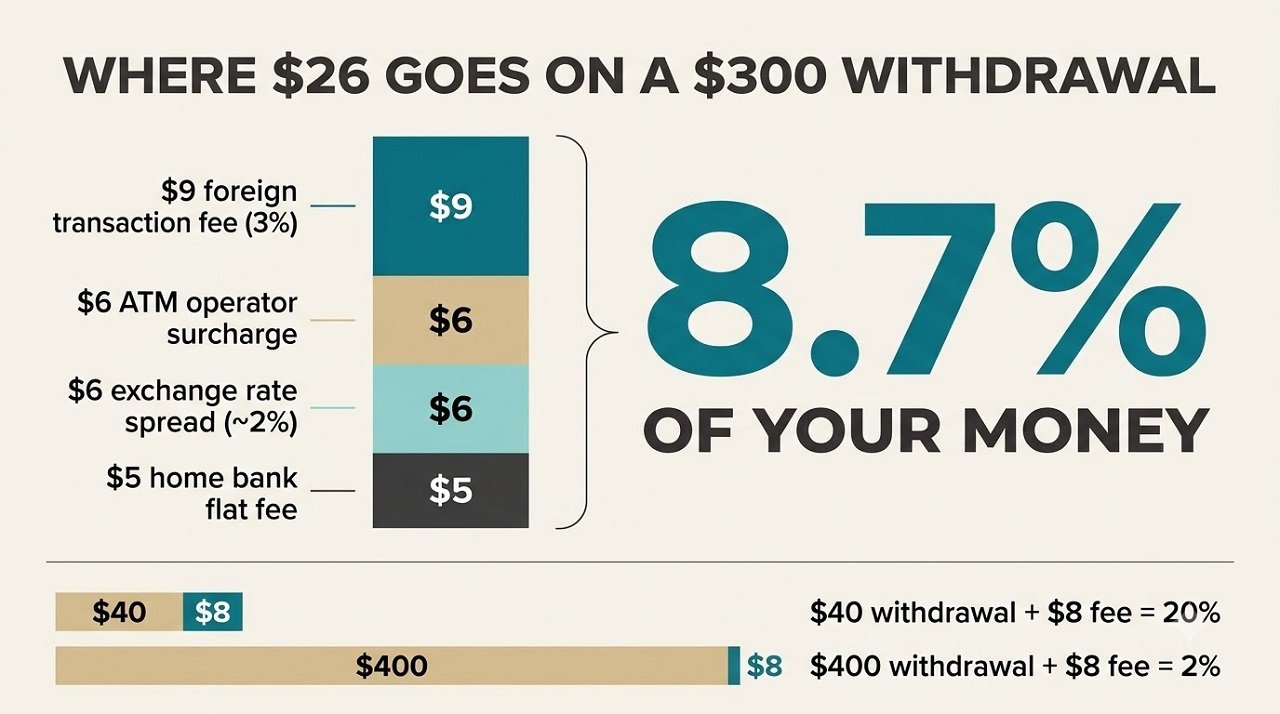
Here is a $300 withdrawal on a typical big-bank debit card, paying in local currency:
| Charge | Amount |
|---|---|
| Home bank flat international fee | $5.00 |
| Home bank foreign transaction fee (3%) | $9.00 |
| Foreign ATM operator surcharge | $6.00 |
| Exchange rate spread (~2%) | $6.00 |
| Total | $26.00 |
That is 8.7% to access your own money. On a trip where you withdraw cash six times, the same structure costs roughly $156 — more than a night’s accommodation in many destinations.
Why Small Withdrawals Are the Worst Deal
Two of the three fees are flat. That makes the percentage cost explode on small amounts.
SmarterTravel puts it precisely: a $40 withdrawal with an $8 fee costs you 20 percent. A $400 withdrawal with the same $8 fee costs you 2 percent.
The practical rule follows immediately: withdraw less often, in larger amounts. Not because the fee changes, but because you pay it fewer times.
One Detail Most Travellers Never Notice
The fee can depend on which card network you use. The Travel ATM Fee Index 2026 found that 19.78% of ATMs charge different fees depending on the card network — so the same machine can cost a Visa holder and a Mastercard holder different amounts.
You cannot control this. It is worth knowing so you stop assuming a quoted fee applies to you.
If you are travelling solo and relying on cash for safety, our solo travel safety guide covers the backup arrangements worth having.
Step 2: Kill Dynamic Currency Conversion First
If you take one thing from this guide, take this. Dynamic currency conversion is the largest avoidable charge in travel money, and it is defeated by saying two words: local currency.
What It Actually Is
At a card terminal or ATM abroad, the machine offers to convert your transaction into your home currency before your bank sees it. The screen frames it as a convenience: you see a familiar number, and you know what you are paying.
What you are actually doing is letting the merchant or ATM operator set the exchange rate instead of your card network. And they set it in their favour.
What It Costs
The published range is consistent across sources, which is unusual for this kind of figure:
- 3% to 7% worse than the market rate, according to SmarterTravel’s analysis
- 3% to 7% or even higher, according to Moneycontrol’s explainer
- 5% to 12% per transaction, according to Wise
- More than 10% in some cases, according to WalletHub
- 2% to 8% on top of foreign transaction charges, per an Indian forex executive quoted by Moneycontrol
The variation is not a contradiction. It reflects different markets, different providers, and different transaction sizes. The safe planning assumption is 3% to 7%, with outliers worse.
The Combined Hit
Here is the part that catches people. Accepting DCC does not replace your card’s foreign transaction fee. It sits on top of it.
WalletHub calculates the total exposure: declining DCC and using a no-foreign-transaction-fee card can save you up to 15% per purchase — roughly 12% from DCC plus 3% from the foreign transaction fee.
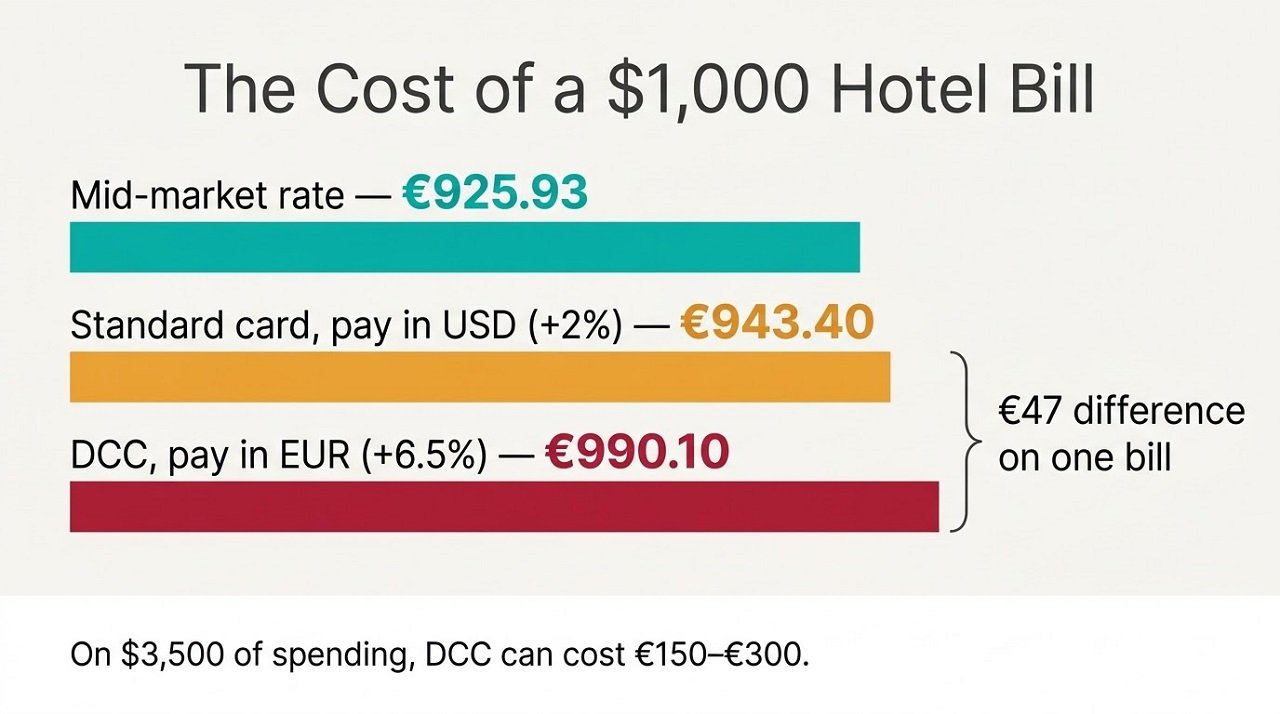
Wise’s worked example makes it concrete. On a $1,000 hotel bill in New York:
| Method | You pay |
|---|---|
| Real mid-market rate | €925.93 |
| Pay in USD with a standard card (+2%) | €943.40 |
| Pay in EUR via DCC (+6.5%) | €990.10 |
The difference between the standard card and the DCC option is **€47 on a single $1,000 transaction**. Across a trip with $3,500 of spending, DCC can cost €150 to €300 in invisible fees.
The Screen Script
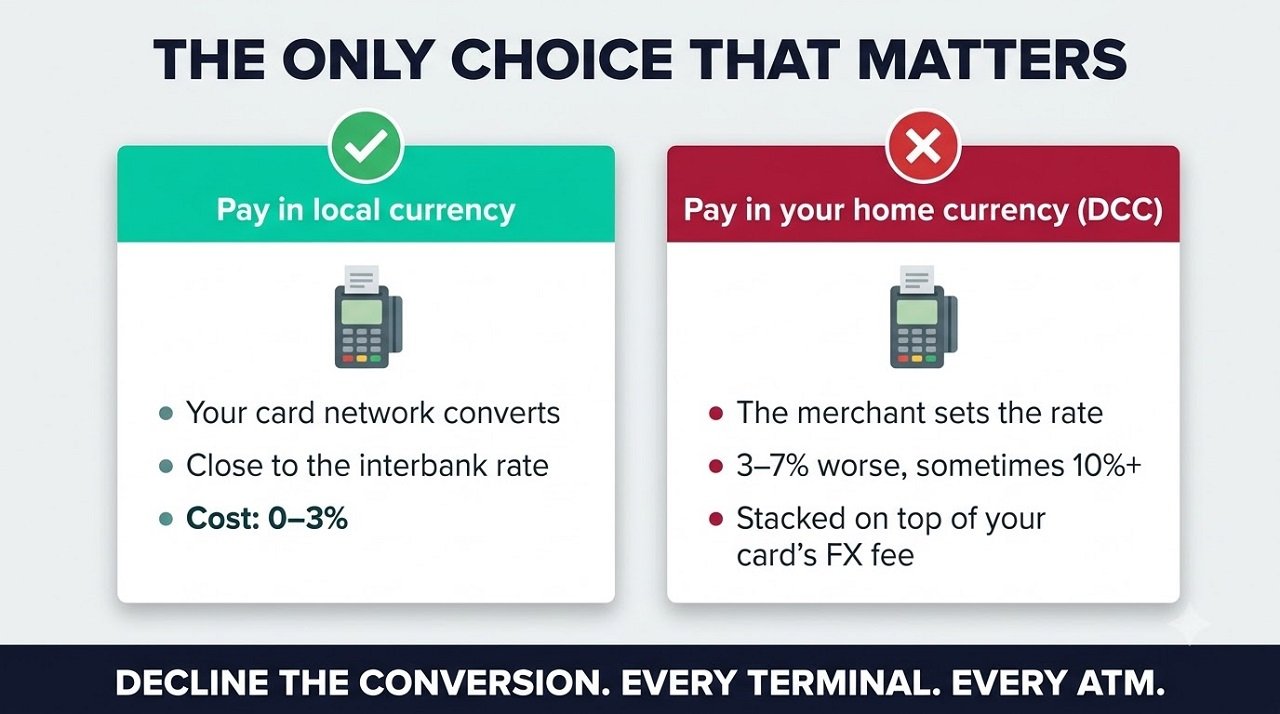
The offer does not always look like an offer. Common forms:
- ATM: “Would you like to be charged in USD or EUR?” or “Accept conversion rate 1 USD = 0.85 EUR?”
- Card terminal: “Pay in GBP or local currency?”
- Hotel bill: a total shown in your home currency with a “rate applied” line
- Online checkout: a billing currency toggle
The rule is the same every time: choose the local currency. The machine may warn that the rate “cannot be guaranteed” or that local currency “may fluctuate.” Ignore it. Your card network’s rate is better than the DCC rate in essentially every case.
The Zero-Forex Illusion
This is where travellers with “zero markup” cards get caught.
Moneycontrol’s analysis is blunt: even if you hold a zero-forex card, choosing your home currency at the terminal can wipe out the benefit completely. The card waived its explicit markup. The terminal reintroduced it through the rate.
A zero-forex card is a good product. It is not protection against a bad decision at the screen.
If you are managing a medical condition and need to know what your insurance does and does not cover before you spend on care, our guide to what to do if you get sick or injured abroad covers the claim sequence.
Step 3: Pick the Right Card by Category, Not Brand
Cards are not interchangeable abroad, and the differences are structural rather than promotional. Four categories do different jobs.
The Four Categories
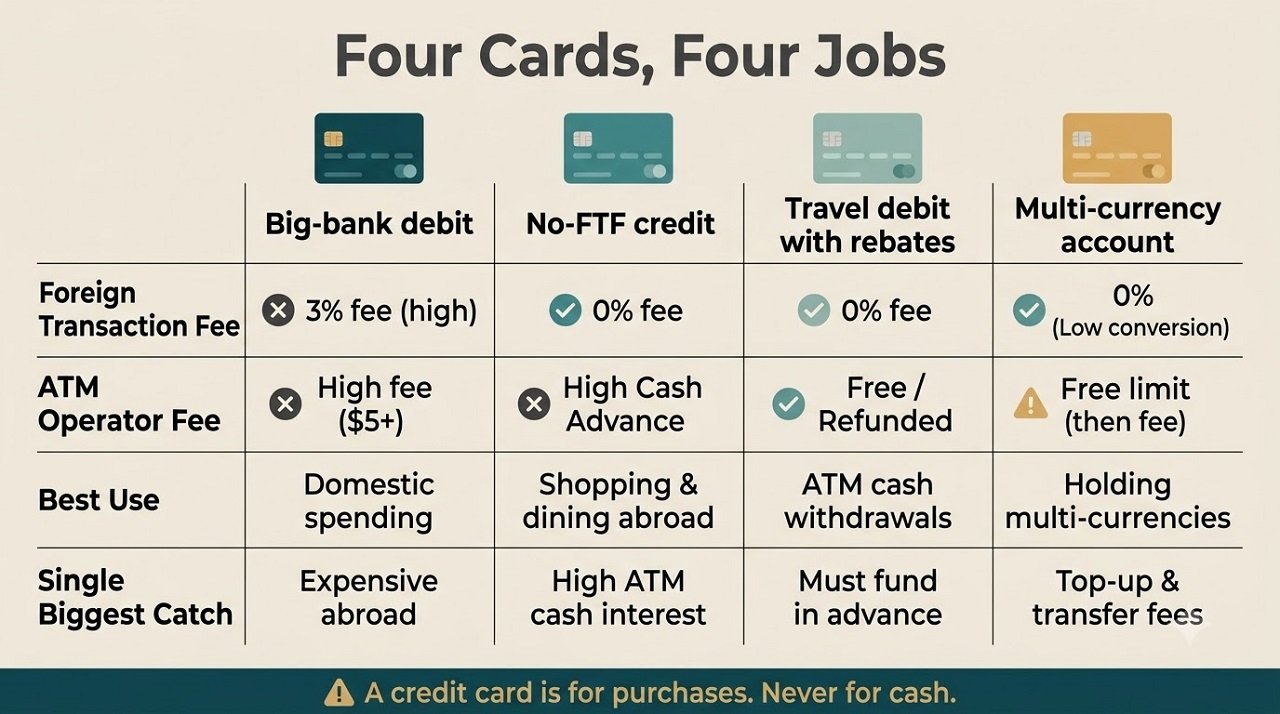
| Category | Foreign transaction fee | ATM fee | Best use |
|---|---|---|---|
| Big-bank debit | ~3% + $2–$5 flat | Operator surcharge, usually not rebated | Emergency backup only |
| No-FTF credit card | 0% | Cash advance fee 3–5% + interest from day one | Purchases, hotels, large bookings |
| Travel debit with rebates | 0% | Unlimited operator fee rebates | Cash withdrawals |
| Multi-currency account card | 0% explicit, small conversion fee | Free up to a monthly cap, then 2–3% | Mixed spending, multi-country trips |
The No-Fee Credit Card
Most major travel credit cards now waive the 3% foreign transaction fee that standard US cards charge — Chase Sapphire Preferred, Capital One Venture X, and Bank of America Travel Rewards are commonly cited examples.
Some carry annual fees; several do not. The Bilt Blue and Wells Fargo Autograph are frequently listed as $0 annual fee with no foreign transaction fee.
But a credit card is for purchases, not for cash. See the next section.
The Rebate Debit Card
This is the category most travellers do not know exists, and it solves the ATM fee problem completely.
Charles Schwab’s High Yield Investor Checking reimburses every ATM fee worldwide, with no monthly fee, no minimum balance, and no foreign transaction fee. Fidelity’s Cash Management Account works the same way: unlimited ATM reimbursements globally and no foreign transaction fee.
For a traveller who withdraws cash several times per trip, this is worth more than any rewards programme.
The Multi-Currency Accounts
Wise, Revolut, and Monzo each advertise fee-free foreign spending. Each also has a fee, placed somewhere the marketing page does not emphasise.
A 2026 comparison modelled a real two-week trip — 2,000 in home currency, 70% card and 30% cash — and found:
- Wise uses the mid-market rate with an explicit conversion fee of 0.4% to 0.6%, shown in the app. Two free ATM withdrawals per month up to £200/$350, then 1.75% plus a small fixed fee.
- Revolut Standard uses the interbank rate on weekdays for the first £1,000 of monthly conversion, then applies a 0.5% to 1% markup. Weekends add 1%. Free ATM withdrawals up to £200/$350 per month, then 2%.
- Monzo adds no foreign transaction fee and uses the Mastercard rate, but allows only £200 per month in free withdrawals abroad, then 3% — the tightest cap of the three.
None of these is a bad product. But “fee-free” means “the fee is somewhere else,” and the somewhere is usually the monthly ATM cap.
The Cash Advance Trap
Using a credit card at an ATM is the single most expensive way to get cash.
Cash advances carry immediate interest, no grace period, and fees of 3 to 5 percent on top. That is before the foreign transaction fee and before the ATM operator’s surcharge.
Cash advance APRs commonly sit in the 23% to 36% range, and interest starts accruing the day you withdraw. A $500 advance with a 3–5% fee and 30 days of interest can cost **$109 to $150** in total.
The whole point of avoiding ATM fees is undone by a single cash advance.
What to Check Before You Fly
- The foreign transaction fee percentage, not just whether the card is marketed as “travel.”
- The international ATM fee and whether it is flat, percentage, or both.
- Whether ATM operator fees are rebated, and whether the rebate is capped monthly.
- Your daily transaction limit — hospital-scale and hotel-scale payments can exceed it.
- Whether the card charges cash advance interest from day one.
If your documents were stolen along with your wallet, the police report you will need is also the one your bank and insurer will ask for. Our guide to what to do if you lose your passport abroad covers that sequence.
Step 4: Withdraw Cash Without Donating to the Machine
Where you withdraw matters as much as which card you use. The 2026 data on this is unusually precise.
Use Bank ATMs, Not Independent Machines
The cluster of machines near airports, stations, and major landmarks is there for a reason. Independent operators in tourist zones charge $5 to $10 per withdrawal and dress it up with familiar branding.
Machines built into a bank branch — Barclays, HSBC, Santander, BNP Paribas, Deutsche Bank — typically charge $0 to $3 in their home markets.
A quick visual test: if the ATM is freestanding in a shop, has flashy multilingual graphics, and sits within 100 feet of a tourist attraction, assume a premium. Walk three blocks to a bank branch instead.
Withdraw Larger, Less Often
Covered in Step 1, but it belongs here too. Every withdrawal is a fee event. A $40 withdrawal with an $8 fee is a 20% charge. A $400 withdrawal with the same fee is 2%.
Know your daily cash need, multiply by trip length, and pull the total in one or two visits rather than stopping daily.
The Country Data That Should Change Your Plan
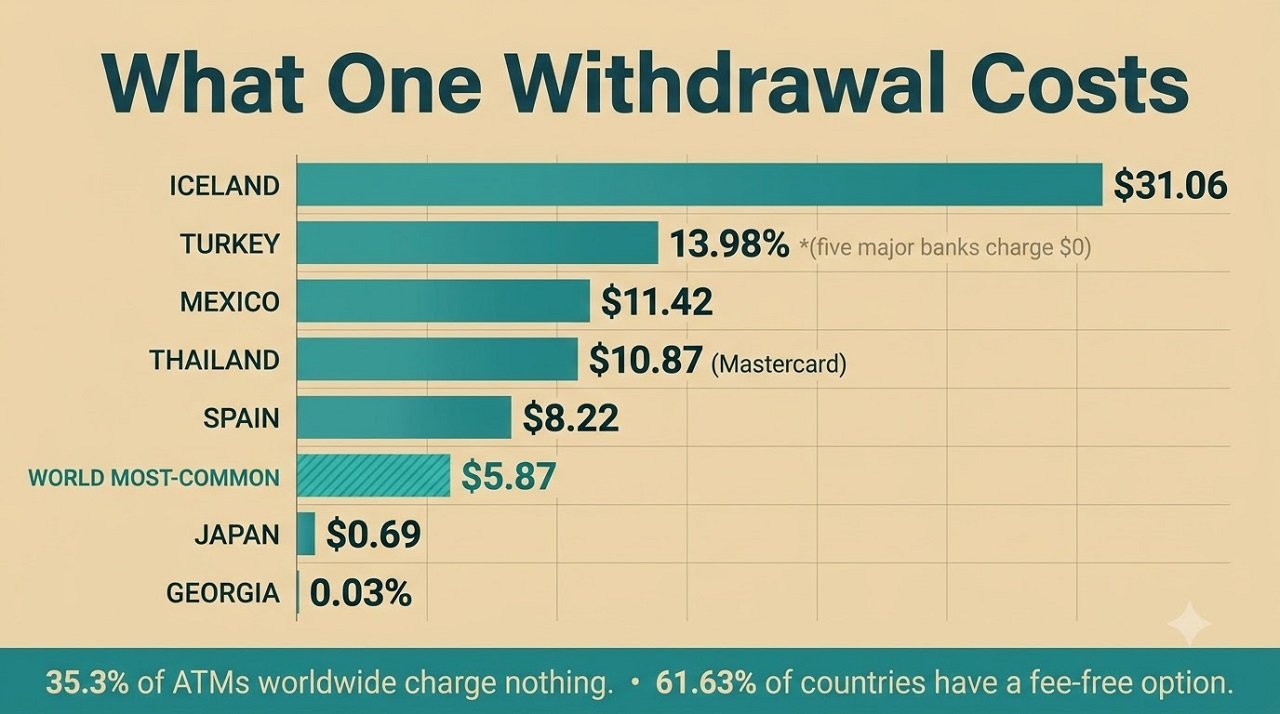
The Travel ATM Fee Index 2026 mapped operator fees across 182 countries, and the spread is enormous.
| Measure | Figure |
|---|---|
| World’s highest ATM fee | 13.98% in Turkey |
| World’s lowest | 0.03% in Georgia |
| Most common fee abroad | $5.87 |
| ATMs charging zero to foreign cards | 35.3% globally |
| Countries with at least one fee-free option | 61.63% |
The same index found that five countries have ATMs charging around 10% — and in four of them, a fee-free option exists with wide national presence.
Specific examples from the index:
- Turkey: the world’s three most expensive ATMs charge 11.99%, 12.09%, and 13.98%. A $200 withdrawal averages a **$12.58** fee. Yet five major Turkish banks charge $0.
- Thailand: $7.60** for foreign Visa cards and **$10.87 for foreign Mastercard — the highest absolute fee in Southeast Asia.
- Japan: $0.69** during business hours, up to **$4.12 at weekends.
- Mexico: up to $11.42** at popular ATMs, **$1.20 at some with limited presence.
- Spain: up to $8.22 per withdrawal, with only three fee-free networks and limited presence.
- Iceland: a 1.09% average fee that exchange-rate mechanics can push to $31.06 per withdrawal.
- Western Europe: 14 of 28 countries charge zero ATM fees to foreign cards, including Belgium, France, Germany, Ireland, Portugal, Switzerland, and the UK.
- Australia: the lowest average fee in the world, but almost no fee-free options.
The Paradox Worth Remembering
High-fee countries usually have a cheap alternative standing next to the expensive machine. The index’s own summary is that travellers are paying 10%+ in countries where a fee-free option is right next door.
You do not need to memorise the list. You need to look at the machine before you commit — and if it is a freestanding branded unit in a tourist zone, keep walking.
The Other ATM Rules
- Decline conversion at the machine. Choose local currency.
- Shield your PIN. Card skimming remains a documented risk in tourist areas, and our guide to common travel scams covers the wider card-fraud picture.
- Check the machine for loose parts before inserting a card.
- Keep the receipt if you may need to dispute a charge.
- Carry a second card from a different network, stored separately.
Step 5: Decide How Much Cash You Actually Need
The cash-versus-card debate is usually framed as a generational argument. The data says it is a destination question.
Cash Is Still the Majority Experience
Travelex’s inaugural Travel Money Insights Report, based on 12 months of transaction data and consumer surveys across key markets, found that 69% of travellers globally still use cash abroad, exceeding card usage in most regions.
The report’s CEO put it plainly: “Domestic cash transactions may be falling, but in the travel money market, cash firmly remains king. Cash remains vital for small items like tipping and taxis, whilst many travellers have reservations over cards being accepted and potential fees”.
That does not mean 69% of spending is cash. It means cash is still part of almost every trip — for tips, taxis, market stalls, temples, and the small vendors that never quite get a card reader.
The Split by Trip Type
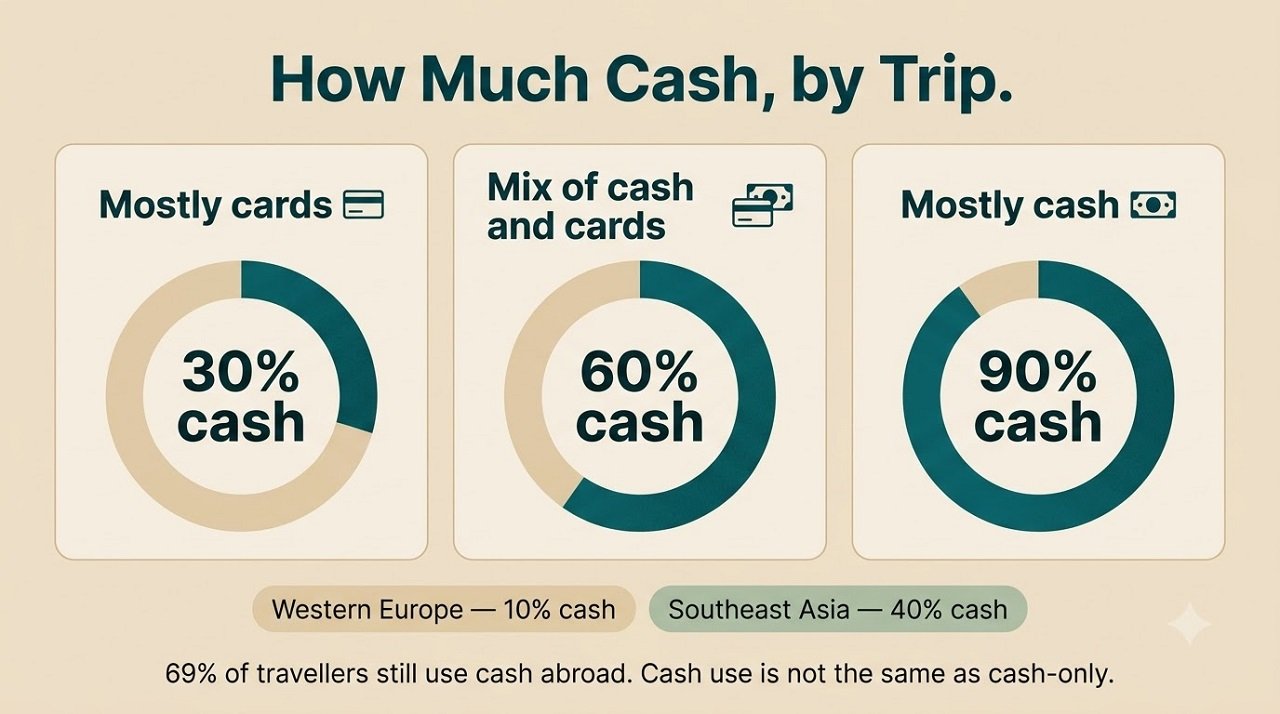
A practical framework from Currency Exchange International scales the cash share to your payment style:
| Your payment style | Share of spending in cash |
|---|---|
| Mostly cards | 30% |
| Mix of cash and cards | 60% |
| Mostly cash | 90% |
Destination-specific guidance tightens this further:
- Western and Northern Europe: shift to roughly 10% cash, since contactless is near-universal and Scandinavia is close to cashless.
- Southeast Asia: shift toward 40% cash, because street food, markets, tuk-tuks, and small guesthouses run on notes.
- Default starting point: a 40% forex card, 40% credit card, 20% cash split for a typical two-week leisure trip.
Indian forex guidance lands in a similar place, recommending a cash buffer of 10% to 15% of total budget for taxis and street vendors.
The Data on When People Buy Currency
The same Travelex report found a clear behavioural shift: only 6% of respondents bought travel money on the day of travel, while over a quarter bought currency a month in advance.
That is the right instinct for a different reason than most people think. Buying early is not about beating the rate — it is about not being forced into the worst-rate option at the airport because you ran out of time.
How Much to Actually Carry on Day One
Enough for transport from the airport, the first meal, and tips. That is the practical answer. Everything else can come from an ATM at your destination, ideally a bank machine, ideally in one withdrawal.
The mistake to avoid is landing with nothing and paying 10% to 15% at an airport kiosk because there was no other option.
If you are packing light and want your cards, cash, and documents organised rather than scattered, the carry-on packing system covers the pouch and backup routine.
Step 6: Budget the Real Cost Before You Go
The final step is arithmetic, and it is the one that changes behaviour.
A Worked Comparison
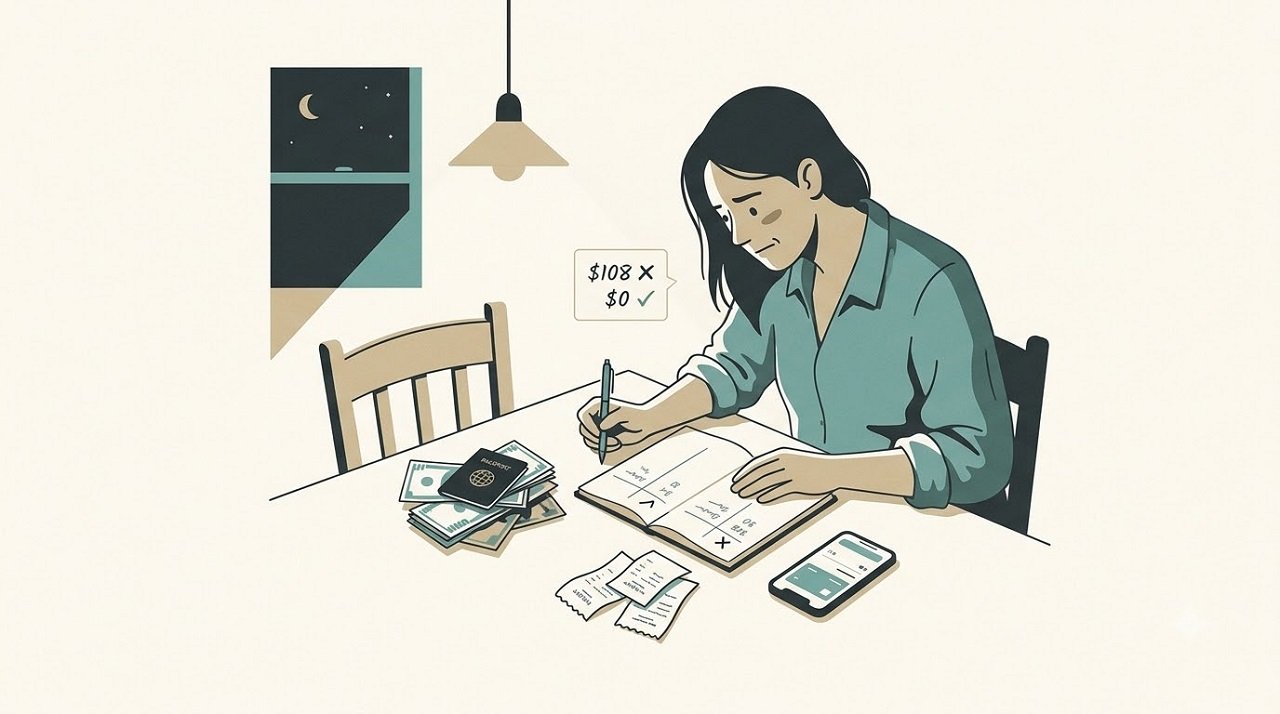
Take a 10-day trip with $2,500 of on-the-ground spending, split 60% card and 40% cash.
With a typical big-bank debit card:
| Item | Cost |
|---|---|
| Card purchases, $1,500 at 3% FX | $45 |
| Three ATM withdrawals of ~$333 each: $5 flat + 3% ($10) + $6 operator | $21 × 3 = $63 |
| Total fees | $108 |
With a no-FTF credit card for purchases and a rebate debit card for cash:
| Item | Cost |
|---|---|
| Card purchases, $1,500 at 0% FX | $0 |
| Three ATM withdrawals, operator fees rebated, 0% FX | $0 |
| Total fees | $0 |
The difference is $108 on a $2,500 trip — about 4.3% of the spend. That is a dinner, a train ticket, or two nights in a hostel, depending on where you are.
Now add one DCC mistake: a $500** hotel bill accepted in your home currency at a 6% markup. That single tap costs **$30 — more than a third of the entire ATM fee bill in the first scenario.
What to Do Four Weeks Out
- Check your existing cards’ foreign transaction fee. Search the terms for “foreign transaction” and “international ATM.”
- Apply for one no-FTF card and one rebate debit card if you do not already have them. Account opening takes time; four weeks is realistic, four days is not.
- Check your daily transaction limits and raise them if your bank allows. A hospital deposit or a hotel hold can exceed a default ceiling.
- Tell your bank you are travelling, so the first large transaction is not declined.
- Decide your cash split by destination, using the table in Step 5.
- Write the two-word rule on your phone’s notes: local currency.
If you have not arranged travel insurance yet, our guide to what travel insurance actually covers explains which benefits matter and which are marketing.
Where Not to Change Money
Three options are almost always the most expensive way to get foreign currency.
Airport Kiosks
Airport currency exchange counters frequently apply spreads of 10% to 15% above the mid-market rate. On a $2,000 exchange, that is **$200 to $300** in margin.
They often advertise “no commission,” which is true in the narrowest sense and irrelevant in practice — the margin is in the rate.
If you must arrive with local cash, order it from your own bank or a currency provider before you fly, and collect it at home.
Hotel Desks
Marginally better than airports, still carrying significant margins. Use them only for small amounts in a genuine emergency.
Buying at the Last Minute
This is a behavioural trap rather than a rate trap. The Travelex data shows only 6% of travellers buy on the day of travel — and those are the people most likely to accept whatever rate is available at the airport because the flight leaves in three hours.
Buying a month ahead does not guarantee the best rate. It guarantees you are not negotiating from a position of zero options.
If you are wondering whether a third-party booking platform is adding its own layer of fees, the comparison of booking direct versus third-party covers where those charges sit.
Conclusion
Travel money fees are not a mystery. They are three separate charges that stack, and each one has a specific countermeasure.
The sequence is short:
- Count the three fees — your bank’s percentage and flat fee, the operator’s surcharge, and the exchange rate spread.
- Refuse dynamic currency conversion every time. Choose local currency. This is the biggest single saving available to you.
- Choose cards by category — a no-FTF card for purchases, a rebate debit card for cash, never a credit card at an ATM.
- Withdraw from bank ATMs, in larger amounts, less often.
- Match your cash share to the destination, not to habit.
- Budget the fee cost in advance, so it is a line item rather than a surprise.
The data explains why this matters more than it looks. 35.3% of ATMs worldwide charge nothing to foreign cards, and 61.63% of countries have at least one fee-free option. The cheap route usually exists. Most travellers simply do not look for it.
If you remember one rule, make it this: the screen is the decision. Local currency, every time, at every terminal and every machine.
If you are planning the wider financial side of a trip, our guide to building a trip budget from scratch shows where these costs sit in the full picture.
Frequently Asked Questions
Why am I charged a fee at an ATM abroad?
Three charges usually apply at once: your bank’s foreign transaction fee (typically 1–3%, sometimes plus a $2–$5 flat fee), the ATM operator’s surcharge (often $5–$10 at independent machines in tourist areas), and a margin built into the exchange rate. Together they can add 5–10% to a withdrawal.
What is dynamic currency conversion and should I accept it?
DCC is when a merchant or ATM converts your transaction into your home currency before your bank sees it, at a rate they set. It costs 3–7% more than the market rate, sometimes over 10%, and it stacks on top of your card’s foreign transaction fee. Always decline it and pay in the local currency.
Is it cheaper to use an ATM or exchange currency?
ATMs are almost always cheaper, provided you use a bank-affiliated machine and decline DCC. Airport kiosks typically apply 10–15% spreads. A $2,000 exchange at an airport can cost $200–$300 more than an ATM withdrawal with a no-fee card.
How much cash should I carry abroad?
Roughly 30% of spending if you mostly use cards, 60% for a mix, and up to 90% in cash-heavy destinations. Western Europe needs about 10% cash; Southeast Asia closer to 40%. Carry enough local currency on arrival for transport, a meal, and tips.
Does a no-foreign-transaction-fee card solve everything?
No. It removes one of the three fees. You still pay ATM operator surcharges unless your card rebates them, and you still pay a 3–5% cash advance fee plus immediate interest if you use a credit card at an ATM.
Can I use a credit card to withdraw cash abroad?
You can, but it is the most expensive way to get cash. Cash advances carry a 3–5% fee, no grace period, and interest from the day of withdrawal, on top of the foreign transaction fee and the ATM surcharge.
Why do two ATMs next to each other charge different fees?
Operator surcharges are set individually by whoever owns the machine, and around 19.78% of ATMs also charge different amounts depending on which card network you use. Bank-branch machines are consistently cheaper than freestanding units in tourist zones.
Sources
- SmarterTravel. How to Avoid Every Fee on Foreign ATMs. Published 22 April 2026. Typical foreign withdrawal costs 5–10% more than necessary; three simultaneous fees — home bank flat charge often $3–$5, foreign operator surcharge $3–$8, currency conversion markup 1–3%; independent tourist-zone ATMs often $5–$10; bank-branch machines $0–$3 in home markets; DCC 3–7% worse than market rate; credit card cash advances carry immediate interest, no grace period, and 3–5% fees; $40 withdrawal with $8 fee = 20%, $400 with same fee = 2%.
https://www.smartertravel.com/how-to-avoid-every-fee-on-foreign-atms/ - Bankrate. How much are ATM fees? Published 4 March 2026. Average out-of-network ATM fee $4.86 per transaction, made up of $3.22 operator surcharge and $1.64 bank fee; using an out-of-network ATM weekly costs about $253 per year; international withdrawals carry 1–3% on top of a flat fee, often $2–$5; Bank of America charges $5 plus 3%; Ally caps at 1%.
https://www.bankrate.com/banking/how-much-are-atm-fees/ - ATM Fee Saver. Travel ATM Fee Index 2026. Published 28 May 2026. 182 countries analysed; highest fee 13.98% in Turkey, lowest 0.03% in Georgia; most common fee abroad $5.87; 35.3% of major ATMs charge zero to foreign cards; 61.63% of countries have at least one fee-free option; 19.78% of ATMs charge different fees by card network; Turkey’s three most expensive ATMs at 11.99%, 12.09%, 13.98%; $200 withdrawal in Turkey averages $12.58; five countries with ~10% ATMs, four of which have a widely available fee-free option; Western Europe average 0.64% with 14 of 28 countries charging zero; Thailand $7.60 Visa and $10.87 Mastercard; Japan $0.69 business hours and up to $4.12 weekends; Mexico up to $11.42; Spain up to $8.22; Iceland up to $31.06 per withdrawal; Australia lowest average fee but almost no fee-free options.
https://atmfeesaver.com/travel-atm-fee-index-2026/ - Wise. Conversion forcée (DCC) : comment l’éviter et arrêter de perdre de l’argent. Published 23 July 2026. DCC costs 5–12% per transaction; worked example on a $1,000 hotel bill — mid-market €925.93, standard card €943.40, DCC €990.10; difference of €47 versus a standard card; on $3,500 of spending DCC can cost €150–300 in invisible fees.
https://wise.com/fr/blog/conversion-forcee-dcc - WalletHub. Dynamic Currency Conversion: What It Is, How It Works & How to Avoid It. Published 2 February 2026. Merchants may use a conversion rate more than 10% higher than normal; the card issuer generally charges the foreign transaction fee in addition to the DCC charge; declining DCC and using a no-foreign-transaction-fee card can save up to 15% (12% DCC plus 3% foreign transaction fee) per purchase; card networks require disclosure and prohibit back-office DCC.
https://wallethub.com/edu/cc/dynamic-currency-conversion/25576 - Moneycontrol. Why ‘zero forex’ cards aren’t always as free as they sound. Published 9 February 2026. Typical Indian card foreign currency markup 2–3.5%; zero-forex cards waive the explicit fee but the exchange rate spread remains; choosing home currency at the terminal can wipe out the zero-forex benefit entirely; DCC rate difference 3–7% or higher; annual fees and reward-rate reductions can narrow the benefit.
https://www.moneycontrol.com/news/business/personal-finance/why-zero-forex-cards-aren-t-always-as-free-as-they-sound-13819247.html - TravelDailyNews. Travelex report shows 69% of travellers still use cash. Published 18 March 2026. 69% of travellers globally use cash abroad, exceeding card usage in most regions; report based on 12 months of Travelex revenue data plus global consumer surveys; cash important for tips, taxis, and destinations where card acceptance and fees are concerns; only 6% bought travel money on the day of travel, over a quarter bought a month in advance; Philip Bowcock quote on cash remaining king.
https://www.traveldailynews.com/statistics-trends/travelex-report-shows-69-of-travellers-still-use-cash/ - Beyond Baggage. The Best Travel Money Card for the US, UK and Australia: Wise, Revolut, Monzo, and Chase Compared on Real Fees. Published 30 August 2026. Two-week trip modelled at 2,000 home currency, 70% card and 30% cash; Wise conversion fee 0.4–0.6% at the mid-market rate, two free ATM withdrawals per month up to £200/$350 then 1.75% plus fixed fee; Revolut Standard interbank rate on weekdays for first £1,000 then 0.5–1% markup, 1% weekend markup, free ATM up to £200/$350 then 2%; Monzo uses Mastercard rate with no foreign transaction fee but only £200 per month free withdrawals then 3%; Chase Sapphire Preferred treats ATM withdrawals as cash advances.
https://beyondbaggage.com/2026/08/30/travel-money-cards/ - Payin Global. Best Way to Exchange Currency While Traveling Abroad. Published 2 April 2026. Airport currency exchange kiosks charge effective fees of 10–15% above the mid-market rate; the same $2,000 exchange costs $200–$300 in margin; bank branches and hotel desks carry significant margins; local ATM withdrawals with a no-fee debit card and credit card payments in local currency are consistently cheapest.
https://www.payinglobal.com/blog/best-way-to-exchange-currency-while-traveling-abroad - Currency Exchange International (CEIFX). How Much Foreign Currency Should You Actually Bring? Published 24 September 2026. Cash share by payment style: mostly cards 30%, mix of cash and cards 60%, mostly cash 90%; cash wins for street food, market stalls, taxis, local transit, tips, small entry fees, rural towns and islands; cards win for hotels, flights, trains, rental cars, city restaurants, and disputable purchases; airport kiosks and hotel desks are the most expensive places to exchange.
https://www.ceifx.com/news/how-much-foreign-currency-should-you-actually-bring%3F - FlightGPT. How Much Cash vs Card Should You Carry Abroad in 2026? The 40-40-20 Rule. Published 7 June 2026. Default split of 40% forex card, 40% credit card, 20% cash for a two-week leisure trip; Europe shifts to roughly 45/45/10; Southeast Asia shifts toward 30/30/40; carrying 60–70% cash is the common first-timer mistake; avoid DCC at every terminal.
https://flightgpt.in/blog/cash-vs-forex-card-vs-credit-card-ratio-foreign-trip-2026 - Moneycontrol. Tips to manage foreign currency effectively while travelling abroad this festive season. Published 19 September 2025. Prepaid forex cards lock rates and avoid the 3–3.5% charged by credit and debit cards; cash buffer of around 10–15% of total budget for taxis and street vendors; DCC costs 2–8%; ATM fees up to ₹500 per withdrawal; withdraw larger amounts at once rather than several small withdrawals.
https://www.moneycontrol.com/news/business/personal-finance/tips-to-manage-foreign-currency-effectively-while-travelling-abroad-this-festive-season-13561095.html - The Economic Times (ETTravelWorld). Forex costs overtake visa concerns for Indian travellers, finds Wise report. Published 2 June 2026. Passport & Paisa: India Travel Money Report 2026, survey of more than 1,000 Indian international travellers; travel budget management now the leading source of anxiety, ahead of visas, flight disruptions, language, and connectivity; hidden exchange rate markups, non-transparent pricing, and difficulty comparing rates are the top frustrations; nearly half spend under INR 1 lakh per trip; 38% exchange cash before departure; only 9% use digital multi-currency accounts; zero forex markup the most valued cost feature; global card acceptance ranked ahead of lounge access and rewards.
https://travel.economictimes.indiatimes.com/news/research-and-statistics/forex-costs-now-a-top-concern-for-indian-travelers-surpassing-visa-worries/131458546 - Money Talks News. ATM Fees Are at an All-Time High. These 11 Banks Refund Them. Published 28 July 2026. Charles Schwab offers unlimited ATM fee rebates for cash withdrawals worldwide; Fidelity’s Cash Management Account offers unlimited reimbursements on ATM withdrawals worldwide.
https://www.moneytalksnews.com/4-banks-that-waive-or-refund-atm-fees/ - FinanceRadar. No Foreign Transaction Fee Checking Accounts 2026. Published 22 October 2026. Schwab, Fidelity Cash Management, Capital One 360, Chime, and Varo charge no foreign transaction fee on debit card purchases; Schwab lists unlimited ATM fee rebates for cash withdrawals worldwide.
https://financeradar.com/blog/checking-accounts-with-no-foreign-transaction-fees - Gerald. Cash Advance Fee Review. Cash advance fees typically 3–5% of the withdrawal amount, charged immediately with no grace period
https://joingerald.com/learn/cash-advance/how-to-review-cash-advance-fees-when-a-bill-is-due - Credit Karma. Synchrony Premier World Mastercard rates and fees. Accessed October 2026. Cash advance fee 5% of each advance with a $10 minimum; cash advance APR 23.49%–36.24% variable as of 28 August 2026; foreign transaction fee 3%.
https://www.creditkarma.com/creditcard/ccsynchrony01
https://www.synchrony.com/partner/synchrony-mastercards