
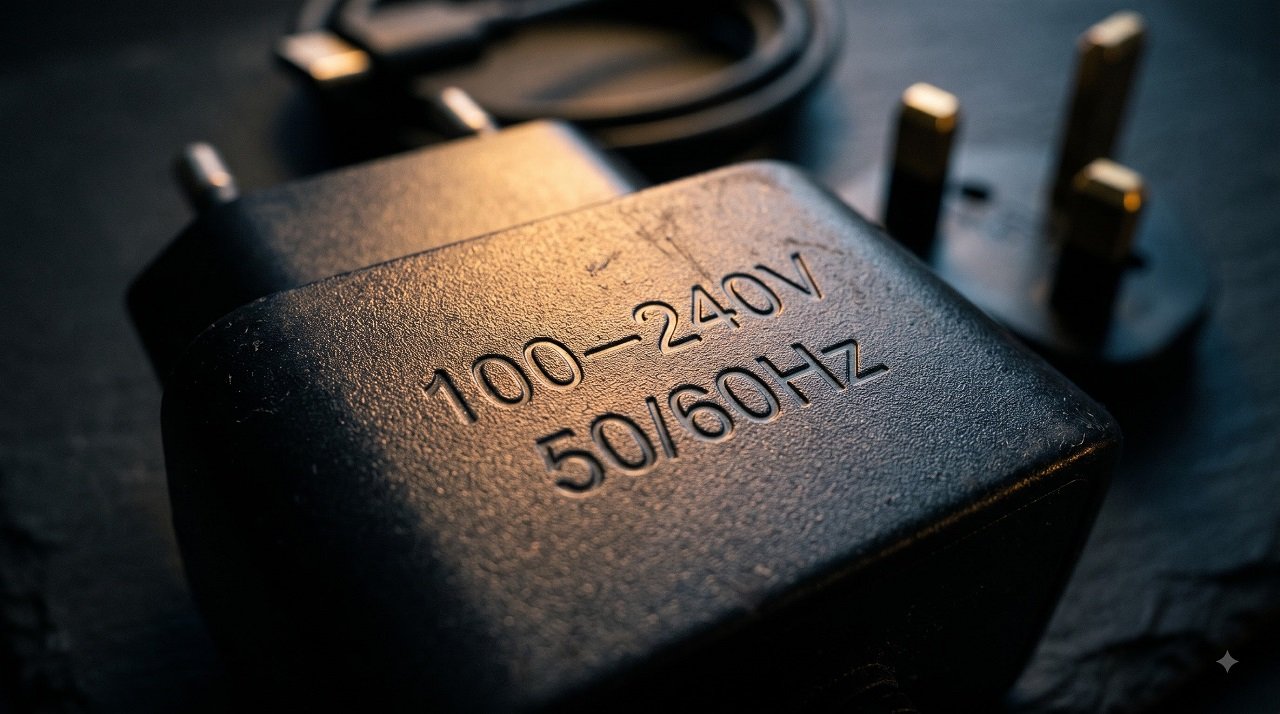
Electrical standards vary by country and change slowly, but device specifications vary by model and change every year. The only reliable answer for your device is printed on its plug, its power brick, or its battery compartment.
If you are reading this in a later year, treat the method as still correct — read the label, check the voltage, check the frequency, then decide whether you need an adapter, a converter, or nothing at all. But confirm your own device before you plug anything in.
This guide is general information, not electrical advice. If you are unsure about a device, do not plug it in. Mains voltage can cause fire, injury and death.
All sources used in this guide are listed at the end.
Introduction
There is a specific kind of travel disappointment that involves a curling iron melting in a Milanese bathroom.
It happens because of one sentence that almost everyone believes: “I just need a plug adapter.”
Sometimes that is true. For a phone, a laptop, a camera battery charger — almost always true, because those devices are dual voltage and only need the plug shape changed. But for a hair dryer, a straightener, a kettle, or a travel iron, an adapter does nothing except let the wrong voltage into the device.
The distinction is simple, and it is printed on your device in characters about three millimetres high.
This guide covers that distinction properly: how to read the voltage label, which plug types go where, what frequency does to clocks and motors, why heating appliances are the ones that fail, what USB-C has changed, and the airline battery rules that catch people at security rather than at the destination.
If you are building a packing list around electronics, the carry-on packing system covers the pouch and cable organisation that makes this workable. If your trip involves staying connected, our guide to using your phone abroad covers data plans and roaming.
Adapter vs Converter: The Difference That Matters
These two words are used interchangeably online. They are not interchangeable, and treating them as synonyms is how devices get destroyed.
An Adapter Changes the Shape
A travel adapter is a mechanical device. It has metal prongs shaped for one country’s sockets and holes shaped for another country’s plug. Nothing else.
It does not change voltage. It does not change frequency. The electricity coming out of the wall socket is exactly what it was before — your device simply fits into it.
A Converter Changes the Current
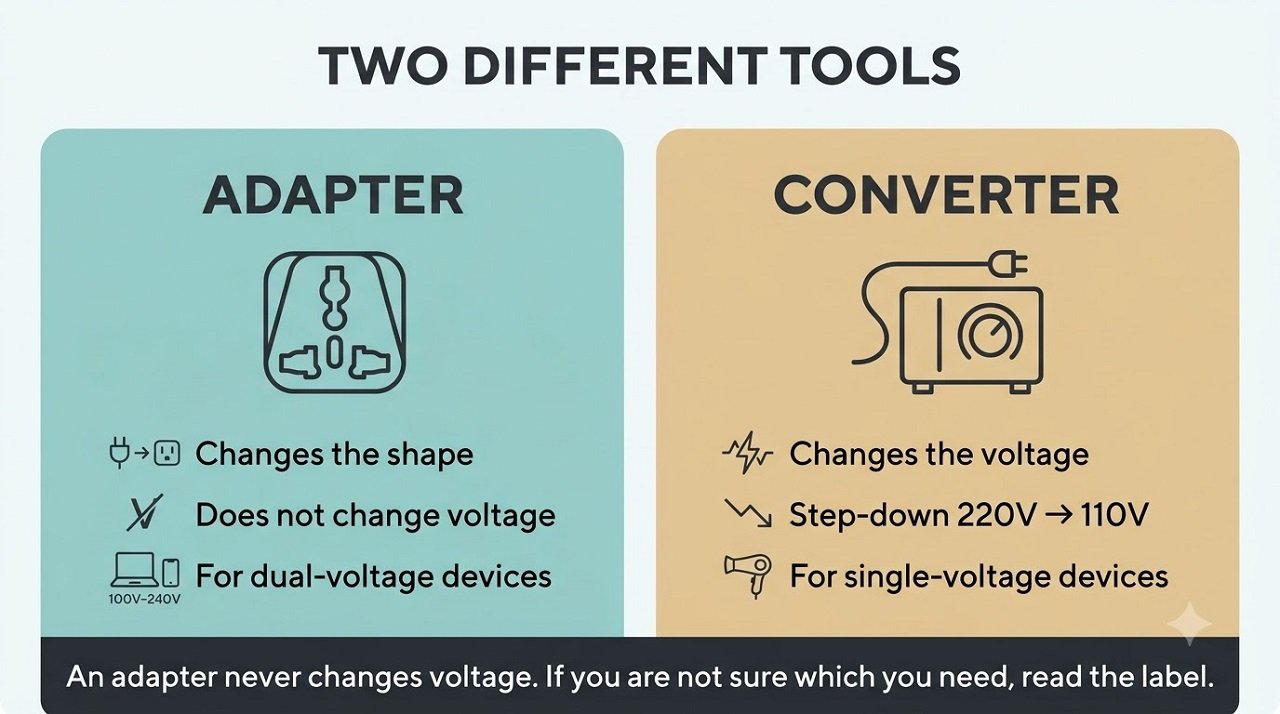
A converter — more precisely a transformer or voltage converter — is an electrical device. It takes one voltage and outputs another. A step-down converter takes 220–240 V and outputs 110–120 V, which is what a North American appliance expects.
Converters come in two broad types, and the difference matters:
- Heavy resistive converters — bulky, brick-like, designed for heating appliances like hair dryers and irons. These handle high wattage.
- Electronic converters — smaller, designed for electronic devices rather than motors or heating elements. Some produce a modified waveform that damages certain devices.
The Practical Rule
| Your device | What you need |
|---|---|
| Phone, laptop, tablet, camera charger, most modern electronics | Adapter only |
| Hair dryer, straightener, curling iron, kettle, travel iron | Converter — or leave it at home |
| Anything you are unsure about | Read the label |
The overwhelming majority of what modern travellers carry is dual voltage. The small minority that is not tends to be exactly the appliances that cause the most trouble — and the most cost.
Read the Label Before You Buy Anything
Every device with a power supply has a label. Find it before you pack.
Where to Look
- On the power brick (the lump on the cable)
- On the plug head of the cable
- Under the device, or in the battery compartment
- In the manual, if all else fails
What the Label Looks Like
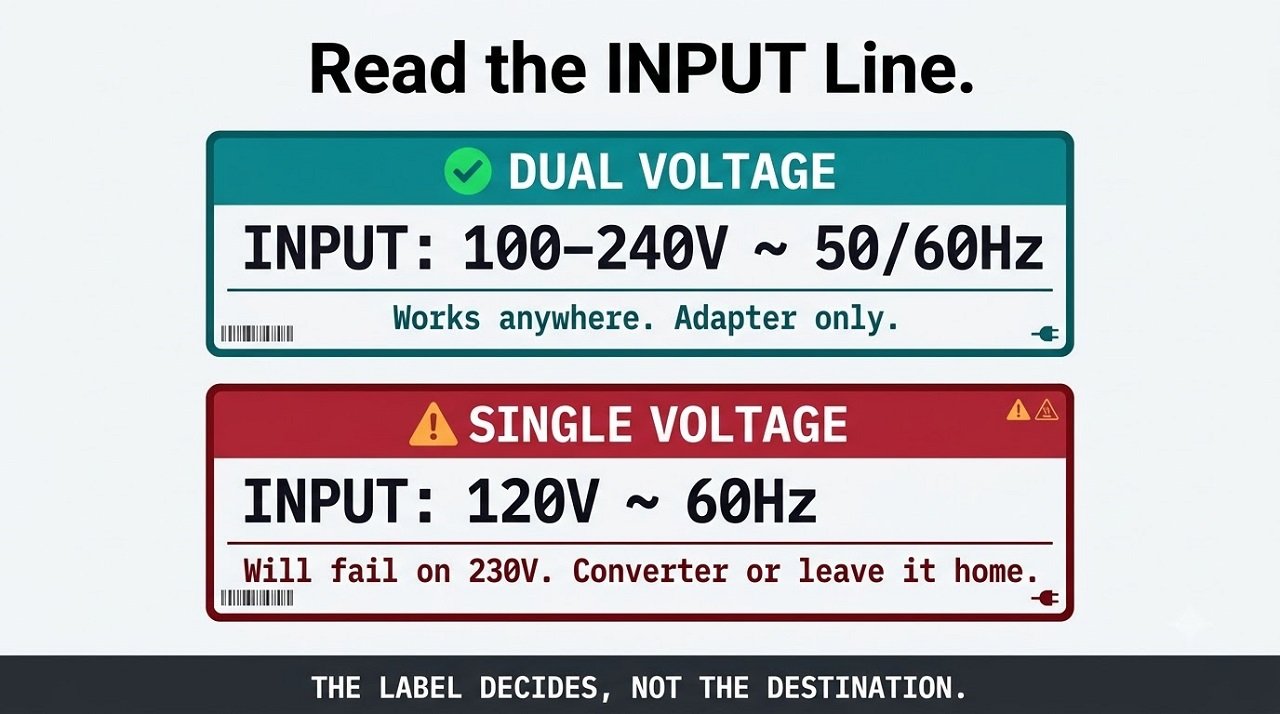
Look for the voltage section. It will be one of these two patterns:
Pattern one — a range:
INPUT: 100–240V ~ 50/60Hz
This is dual voltage. It works anywhere in the world. You need an adapter and nothing else. The 50/60Hz part means it also tolerates both frequencies.
Pattern two — a single figure:
INPUT: 120V ~ 60Hz
This is single voltage. It expects North American current. Plugging it into a 230 V socket through a plain adapter will damage it, possibly spectacularly.
INPUT: 230V ~ 50Hz
This is European single voltage. The same problem runs in the other direction — it will not work properly on North American current.
The Symbol That Saves You a Search
Many manufacturers print a small switch or slider marked 115 / 230. If your device has one, set it to the destination voltage before you plug it in. Some have a recessed switch you need a coin to turn. Forgetting to set it produces the same result as having no switch at all.
What Wattage Tells You
Voltage is only half the label. Wattage (W) tells you how much power the device draws.
This matters because converters have wattage limits, and a hair dryer is one of the hungriest devices people travel with. A typical hair dryer draws 1,200–1,800 W. A cheap converter rated for 50 W will either fail immediately or fail dangerously.
The rule: the converter’s wattage rating must exceed the device’s stated wattage. Not equal it. Exceed it, with headroom.
Plug Types by Region
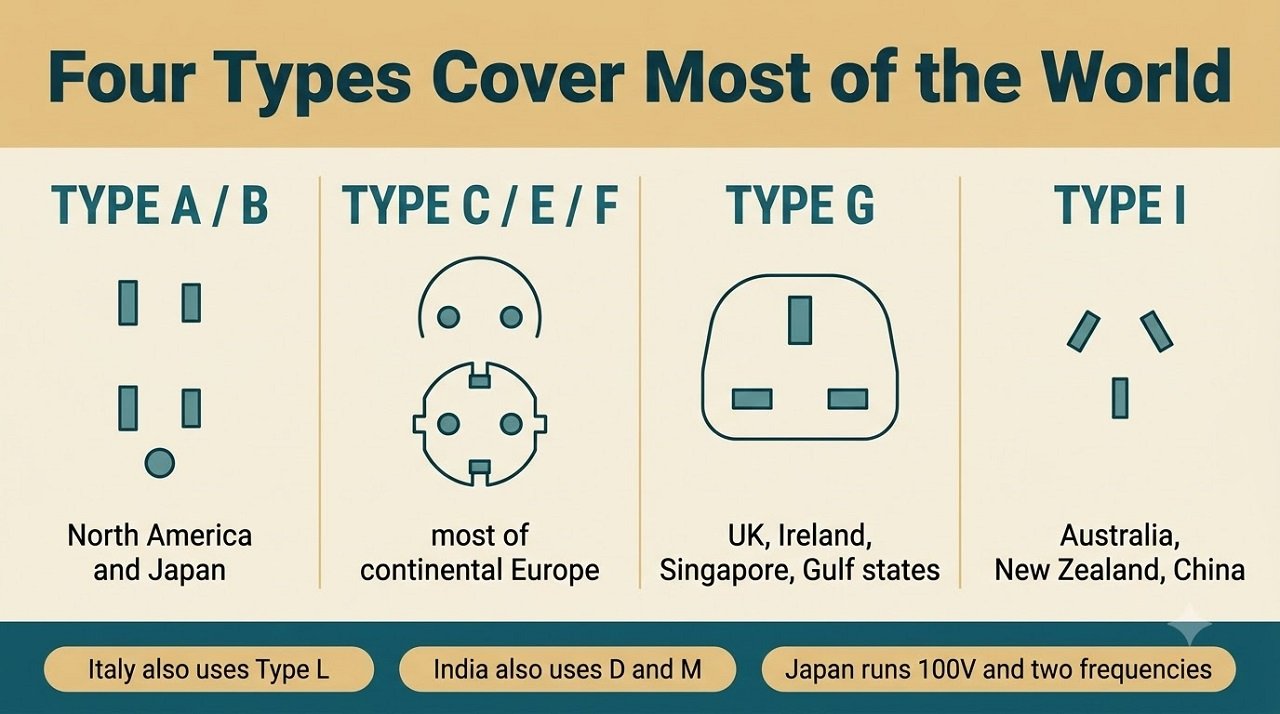
There are around fifteen plug types in use worldwide, lettered A to O. You do not need to memorise all of them, but four cover most of the world.
| Type | Where you find it | Notes |
|---|---|---|
| A / B | North America, Japan, parts of Central America | A is two flat pins; B adds an earth pin |
| C / E / F | Most of continental Europe | C is the simple two-round-pin; E and F add earth in different configurations |
| G | UK, Ireland, Singapore, Malaysia, Hong Kong, Gulf states | Three substantial rectangular pins, fused plug |
| I | Australia, New Zealand, China, Argentina | Two angled flat pins plus earth |
The Complications
- The UK’s Type G has a fuse inside the plug. Not a problem for travel, but worth knowing if you are buying devices to bring home.
- Italy uses Type L in some older buildings, alongside C and F. A standard European adapter may not fit all sockets in one hotel.
- India uses Type D and M in older installations, alongside C. Universal adapters usually cope; single-purpose European adapters often do not.
- Japan runs on 100 V, not 110 or 120, and on 50 Hz in the east and 60 Hz in the west. This is the only country where the frequency genuinely differs within one country.
What to Actually Buy
For most travellers, a universal adapter with a slider or interchangeable plug heads covers the widest range and replaces a drawer of single-country adapters.
Two things to check before buying:
- Does it accept earthed plugs? Look for a metal clip or contact for the earth pin. A cheap universal adapter often accepts only two-pin plugs, which means a UK three-pin laptop charger will not fit.
- Does it have a USB-C port with Power Delivery? This has become the more important feature — see the next section.
What USB-C Changed
The charging picture has shifted substantially in the last few years, and some older adapter advice is now unnecessarily complicated.
The Brick Is Disappearing
Most phones, tablets, earbuds, and increasingly laptops now charge from a USB-C port rather than a proprietary barrel connector.
This means the thing that plugs into the wall is often just a USB-C power adapter — and most of those are dual voltage. A 65 W GaN charger rated 100–240 V will run a laptop in Tokyo, Lisbon and Sydney from the same cable.
What this changes for packing: instead of a laptop charger, a phone charger, a camera charger and a tablet charger, you can carry one USB-C brick and a multi-port cable arrangement. That is a real weight saving, and it is covered in the carry-on packing guide.
What It Does Not Change
USB-C does not make a hair dryer dual voltage. It does not make a single-voltage appliance safe. It solves the charging problem for small electronics, not the heating problem.
The One Cable to Test Before You Fly
Test your cables at home with the devices you plan to bring. Charging failures abroad are usually cable failures, not socket failures — and a cable that works for one device may not carry enough wattage for another.
The Appliances That Actually Fail
If you want a single rule to prevent every ruined device on your trip, it is this: the higher the heat, the higher the risk.
Why Heating Appliances Are Different
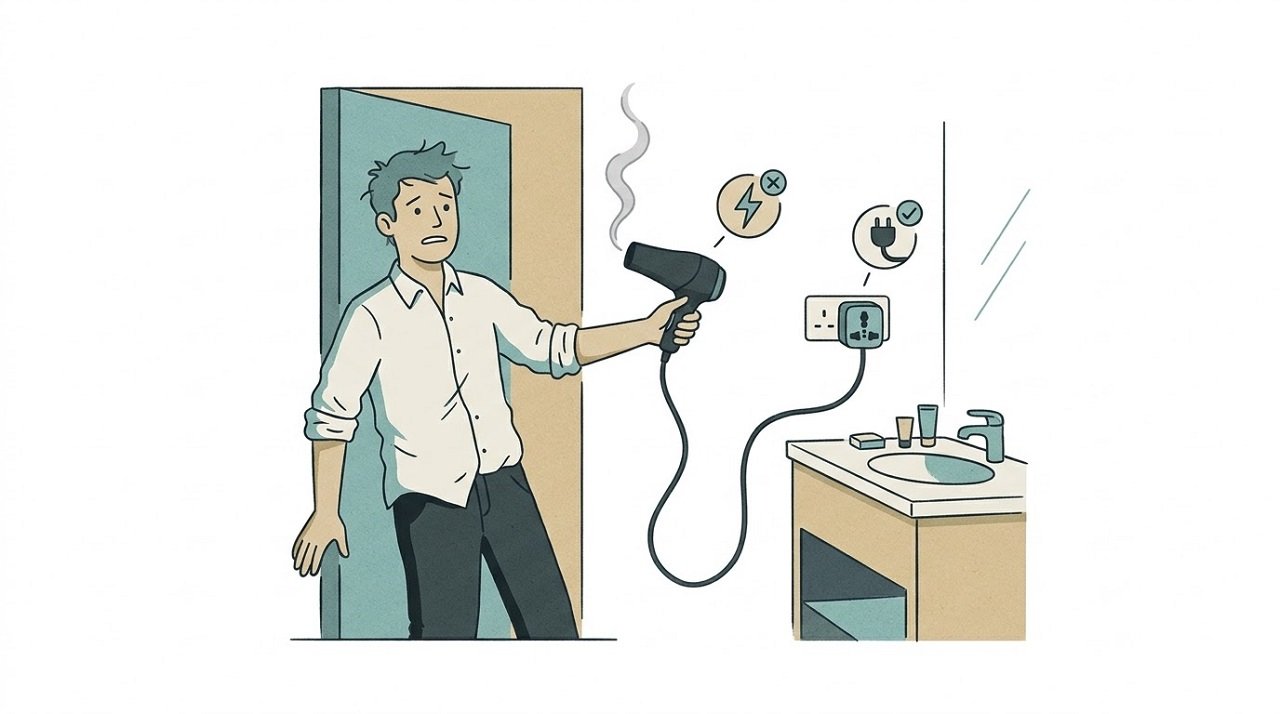
A phone charger converts a small amount of power into direct current. A hair dryer converts a large amount of power into heat, using a heating element and a motor.
At double the intended voltage, a heating element produces roughly four times the heat, and the motor runs far beyond its design speed. The result is not gradual wear. It is immediate failure, sometimes with flame.
The Usual Suspects
- Hair dryers — the classic casualty
- Straighteners and curling irons
- Travel kettles
- Garment steamers
- Electric shavers with motors, depending on the model
The Cheapest Solution
Most hotels provide hair dryers. Ask before you pack one.
If you need your own, buy a dual voltage travel hair dryer specifically designed for it, and check that it is rated 100–240 V. These exist, they are inexpensive, and they sidestep the converter question entirely.
Do not rely on a converter for a high-wattage appliance unless the converter is explicitly rated for it. A converter that costs less than the hair dryer is not designed to run the hair dryer.
Power Banks and Airline Rules
This is the part of travel electronics that is enforced at security, not at the destination.
The Rule Most Airlines Follow
Power banks and spare lithium batteries must go in cabin baggage, not checked baggage. This applies almost universally, because a lithium battery fire in the hold cannot be reached.
The common threshold is 100 watt-hours (Wh) for lithium-ion batteries:
- Under 100 Wh — generally permitted in carry-on
- 100–160 Wh — permitted on many airlines with approval, and usually limited in number
- Over 160 Wh — generally not permitted
Rules vary by airline and by country, and they are enforced by the carrier rather than by a single global standard.
How to Work Out Your Wh
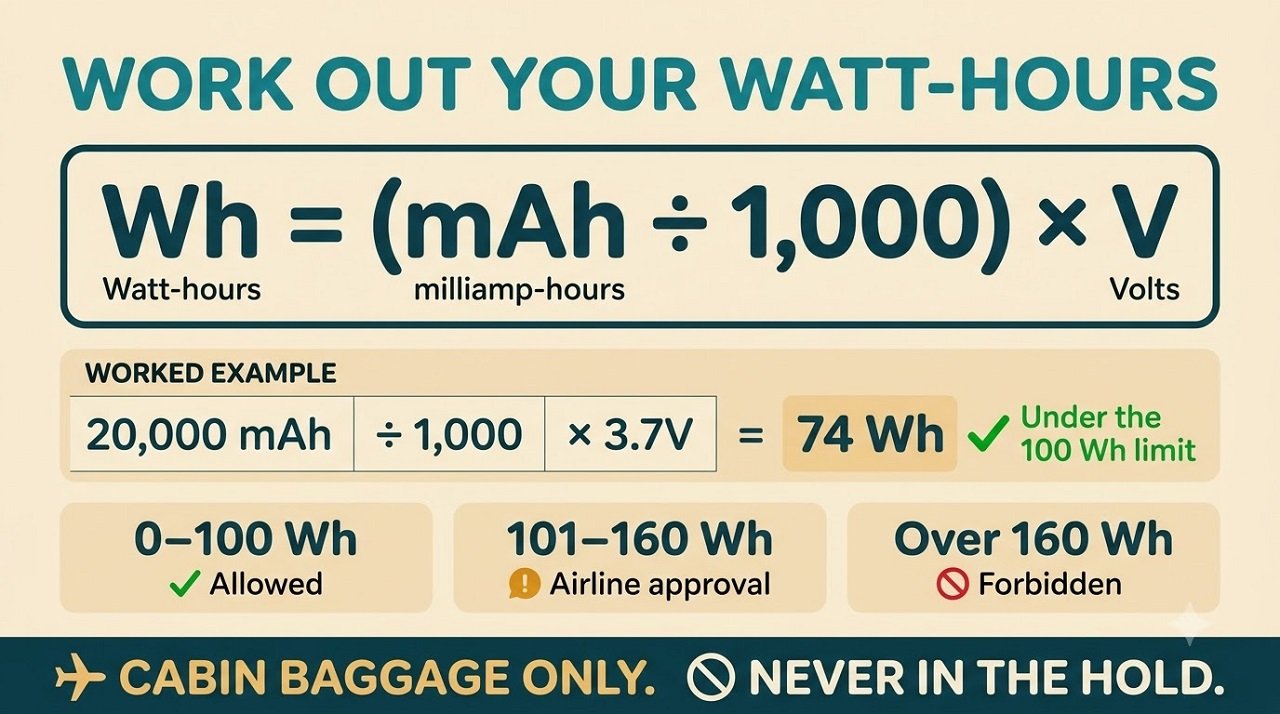
If your power bank states milliampere-hours (mAh) rather than Wh, the conversion is:
Wh = (mAh ÷ 1,000) × voltage
For a power bank marketed as 20,000 mAh at a nominal 3.7 V:
(20,000 ÷ 1,000) × 3.7 = 74 Wh
That is comfortably under the 100 Wh threshold. A 27,000 mAh bank at the same voltage is about 100 Wh — right at the line, and likely to attract a second look.
Practical Rules
- Carry power banks in your cabin bag, never checked.
- Check the printed capacity before you fly. An unlabelled power bank may be refused.
- Keep terminals covered — a spare battery shorting against keys in a bag is a genuine fire risk.
- Check your specific airline’s rule, because the limits and approval processes differ.
What to Pack
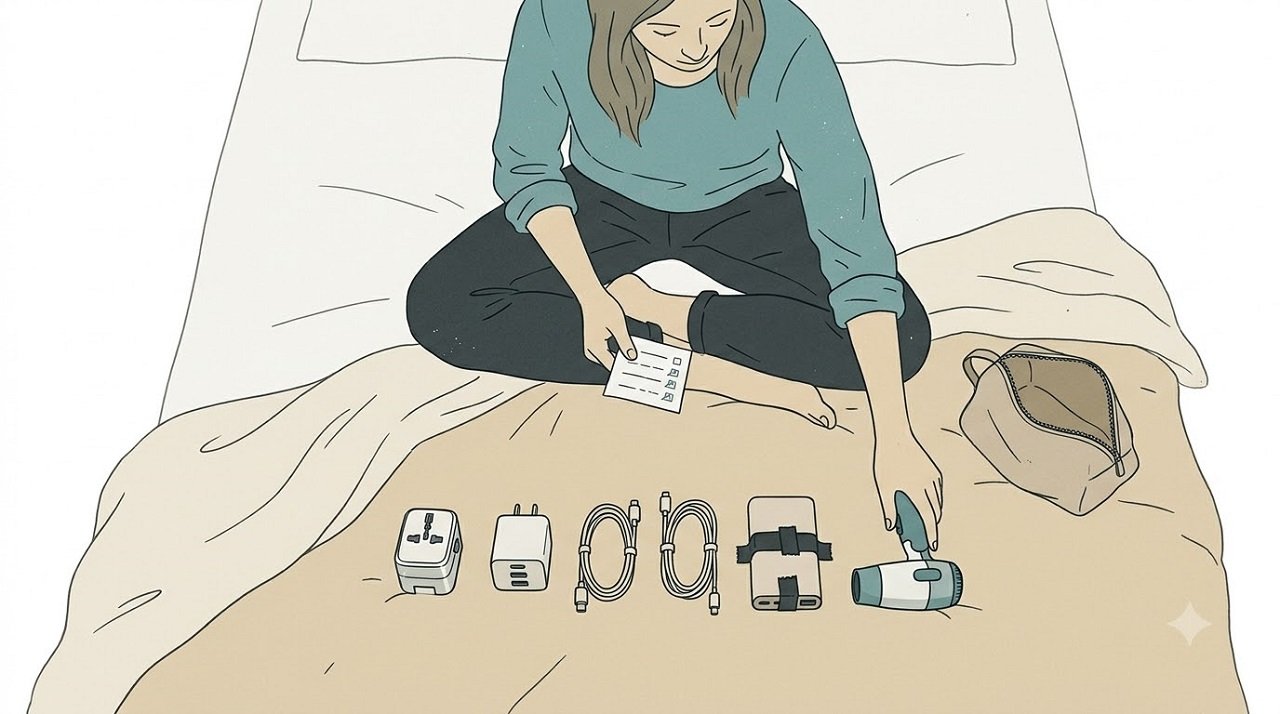
A working setup for a typical trip:
- One universal adapter with earthed-plug support and at least one USB-C port
- One multi-port USB-C charger rated 100–240 V, with enough wattage for your laptop
- Two USB-C cables, one rated for your laptop’s wattage
- Power bank under 100 Wh, in your cabin bag, terminals taped or covered
- Dual voltage travel hair dryer only if the accommodation does not provide one
- A small plug-in surge protector if you carry expensive electronics and the destination has unstable power
What Not to Pack
- A single-country adapter if you are crossing borders
- A cheap converter for a high-wattage appliance
- Any heating appliance that is not dual voltage and not specifically a travel model
- Spare lithium batteries in a checked bag
If you are travelling with medical devices that require power, our guide to travelling with prescription medication covers the documentation that should accompany them.
The Pre-Trip Checklist
Five minutes at home prevents almost every problem in this article.
- Pick up every device you plan to bring and find the INPUT line on the label.
- Write down which are dual voltage (100–240 V) and which are single voltage.
- For any single-voltage device, decide: converter, dual-voltage replacement, or leave it behind.
- Check your power bank’s Wh and confirm it is under your airline’s limit.
- Test your cables and charger with each device before packing.
If the answer to a question is unclear, the safe default is always: do not plug it in.
Conclusion
The travel adapter question is not really about adapters. It is about reading one line of small print on the back of a device.
Two facts resolve almost everything:
Adapters change the shape. Converters change the current. They are different tools, and the word “adapter” should never be used when a converter is meant.
Most modern electronics are dual voltage. Most heating appliances are not. A phone charger from 2019 onwards almost certainly says 100–240 V. A hair dryer almost certainly does not.
Everything else — plug types, frequency, wattage, power bank limits — follows from those two facts.
If you remember one rule, make it this: the label decides, not the destination. Check the device before you check the socket.
If you are assembling the rest of your bag, the carry-on packing system covers the volume limits and organisation that keep it all manageable.
Frequently Asked Questions
Do I need a voltage converter or just an adapter?
It depends entirely on your device. Check the INPUT label. If it reads 100–240 V, you need only an adapter to change the plug shape. If it reads a single voltage, you need a converter — or a different device.
Will my hair dryer work in Europe?
Almost certainly not safely. Most hair dryers are single voltage and draw high wattage. At European voltage they overheat rapidly. Use the hotel’s hair dryer, or buy a dual-voltage travel model rated 100–240 V.
What plug type does Europe use?
Most of continental Europe uses Type C, E or F — two round pins, with E and F adding an earth connection in different configurations. The UK and Ireland use Type G with three rectangular pins. Italy has some Type L sockets alongside C and F, so a single European adapter may not fit every socket in one hotel.
Can I bring a power bank on a plane?
Yes, in your cabin bag — almost never in checked baggage. The common threshold is 100 Wh for lithium-ion batteries, with 100–160 Wh often permitted with airline approval, and anything above 160 Wh generally refused. Check your specific airline, because rules vary.
How do I work out my power bank’s watt-hours?
Multiply the mAh figure by the voltage and divide by 1,000. A 20,000 mAh bank at 3.7 V is about 74 Wh, comfortably under the usual 100 Wh limit.
Why do some clocks run fast abroad?
Frequency. Some countries supply 50 Hz, others 60 Hz. Anything that uses the mains frequency to keep time — an older plug-in clock, some timers — will gain or lose time accordingly. This is a minor issue now, because most clocks are quartz or digital.
Sources
- International Electrotechnical Commission. IEC TR 60083:2015 — Plugs and socket-outlets for domestic and similar general use standardized in member countries of IEC. 7th edition, published 29 October 2015. General information on plug and socket systems used in IEC countries, limited to a.c. systems rated above 50 V and not exceeding 440 V for household and similar purposes. Stability date 2026.
https://webstore.iec.ch/en/publication/23628 - World Standards. Full list: Plug, socket & voltage by country. Last updated 7 September 2025. Country-by-country overview of plugs, outlets, voltages and frequencies for domestic appliances; notes that most countries operate between 220 and 240 volts at 50 or 60 Hz, that 100–127 volt countries are greatly outnumbered, and that types A and C are the most frequently used plugs worldwide.
https://www.worldstandards.eu/electricity/plug-voltage-by-country/ - International Air Transport Association (IATA). Safe Travel with Lithium Batteries. Current 2026. Seven safety rules for flying with lithium batteries, including: check battery size, as batteries over 100 watt-hours may require airline approval; always carry phones, laptops, cameras and other battery-powered items in hand baggage, not checked baggage; remove all lithium batteries and devices before gate-checking hand baggage; keep spare batteries and power banks in original packaging or cover the terminals with tape to prevent short-circuits. An IATA passenger survey found 44% of travellers carry a power bank, and 45% incorrectly believe power banks can go in the hold.
https://www.iata.org/en/youandiata/travelers/batteries/ - UK Civil Aviation Authority. Regulator launches lithium battery safety checklist ahead of busy half-term travel period. Published October 2026. Six-point checklist requiring passengers to take power banks in the cabin, check airline size and quantity limits, avoid charging power banks in flight, and alert cabin crew immediately if a device becomes hot, smokes or catches fire. Survey data: 54% of air passengers now carry a power bank, up from 49% the previous year, while 31% still incorrectly believe lithium battery items should be packed in checked luggage.
https://www.caa.co.uk/newsroom/news/regulator-launches-lithium-battery-safety-checklist-ahead-of-busy-half-term-travel-period/ - US Federal Aviation Administration. Lithium Battery Resources. Current 2026. States that lithium-ion batteries are allowed based on watt hours: batteries of 0–100 Wh are allowed on passenger aircraft, 101–160 Wh require an air carrier’s approval, and batteries exceeding 160 Wh are forbidden.
https://www.faa.gov/hazmat/resources/lithium_batteries