All airport statuses in this guide reflect published security rules current in late 2026. Airports are switching to CT scanners continuously, and some have reversed course once already.
If you are reading this in a later year, treat the method as still correct — check your departure airport, check your return airport, check every connection. But confirm the current rule at your specific airport before you pack, because a list compiled today may be wrong by your travel date.
This guide is general information, not a security authority. Only the airport and the screening officer decide what passes.
All sources used in this guide are listed at the end.
Introduction
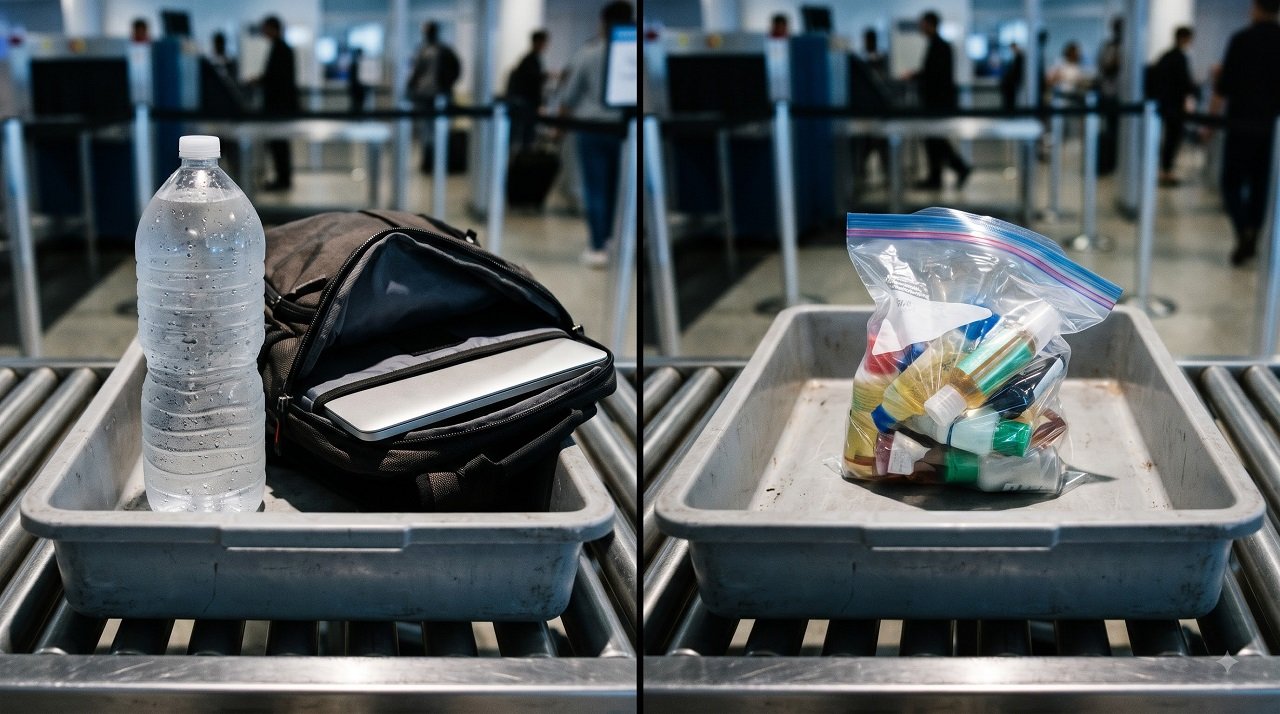
For nearly twenty years, the most universal rule in air travel was the 100ml limit. One clear bag, one litre, no exceptions, everywhere.
That rule is now being dismantled — and the dismantling is uneven in a way that is genuinely dangerous for your luggage.
At London Heathrow, the limit was lifted on 23 January 2026 after a £1 billion upgrade across all four terminals. Passengers can now carry liquid containers of up to two litres and leave laptops and tablets inside their bags. Heathrow is the largest airport in the world to make the change.
The same is true at Gatwick, Birmingham, Edinburgh, Bristol, Belfast, London City and Luton, and increasingly across continental Europe — Vienna from July 2026, Munich from 18 September 2026, Rome Fiumicino, Milan Linate and Milan Malpensa, Prague Terminal 2, Zurich, Dublin, Kraków, Malta, Palma de Mallorca and Billund.
It is not true at Paris, Frankfurt, Amsterdam Schiphol, Madrid, Athens, Lisbon, Budapest, Marseille or Málaga. Those airports still enforce 100ml.
The result is a genuine trap that did not exist before: you can buy a two-litre bottle of duty-free perfume at Heathrow, carry it legally through security, and have it confiscated at Athens on your return journey — because the rule at the airport you fly home from is the rule that applies.
This guide explains why the change happened, which airports have switched and which have not, how to check your specific itinerary, and the two scenarios where the patchwork costs travellers the most.
If you are packing a carry-on and want the wider routine, our guide to one-bag packing covers volume and organisation. If you are travelling with medication that exceeds the liquid limit, our guide to travelling with prescription medication covers the documentation that should accompany it.
Why the Rule Is Changing
The 2006 Origin
The 100ml limit was introduced across Europe and internationally in August 2006, following the discovery of a plot to detonate liquid explosives concealed in drink bottles on transatlantic flights.
The restriction was a blunt instrument. Security scanners of the era could not reliably determine whether a bottle contained water or a liquid explosive, so the response was to limit container size and force passengers to present liquids separately. It worked, in the narrow sense that it closed the specific vulnerability. It also created two decades of tiny shampoo bottles and overpriced airport water.
What CT Scanners Changed
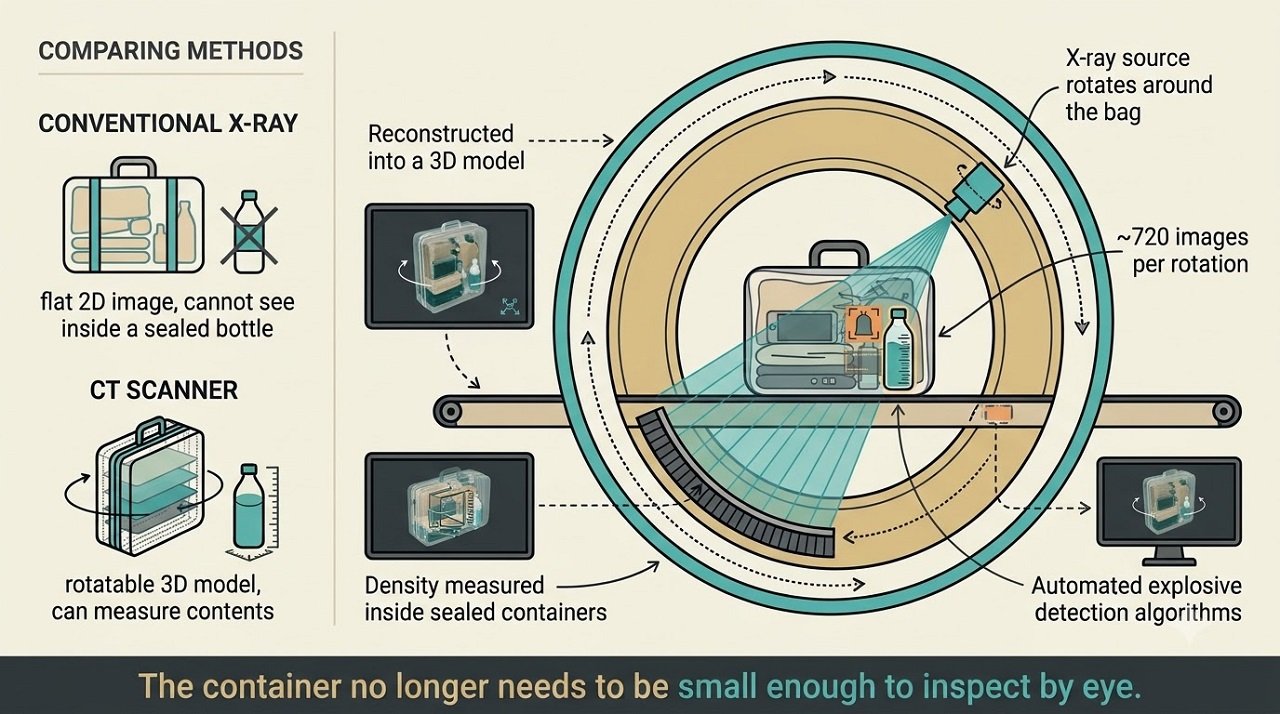
The technology that makes the rule unnecessary is computed tomography — the same principle as a medical CT scan, applied to baggage.
A CT scanner rotates an x-ray source around the bag, capturing hundreds of images per rotation and reconstructing them into a high-resolution 3D model. Security staff can rotate the contents virtually, measure density, and apply automated explosive-detection algorithms.
The practical difference is that the scanner can distinguish the contents of a sealed bottle, which conventional x-ray cannot. The container no longer needs to be small enough to be inspected by eye.
The EU’s Reversal — and Second Reversal
The transition has not been smooth, and the history explains why some airports are still on the old rule.
Several European airports began removing the 100ml limit after installing CT scanners. Then, in September 2024, the European Commission temporarily reimposed the 100ml restriction at airports using standard C3 scanners, after raising technical concerns about whether certain models could reliably detect explosives inside larger liquid containers.
The restriction was lifted again from 25 July 2025, after the European Civil Aviation Conference (ECAC) recertified the equipment — around 700 scanners across 21 member states. Crucially, the Commission left the decision to each airport, and only one manufacturer’s equipment had been recertified at that point.
That is why the map is a patchwork rather than a switch. It is not a single policy being rolled out. It is individual airports, individually certified, individually deciding.
Which Airports Have Changed
The lists below are current to late 2026. Treat them as a starting point rather than a guarantee, because the count is still growing.
Airports allowing up to 2 litres per container
United Kingdom:
- London Heathrow (all four terminals, from 23 January 2026)
- London City
- London Gatwick
- London Luton
- Edinburgh
- Birmingham
- Bristol
- Belfast
- Teesside
Continental Europe:
- Vienna (from July 2026)
- Munich (from 18 September 2026, all checkpoints)
- Rome Fiumicino
- Milan Linate
- Milan Malpensa
- Prague Terminal 2
- Zurich
- Dublin
- Kraków John Paul II
- Vilnius
- Bologna
- Turin
- Malta
- Palma de Mallorca
- Billund
Airports still enforcing 100ml
- Paris (Charles de Gaulle and Orly)
- Frankfurt (in older terminals; Terminal 3 applies the new procedures)
- Amsterdam Schiphol
- Madrid
- Barcelona
- Athens and major Greek regional airports
- Lisbon
- Marseille
- Málaga (more limited implementation than Palma)
- Budapest
- Most airports outside Europe, including the United States
The Partial Cases
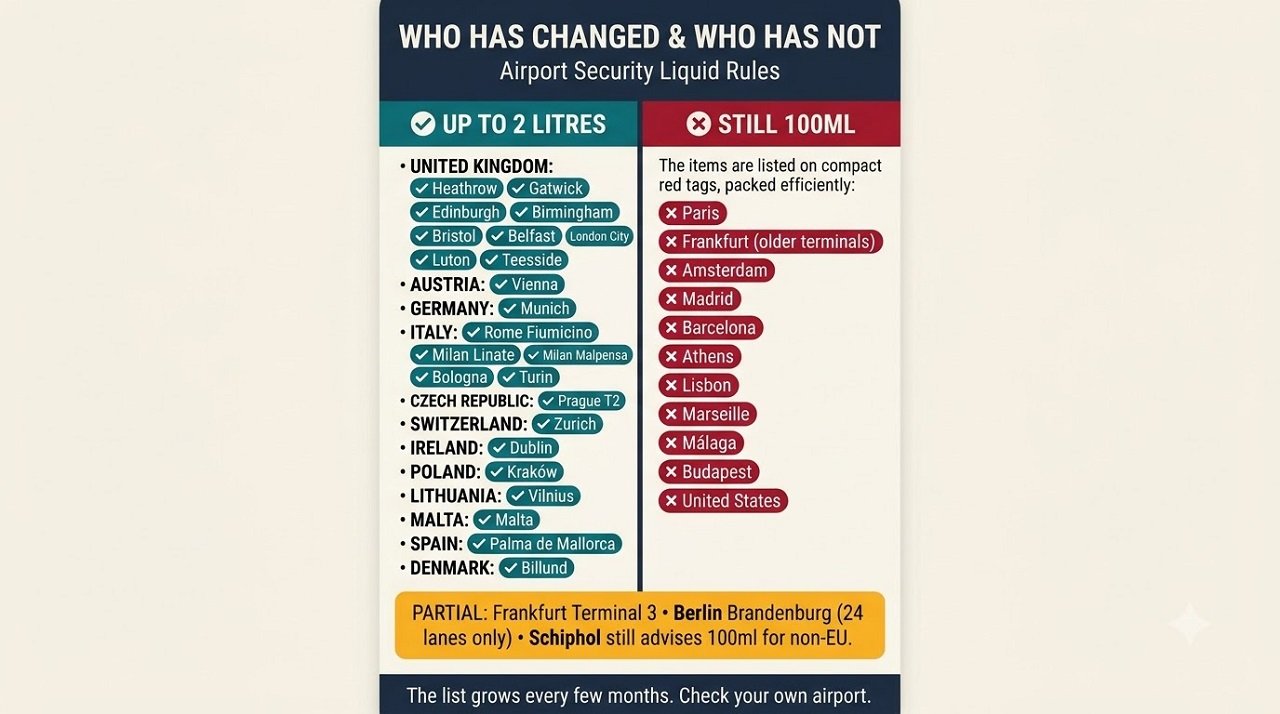
Some airports are in between, and these are the ones that cause the most confusion.
Frankfurt applies the relaxed rules in its recently built Terminal 3, while older terminals continue upgrading their equipment. Munich operated a phased approach before completing its rollout on 18 September 2026. Berlin Brandenburg allows 2 litres only on 24 security lanes, not all of them. Amsterdam Schiphol has installed advanced scanners but still advises passengers travelling outside the EU to comply with the 100ml rule, so they are not caught on the return leg.
The practical implication: even within one airport, the lane you are sent to may determine the rule you meet.
The Return Journey Problem
This is the single most expensive consequence of the patchwork, and it is the reason a simple list of airports is not enough.
What Happens
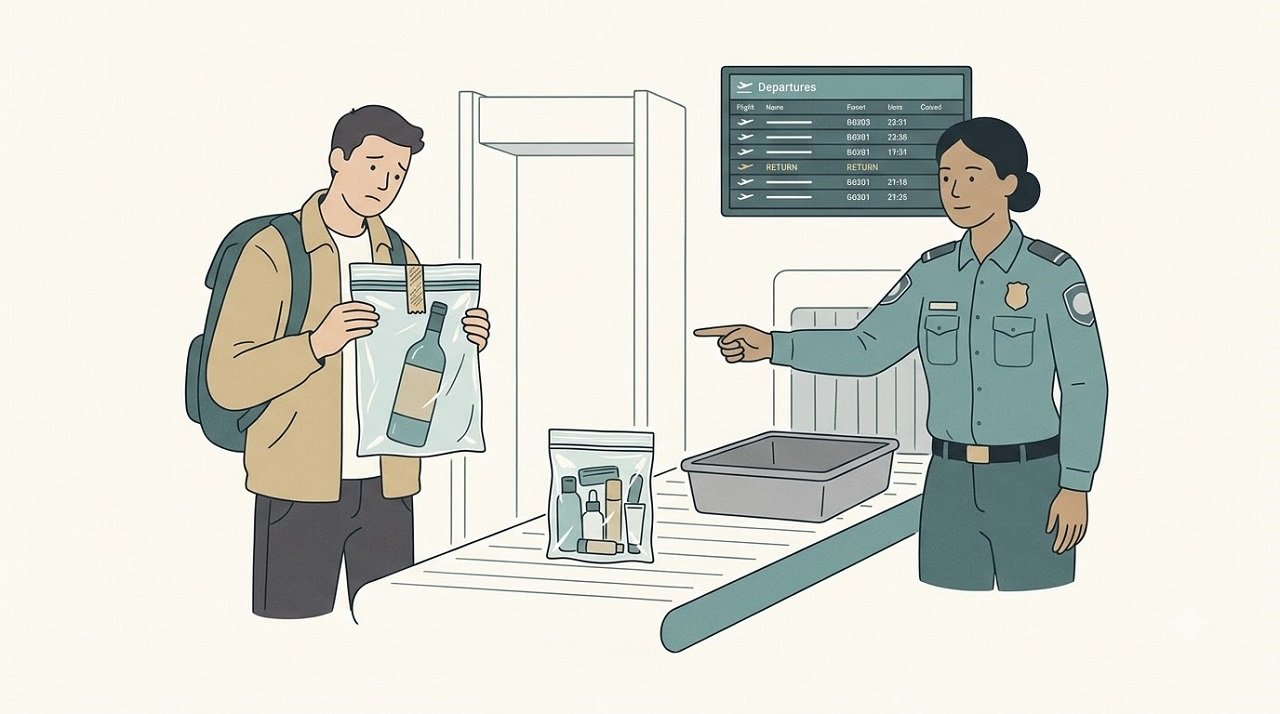
You depart from Heathrow. You buy a large bottle of perfume, whisky, or olive oil in the departures area. It is sealed in a tamper-evident security bag with the receipt visible — the standard duty-free procedure. You board.
You then fly home from Athens, or Budapest, or Paris, or New York. At that airport’s security checkpoint, the 100ml rule still applies. The sealed bag does not exempt you. The receipt does not exempt you. The fact that you bought it legally airside at a compliant airport does not exempt you.
The item is confiscated.
Why the Duty-Free Bag Does Not Help
The tamper-evident bag system exists to allow transfer passengers to carry duty-free liquids through a connecting airport without re-screening. It does not override the departure airport’s own liquid rules.
If you are starting your journey at a 100ml airport, and the item is in your hand luggage, it is subject to that airport’s rules regardless of where it was bought or how it is sealed.
What to Do
- Check the rule at your return airport, not just your departure airport. This is the whole point.
- If your return airport enforces 100ml, do not buy large liquids on the outbound leg unless you are checking a bag and can pack them in it before returning to security.
- If you are connecting, the duty-free bag matters — but confirm whether the connection involves re-screening, because some airports require all passengers to clear security again even on international-to-international transits.
- Consider buying duty-free on the way home instead. If you are departing from a 2-litre airport, you can buy there and carry it legally.
If you are planning a multi-country trip where this is a risk, our guide to overtourism rules and destination restrictions covers the other booking requirements that vary by country.
What Has Not Changed
Two things are worth stating plainly, because they are widely misunderstood.
The 100ml Rule Still Applies in the United States
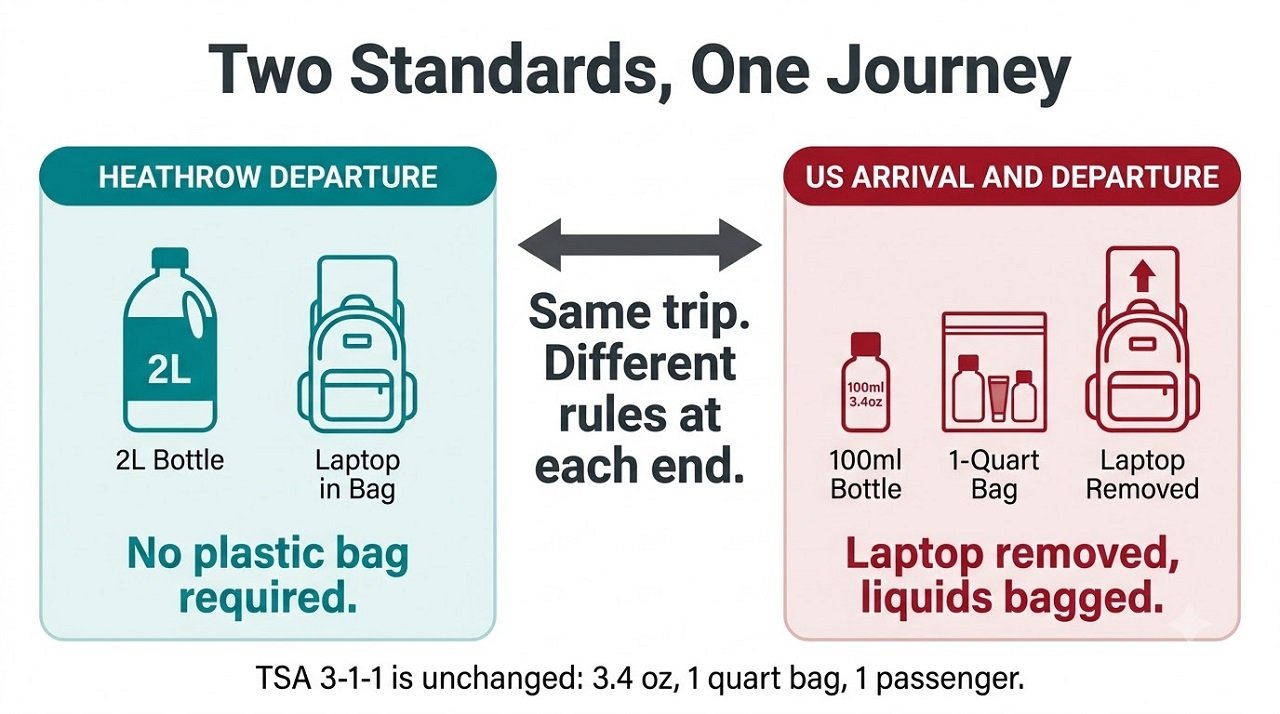
The TSA’s 3-1-1 rule is unchanged. Liquids, aerosols, gels, creams and pastes must be in containers of 3.4 ounces (100ml) or less, all fitting inside one clear quart-sized bag, one bag per passenger, placed in the screening bin.
The United States has not adopted the 2-litre standard. If you are flying to or from the US, the 100ml rule applies at the US end regardless of what your departure airport allows.
Electronics Rules Are Also Uneven
Where CT scanners are installed and certified, laptops and tablets can usually stay in the bag. Where they are not, the old rule applies and electronics must be removed.
This is not always aligned with the liquid rule. Budapest, for example, still enforces 100ml but does not require laptops to be removed. Frankfurt has the new rules in Terminal 3 and the old rules elsewhere. Amsterdam has the scanners but still advises 100ml compliance for non-EU destinations.
Do not assume that a relaxed liquid rule means a relaxed electronics rule, or the reverse. They are separate.
Exemptions That Still Apply Everywhere
Regardless of which airport you are at, some items are exempt from the container-size limit. These are the genuine exceptions, and they are consistent across the UK, EU and US.
Medication
Medically necessary liquids — prescription medicines, insulin, injectable medications, contact lens solution in some jurisdictions — may exceed 100ml. They must be declared at the checkpoint and may require a prescription, pharmacy label or doctor’s letter.
They do not need to fit inside the one-litre bag, but they will be screened separately. Our guide to travelling with prescription medication covers the documentation to carry.
Baby Food and Formula
Breast milk, infant formula, sterilised water and baby food are permitted in quantities above 100ml when travelling with an infant. Expect additional screening — staff may ask you to open a container or taste the contents.
Medical Equipment
Insulin, liquid nutrition, and equipment such as CPAP machines and nebulisers are allowed. Declare them at the checkpoint and keep them accessible rather than buried in the bag.
The Practical Habit
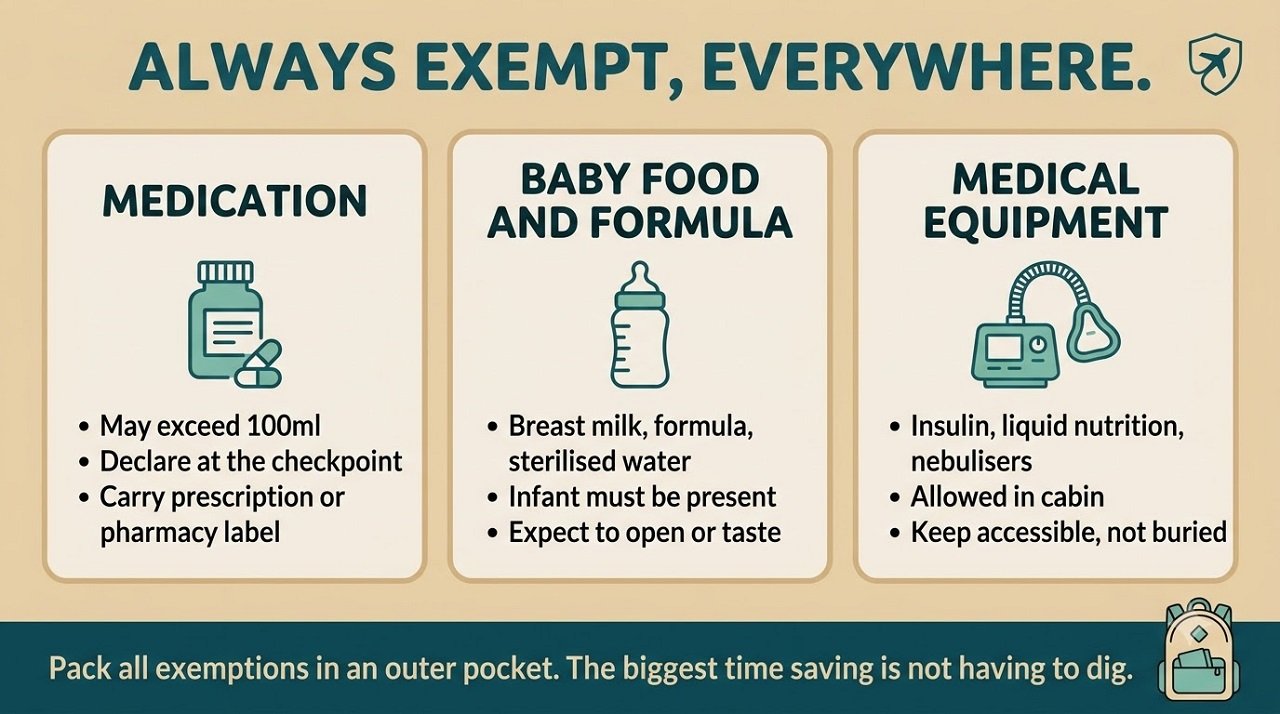
Pack all exemptions in an outer pocket. The single biggest time saving at any checkpoint is not having to unpack a full bag to reach the one item that needs separate screening.
How to Check Your Own Itinerary
There is no single global source, and the lists above will be out of date within a year. Here is the routine that works.
The Four-Step Check
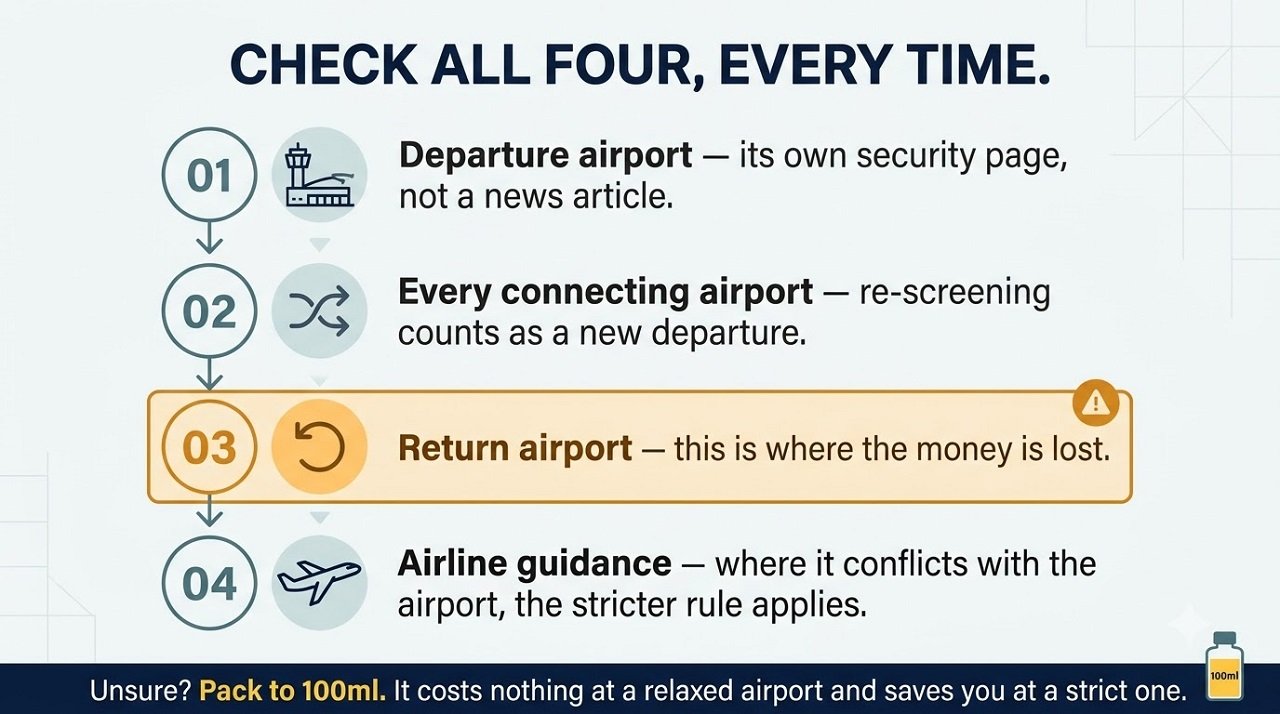
1. Check the departure airport’s own website. Not a news article about the airport, not a blog — the airport’s security page. Airports publish their own rules and update them when the equipment changes.
2. Check every connecting airport. A connection that involves re-screening is a second departure airport for these purposes. If you are changing planes in Paris on the way to Rome, the Paris rule applies to that leg.
3. Check the return airport. This is the one people forget, and it is where the money is lost.
4. Check the airline. Some carriers publish their own guidance, and it sometimes differs from the airport’s. Where they conflict, the stricter rule generally applies in practice.
What to Pack if You Are Unsure
If you cannot confirm the rule at every airport on your itinerary — and on a complex trip, you probably cannot — pack to the strictest standard you will encounter.
That means: 100ml containers, one clear one-litre bag, nothing larger. It costs you nothing at an airport that allows 2 litres, and it saves you at one that does not.
The reverse is not true. Packing to the relaxed standard and arriving at a strict airport means surrendering items at the security tray.
The Screenshot Habit
Screenshot the security page for each airport on your itinerary before you fly. Signal is unreliable in terminals, and a screenshot settles an argument at the checkpoint faster than a search.
Conclusion
The 100ml rule is not being abolished. It is being replaced unevenly, airport by airport, as CT scanners are installed and certified — and the result is a set of rules that changes depending on which direction you are flying.
Three things resolve it:
Heathrow and a growing list of UK and European airports now allow up to 2 litres per container. The rule change is real, it is permanent, and it applies to liquids and electronics together at those airports.
Paris, Frankfurt, Amsterdam, Madrid, Athens, Lisbon, Budapest and the entire United States still enforce 100ml. If your return journey passes through any of them, the relaxed rule at your departure airport does not help you.
The return journey is where the money is lost. A sealed duty-free bag does not override the departure airport’s own liquid rules, and a large bottle bought legally at Heathrow can be confiscated at Athens.
If you remember one rule, make it this: check the airport you are flying home from. That is the rule that decides whether the bottle survives.
If you are packing for a trip that includes several countries with different rules, our guide to carry-on packing covers how to build a bag that works regardless. If you are travelling with a phone and need data for checking airport rules on the move, our guide to using your phone abroad covers eSIM, roaming and local SIM options.
Frequently Asked Questions
Which airports have scrapped the 100ml liquid rule?
London Heathrow (from 23 January 2026), London City, Gatwick, Luton, Edinburgh, Birmingham, Bristol, Belfast and Teesside in the UK. In continental Europe: Vienna, Munich, Rome Fiumicino, Milan Linate and Malpensa, Prague Terminal 2, Zurich, Dublin, Kraków, Vilnius, Bologna, Turin, Malta, Palma de Mallorca and Billund. The list is growing as airports complete CT scanner certification.
Can I take a 2 litre bottle through airport security?
Only at airports that have installed and certified CT scanners and chosen to relax the rule. At those airports, containers of up to two litres are permitted. At airports still enforcing 100ml, a 2-litre bottle will be confiscated regardless of contents.
Why does my return airport still have the 100ml rule?
Because the European Commission left the decision to each airport after recertifying the scanner equipment in July 2025. Airports that have not completed installation or certification still apply the old rule. Paris, Frankfurt (older terminals), Amsterdam, Madrid, Athens, Lisbon, Budapest and the entire United States are among those still enforcing 100ml.
Do I still need to take my laptop out at security?
It depends on the airport, and it is not always aligned with the liquid rule. Where certified CT scanners are installed, laptops and tablets can usually stay in the bag. Budapest, for example, still enforces 100ml but does not require laptops out. Frankfurt applies the new rules in Terminal 3 and the old rules elsewhere. Check the specific airport’s security page.
Can I buy duty-free liquids and carry them through a connecting airport?
Yes, if the item is sealed in a tamper-evident security bag with the receipt visible, and you are transiting rather than starting your journey there. But if you are starting your journey at an airport that enforces 100ml, the sealed bag does not exempt you — the item is subject to that airport’s rules.
Does the 100ml rule still apply in the United States?
Yes. The TSA’s 3-1-1 rule is unchanged: containers of 3.4 ounces (100ml) or less, in one clear quart-sized bag, one bag per passenger. The United States has not adopted the 2-litre standard.
Are medication and baby formula exempt from the liquid limit?
Yes. Medically necessary liquids, prescription medicines, insulin, breast milk, infant formula, sterilised water and baby food may exceed 100ml. They must be declared at the checkpoint and may require documentation, but they do not need to fit in the one-litre bag.
Sources
- Condé Nast Traveler. Heathrow Drops the 100ml Liquids Rule: Everything You Need to Know. Published 23 January 2026. Heathrow ended the 100ml rule on 23 January 2026 following a $1 billion technology upgrade; liquids and electronics may remain in luggage unless flagged; the rule was first introduced in August 2006 over liquid explosives concerns; Heathrow handled 84.5 million passengers in 2025; CEO Thomas Woldbye quoted on being the largest airport in the world to roll out the technology and eliminating millions of single-use plastic bags.
https://www.cntraveler.com/story/heathrow-drops-the-100ml-liquids-rule-everything-you-need-to-know - Travel Gossip. Heathrow removes 100ml liquid rule after completing security screening rollout. Published 23 January 2026. Hand luggage liquid limit lifted from 100ml to 2 litres; Gatwick, Birmingham and Edinburgh already have the technology and allow the higher limit; other UK airports have rolled out the technology but maintain the 100ml rule; Heathrow estimates the change eliminates nearly 16 million single-use plastic bags per year.
https://travelgossip.co.uk/latestnews/heathrow-removes-100ml-liquid-rule-after-completing-security-screening-rollout/ - Travel Daily News. Carry-on liquids: Vienna lifts the 100 ml limit, but Europe still in confusion. Published 29 June 2026. Vienna removed the 100ml restriction from the beginning of July 2026, allowing containers up to 2 litres and no longer requiring removal of liquids, laptops or tablets; the EU temporarily reinstated the 100ml limit after technical concerns about scanner models; the Commission gradually authorised airports to lift the restriction again following ECAC certification; Rome Fiumicino, Milan Malpensa and Linate, Zurich, Frankfurt Terminal 3 and Munich operate mixed or full new procedures; Amsterdam Schiphol continues to advise 100ml compliance for non-EU destinations; Athens and major Greek regional airports still apply 100ml in a transparent resealable one-litre bag; Brussels expects full rollout only after 2028; the biggest challenge is return flights and connecting journeys where large bottles bought legally at a relaxed airport are confiscated at a strict one.
https://www.traveldailynews.com/aviation/carry-on-liquids-vienna-lifts-the-100-ml-limit-but-europe-still-in-confusion/ - Travelbook. Airports Where Liquid Limits for Carry-On Luggage No Longer Apply. Published 17 March 2026. The 100ml limit was introduced in 2006 as a protective measure; CT scanners provide high-resolution 3D images and can detect liquid and solid explosives; the EU Commission set a goal of abolishing the limit across the EU by July 2025; passengers are allowed up to 2 litres per container where the technology is installed; German airports Berlin Brandenburg, Munich, Frankfurt and Cologne Bonn have CT scanners but not comprehensively; travellers should check the departure airport and any connecting airports.
https://www.travelbook-magazine.com/flying/airports-where-liquid-limits-for-carry-on-luggage-no-longer-apply - Budapest Airport Guide. Budapest Airport Security & Liquid Rules 2026. Last updated 2026. Budapest still enforces the 100ml limit even though Vienna, Prague Terminal 2, Heathrow, Rome and Milan have dropped it; the EU restricted CT scanner use from 1 September 2024 and reimposed 100ml, reversed on 25 July 2025 when the Commission approved lifting the limit at airports whose equipment had been recertified by ECAC — around 700 scanners across 21 member states; the Commission left the decision to each airport and only one manufacturer’s equipment has been recertified; Budapest does not require laptops to be removed; exemptions for medication, baby food, insulin and medical equipment; power bank rules of 100 Wh without approval, 100–160 Wh with airline consent, above 160 Wh refused.
https://budapest-bud-international-airport.com/budapest-airport-security-liquid-rules - The Portugal News. Europe eases airport liquid rules. Published 18 August 2026. C3/CT scanners create detailed three-dimensional images of cabin baggage; rules are not the same at every airport; airports reported to allow containers up to 2 litres include Rome Fiumicino, Vienna, Dublin, Billund, Malta, Palma de Mallorca and Kraków, as well as a number of UK airports; implementation varies within countries — Palma de Mallorca is fully operational while Málaga has a more limited implementation; the general European rule continues to restrict liquids to containers of no more than 100ml in a transparent one-litre bag unless passing through an airport operating approved scanners; the relaxed rules create a potential problem on return journeys.
https://www.theportugalnews.com/news/2026-08-18/europe-eases-airport-liquid-rules/1072122 - TSA. TSA Travel Tips. Published 12 June 2026. The 3-1-1 rule: liquids, aerosols, gels, creams and pastes in containers of 3.4 ounces (100ml) or less, in one quart-sized clear plastic zip-top bag, one bag per passenger placed in the screening bin; medically necessary liquids, medications and creams in excess of 3.4 ounces are allowed and should be removed from the carry-on to be screened separately; liquid medication is not required to be in a plastic zip-top bag; ice packs and frozen gel packs must be completely solid at the checkpoint.
https://www.tsa.gov/videos/travel-tips-3-1-1-liquids-rule
https://www.tsa.gov/travel/security-screening/liquids-aerosols-gels-rule
https://www.tsa.gov/travel/frequently-asked-questions/i-am-traveling-medication-are-there-any-requirements-i-should-be
https://www.tsa.gov/travel/security-screening/whatcanibring/items/freezer-packs - EUR-Lex. Commission Implementing Regulation (EU) 2015/1998 — aviation security. Current consolidated text as of 1 October 2026. Liquids, aerosols and gels carried by passengers may be exempted from screening with liquid explosive detection equipment only if in individual containers with a capacity not greater than 100 millilitres, in one transparent resealable plastic bag of a capacity not exceeding 1 litre.
https://eur-lex.europa.eu/legal-content/EN/TXT/PDF/?uri=CELEX:02015R1998-20260322 - European Parliament. Answer to written question E-001453/2025 on liquid screening at EU airports. Published 8 August 2025. Implementing Regulation (EU) 2024/2108 put in place, from 1 September 2024, a temporary restriction on liquid screening at EU airports using standard C3 Explosive Detection Systems for Cabin Baggage (EDSCB), based on technical information validated by ECAC.
https://www.europarl.europa.eu/doceo/document/E-10-2025-001453-ASW_EN.html - Scientific American. How new CT scanners ended Heathrow’s 100ml liquids rule. Published 29 January 2026. The CT scanner rotates an x-ray source around the bag, capturing an image roughly every half-degree — about 720 images per rotation — and reconstructs the slices into a high-resolution 3D model of the carry-on.
https://www.scientificamerican.com/article/how-new-ct-scanners-ended-heathrow-100ml-liquids-rule/?search=How%20new%20CT%20scanners%20ended%20Heathrow%27s%20100ml%20liquids%20rule.%20Published%2029%20January%202026. - Travel Tomorrow. Passengers departing Heathrow can now leave litres of liquid and laptops in carry-ons. Published 26 January 2026. New CT scanners allow up to two litres of liquid in carry-on without removal or transparent plastic bags; the technology creates advanced three-dimensional images of bags as they pass through scanners.
https://traveltomorrow.com/passengers-departing-heathrow-can-now-leave-litres-of-liquid-and-laptops-in-carry-ons/ - TNT Magazine. Europe’s Carry-On Liquids Rules Are a Mess. Published 8 June 2026. As of early 2026 the result is a patchwork: some airports allow liquids up to around two litres in a single container, while others still enforce the traditional 100ml rule; departing from an airport with the new scanners does not help if the return airport does not have them.
https://www.tntmagazine.com/news/europe/europes-carry-on-liquids-rules-are-a-mess/