
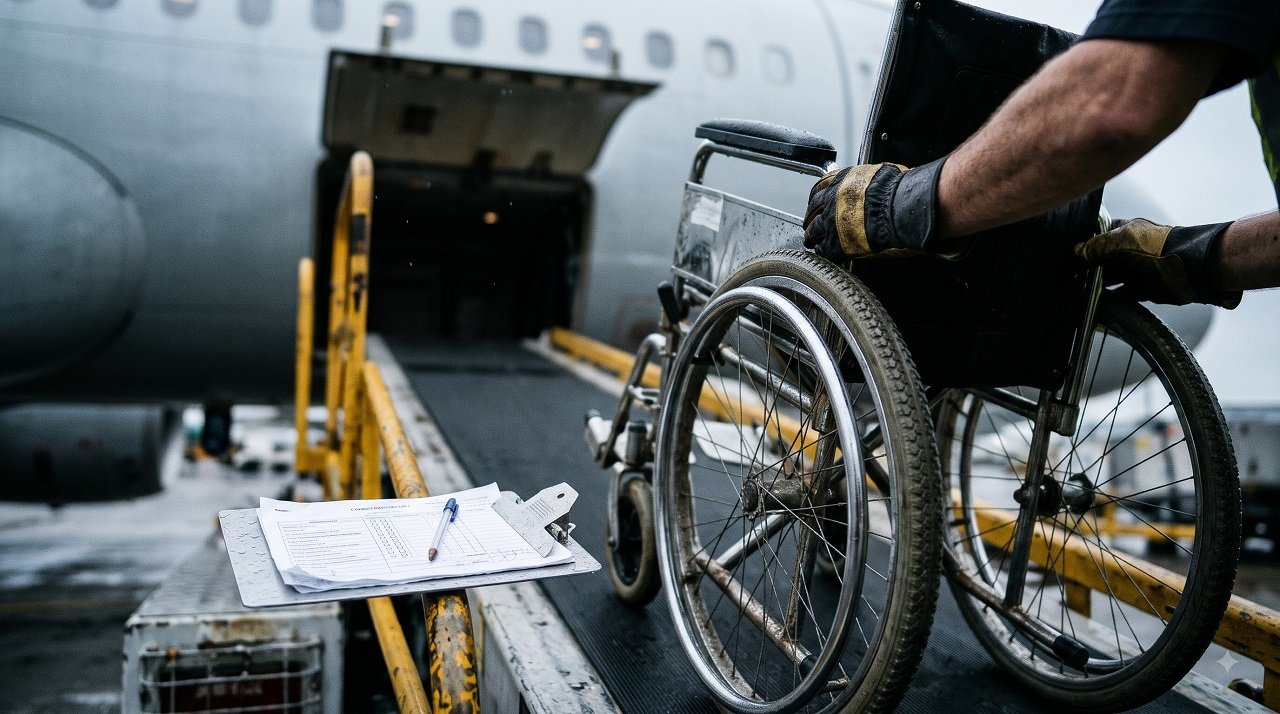
All legal references and statistics in this guide reflect published rules and reports current in late 2026. Aviation accessibility rules are actively being rewritten in both the UK and the US.
If you are reading this in a later year, treat the rights as still broadly correct — the EU regulation has not changed — but check whether the enforcement position in your destination country has shifted, because that is what determines whether the right is actually delivered.
This guide is general information, not legal advice. Your specific entitlement depends on your route, carrier, and the nature of your mobility equipment.
All sources used in this guide are listed at the end.
Introduction
There is a strange asymmetry in air travel accessibility right now, and it is worth understanding before you book anything.
In Europe, the legal rights are strong and getting stronger. Regulation (EC) 1107/2006 has been in force since 2006. You cannot be denied boarding because of a disability. Assistance at the airport is free. Your wheelchair flies free. And in the UK, the aviation regulator has just reported that for the first time in a decade, not one of the 28 airports it assesses was rated “Needs Improvement” or “Poor.”
In the United States, the rights exist on paper but enforcement of four specific protections has been suspended. On 30 September 2025, the Department of Transportation announced it would not enforce four provisions of its wheelchair rule while it considered a new rulemaking. In August 2026, it extended that non-enforcement from 31 December 2026 to at least 30 April 2027.
One of the four suspended provisions is the presumption that a violation has occurred when a wheelchair is not returned in the condition it was received.
That is not a small detail. It is the mechanism by which a damaged wheelchair becomes a claim.
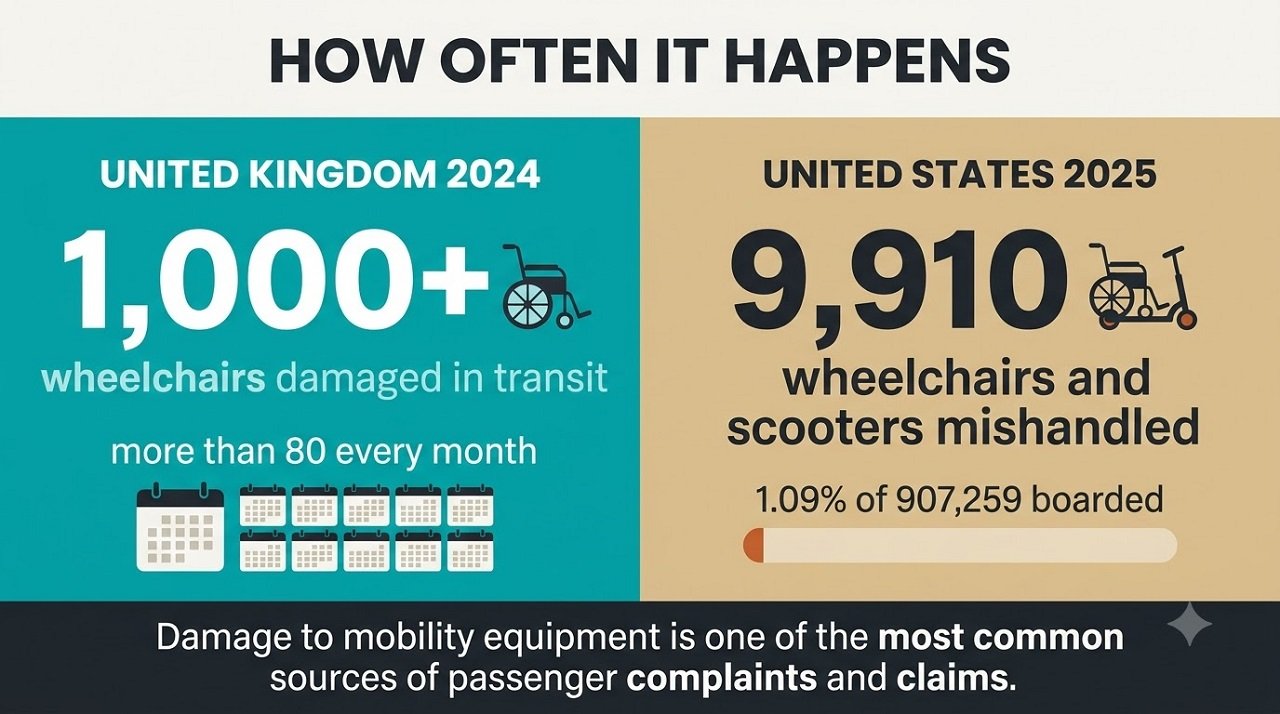
And the scale is not marginal. In the UK, more than 1,000 wheelchairs were damaged in transit in 2024 — more than 80 every month. In the US, airlines reported 9,910 wheelchairs and scooters mishandled in 2025, a rate of 1.09% across 907,259 boarded.
This guide sets out what the law actually requires, what the recent data shows about whether those requirements are being met, where enforcement has diverged, and the practical sequence that gives you the best chance of arriving with your equipment intact.
If you are managing other medical arrangements for the same trip, our guide to travelling with prescription medication covers the documentation that travels with you. If you need to claim for damage after the fact, our guide to claiming for lost or damaged baggage covers the liability framework.
What the Law Actually Requires
The European regulation is unusually specific, and knowing the specifics is what turns a request into an entitlement.
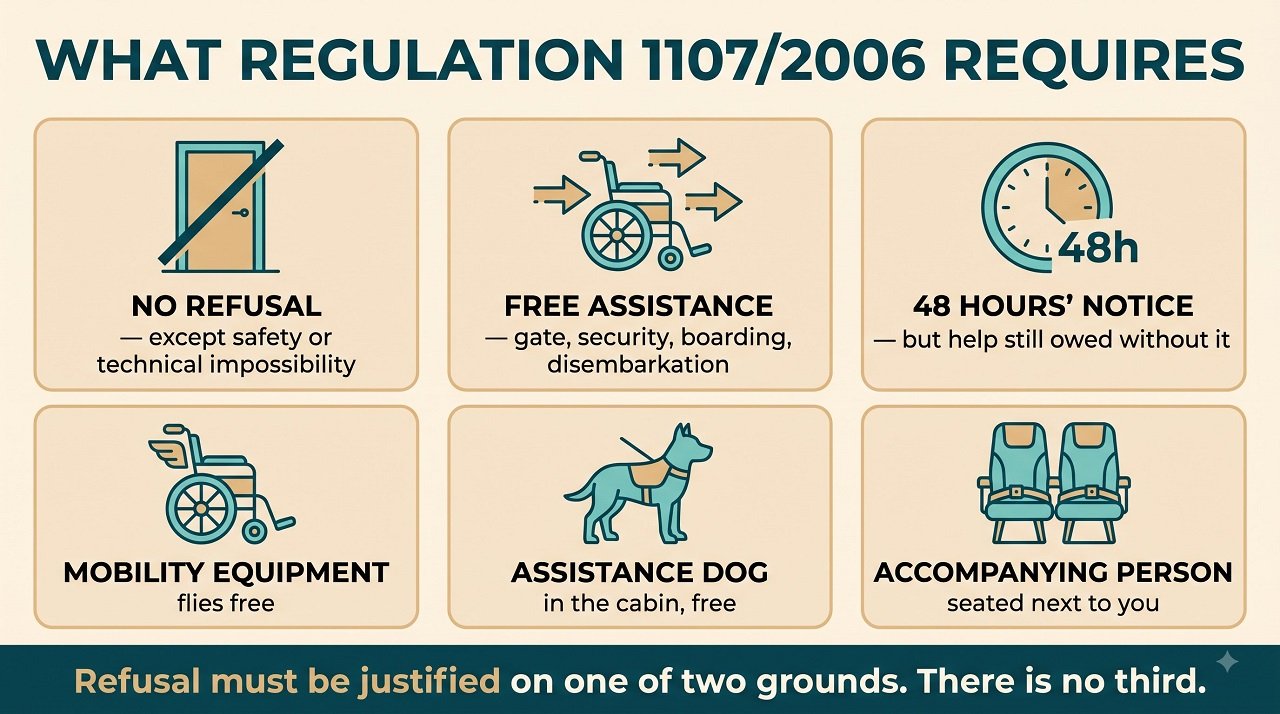
You Cannot Be Refused Boarding
The starting point is that passengers with disabilities or reduced mobility may not be denied boarding on the basis of their disability.
Refusal is permitted in only two situations:
- Safety regulations prevent carriage, or
- Carriage is technically impossible — for example, because of the design of the aircraft.
Both exceptions are narrow, and the burden is on the carrier to justify them. “Operational reasons” is not one of the listed grounds.
You Must Give 48 Hours’ Notice — But It Is Not a Condition of Help
Assistance should be registered at least 48 hours before departure so the airport can organise it.
Crucially, though: if you do not give notice, the airport is still obliged to provide the best possible assistance. The deadline affects how well prepared the service is, not whether you are entitled to it.
Most airlines let you register your requirements during booking, which is the simplest route.
The Assistance Itself Is Free
At the airport, the following are provided free of charge:
- Assistance on the way to the gate
- Assistance through security and customs
- Assistance when boarding
- Assistance on disembarkation
- Help transporting luggage
Your Mobility Equipment Flies Free
Medical devices and mobility aids — including electric wheelchairs — must be transported free of charge, provided they have been registered in advance and can be transported safely.
That “can be transported safely” clause is where the practical friction lives. For an electric wheelchair, transportability often turns on the battery’s wattage and type, and clarifying this before you travel is the single most useful preparation step.
Your Assistance Dog Flies in the Cabin, Free
Airlines must carry recognised assistance dogs in the cabin, free of charge.
The regulation is clear. The practice is less so. The Austrian Federal Disability Ombudsperson’s office reports that some airlines require additional medical documents, refuse dogs on certain routes, and make contradictory or arbitrary decisions. In the European Disability Forum’s report, affected passengers describe travelling with an assistance dog as a “bureaucratic marathon.”
An Accompanying Person Sits Next to You
Where an accompanying person is necessary, the airline must ensure, as far as possible, that they are seated directly next to you. That person may also assist at the airport and during boarding.
Who Is Liable When Something Breaks
Wheelchairs are often individually customised and expensive — some costing over €10,000.
If they are damaged or lost, airlines or airports are liable for repair or replacement.
That is the legal position. Whether it is delivered smoothly is a different question, and the next section is about the gap between the two.
The Gap Between Law and Experience
Two datasets, published within months of each other, tell complementary stories.
The UK: Genuine Progress, Record Demand
In August 2026, the UK Civil Aviation Authority published its Airport Accessibility Report for 2025/26.
| Measure | Figure |
|---|---|
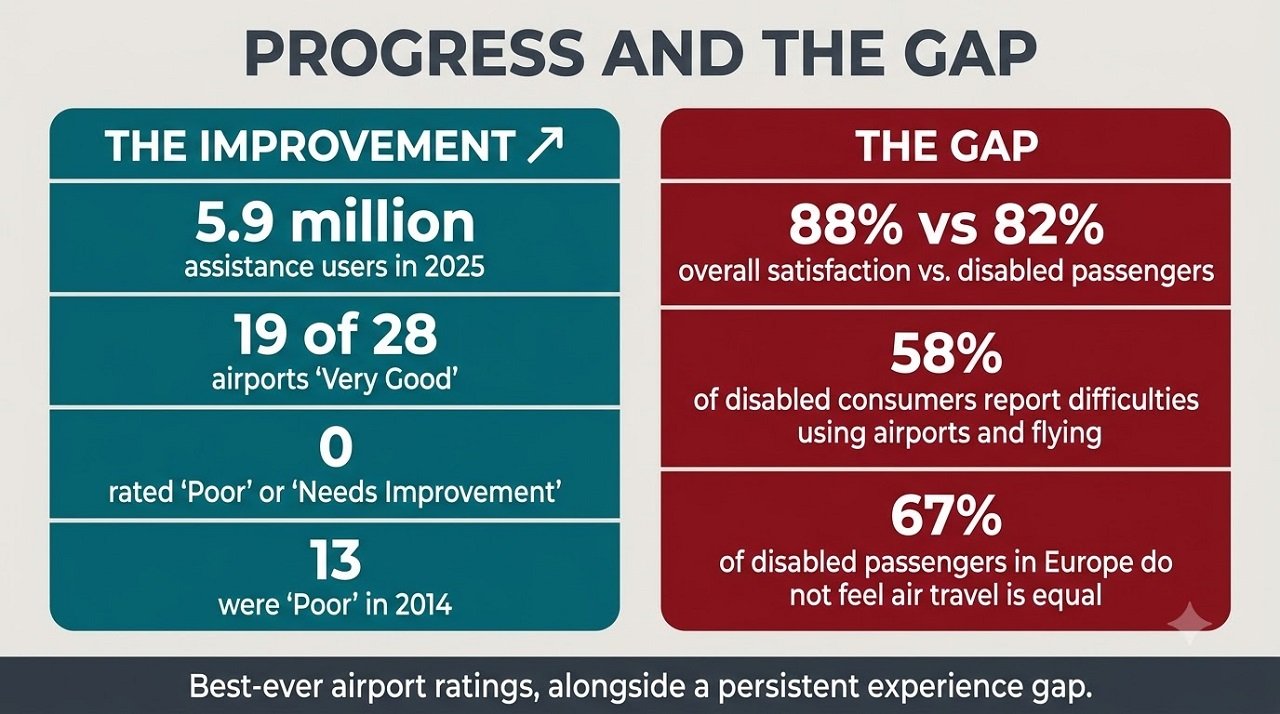
| Passengers using assistance services at UK airports in 2025 | 5.9 million (record) |
| Airports assessed | 28 |
| Rated “Very Good” | 19 |
| Rated “Good” | 9 |
| Rated “Needs Improvement” or “Poor” | 0 |
| Airports rated Poor or Needs Improvement in 2014 | 13 |
| Growth in assistance requests since 2015 | +115.8% |
| Growth in overall passengers since 2015 | +23.9% |
The trend is unambiguous. Demand for assistance has grown nearly five times faster than passenger numbers, and airport performance has improved at the same time.
But the same report contains the other half of the picture.
Overall passenger satisfaction reached 88% — the highest since the survey began in 2016. Among passengers with accessibility or disability needs, satisfaction was 82%.
And 58% of disabled consumers reported difficulties accessing or using airports and flying, with the most common needs relating to walking, standing, or carrying luggage.
Anna Bowles, Head of Consumer Protection at the CAA, put the position plainly: “The fact that no airport was rated ‘Needs Improvement’ or ‘Poor’ this year is welcome, but we cannot be complacent. Some disabled passengers still face difficulties when travelling.”
Europe: Two-Thirds Do Not Feel Equal
The European Disability Forum’s Human Rights Report 2025 adds the passenger-side view.
67% of respondents with disabilities or reduced mobility do not feel that their air travel is equal.
The obstacles they identified were consistent and specific:
- Booking and admin: complicated online forms, inaccessible websites, unclear conditions for mobility assistance, additional documents required
- Airport assistance: long waits, unreliable pick-up, and — most seriously — the risk of missing your flight
- Cabin access: lack of onboard wheelchairs, non-accessible toilets, and painful or undignified transfers to seats
- Security and border control: lack of staff training, invasive searches, and difficulties for people with invisible disabilities
- Information: no visual information for deaf passengers, no audio announcements for blind passengers, unclear gate changes
The pattern across both datasets is the same. The formal entitlement is strong. The failure points are in execution — and they cluster around the parts of the journey where you are dependent on someone else’s preparation.
If you are travelling alone and will need assistance you cannot arrange yourself, our guide to safe solo travel covers the backup arrangements worth having in place.
The US Divergence: Four Protections Not Being Enforced
This is the section that matters most if your itinerary touches the United States, and it is almost entirely absent from consumer coverage.
What Happened
In June 2025, the Department of Transportation announced it was reviewing a rule that provided additional protections for wheelchair users in air travel. During the review, it said it would not take enforcement action against airlines for failing to comply with the new or revised requirements.
Then, on 30 September 2025, it confirmed it would not enforce four specific provisions while considering a new rulemaking.
The four:
- The presumption of a violation when a wheelchair or assistive device is not returned on time and in the condition it was received
- The required frequency of refresher training for airline employees and contractors
- The requirement to notify passengers in advance, before they check a wheelchair, of their right to contact a Complaint Resolution Official and file a claim
- Reimbursement of the fare difference between the flight the passenger took and the flight they would have taken if their wheelchair had fitted
In August 2026, the DOT extended the non-enforcement period from 31 December 2026 to at least 30 April 2027. It also announced it would not enforce a provision requiring annual flight attendant training on assisting passengers to the onboard lavatory, until at least the same date.
Why the First One Matters Most
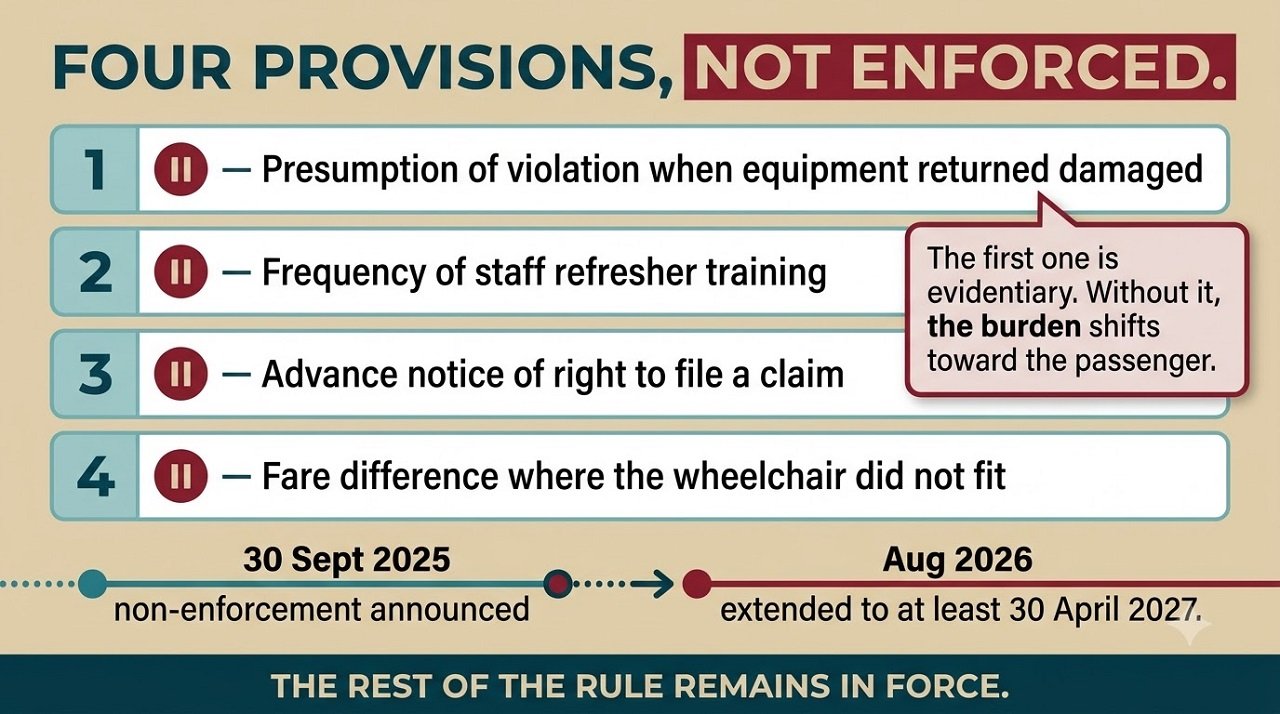
Provisions two, three and four are procedural or financial. Provision one is evidentiary, and that is a different order of problem.
If your wheelchair comes back damaged, the question is who has to prove what. A presumption of violation means the airline must show it did nothing wrong. Without that presumption, the burden shifts toward you — the passenger holding a broken €10,000 device and trying to establish what happened in a hold you never saw.
The National Council on Disability put the stakes directly: when people with disabilities are injured or their wheelchairs are damaged, “they lose dignity and independence” and must wait for costly repairs that “can sometimes take months.”
What Still Applies
The Air Carrier Access Act itself has not been repealed, and the rest of the rule remains in force. Only these four provisions are unenforced.
The practical consequence is that in the US, the advice to document everything yourself is not generic caution — it is compensating for an absent legal presumption. Photographs before handover, a written condition report, and a same-day complaint are doing work that the regulation would otherwise do for you.
Where the Divergence Leaves You
If you are flying between Europe and the US, you are covered by two different regimes on the two halves of the same journey.
The EU regulation applies to the European departure. The ACAA applies to the US departure. Where those protections differ, the more protective one applies to the leg it governs — which means your return leg from a US airport is materially weaker than your outbound leg from a European one.
That is the asymmetry worth understanding before you choose where to check the wheelchair.
The Equipment Problem
The law on liability is clear. The data on frequency is not reassuring.
The UK Numbers
More than 1,000 wheelchairs were damaged in transit in 2024 — equivalent to more than 80 every month, according to government data published alongside the October 2026 announcement of stronger safeguards.
The CAA’s own report identifies damage to mobility equipment as one of the most common sources of passenger complaints and related claims.
For a passenger who relies on a wheelchair daily, the consequences go beyond the repair cost: losing independence, missing holidays or work commitments, lengthy waits for specialist repairs, and what the Department for Transport describes as physical and mental health impacts.
The US Numbers
In 2025, US air carriers reported 9,910 wheelchairs and scooters mishandled — a rate of 1.09% across 907,259 devices boarded. That rate is a slight decrease on 2024.
Between January and July 2026, US airlines mishandled 5,500 wheelchairs and scooters, affecting around one percent of all such devices boarded.
One percent sounds small until you apply it to yourself. It means that on a return trip involving two boardings, the probability of the device arriving intact is not something you can simply assume.
Why the Battery Detail Is Not Bureaucracy
The single most common cause of avoidable difficulty is the battery.
Airlines assess whether an electric wheelchair can be carried partly on its wattage, and the transportability assessment often depends on it. If you cannot state the battery type and rating at booking, you are asking an airline to make a safety judgement about your device without information.
What to have ready before you book:
- The battery type (lithium-ion, sealed lead acid, or dry cell)
- The watt-hour rating, if lithium
- Whether the battery is removable
- The device’s dimensions and weight
- Whether it can be folded or dismantled
The UK introduced a standardised form in March 2026 allowing passengers to share wheelchair battery and handling information before travel, specifically to cut the risk of devices being damaged in the hold. If your carrier offers something similar, use it — it is the mechanism the industry itself has identified as reducing damage.
If your equipment includes other medical items that need documenting at a border, our guide to travelling with prescription medication covers the paperwork that should travel in your hand luggage.
The Practical Sequence
Rights only help if they are exercised. This is the order that gives you the strongest position.
When You Book
1. Register your requirements at booking, not later. The 48-hour deadline is the threshold for the airport to organise properly. Registering at booking is better still.
2. State the battery specification. Type, watt-hour rating, removability. Without this, the transportability assessment has no basis.
3. Ask for the written conditions of carriage for mobility equipment, and read the section on advance notice and any route restrictions.
4. Book the accompanying seat together if you need one, and request adjacent seating explicitly.
Before You Fly
5. Reconfirm the assistance booking by phone, 72 hours out. Written confirmation is better than a verbal assurance.
6. Photograph the wheelchair from four angles on the day, including the battery, the frame, and any existing damage. Timestamp the images.
7. Write a condition report — one page, signed and dated, listing existing marks and the device’s value. Ask the check-in agent to note it. This is the substitute for the US presumption of violation that is currently not being enforced.
8. Keep the wheelchair with you until the gate where the aircraft allows it. Many carriers permit gate delivery, which shortens the time the device spends in airline custody.
At the Gate
9. Watch it being loaded if you can, and note the time.
10. Ask where the device will be returned — at the gate or at the baggage belt. Gate return is standard on many routes and materially reduces handling risk.
On Arrival
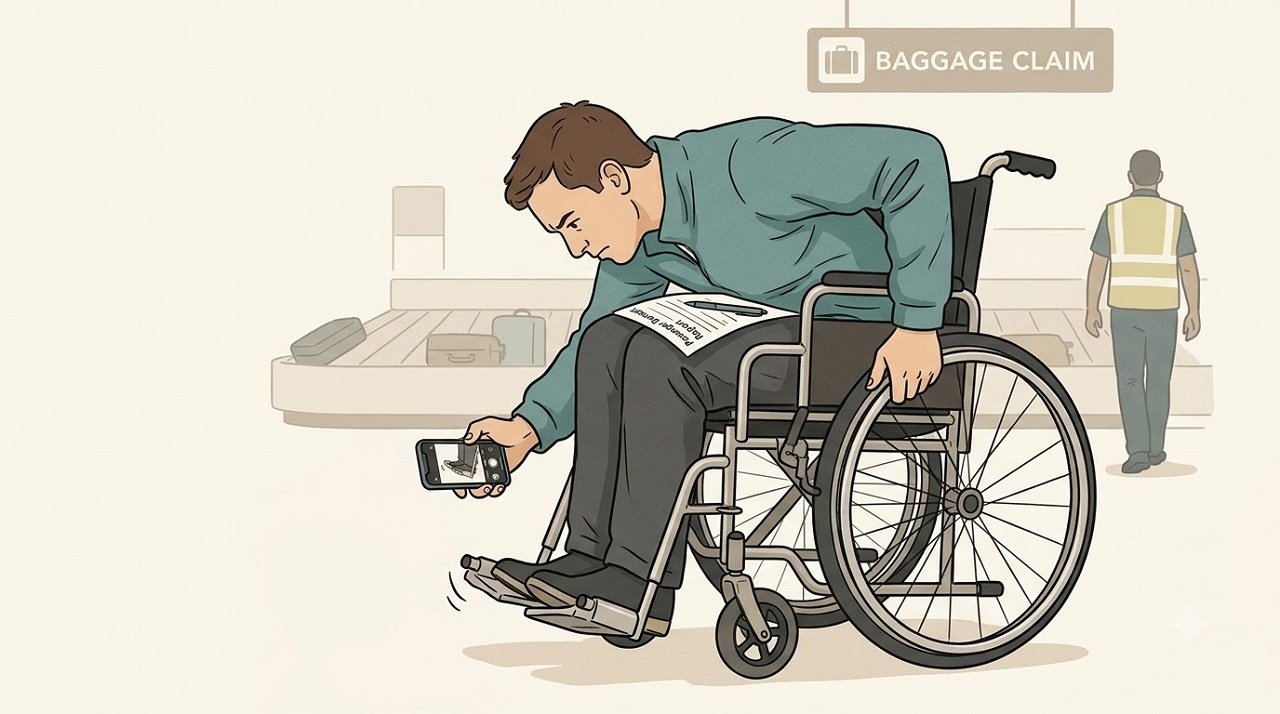
11. Inspect before you leave the airport. Once you are through arrivals, the evidentiary position weakens considerably.
12. If it is damaged, file a Property Irregularity Report before leaving and photograph the damage in situ. Our guide to claiming for lost or damaged baggage covers the deadlines, which are tight.
13. Ask for a Complaint Resolution Official at a US airport, or the equivalent ground handler at a European one, and get a name and a reference.
If You Are Refused Carriage
Ask the carrier to state, in writing, which of the two permitted grounds it is relying on: safety regulations, or technical impossibility. There is no third ground.
If the answer is vague, that is worth documenting — and it is the point at which the national enforcement body for the country of departure becomes relevant. In the UK, that is the CAA, which has said the pending Civil Aviation Bill would, if approved, give it additional enforcement powers to hold airports to account for meeting legal rights, including on accessibility.
What Is Changing
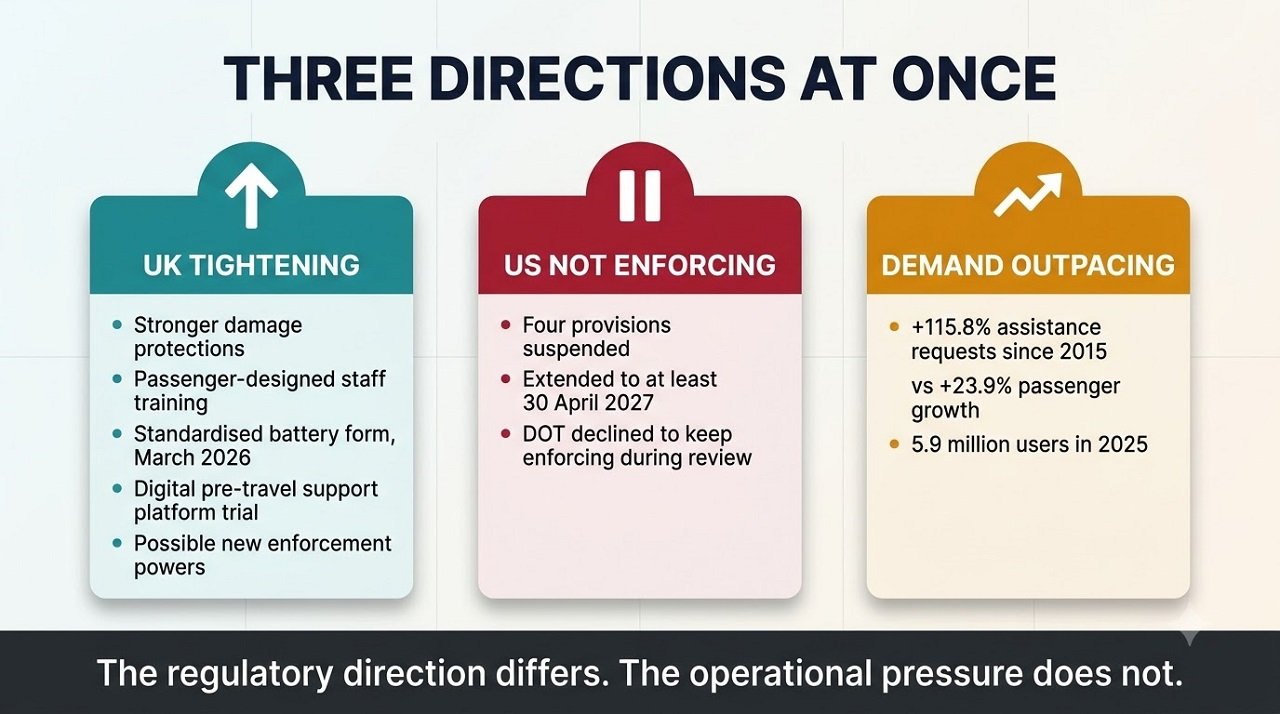
Three developments are worth tracking, and they point in different directions.
The UK Is Tightening
The October 2026 announcement confirmed:
- Greater protection against wheelchair damage
- Better training for airline and airport staff, designed with disabled passengers, so staff recognise different needs without people having to repeatedly explain their disability
- A standardised battery and handling form (introduced March 2026)
- A new digital platform to be trialled, allowing passengers to provide support needs before travel — potentially covering buggy assistance, separate assistance queues at security, and quiet waiting areas
These followed recommendations from Baroness Tanni Grey-Thompson’s investigation into aviation accessibility, and are being implemented through the cross-industry Aviation Accessibility Group.
The US Is Not Enforcing
The non-enforcement period for the four provisions now runs to at least 30 April 2027, with no replacement rule yet in force.
The National Council on Disability has recommended that the DOT continue enforcing the existing rule while it reviews it. The DOT declined that recommendation.
Demand Is Outpacing Everything
Across the UK, assistance requests grew 115.8% between 2015 and 2025 while passenger numbers grew 23.9%. Record volumes were recorded in 2025 at 5.9 million passengers.
Whatever the regulatory direction, the operational pressure is increasing — which is why preparation on your side matters more, not less.
The Market Context
The accessible and assisted travel market was valued at $75.81 billion in 2025**, projected to reach **$104.73 billion by 2031. Travellers with disabilities are estimated to spend around $54 billion every two years on travel, and more than a billion people worldwide live with a disability.
The commercial case for getting this right is not small. That matters because it means the pressure on carriers is not purely regulatory.
Conclusion
The legal position for disabled air passengers in Europe is stronger than most travellers realise, and weaker in delivery than the regulation suggests.
Three things are worth holding together:
The rights are specific and real. You cannot be refused boarding except on safety or technical grounds. Assistance is free. Your wheelchair flies free. Your assistance dog flies in the cabin. An accompanying person should be seated next to you. The carrier is liable for damage.
The delivery gap is documented, not anecdotal. 67% of disabled passengers in Europe do not feel their air travel is equal. In the UK, 58% of disabled consumers report difficulties using airports and flying, even as airport ratings reach their best level in a decade.
Enforcement has diverged. The UK is adding safeguards and seeking stronger powers. The US has suspended four provisions of its wheelchair rule, including the presumption of a violation when equipment is returned damaged, until at least April 2027.
If you remember one rule, make it this: the presumption that the airline must prove it handled your wheelchair properly is not currently guaranteed in the US. Photograph the device, write a condition report, and get it noted at check-in. That documentation is standing in for a right that is, for now, unenforced.
If you are planning a trip that involves several countries with different rules, our guide to reading government travel advisories covers how to check conditions before you commit. And if your itinerary includes a connection booked on separate tickets, our guide to self-transfer and transit visa rules covers why that is a materially higher-risk choice when travelling with mobility equipment.
Frequently Asked Questions
Can an airline refuse to take my wheelchair?
In the EU, carriage can be refused only if safety regulations prevent it or carriage is technically impossible because of the aircraft’s design. “Operational reasons” is not a permitted ground. If refused, ask the carrier to state in writing which of the two grounds applies.
How much notice do I need to give for airport assistance?
You should register your requirements at least 48 hours before departure so the airport can organise the service. However, if you do not give notice, the airport is still obliged to provide the best possible assistance — the deadline affects preparation, not entitlement.
Does my wheelchair fly free?
Yes. Under Regulation (EC) 1107/2006, medical devices and mobility aids including electric wheelchairs must be transported free of charge, provided they are registered in advance and can be transported safely. The transportability assessment often depends on the battery’s wattage, so have the specification ready at booking.
Who pays if my wheelchair is damaged?
Airlines or airports are liable for repair or replacement. In practice, whether that is straightforward depends heavily on documentation. Photograph the device before handover, write a signed condition report, and file a Property Irregularity Report before leaving the airport.
What are the four US protections that are not being enforced?
The presumption of a violation when a wheelchair is not returned on time and in its original condition; the required frequency of staff refresher training; pre-departure notification of the right to contact a Complaint Resolution Official and file a claim; and reimbursement of the fare difference when a wheelchair does not fit on the booked flight. Non-enforcement was extended to at least 30 April 2027.
Does my assistance dog fly in the cabin?
Yes, under EU rules airlines must carry recognised assistance dogs in the cabin free of charge. In practice the European Disability Forum reports inconsistent treatment, with some carriers requiring additional medical documents or refusing dogs on certain routes.
What is the best way to reduce the risk of damage?
State the battery type and watt-hour rating at booking, use any standardised handling form the carrier offers, photograph the device from several angles on the day, write a condition report and have it noted at check-in, and ask for gate delivery and gate return where available.
How common is wheelchair damage?
In the UK, more than 1,000 wheelchairs were damaged in transit in 2024 — over 80 per month. In the US, 9,910 wheelchairs and scooters were mishandled in 2025, a rate of 1.09% across 907,259 boarded.
Sources
- Austrian Federal Disability Ombudsperson (Sozialministeriumservice). PRM in air travel: Rights of persons with disabilities and those in need of assistance in aviation. Published 9 December 2025. Passengers with disabilities or reduced mobility may not be denied boarding on the basis of their disability; refusal permitted only where safety regulations prevent carriage or carriage is technically impossible due to aircraft design; assistance should be registered at least 48 hours before departure, but airports remain obliged to provide the best possible assistance even without notice; free assistance to the gate, through security and customs, during boarding and disembarkation, and with luggage; medical devices and mobility aids including electric wheelchairs transported free of charge if registered in advance and safely transportable, with transportability often depending on wattage; accompanying persons seated directly next to the passenger where necessary; assistance dogs carried in the cabin free of charge; wheelchairs individually customised and some costing over €10,000, with airlines and airports liable for repair or replacement; 67% of respondents with disabilities or reduced mobility do not feel their air travel is equal, according to the EDF Human Rights Report 2025.
https://en.apf.gv.at/news-detail/prmflug1 - UK Civil Aviation Authority. UK airports improve accessibility as demand for assistance reaches record levels. Published 4 August 2026, publishing the Airport Accessibility Report 2025/26 (CAP3264). Record 5.9 million passengers used assistance services at UK airports in 2025; of 28 airports assessed, 19 “Very Good” and 9 “Good”, with none “Needs Improvement” or “Poor”; 13 airports were rated Poor or Needs Improvement when the Framework was introduced in 2014; assistance requests increased 115.8% since 2015 against overall passenger growth of 23.9%; overall passenger satisfaction 88%, the highest since the survey began in 2016, but satisfaction among passengers with accessibility or disability needs lower at 82%; 58% of disabled consumers reported difficulties accessing or using airports and flying, most commonly relating to walking, standing or carrying luggage; Anna Bowles, Head of Consumer Protection, quoted on progress and on the Civil Aviation Bill providing additional enforcement powers.
https://www.caa.co.uk/newsroom/news/uk-airports-improve-accessibility-as-demand-for-assistance-reaches-record-levels/ - Department for Transport. Stronger safeguards for wheelchair users and better-trained staff to support disabled air passengers. Published 19 October 2026. More than 1,000 wheelchairs damaged in transit in 2024, equivalent to more than 80 every month; consequences include loss of independence, missed holidays or work, lengthy waits for specialist repairs and physical and mental health impacts; changes driven by former Paralympian Baroness Tanni Grey-Thompson’s investigation and implemented through the Aviation Accessibility Group; a standardised form introduced in March 2026 allowing passengers to share wheelchair battery and handling information before travel, cutting the risk of damage in the hold; staff training designed with disabled passengers; a new digital platform to be trialled for pre-travel support needs including buggy assistance, separate security queues and quiet waiting areas; Transport Secretary Heidi Alexander quoted on flying with dignity.
https://dft-newsroom.prgloo.com/news/stronger-safeguards-for-wheelchair-users-and-better-trained-staff-to-support-disabled-air-passengers - DAC Beachcroft (Sophie Allkins). Rising demand, higher expectations: key takeaways from the CAA’s Airport Accessibility Report 2025/26. Published 8 September 2026. The CAA enforces Assimilated Regulation (EU) 1107/2006, which imposes obligations on airports and air carriers to protect the rights of disabled passengers and passengers with reduced mobility; assistance obligations extend across the journey including meeting passengers, baggage help, accompanying through check-in and security, wheelchair support, priority boarding, aisle chairs, ambulifts and physical assistance between terminal and seat; particular protection is afforded to passengers travelling with wheelchairs and mobility aids, which airlines must accommodate subject to operational constraints and return promptly on arrival; damage to mobility equipment remains one of the most common sources of passenger complaints and related claims.
https://www.dacbeachcroft.com/en/What-we-think/Rising-demand-higher-expectations-key-takeaways-from-the-CAA’s-Airport-Accessibility-Report-2025-26 - National Council on Disability (US). 2026 Progress Report. Published 2026. In June 2025 the DOT announced it was reviewing a rule providing additional protections for wheelchair users and would not take enforcement action during the review; individuals cannot enforce the Air Carrier Access Act, so DOT enforcement plays a critical role; on 30 September 2025 the DOT announced it would continue not enforcing four provisions: the presumption of violation when wheelchairs or assistive devices are not timely returned in the condition received; the specified frequency of required refresher training; pre-departure notification of the right to contact a Complaint Resolution Official and file a claim; and reimbursement of the fare difference where a wheelchair did not fit on the booked flight; in August 2026 the DOT extended the non-enforcement period from 31 December 2026 until at least 30 April 2027, and announced it would not enforce a provision requiring annual flight attendant training on assisting passengers to the onboard lavatory until at least the same date; all other parts of the rule remain in force.
https://www.ncd.gov/assets/uploads/reports/2026/ncd-2026-progress-report.pdf - US Department of Transportation, Office of Aviation Consumer Protection. February 2026 Air Travel Consumer Report. Last updated 20 March 2026. The report is a monthly product of the Office of Aviation Consumer Protection covering flight delays, mishandled baggage, wheelchairs and scooters, oversales and consumer complaints.
https://www.transportation.gov/resources/individuals/aviation-consumer-protection/february-2026-air-travel-consumer-report - Regulation (EC) No 1107/2006 of the European Parliament and of the Council of 5 July 2006 concerning the rights of disabled persons and persons with reduced mobility when travelling by air. Official Journal L 204, 26 July 2006. In force 15 August 2006 and fully applicable from 26 July 2008. Articles 3 and 4 prohibit refusal of reservation or boarding on the ground of disability or reduced mobility, subject only to safety requirements or technical impossibility; Article 10 and Annex II govern assistance at airports and the 48-hour notification requirement.
https://eur-lex.europa.eu/legal-content/EN/TXT/?uri=CELEX:32006R1107 - Mordor Intelligence. Accessible and Assisted Travel Market Size, Share & 2031 Growth Trends Report. Published 25 September 2026. The accessible and assisted travel market was valued at USD 75.81 billion in 2025 and is estimated to grow from USD 78.74 billion in 2026 to reach USD 104.73 billion by 2031.
https://www.mordorintelligence.com/industry-reports/accessible-and-assisted-travel-market - Inflight Online. How is aviation transforming towards accessible travel? Published 3 December 2025. The disability travel market comprises more than one billion people worldwide, and travellers with disabilities spend about $54 billion every two years on travel.
https://www.inflight-online.com/accessible-skies-aviations-transformation-towards-travel-for-all/