
All statistics in this guide come from European Commission data for 2025, published 28 May 2026, and from rules current in late 2026. Fees, refusal rates and border procedures are revised regularly.
If you are reading this in a later year, treat the method as still correct — find your nationality’s rate, find the consulate’s rate, apply where the rules allow. But confirm current figures with the consulate you intend to use, not with this article.
This guide is general information, not immigration advice. Only the consulate processing your application can tell you what it requires, and no article can predict the outcome of an individual case.
All sources used in this guide are listed at the end.
Introduction
Most Schengen visa advice is about documents: bank statements, insurance, hotel bookings, a cover letter.
That advice is not wrong. But it is incomplete, and the omission is significant. The consulate that processes your application has a refusal rate of its own — and the spread between them is far wider than most applicants realise.
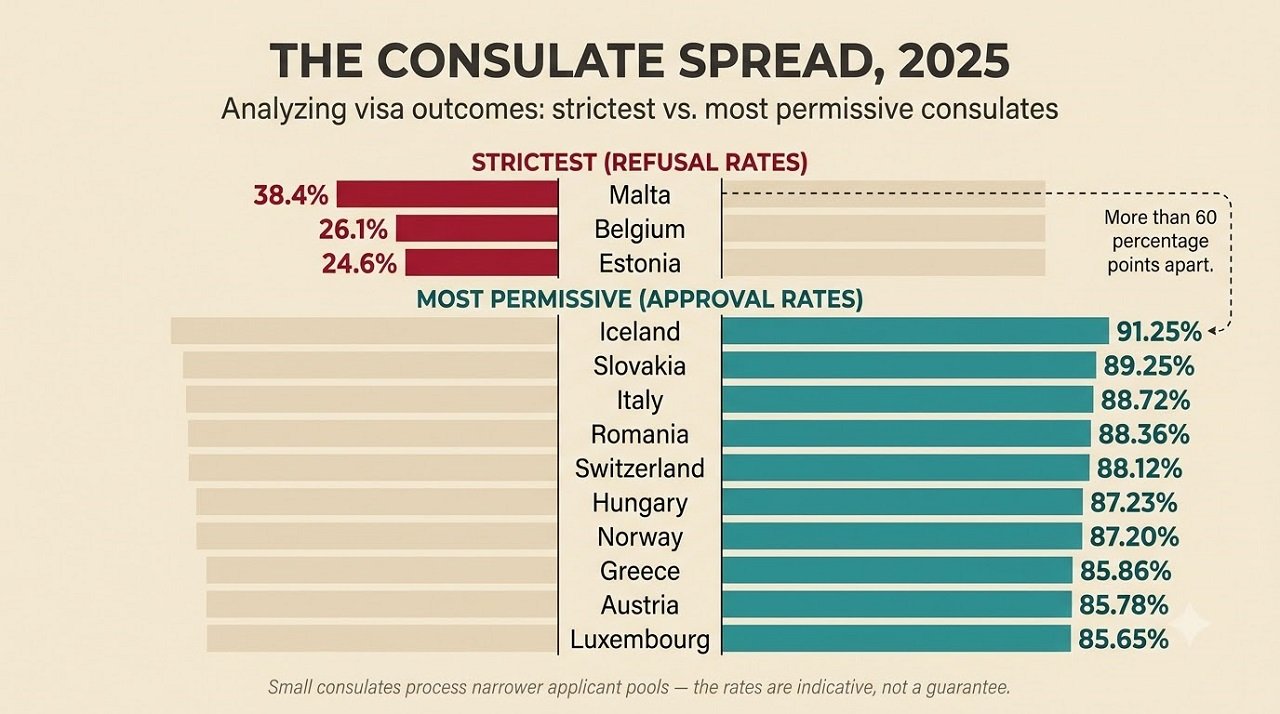
According to European Commission data for 2025, published on 28 May 2026, Malta refused 38.4% of the applications it processed. Belgium refused 26.1%. Estonia refused 24.6%. At the other end, Iceland approved 91.25%, followed by Slovakia at 89.25%, Italy at 88.72% and Romania at 88.36%.
That is not a small variation. It is a difference of more than sixty percentage points between the hardest and easiest consulates in the same visa area, processing applications under the same legal framework.
The global refusal rate in 2025 was 14.6%, down from 14.8% in 2024 — the third consecutive annual fall. But that average conceals two much sharper divides: by consulate, and by nationality.
By nationality, the gap is starker still. Bangladesh was refused at 54.5%, Senegal at 51.9%, Nigeria at 47.8%, Pakistan at 46% and Angola at 45.4%. Burundi reached 53.4%, up from 40% the previous year.
And the money is not trivial. Rejected short-stay applications generated €157.1 million in non-refundable fees in 2025, up from €145.1 million in 2024 and €130 million in 2023. Africa accounted for 42% of the lost fees despite being 24% of applicants.
This guide covers what the data actually shows: the legal rule that constrains which consulate you can use, the refusal rates by country and nationality, the three documented reasons applications fail, and the two border changes that have already happened — the Entry/Exit System going fully live in April 2026, and ETIAS being pushed back indefinitely.
If you are working out how a visa fits into your trip timeline, our guide to building a trip budget from scratch treats visa fees as a pre-trip admin line. If your itinerary involves a multi-country route, our guide to overtourism rules and visitor caps covers the separate booking constraints that apply at several of these destinations.
The Rule That Limits Your Choice
Before the data is useful, one legal constraint needs stating plainly, because it determines how much choice you actually have.
You Cannot Shop Around
The Schengen visa is a single document valid across the whole area, but you do not apply to “Schengen.” You apply to one member state’s consulate, and the rules on which one are specific.
The standard rule, stated by multiple member states’ own foreign ministries: you must lodge your application at the embassy or consulate of the Schengen country that is your main destination.
Main destination means, in order of precedence:
- The country where you will spend the most time, measured by length of stay.
- If the stay is equal, the country whose purpose of visit is the main one — for example, a conference in one country and tourism in another.
- If no main destination can be determined, the country whose external border you will cross first.
Where the Genuine Choice Exists
This is where the data becomes actionable rather than decorative.
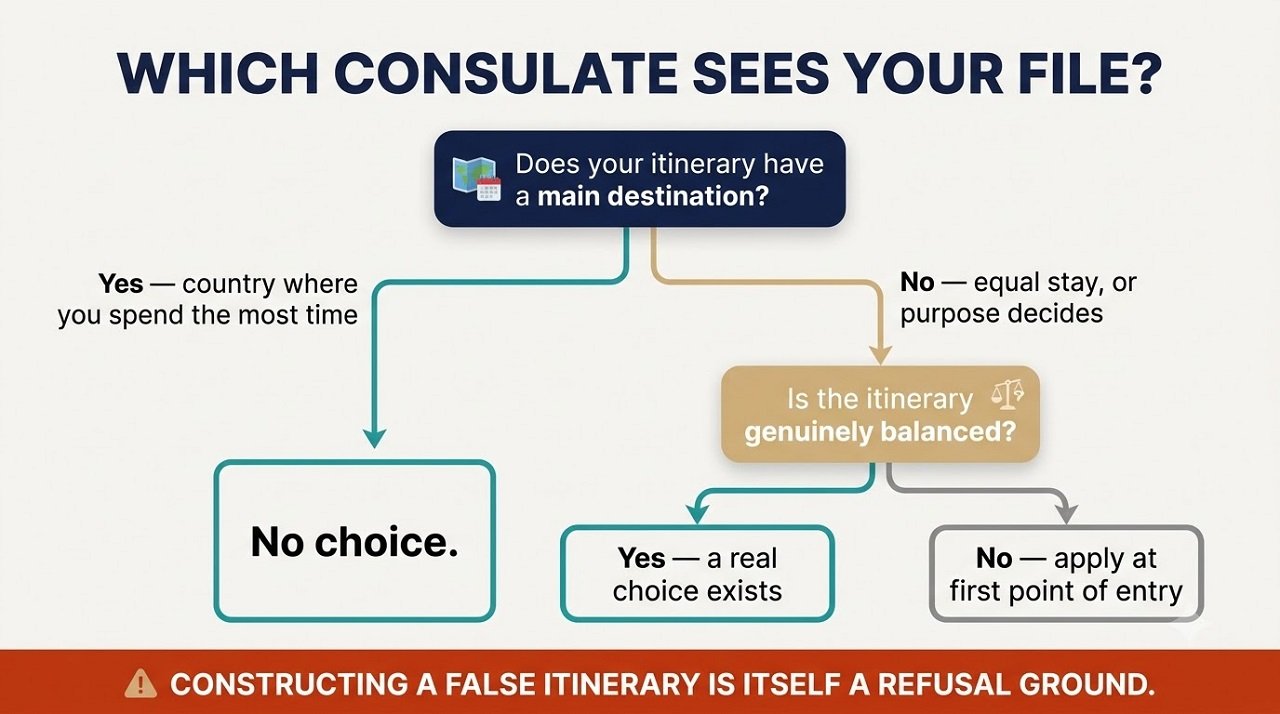
If your itinerary has one clear main destination, you have no choice. You apply there, and the refusal rate of that consulate is simply your starting condition.
If your itinerary is genuinely balanced — seven nights in Spain and seven in Portugal, or a trip where you could plausibly restructure the emphasis — then the main-destination question has more than one defensible answer, and which one you choose determines which consulate sees your file.
That is the legitimate margin. It is not shopping for the easiest consulate; it is recognising that a flexible itinerary produces a choice, and that the choice has consequences.
The Consequence of Getting It Wrong
Applying at the wrong consulate is not a minor administrative error. Member states can refuse to process an application lodged at a consulate that does not have territorial or main-destination competence, and the fee is non-refundable either way.
If you are unsure which country qualifies as your main destination, our guide to booking direct versus third-party platforms covers how to read cancellation terms when you may need to restructure a booking.
The Refusal Rates by Consulate
European Commission data for 2025 shows a pronounced split between smaller, stricter consulates and larger ones that process higher volumes.
The Strictest Consulates
| Country | 2025 refusal rate |
|---|---|
| Malta | 38.4% |
| Belgium | 26.1% |
| Estonia | 24.6% |
The reasons given for each are distinct, and they matter because they suggest what the consulate is scrutinising.
Malta is described as particularly strict during peak tourist months, with refusals triggered by a poorly planned itinerary, a vaguely stated purpose of visit, or incomplete hotel and ticket reservations. Financial documentation must be convincing and detailed.
Belgium is characterised as verifying that all documents are consistent with one another — a discrepancy in dates between a bank statement, an employment certificate and an itinerary can be grounds for refusal.
Estonia places heavy emphasis on security checks, particularly for business and professional visits, and gaps in documentation lead to additional scrutiny.
The common thread is not strictness for its own sake. It is scrutiny of internal consistency — and that is something an applicant can prepare for.
The Most Permissive Consulates
| Country | 2025 approval rate |
|---|---|
| Iceland | 91.25% |
| Slovakia | 89.25% |
| Italy | 88.72% |
| Romania | 88.36% |
| Switzerland | 88.12% |
| Hungary | 87.23% |
| Norway | 87.20% |
| Greece | 85.86% |
| Austria | 85.78% |
| Luxembourg | 85.65% |
Consulate-level figures are from the European Commission’s 2024 dataset, the most recent published at that granularity.
Iceland’s position is long-standing rather than a one-year anomaly — it recorded 94.26% in 2023 before easing slightly to 91.25%.
The Caveat That Matters
High approval rates at small consulates are partly a function of low application volumes and different applicant pools. A consulate processing a few thousand applications from a narrow set of nationalities is not directly comparable to one processing hundreds of thousands from everywhere.
The visitukraine.today analysis makes this point explicitly, noting that a high approval rate was also recorded among applicants from countries with relatively low application volumes.
What that means practically: the rates are informative about consulate behaviour, but they are not a guarantee. A consulate with an 88% approval rate still refuses one application in eight.
The Refusal Rates by Nationality
The consulate divide is wide. The nationality divide is wider.
The Highest Refusal Rates
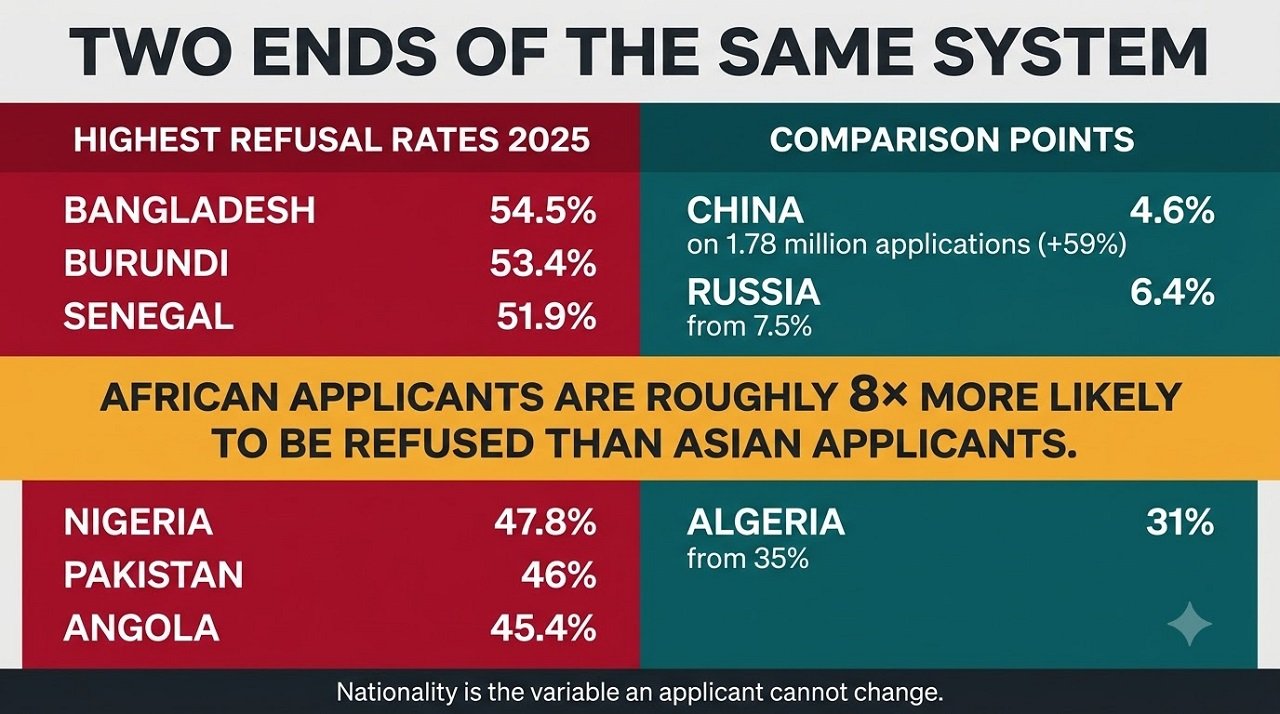
| Nationality | 2025 refusal rate |
|---|---|
| Bangladesh | 54.5% |
| Burundi | 53.4% |
| Senegal | 51.9% |
| Nigeria | 47.8% |
| Pakistan | 46% |
| Angola | 45.4% |
Sources report Comoros and Guinea-Bissau reaching 61% or above.
The Direction of Travel
Not every rate moved the same way, and the divergence is instructive.
Rates that rose:
- Senegal — 51.9%, up from 46.8%
- Burundi — 53.4%, up from 40%
- DR Congo — 40.1%, up from 29.9%
Rates that fell:
- Algeria — 31%, down from 35%
- Russia — 6.4%, down from 7.5%
The Regional Divide
The overall picture, from 2024 data at the finest level of detail available: African applicants are roughly eight times more likely to be refused than Asian applicants.
China illustrates the other end. It filed 1.78 million applications in 2024, up 59%, with a refusal rate of 4.6%.
That contrast is not a function of individual application quality. It reflects consular risk assessment by nationality — a pattern that applicants cannot change and that no amount of document preparation fully overrides.
This is the honest limitation of every “how to get approved” article, including this one. Preparation improves your odds at the margin. It does not equalise a 54.5% refusal rate with a 4.6% one.
Why Applications Actually Fail
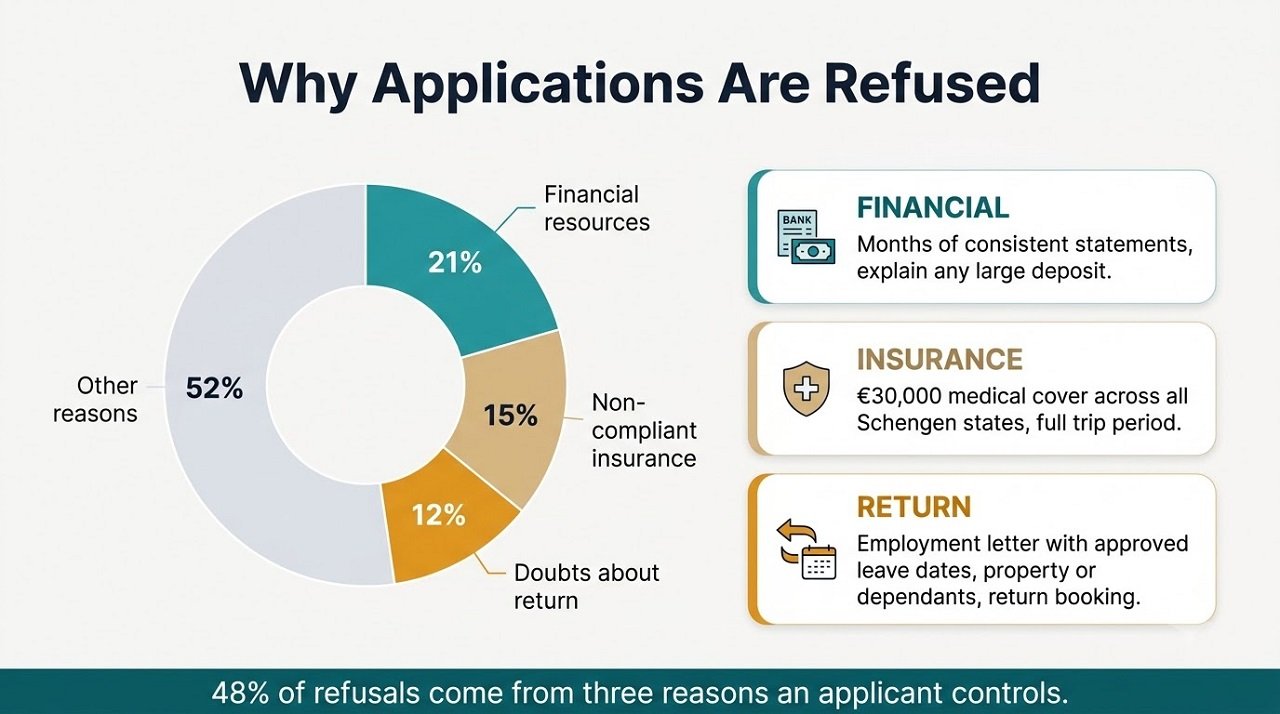
The three most common refusal reasons are specific, and all three are things an applicant controls.
| Reason | Share of refusals |
|---|---|
| Financial resources | 21% |
| Non-compliant insurance | 15% |
| Doubts about return | 12% |
Financial Resources (21%)
The consulate is assessing whether you can fund the trip without working illegally, and whether the money is genuinely yours.
What tends to fail: a bank statement showing a large deposit days before the application, with no explanation of where it came from. A balance that barely covers the declared itinerary. No evidence of regular income.
What tends to work: statements covering several months showing consistent income, a balance comfortably above the calculated daily requirement for the trip length, and an explanation for any unusual movement.
Non-Compliant Insurance (15%)
Travel medical insurance must meet the Schengen specification. Policies that fall short are routinely refused, and the applicant often does not realise until the refusal arrives.
What to check: that the policy is valid across all Schengen states, covers the full period of the trip, and provides at least €30,000 in medical cover including repatriation. A policy that meets the requirements for one country but not the whole area will fail.
Doubts About Return (12%)
The consulate is assessing whether you have sufficient ties to your country of residence to leave at the end of the permitted stay.
What tends to fail: no employment evidence, no property or family ties, an itinerary that suggests a one-way intent.
What tends to work: an employment letter stating your position, salary and approved leave dates; evidence of property, dependants or ongoing study; a return flight booking.
The Pattern Across All Three
None of these three reasons is about the applicant’s nationality, and none is about which consulate they chose. They are all about the coherence of the file — which is exactly why the strict consulates are described as scrutinising consistency rather than rejecting on principle.
What Changed at the Border in 2026
Two border changes matter for anyone applying now, and one of them has already happened.
The Entry/Exit System Is Fully Live
The Entry/Exit System (EES) became fully operational on 10 April 2026, following a six-month phased deployment that began in October 2025.
It replaces passport stamping with biometric registration for non-EU travellers across 29 participating countries. On first entry you provide fingerprints and a facial scan, typically at a self-service kiosk or with a border officer.
Three practical consequences:
- Your first entry after the change takes longer. Authorities warned of longer waits at airports during the initial phase.
- It applies to short stays of up to 90 days in any 180-day period.
- A biometric passport is not strictly required — it is only needed to use the self-service kiosks. Without one, registration happens manually at border control.
The EES matters for visa applicants because it makes overstaying visible in a way stamps did not. The 90/180 calculation is now recorded electronically at every crossing.
ETIAS Has Been Delayed Indefinitely
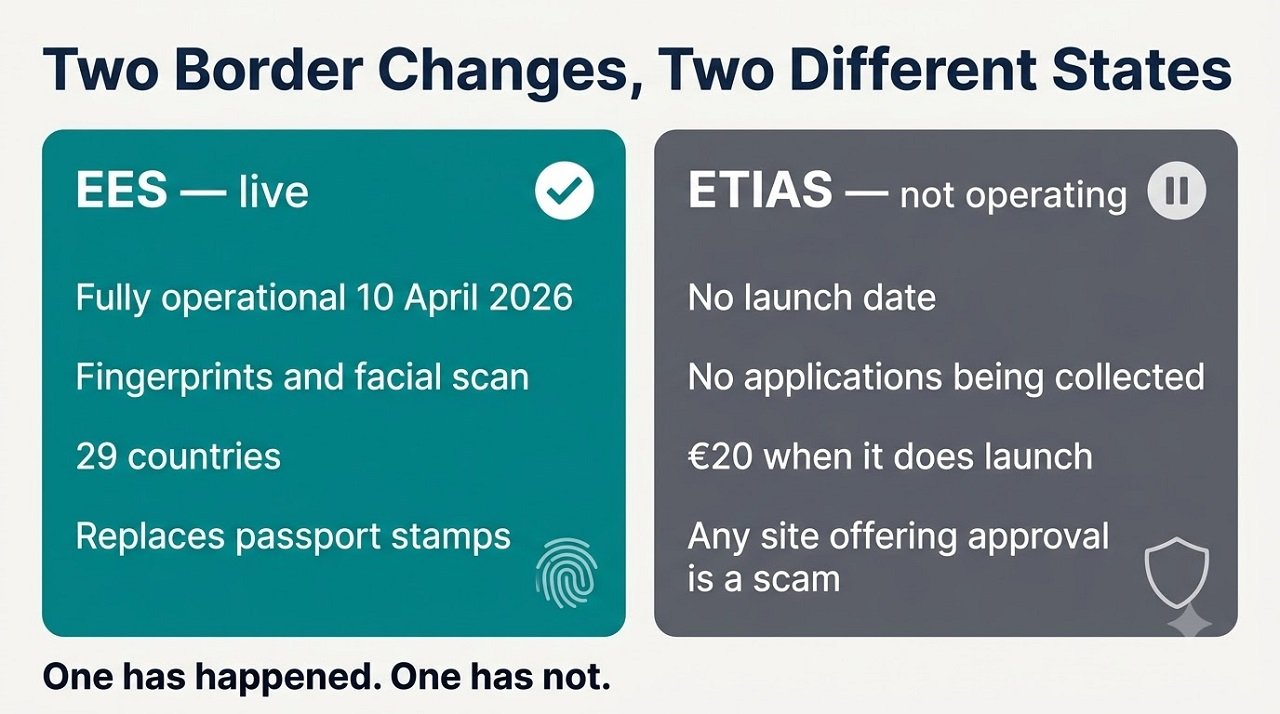
ETIAS is not in operation, and it has no launch date.
The EU removed its late-2026 target in August 2026. The official ETIAS portal states the system is “currently not in operation,” and authorities will announce a definitive launch date several months before going live.
This matters for two reasons:
If you are visa-exempt — travelling on a US, Canadian, UK or similar passport — you do not need to do anything. No application, no fee, no online authorisation. When ETIAS does launch, the fee will be €20 for applicants aged 18 to 70, valid for three years or until the passport expires.
If you are being offered ETIAS “approval” by a third-party website, it is a scam. No applications are being collected, so nothing legitimate can be issued.
If you are travelling to Europe and want to understand the separate requirement around liquids at security, our guide to the changing airport liquid rules covers which airports have relaxed and which have not.
The Fee and the Timing
Two practical constraints that affect planning more than most applicants expect.
The Fee Is €90 and Non-Refundable
The Schengen visa fee rose from €80 to €90 for adults on 11 June 2024, under Commission Delegated Regulation (EU) 2024/1415. For children aged six to under twelve it rose from €40 to €45; children under six are free.
The fee is non-refundable regardless of outcome. That is why the €157.1 million figure exists at all — rejected applicants paid for the decision, not the visa.
Appointment Waits Can Exceed Processing Times
Processing time and appointment availability are different constraints, and the second often dominates.
Standard processing is 15 days globally, rising to 25 to 30 days in North Africa. But appointment waits can be far longer than that.
Reporting from May 2026 found Schengen visa appointment delays of three to eight weeks across major Indian metros, with application volumes up 15–20% and confirmed booking conversions down 10–15% because travellers could not secure appointments within their timelines.
Spain’s processing alone was taking six to eight weeks in summer 2026 — not counting the appointment wait.
The practical rule: count backwards from your travel date. Appointment wait plus processing time plus a margin. If that lands before today, the trip is not feasible on that itinerary.
If you are choosing travel dates around a visa, our guide to finding cheaper flights covers why booking late is expensive — which matters more when your dates are fixed by a visa appointment rather than a fare.
How to Use This Data
The rates are not a strategy on their own. Here is what they actually support.
Check Your Own Two Numbers First

Your nationality’s refusal rate tells you the baseline difficulty. The consulate’s refusal rate tells you the additional strictness of the office processing your file.
Both matter. A strong applicant from a 4.6% nationality applying through Malta faces a different proposition from the same applicant applying through Iceland — but neither is a guarantee in either direction.
Then Check the Three Controllable Reasons
Financial resources, insurance compliance and ties to your country of residence account for 48% of refusals between them. These are the categories where preparation has real leverage.
A file that is internally consistent — dates that match across bank statements, employment letters and bookings; insurance that meets the €30,000 specification for the whole Schengen area; a return booking — addresses the reasons consulates actually cite.
Confirm the Main Destination Before You Book Anything
Establish which country is legally your main destination before you pay for accommodation or flights. If the itinerary could reasonably be structured either way, make that decision deliberately, in full knowledge of the difference in refusal rates.
Do not, however, construct a false itinerary to access a more favourable consulate. Consulates cross-check bookings, and an itinerary that does not match your actual intentions is a refusal ground in itself.
Apply Early Enough That a Refusal Is Recoverable
A refusal is not the end of the process, but it takes time to address. If you apply six weeks before travel and are refused in week five, there is no realistic route to a second application before departure.
Applying early enough to absorb a refusal — and to reapply with a corrected file — is worth more than any marginal choice of consulate.
Conclusion
The Schengen visa data says something most application guides avoid: your file is not the only variable.
The consulate matters. Malta at 38.4% refusal against Iceland at 91.25% approval is not noise — it reflects different screening cultures operating under the same legal framework. The main-destination rule limits how much you can act on that, but where your itinerary is genuinely balanced, the choice is real.
Your nationality matters more. Bangladesh at 54.5% against China at 4.6% is a divide that no document preparation closes.
What you control is narrower, and it is specific: financial evidence that is consistent and explained, insurance that meets the €30,000 specification across the whole area, and demonstrable ties to home. Those three account for roughly half of all refusals.
And the timeline matters as much as the paperwork. At €90 non-refundable, with appointment waits of three to eight weeks before processing even begins, the decision point is months before the trip, not weeks.
If you remember one rule, make it this: find your main destination before you find your hotel. Everything about which consulate sees your file follows from that one decision.
If you are preparing the rest of the trip documentation, our guide to what to do if you lose your passport abroad covers what happens when the document you relied on goes missing. And if you are travelling with medication, our guide to travelling with prescription medication covers the border documentation that applies separately from the visa.
Frequently Asked Questions
Which Schengen country has the highest rejection rate?
Malta, at 38.4% for 2025, followed by Belgium at 26.1% and Estonia at 24.6%. Malta’s consulates are described as particularly strict during peak tourist months, with refusals triggered by poorly planned itineraries, vaguely stated purposes of visit, and incomplete reservations.
Which country is easiest to get a Schengen visa from?
Iceland had the highest approval rate at 91.25%, followed by Slovakia at 89.25%, Italy at 88.72%, Romania at 88.36% and Switzerland at 88.12%. Note that smaller consulates often process lower volumes from narrower applicant pools, so the rates are not directly comparable across all countries.
Can I choose which country to apply to for a Schengen visa?
Only within limits. You must apply at the consulate of the country that is your main destination — the one where you will spend the most time, or where the main purpose of the visit lies. If no main destination can be determined, you apply at the country of first entry. Applying at the wrong consulate can result in the application not being processed, with the fee non-refundable.
Why do Schengen visas get rejected?
The three most common reasons are insufficient financial resources (21% of refusals), non-compliant travel medical insurance (15%), and doubts about the applicant’s intention to return (12%). Together these account for roughly 48% of refusals, and all three are addressable through better documentation.
Is ETIAS in force yet?
No. The EU removed its late-2026 target in August 2026, and the official portal states the system is currently not in operation with no launch date announced. Visa-exempt travellers need to do nothing. Any website offering to issue ETIAS approval is operating a scam, because no applications are being collected.
What changed at the Schengen border in 2026?
The Entry/Exit System became fully operational on 10 April 2026, replacing passport stamps with biometric registration — fingerprints and a facial scan — for non-EU travellers across 29 countries. The first entry after the change takes longer, and the 90/180 day calculation is now recorded electronically at every crossing.
How much does a Schengen visa cost?
€90 for adults and €45 for children aged six to under twelve, since 11 June 2024. Children under six are free. The fee is non-refundable regardless of the outcome.
How long does a Schengen visa take?
Standard processing is 15 days, rising to 25–30 days in North Africa. But appointment waits can be considerably longer — three to eight weeks in major Indian metros in 2026, and Spain’s processing alone reached six to eight weeks in summer 2026, before counting the appointment wait.
Sources
- HelloSafe. Schengen visa rejection rates 2025: odds by nationality. Updated 28 September 2026, based on European Commission statistics published 28 May 2026. 12.2 million applications in 2025 (+4.3% on 11.7 million in 2024); over 10 million visas issued (+5.2%); global refusal rate 14.6%, down from 14.8% in 2024, the third consecutive annual fall; Senegal 51.9% (from 46.8%), Burundi 53.4% (from 40%), DR Congo 40.1% (from 29.9%), Algeria 31% (from 35%), Russia 6.4% (from 7.5%); estimated €329 million in refused application costs; African applicants 8× more likely to be refused than Asian applicants; China 1.78 million applications (+59%) at 4.6% refusal; processing 25–30 days in North Africa against 15 days globally; top refusal reasons financial resources 21%, non-compliant insurance 15%, doubts about return 12%.
https://hellosafe.com/schengen-visa/rejection - EUobserver. EU states cash in €157m in fees for rejected visas. Published 8 June 2026. €157.1 million in application fees for rejected short-stay visitor visas in 2025, up from €145.1 million in 2024 and €130 million in 2023, based on European Commission data analysed by the LAGO Collective; highest rejection rates Bangladesh 54.5%, Senegal 51.9%, Nigeria 47.8%, Pakistan 46%, Angola 45.4%; Angola’s rejection costs rose 177% from €1 million to €2.9 million; Africa accounted for 42% of lost fees against 24% of applicants; the adult application fee is €90, up from €80 in 2024, and non-refundable regardless of outcome.
https://euobserver.com/220613/eu-states-cash-in-e157m-in-fees-for-rejected-visas/ - Visit World Today. Schengen Visa 2026: Which Countries Most Often Deny Visas and How to Avoid a Denial. Published 28 June 2026. Malta 38.4% refusal, Belgium 26.1%, Estonia 24.6%; Malta strict during peak tourist months with refusals triggered by poorly planned itineraries, vague purpose of visit, and incomplete hotel and ticket reservations; Belgium verifies internal consistency of documents, with date discrepancies between bank statement, employment certificate and itinerary as grounds for refusal; Estonia emphasises security checks for business and professional visits.
https://visitworld.today/blog/4096/schengen-visa-2026-which-countries-most-often-deny-visas-and-how-to-avoid-a-denial - Visit Ukraine. Schengen visa 2026: top countries where it is easiest to obtain. Iceland 91.25% approval rate, down from 94.26% in 2023; Slovakia 89.25%, Italy 88.72%, Romania 88.36%, Switzerland 88.12%, Hungary 87.23%, Norway 87.20%, Greece 85.86%, Austria 85.78%, Luxembourg 85.65%; high approval rates also recorded among applicants from countries with relatively low application volumes.
https://visitukraine.today/blog/6316/schengen-visa-2026-top-countries-where-it-is-easiest-to-obtain - Trav Talk India. Schengen visa delays stretch up to 8 weeks; summer booking conversions drop by 10–15%. Published 8 May 2026. Appointment delays of three to eight weeks across major Indian metros; application volumes up 15–20%; confirmed booking conversions down 10–15% because travellers could not secure appointments within expected timelines; shift towards destinations offering quicker e-visas or visa-free access.
https://travtalkindia.com/schengen-visa-delays-stretch-up-to-8-weeks-summer-booking-conversions-drop-by-10-15/ - Wego Travel Blog. Schengen Visa Slots Full for Summer 2026: What to Do Now. Published 18 May 2026. Spain’s processing taking six to eight weeks in summer 2026, not counting the appointment wait; Spain near fully booked; France 4–8 weeks in summer; Germany 5–10 working days.
https://blog.wego.com/schengen-visa-appointment-2026/ - European Commission, Directorate-General for Migration and Home Affairs. Schengen Visa Fee increased as of 11 June 2024. Published 13 June 2024. Fee raised from €80 to €90 for adults and from €40 to €45 for children aged six to below twelve, under Commission Delegated Regulation (EU) 2024/1415.
https://home-affairs.ec.europa.eu/news/schengen-visa-fee-increased-11-june-2024-2024-06-13_en - European External Action Service. Dos and Don’ts for applicants applying for a Schengen visa. 2025. If visiting more than one Schengen country, the application must be lodged at the embassy, consulate or external service provider of the country that is the main destination with the longest intended stay. If equal amounts of time are spent in several countries, the application goes to the country of first entry. Applicants who do not follow the rules may have the application refused, the visa revoked, or be denied entry at the border.
https://www.eeas.europa.eu/sites/default/files/2025/documents/Schengen_PDF%20Eng%20Dos_Dont_1206_0.pdf - Government of Iceland (Ísland.is). Apply for a visa to Iceland (Schengen visa). Published 3 June 2026. Applications must be lodged at the embassy or consulate of the Schengen country that is the main destination, and at the mission with territorial responsibility for the country where the applicant is legally resident.
https://island.is/en/get-a-visa - Consolato Generale d’Italia Vancouver. Schengen visa — main destination. Published 1 March 2026. Where more than one Schengen country is visited, the application must be lodged at the consulate of the country where the most time will be spent; where there is no main destination, at the consulate of the country of first point of entry.
https://consvancouver.esteri.it/it/servizi-consolari-e-visti/servizi-per-il-cittadino-straniero/visti/ - Travel Market Report. Europe Pushes Back ETIAS Launch Indefinitely. Published 11 August 2026. The EU removed its late-2026 ETIAS launch target; the official portal states the system is “currently not in operation” with a definitive date to be announced several months in advance; delays attributed to IT integration issues and the EES rollout; when live, the fee will be €20 for applicants aged 18–70, valid three years or until passport expiry; no applications are being collected, and third-party sites claiming to issue approvals should be avoided.
https://www.travelmarketreport.com/air/articles/europe-pushes-back-etias-launch-indefinitely - European Commission, Directorate-General for Migration and Home Affairs. Main differences between the EES and ETIAS: What travellers need to know. Published 28 April 2026. EES fully operational across all Schengen countries since 10 April 2026; ETIAS scheduled to start in the last quarter of 2026 at the time of publication, with the exact date to be communicated later.
https://home-affairs.ec.europa.eu/news/main-differences-between-ees-and-etias-what-travellers-need-know-2026-04-28_en - The Economic Times (Travel). Europe’s travel rules to change from April 10: What it means for visitors. Published 8 April 2026. Fully digital Entry/Exit System rolled out across 29 countries from 10 April 2026, replacing passport stamping with biometric registration for non-EU travellers; authorities warned of longer wait times at airports during the initial phase.
https://economictimes.indiatimes.com/nri/visit/europes-travel-rules-to-change-from-april-10-what-it-means-for-visitors/articleshow/130111750.cms - News18. Schengen’s New Entry-Exit System Goes Live: What Indian Travellers Need To Know. Published 13 April 2026. EES fully operational as of 10 April 2026, replacing passport stamping with biometric registration; travellers must provide fingerprints and a facial scan, typically at self-service kiosks or with border officials.
https://www.news18.com/lifestyle/travel/schengens-new-entry-exit-system-goes-live-what-indian-travellers-need-to-know-10029697.html - Euronews. Europe’s Entry/Exit System: What to know about all the EES changes. Published 6 April 2026. EES fully operational from 10 April 2026; biometric passports are not strictly required and are only needed to use self-service kiosks; third-country travellers can pre-register.
https://www.euronews.com/2026/04/06/europes-entryexit-system-ees-what-travellers-need-to-know-before-10-april-rollout